Books Reviewed
Winston S. Churchill will remain worthy of study and admiration wherever true greatness is celebrated. His is a legacy of noble thoughts and actions in defense of Western democracy, which he called (with characteristic wit) “the worst form of government except for all the others.”
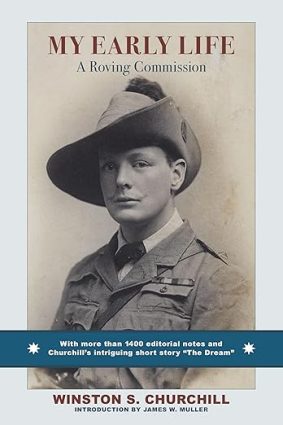
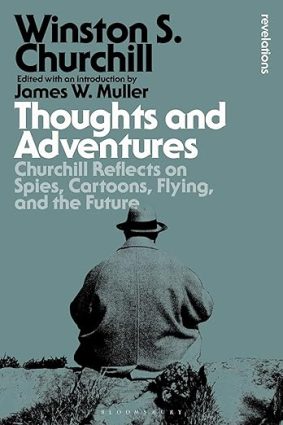
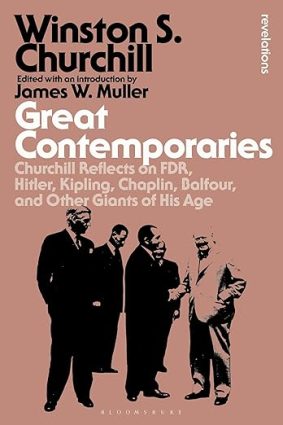
There is no better way to encounter Churchill as a statesman and a thinker than to engage the writings of the man himself, and there is no surer guide to those writings than James W. Muller, professor emeritus at the University of Alaska, Anchorage. For the 150th anniversary of Churchill’s birth in 2024, Muller edited, amply annotated, and thoughtfully introduced a beautiful new edition of Churchill’s My Early Life (originally published in 1930) and reissued and reintroduced previous editions he had edited of Thoughts and Adventures (1932), and Great Contemporaries (1937).
Great Contemporaries provides charming sketches of the great and the good, such as the demi-Victorians Arthur Balfour, Joseph Chamberlain, George Curzon, and the Earls of Rosebery, Morley, and Asquith; the great and intellectually confused, such as playwright George Bernard Shaw; the great and mediocre such as Kaiser Wilhelm; and the “great” and malevolent such as Leon Trotsky and Adolf Hitler. But in Thoughts and Adventures and My Early Life, the character of Churchill himself leaps off the page. The scope of the insight in these two books is truly remarkable.
Youthful Feats
My Early Life is a rollicking memoir that has been in continual print since its initial publication, with editions in 20 other languages. Churchill calls on young men and women to cultivate the love of “adventure and adventure for adventure’s sake,” an attitude he not only endorses but embodies. His youthful feats provide a contagious example of joie de vivre combined wonderfully with civic duty and moral seriousness.
In the years from Churchill’s birth in 1874 until his marriage in 1908, the world dramatically changed, as he observes, “without any violent domestic revolution.” Looking back with some melancholy on that bygone age, Churchill remarks that “[t]he character of society, the foundations of politics, the methods of war, the outlook of youth, the scale of values” were all transformed as the new century dawned. The supreme self-confidence of Victorian England and the empire became a thing of the past. By the time he reached full maturity, Britons and Europeans more generally lived “in anxious and dubious times.” By contrast, a sense of adventure permeated Churchill’s youth. He went from vigorous training at the Royal Military College in Sandhurst, to dramatic escapades in Cuba as a journalist amid armed rebellion, to military service in India and Sudan, engaging fanatical Islamic dervishes in a war where few officers expected to be killed. He relished the exhilaration of horseback riding, of flying bullets, of dramas like his escape from prison during the Boer War (an episode that made him immediately famous worldwide). Wild as those years were, they were uniformly marked by his profound sense of purpose, his deep-seated commitment to empire and liberty under the Union Jack. Churchill describes a world that was fading away—a flawed world, but one in which nobility, adventure, and high principle held pride of place.
Life was not perfect for the young Churchill. He loved his mother, the American Jennie Jerome Churchill, “but at a distance” like “the Evening Star.” His best friend was his nurse, the warm and protective Mrs. Everest, who “tended to all his wants.” He would remain loyal to her until her dying days. Churchill struggled mightily with learning Latin at Harrow School, but he was excellent at learning history. He even recited 1,200 lines from the poet and historian Thomas Babington Macaulay’s beloved anthology Lays of Ancient Rome without a single mistake.
His teachers at Harrow were perplexed by his mixture of brilliance and academic failure. But some, like the famous translator James Welldon, took a liking to him. Gradually he found his way in the world. He excelled at Sandhurst; in due course he became a military officer, and a famous one at that. He enjoyed speaking to his father’s old friends and political companions such as Archibald Primrose, Earl of Rosebery (to whom he dedicates an especially affectionate portrait in Great Contemporaries). Looking back on all this, through the ups and downs, Churchill affirms that “I cannot but return my sincere thanks to the high gods for the gift of existence.”
Education at Bangalore
“A man’s life,” writes Churchill, “must be nailed to a cross either of Thought or Action.” James Muller persuasively argues in his introduction to My Early Life that Churchill exhibited a rare capacity to combine the two. His true formation began at the end of his 22nd year, when he was stationed as an officer in the southern Indian city of Bangalore (now known as Bengaluru). In the all-important chapter titled “Education at Bangalore,” he explains that he “aspired to understand human nature and the world around him,” to “excel as a thinker” as well as a statesman. Writing served as a bridge between these two activities or “parallel aspirations,” as Muller nicely calls them. Reflection on fundamental questions came to inform Churchill’s use and understanding of rhetoric, as well as his own dedication to a life of principled action.
He “had picked up a wide vocabulary,” no doubt through his early reading and the company he kept, but he remained “wanting in even the vaguest knowledge about many large spheres of thought.” He found himself using many words “the meaning of which” he could not “define precisely.” He also recalls having a conversation before he left England, in which a friend of his proclaimed that “Christ’s gospel was the last word in Ethics.” “This sounded good,” Churchill thought, “but what were Ethics?” He had a more than general idea about “the things you ought to do,” but no deeper understanding of “why you ought to do them.” He would have happily “paid some scholar £2 at least to give me a lecture of an hour and a half about Ethics…. But here in Bangalore there was no one to tell me about Ethics for love or money. Of tactics, I had a grip: on politics I had a view: But a concise compendious outline of Ethics was a novelty not to be locally obtained.”
The figure who most fascinated him was the enigmatic Socrates. He “wanted the Socrates story” that could explain this “very argumentative Greek who had a nagging wife and was finally compelled to commit suicide because he was a nuisance!” Why, Churchill asked, “had his fame lasted through all the ages? …Evidently Socrates had called something into being long ago which was very explosive. Intellectual dynamite! A moral bomb!” Churchill longed to know more. “But there was nothing about it in The Queen’s Regulations.” So he turned to books great and good, sent to India at his request by his mother.
Churchill had resolved to read widely in history, philosophy, economics, “and things like that.” He devoured Edward Gibbon’s Decline and Fall of the Roman Empire as much for Gibbon’s prose style as the content of his thought, becoming “his vehement partisan” against all challengers. From November 1896 to May 1897 he read for four or five hours a day, devouring everything from Plato’s Republic and Aristotle’s Politics to Schopenhauer on pessimism, Malthus on population, and Darwin’s Origin of Species, “all interspersed with other books of lesser standing.” Churchill admits that his was “a curious education,” since he had no one to direct his reading or answer his questions. But there were advantages to this idiosyncratic approach as well. He pitied undergraduates at Oxford and Cambridge, who too often led “frivolous lives” of wastrel hedonism and drunkenness at all hours.
When he was in “the Socratic mood,” Churchill dreamed of rectifying this situation by making “drastic changes in the education of the sons of well-to-do citizens” as in Plato’s Republic. He thought education for young men must begin with manual labor, along with “plenty of poetry, songs, dancing, drill and gymnastics in their spare time.” Higher, Socratic education would follow later for those who were “really thirsty for knowledge” and wanted “to hear about things.” It would thus become a “coveted privilege” for those who had “proved their worth in factory or field” and “whose qualities and zeal were preeminent.” This course of reform, Churchill quickly realized, “would upset a lot of things,” bringing “commotion” and “perhaps in the end a hemlock draught” for Churchill himself. The proposal was at once whimsical and serious, showing the deep impression that Socratic philosophizing left on Churchill’s mind and character.
The Dream and the Nightmare
The books he read in those two years also “challenged the whole religious education” he had received at Harrow. Mrs. Everest, devout and low-church as she was, had already predisposed him to distrust both “popery” and high Anglicanism. Now Churchill fell under the spell of a ferociously “rationalistic” book by the explorer William Winwood Reade, The Martyrdom of Man (1872), a work that dealt “in harsh terms with the mysteries of all religions…leading to the depressing conclusion that we simply go out like candles.” This stark rationalism was reinforced by the works of Gibbon and the essayist W.H. Lecky, who “evidently held the same view.”
As a result, Churchill “passed through a violent and aggressive anti-religious phase which, had it lasted, might easily have made [him] a nuisance.” But, facing “frequent contact with danger,” Churchill found himself praying to a providential God. This left his head and his heart increasingly at odds, which initially troubled him not a little. But Reade notwithstanding, he came to think “the idea that nothing is true except what we comprehend is silly, and that ideas which our minds cannot reconcile are mutually destructive, sillier still.” So he made room for the truths of the heart and of lived experience, “while at the same time leaving reason to pursue unfettered whatever paths she was capable of treading.” Gradually he learned to temper his secular outlook with a healthy respect for divine mystery. He went to church, albeit sparingly, mainly on the occasions of “weddings, christenings and funerals.” At the same time, he cherished the Church of England as a national institution which brought solace and grace to those facing down the harsh winds of everyday life. Following Macaulay, he detested “the strength of a civilization without its mercy.” As such, Churchill was unquestionably indebted to Christianity.
This became evident later in his great speeches. He saw Nazi tyranny as a barbarous assault on human dignity and “Christian ethics,” as he put it in an address to Parliament on the occasion of the “Munich Pact” between Germany and the Allied powers in 1938. He spoke often and freely about defending “Christian civilization” against what he called, in his “Finest Hour” speech of June 18, 1940, “the abyss of a new Dark Age made more sinister, and perhaps more protracted, by the lights of perverted science.” Except during his brief flirtation with dogmatic rationalism, Churchill never identified intellectual penetration with atheism or disbelief.
As a bonus for the reader, James Muller’s new edition of My Early Life includes “The Dream,” a wonderfully suggestive short story (or “private article”) of Churchill’s written in 1947 but not published until 1966, a year after his death. Churchill intentionally left it as a posthumous gift to future readers. It was inspired by a conversation with his family at their country house in Chartwell, where they asked each other which historic figures they would like to dine with. Churchill chose his father, Randolph, a talented if ultimately failed statesman. Randolph Churchill did not have much confidence in his son. He kept him at bay, barely indulging his yearning for affection. Winston came to hope that, had Randolph not died prematurely, the father and son might have formed a closer adult bond. “The Dream” explores this possibility by dramatizing a mysterious “visitation” between them.
Churchill fils reports on the momentous events that have unfolded in Britain and the world since 1895 (the year Randolph died). In particular, Churchill speaks of the rise of monstrous tyrannies (Stalin is said to be “much more powerful, and much more despotic” than the Romanov tsars) and devastating “wars of nations, caused by demagogues and tyrants…. We have had nothing else but wars since democracy took charge,” he laments.
In response, Churchill père remarks, “As I listened to you unfolding these fearful facts, you seemed to know a great deal about them. I never expected that you would develop so far and so fully.” Yet Winston never mentions his own central role in the events described, or how utterly his political career has surpassed his father’s own. “You might have done a lot to help” by going into politics, his father adds; “You might even have made a name for yourself.” At just that moment the dream fades, and the conversation is over. “The Dream” ends on this wistful yet resolute note: despite everything, Winston tells his father, “we do not despair.”
The Adventure of Thought
This mixture of sobriety and hope is on full display throughout Thoughts and Adventures, which Muller rightly describes as “much more than a collection of articles: it is an undiscovered classic of twentieth-century prose.” A leisurely engagement with these essays confirms Muller’s point that Churchill’s thoughts were his adventures, or at least an integral part of his adventures. His literary work was not an academic distraction but a way of shaping the philosophy that would guide his actions. This, writes Muller, is Churchill’s “most philosophical book, one of six singled out by the Swedish Academy when he won the Nobel Prize for Literature in 1953…. [N]ot for nothing has it been called ‘the broadest range of Churchill’s thought between hard covers.’”
Churchill begins with “A Second Choice,” an astute and challenging meditation on the meaning of human existence via the question whether it would be wise to live life a second time through if given the chance. He points out that anyone who did so would confront “the same perplexities and hesitations…and [the] same sense of proportion…[the] same guiding lights…[the same] onward thrust…and [the] same limitations.” The value of forethought would dissipate after the first new decision, which would set a different course of events unfolding and annul the advantages that come with knowing how things turned out. After due consideration, Churchill comes out squarely against wishing to live his life over again. Why step into “another chain of causation,” especially if one has been blessed, as he largely had been, with good fortune? “Let us accept the natural order in which we move,” he concludes humbly. “Life is a whole, and good and ill must be accepted together. The journey has been enjoyable and well worth making—once.”
The two weightiest essays—“Consistency in Politics” and “Mass Effects in Modern Life”—are mandatory reading for any student of Churchill. They reveal the core of his political philosophy. “Consistency in Politics” examines the delicate balance of principle and flexibility that constitutes prudence for a statesman. In a Ciceronian mode, Churchill argues that “a Statesman in contact with the moving current of events and anxious to keep the ship on an even keel and steer a steady course may lean all his weight now on one side and now on the other.” His “resolves, his wishes, his outlook” are unchanged, even if his methods appear “verbally irreconcilable.” If a statesman remains “committed to the same dominating purpose,” his is in fact “the truest consistency.”
Churchill’s beau idéal of this underlying consistency is Edmund Burke. He sees no true contradiction between “the Burke of Liberty,” who stood up to “a domineering Monarch” for the rights of Americans and Irish Catholics, and the “redoubtable champion of Authority” who denounced revolution gone awry in France. Throughout his career, Burke remained “the same man pursuing the same ends, seeking the same ideals of society and Government, and defending them from assaults, now from one extreme, now from the other.”
The same could be said of Churchill himself. He was in decisive respects the Burke of the 20th century, a hero for all true liberals and all true conservatives. The same man who introduced a generous insurance and pension system while serving under a liberal government, nevertheless opposed the compulsion and penury that came with full-scale socialism. He zealously made war when necessary and energetically worked for peace when possible.
“Mass Effects in Modern Life” is, as Muller notes, a Tocquevillian reflection on the threats to human greatness, dignity, and even individuality in a democratic age marked by leveling, conformity, and soul-crushing mediocrity. These “mass effects” were in the process of crowding out the “Master Teachers” who had hitherto shaped the history of the human race with “their thoughts, actions, qualities, virtues, triumphs, weaknesses and crimes.” Most egregiously, the “Russian Bolsheviks” had established an unprecedented form of “universal standardization” that crushed liberty and the human soul.
Churchill’s tone here is elegiac and melancholic. He is largely resigned to a kind of democratic mediocrity, which he finds greatly preferable to the totalitarian forms of collectivism and standardization. But he wonders, “Can modern communities do without great men?” And he worries that the “need for a personal chief” would itself “become the mass desire.” (The essay was written in 1925, as aspiring Führers, Duces, and Vozhds were fast appearing on the European scene.) In these new circumstances, Churchill does not succumb to despair, nor does he yearn for heroism or vitalism (i.e., action for action’s sake) without restraint. He offers no easy answers. But perhaps his final statement on mass effects is to be found in his own noble and inspiring words and deeds during the Battle of Britain, memorably honored by Isaiah Berlin in his 1949 essay “Mr. Churchill in 1940.”
A Lion among Wolves
Indeed, nowhere are the dangers of mass effects more starkly evident than on the battlefield. After the Great War, battles increasingly featured “mass destruction by lethal vapor.” The thrills of the cavalry charge and hand-to-hand combat that the young Churchill experienced in My Early Life gave way to indiscriminate slaughter. In another striking piece, “Shall We All Commit Suicide?,” Churchill points out that “it was not until the dawn of the twentieth century of the Christian era that War really began to enter into its kingdom as the potential destroyer of the human race.” He demonstrates just how cruel and destructive the fifth year of the Great War would have been, especially for the German people as they spiraled into defeat. As he observes, the dramatic “progress” of destructive technology was not accompanied by any appreciable improvement in human excellence or wisdom. Instead, the old virtues—bravery, heroism, daring, self-sacrifice—are on the verge of becoming obsolete.
This observation leads into the eerily prescient “Fifty Years Hence,” in which Churchill lays out a moral and civic challenge to Western democratic man: “It is…above all things important that the moral philosophy and spiritual conceptions of men and nations should hold their own amid [the] formidable scientific evolutions” that have characterized the 20th century. It is imperative to meet those material evolutions with “an equal growth of Mercy, Pity, Peace and Love.” As the dysfunctions of the post-COVID age continue to demonstrate, science herself cannot show the way out of our dilemma. We idolize it at our peril.
Despite his warnings and apprehensions, however, Churchill was not a prophet of doom and destruction. As he puts it in the preface to Thoughts and Adventures, the “pleasures of life are luckily still with us.” Many of the essays are suffused with delight and gratitude for the riches of Western civilization. For instance, in “Moses: The Leader of a People,” Churchill celebrates the genuine “miracle” of a small “wandering tribe” that “grasped and proclaimed an idea of which all the genius of Greece and all the power of Rome were incapable.” The Jewish people discerned that there was “only one God, a universal God, a God of nations, a just God, a God who would punish in another world a wicked man dying rich and prosperous; a God from whose service the good of the humble and of the weak and poor was inseparable.” Churchill had come a long way from the hyper-rationalism that gripped his soul for two years or so during the Bangalore interlude.
Turning to smaller delights in his penultimate essay on “Hobbies,” Churchill advises taking up hobbies to relieve “the worry and mental overstrain” of modern political life. He recommends books as a means of endless discovery. But he also cautions against reading a book “too soon in life,” since “the first impression is the one that counts.” Moreover, for those whose business is in any way literary, Churchill advertises the benefits of an altogether non-verbal pursuit in “Painting as a Pastime.” Upon picking up a brush at the age of 40, Churchill discovered that creating visual art is “just…great fun,” besides being “fascinating and absolutely absorbing” in its own right. He gives a moving description of what it means to bring the natural world onto canvas in the form of color and light, an endeavor he skillfully compares to the task of a military commander sizing up the “wholes” and “parts” that make for a battle scene.
Reckless Iconoclasts
From his youthful derring-do to his mature statesmanship, from his penetrating philosophizing to his light amusements, Winston Churchill was a man in full—a master of thought and a paragon of action. Despite or perhaps because of these facts, his ignorant detractors multiply today. The predominant voices on the intellectual left are committed to repudiating our Western inheritance, and Churchill is one of their most prominent targets. Those obsessed with the alleged evil of “settler colonialism” also reject out of hand the idea of “civilized empire” that Churchill did so much to embody and defend. The Labour government of Prime Minister Keir Starmer, in an act of colossal ingratitude, has even stripped from the House of Parliament all drawings, prints, and paintings of modern Britain’s greatest wartime leader.
The reckless iconoclasts of the Left used to have a monopoly on this kind of contemptuous and flippant polemic. But now there are even some on the Alt-Right and the New Right, know-nothing neo-Nietzscheans and trollish provocatuers, who seem to prefer Hitler to Churchill—or at least to aim their scorn more directly at the English statesman than at the genocidal tyrant. Others confuse Churchill with Bill Kristol, always looking for new wars to fight. A recent article in the otherwise valuable journal Chronicles even bizarrely associated Churchill—an essentially Burkean conservative—with the nihilist secularism expressed in John Lennon’s anthem “Imagine.”
Yet even a glance at Churchill’s written work will dispel these petty criticisms like so much vapor. As Muller shows, Churchill had a rare capacity to combine thought with action, solicitude for human affairs with a calm detachment from the here and now. He was remarkably open both to the mysteries of human existence and to the wisdom to be discerned from the natural order of things. His lifelong education—idiosyncratic and haphazard as it was—made him a writer and thinker of distinction, as well as a statesman of the first order. He bristled with curiosity, and his fiercely independent mind remains a joy to encounter in his writing. Once one has done so, the caricatures and calumnies of both Left and Right sink into oblivion, while Churchill rises again to charm and instruct.