Books Reviewed





Emerson, Longfellow, Lowell, Holmes—I knew them all and all the rest of our sages, poets, seers, critics, humorists; they were like one another and like other literary men; but Clemens was sole, incomparable, the Lincoln of our literature.
—William Dean Howells
Mark Twain had worn white suits before, but in late fall 1906 he finally decided to start wearing them year-round. He was 70 and had just returned to his New York home at 21 Fifth Avenue after summering in New Hampshire. He said to Albert Bigelow Paine, who had been working as his authorized biographer since the beginning of the year:
I can’t bear to put on black clothes again…. If we are going to be gay in spirit, why be clad in funeral garments? I should like to dress in a loose and flowing costume made all of silks and velvets resplendent with stunning dyes, and so would every man I have ever known; but none of us dares to venture it…. I could be satisfied with white all the year round.
As Paine reports, “he did not wear black again, except for evening dress and on special occasions.”
The public unveiling of the new style came a couple of weeks later, on December 7, in the Library of Congress’s Congressional Reading Room, where the Congressional Joint Committee on Patents was holding a hearing on copyright law, a favorite subject of Twain’s. With only half an hour’s notice, Twain learned to his surprise that he was expected to address the committee. He entered the packed room and was led to his seat, where he removed his overcoat and, in Paine’s words, “stood in that dim room clad as in white armor. There was a perceptible stir.”
When Twain’s turn came to speak,
He did not stand by his chair, as the others had done, but walked over to the Speaker’s table, and, turning, faced his audience…. He never touched his notes…and, without a break or a hesitation for a word, he delivered a copyright argument, full of humor and serious reasoning, such a speech as no one in that room…had ever heard.
After hours of dull committee-hearing testimony, the audience “began to brighten and freshen…. Every listener was as if standing on tiptoe. When the last sentence was spoken the applause came like an explosion.” Twain’s friend of 35 years, novelist and literary eminence William Dean Howells, was in the room. In his book My Mark Twain (1910) he records:
Nothing could have been more dramatic than the gesture with which he flung off his long loose overcoat and stood forth in white from his feet to the crown of his silvery head. It was a magnificent coup, and he dearly loved a coup; but the magnificent speech which he made, tearing to shreds the venerable farrago of nonsense about nonproperty in ideas which had formed the basis of all copyright legislation, made you forget even his spectacularity.
Twain returned to the Willard Hotel where he and Paine were staying. He was elated by the day and as they prepared for dinner, he said that “the occasion required full-dress.” Soon, they were “fronted and frocked like penguins.” In the Willard there was an entrance to the dining room through a long corridor known as Peacock Alley, because the “handsomely dressed fashionables of the national capital” liked to display themselves there (today, the Willard’s popular afternoon tea is served there).
Paine, thinking that Twain had had enough for one day of rubbing elbows with the multitudes, deliberately took him to an elevator leading to a quiet entrance to the dining room. When they arrived, Twain asked, “Isn’t there another entrance to this place?” Paine allowed that there was but that it was very conspicuous. “Oh, well,” Twain said, “I don’t mind that. Let’s go back and try it over.” Back up the elevator they went, and over to the other end of the hotel, and down to the F Street entrance. There, a grand staircase led down into Peacock Alley. Paine was nervous, but took encouragement from the aplomb of his companion, “so side by side, both in full-dress, white ties, white-silk waistcoats, and all, [they] came down that regal flight.”
Twain “was seized upon at once by a lot of feminine admirers, and the passage along the corridor was a perpetual gantlet.” For Twain, it was a perfect consummation of the day. “The dinner was a continuous reception. No sooner was he seated than this Congressman and that Senator came over to shake hands with Mark Twain.” As unlikely as it sounds, for Mark Twain, throughout most of his adult life, that was not an unusual day. He had a genius for extravagant display and entertainment, for anything that might arrest the attention or inspire the amazement of those around him, and he took keen pleasure in the exercise of that genius. Often, the results were so uncanny that eye-witnesses had a hard time conveying what they had seen, and many who didn’t see them firsthand have been questioning them ever since.
Mesmerized
When Samuel Clemens absconded to Nevada Territory in the 1860s to let the Civil War sort itself out, he cut quite a figure in Carson City even before he started his writing career and took on the nom de guerre “Mark Twain.” Paine paints the picture:
[Sam] was about the most conspicuous figure on the Carson streets. His great bushy head of auburn hair, his piercing, twinkling eyes, his loose, lounging walk, his careless disorder of dress, drew the immediate attention even of strangers; made them turn to look a second time and then inquire as to his identity…. [H]e had become the roughest of rough-clad pioneers, in rusty slouch hat, flannel shirt, coarse trousers slopping half in and half out of the heavy cowskin boots. Always something of a barbarian in love with the loose habit of unconvention, he went even further than others and became a sort of paragon of disarray.
Winter mining camps in the Comstock were short on civilized entertainments, aside from saloons and gambling houses. As Albert Paine reports, one of the miners described a great ball in the winter of 1861-62, given at a newly opened dance hall, where Sam Clemens distinguished himself:
In changing partners, whenever he saw a hand raised he would grasp it with great pleasure and sail off into another set, oblivious to his surroundings. Sometimes he would act as though there was no use in trying to go right or to dance like other people, and with his eyes closed he would do a hoe-down or a double-shuffle all alone, talking to himself and saying that he never dreamed there was so much pleasure to be obtained at a ball…. By the second set, all the ladies were falling over themselves to get him for a partner, and most of the crowd, too full of mirth to dance, were standing or sitting around, dying with laughter.
His exploits along these lines began early in his small boyhood village of Hannibal, Missouri and continued on an ever-expanding scale until, as he reflected in the last years of his life, he was “the most conspicuous person on the planet.”
In his Autobiography Mark Twain tells the story of a mesmerizer who came to Hannibal in May 1850, charging 25 cents for admission to see his marvels. Within a couple of weeks, the hypnotist was doing a booming business. When Sam Clemens saw all the mesmerized “subjects” performing antics on the platform and making the crowds laugh and shout, he was stung with envy, especially when a young man named Hicks became the glorified hero. Hicks was a journeyman printer in the print shop where Sam worked. Sam was 14. Twain looked back on his young self and recalled that he was at “the age at which a boy is willing to endure all things, suffer all things short of death by fire, if thereby he may be conspicuous and show off before the public.” So, he determined to become one of the mesmerizer’s subjects himself and to outdo all others, especially young Hicks: “Upon suggestion I fled from snakes; passed buckets at a fire; became excited over hot steamboat-races; made love to imaginary girls and kissed them; fished from the platform and landed mud-cats that outweighed me.”
He did much more, too, and soon achieved triumphant victory, and found that it was easy. For
Hicks was born honest; I, without that encumbrance…. Hicks had no imagination, I had a double supply. He was born calm, I was born excited. No vision could start a rapture in him and he was constipated as to language, anyway; but if I saw a vision I emptied the dictionary onto it and lost the remnant of my mind into the bargain.
Under the supposed spell of the mesmerizer, Sam performed such prodigies of his own invention that he succeeded in making his whole town, including his mother, believe that they had witnessed such mesmerization as had never before been seen.
Thirty-five years later, visiting his mother after not seeing her for ten years, the noble impulse came upon Clemens to confess the deception he had perpetrated so many years before. It was fruitless. Nothing he could say or do would convince her. She had seen 35 years ago that he had been mesmerized in truth, and nothing he could now tell her could make her believe otherwise. Twain draws the bitter moral: “How easy it is to make people believe a lie and how hard it is to undo that work again!” The lie that he had played upon his mother in his youth “remained with her as an unchallengeable truth to the day of her death.” Twain read the Scottish philosopher and historian Thomas Carlyle all his life. Reflecting on this experience, he recalled Carlyle’s maxim that “a lie cannot live.” Twain concludes: “[I]t shows that he did not know how to tell them.”
From his earliest days in Hannibal, Sam Clemens was known for telling tall tales. So notorious was he for his stretchers that as he records in his Autobiography, when he was “seven or eight, or ten, or twelve years old—along there,” a neighbor said to his mother, “Do you ever believe anything that that boy says?” And his mother replied:
He is the well-spring of truth, but you can’t bring up the whole well with one bucket…. I know his average, therefore he never deceives me. I discount him thirty per cent. for embroidery, and what is left is perfect and priceless truth, without a flaw in it anywhere.
In the authorized biography, his mother offers a different discount: “Oh yes, I know his average. I discount him ninety per cent. The rest is pure gold.” Everything Twain says, or authorizes to be said, of himself suffers something like the fate of the ancient Cretan who insisted “all Cretans are liars.”
The Biographers
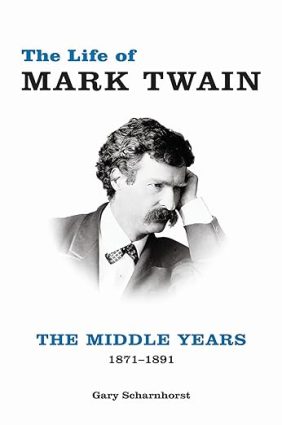
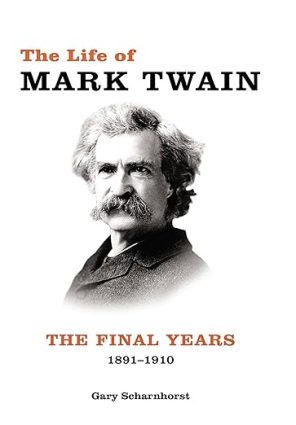
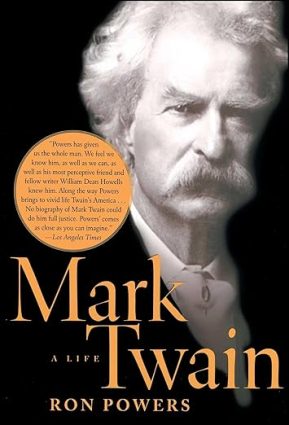
In his new biography, Mark Twain, Ron Chernow writes to correct the “sanitized view” of a “humorous man in a white suit,” an “avuncular figure” cracking harmless jokes and smoking a cigar. The award-winning biographer of George Washington, Alexander Hamilton, and Ulysses S. Grant, among others, wants to present the true “waspish” Mark Twain fired by a “mysterious anger” and “pervasive melancholy,” a man who in his “unabashed irreverence” held “nothing sacred.” In his The Life of Mark Twain (2018-22), the first three-volume biography of Twain since Albert Bigelow Paine’s authorized biography in 1912, Gary Scharnhorst, Distinguished Emeritus Professor of English at the University of New Mexico, also wants to replace the “legend of Saint Mark” with “the whole truth and nothing but the truth.” Scharnhorst aims to get the “facts” and only the facts, from “entirely reliable sources,” to provide what one admirer calls an “unsentimental view” of Mark Twain and his world. A dozen years or so before Scharnhorst’s effort, Ron Powers, in his bestselling Mark Twain: A Life (2005), felt duty-bound to present a Twain that was something greater than “the perfumed costume of a polite National Uncle.” But this project was already over 70 years old. Historian and spirited man of letters Bernard DeVoto based his Mark Twain’s America (1932) in part on skepticism of the received account of an episode in Mark Twain’s youth. And he fumed in a 1952 review that biographers of Twain had to overcome the earlier efforts of one of their guild who believed that “a biographer’s duty was to paint out the warts.”
This 90-year old tradition of biographers and scholars, from DeVoto to Chernow, striving to overcome the “myth” of Mark Twain so as to present the real McCoy, is inspired primarily by two things: Albert Bigelow Paine’s Mark Twain: A Biography (1912)—three volumes, 1,719 pages, 500,000 words, and authorized by Mark Twain; and Mark Twain’s Autobiography—another 500,000 words written or spoken and more or less authorized by Twain. In Chernow’s view, Paine belonged to “the worshipful cult of Mark Twain,” and his biography was a “hagiographic enterprise.” Scharnhorst agrees in advance that Paine’s work is “hagiographical”; Paine himself was “a young sycophant without a pedigree”; his biography was an “indispensable source for the legend of Saint Mark.” Powers is way ahead of them: Paine’s biography was “a fawning deification.” And DeVoto is further ahead still, writing with a sledgehammer as usual:
[Paine’s] qualifications were a willingness to play billiards all night and a stammer…. He was pompous, he was a prude…. He suppressed some of Mark’s ideas, and emasculated many others. He bowdlerized parts of Mark’s texts, rewrote some parts, and concealed some crucial ones.
Albert Bigelow Paine’s partner in the crime of foisting the myth of Mark Twain on the world was, of course, Twain himself—in practically everything he wrote, but most especially in his Autobiography. Scharnhorst sternly cites scholarly authority that Twain committed “enormous violations of the facts” in all of his writings—even his travel writings—and that in writing his life Twain actually tried to “make it even more interesting and melodramatic than it had been.” Paine’s gullibility and cultish hero worship were perfectly complemented by Twain’s incurable love of telling stretchers. Between them, according to the nearly century-old tradition, they produced half a million words of credulous hagiography and half a million words remembering things that never happened.
It Ranks with the Steam Engine
Paine’s biography and Twain’s Autobiography were born together. On Tuesday morning, January 9, 1906, smoking his perpetual cigar and wearing his crimson silk dressing gown with rich Persian patterns, propped up with pillows in the large walnut bed he had brought back from Venice years ago—with cherubs carved in the bedposts—Mark Twain began to dictate to Paine and his stenographer. This was in Twain’s Fifth Avenue home in New York. His beloved wife, Livy, had died 18 months before in a villa outside Florence; they had lost their eldest daughter, Susy, eight years before that. She was 24, and her parents were on a globe-circling lecture tour, trying to climb out of bankruptcy, when she died at the family home in Hartford, Connecticut. Their youngest daughter, Jean, 26, suffered from epilepsy and frequently had to be confined in sanatoriums. Middle daughter, Clara, 32, ran the household when she could spare time from her struggling singing career. Twain intended his dictation to serve as the basis of an authorized biography of his life to be written by Paine; it was also to constitute Twain’s own autobiography, composed according to his chosen method and not to be published until 100 years after his death. As Twain described the work to Clara, “I dictate 2 hours in the morning, about 4 days per week; and read & revise an hour or two, afternoons.”
Twain had been writing his autobiography off and on in spurts and starts for 35 years. He eventually arrived at definite notions about the limitations and dangers of the genre—though his notions on this, as on everything, were vulnerable to radical revision. He said to Rudyard Kipling in 1889, “[I]n genuine autobiography, I believe it is impossible for a man to tell the truth about himself or to avoid impressing the reader with the truth about himself.” Only writing from the grave could any man be “approximately frank.” No man could be “unqualifiedly frank either in the grave or out of it.” But writing from the grave, “[i]t has seemed to me that I could be as frank and free and unembarrassed as a love letter if I knew that what I was writing would be exposed to no eye until I was dead, and unaware, and indifferent.” He also eventually settled on a method that satisfied him:
Finally, in Florence in 1904, I hit upon the right way to do an Autobiography: start it at no particular time of your life; wander at your free will all over your life; talk only about the thing which interests you for the moment; drop it the moment its interest threatens to pale, and turn your talk upon the new and more interesting thing that has intruded itself into your mind meantime.
By July 1906, Twain had produced about 250,000 words with his dictation, and he relented a bit on his hundred-year rule; he decided that some of his autobiographical words might deserve to be published before he became posthumous. He arranged with his friend Colonel George Harvey, president of Harper & Brothers Publishers and owner and editor of The North American Review, to publish 25 features from his dictations, selected and edited by Harvey, in The North American Review, between September 1906 and December 1907. Harvey paid Twain $30,000 for the privilege, equivalent to over $1,000,000 in today’s money. The series included about 100,000 words of the 250,000 already spoken, transcribed, edited, and approved. Around the same time, Twain “expressed a willingness that any portions of the work not dealing too savagely with living persons or their immediate descendants should be published sooner [than 100 years after his death], either serially or in book form.”
He continued to dictate at a decreasing pace, and by the end of 1909 he had produced over half a million words. On Christmas Eve morning, his daughter Jean, who was living with Twain at the time, was found dead. For two days, Twain wrote. When he was done, he said to Paine, “I have finished my story of Jean’s death. It is the end of my autobiography. I shall never write any more.” Twain died four months later on April 21, 1910.
Twain changed his mind about practically everything. But at least at one stage of the proceedings, he expressed a high opinion of his autobiography:
[T]he form of this book is one of the most memorable literary inventions of the ages…. It ranks with the steam engine, the printing press & the electric telegraph. I’m the only person who has ever found out the right way to build an autobiography…. [I]t shall be read and admired a good many centuries because of its form and method.
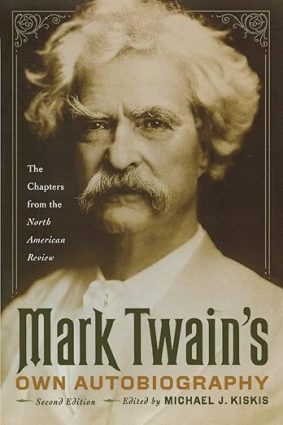
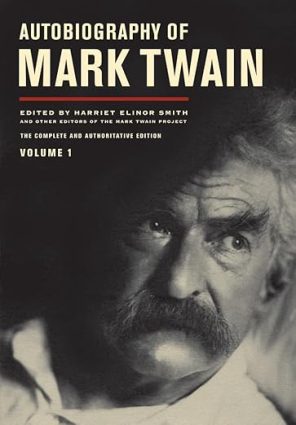
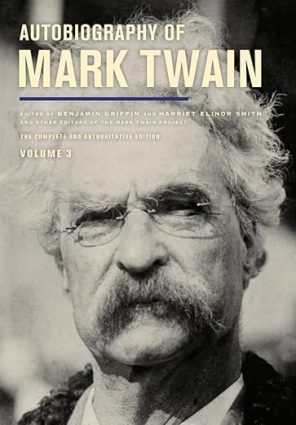
As Twain announced when The North American Review selections were published, “No part of the autobiography will be published in book form during the lifetime of the author.” Not long after the lifetime of the author, parts began to appear in book form. Albert Bigelow Paine published a two-volume edition of Mark Twain’s Autobiography in 1924. Bernard DeVoto published a different version titled Mark Twain in Eruption in 1940. Charles Neider published yet another version, The Autobiography of Mark Twain, in 1959. In 1990, Michael J. Kiskis edited and published Mark Twain’s Own Autobiography, containing all the selections published by The North American Review in 1906-07, with notes and annotations. Naturally each of these editors gave reasons—sometimes good and instructive reasons—why the previous versions were flawed and his version was needed. Finally (for now), Harriet Elinor Smith, Benjamin Griffin, Victor Fischer, Michael B. Frank, Sharon K. Goetz, Leslie Diane Myrick, Robert Hirst, Amanda Gagel, and Christopher M. Ohge gave us the three-volume Autobiography of Mark Twain: The Complete and Authoritative Edition from the University of California Press (2010-15).
Following custom, Harriet Elinor Smith notes in her introduction to the “complete and authoritative” edition that the editors of each of the three previously published versions (she leaves Kiskis aside) had published only parts of the autobiography; and in any case, they had in one way or another chosen not to use the material as Twain had wanted it used. Now, more than 100 years after Twain’s death—as he had wanted—she was proud, with her colleagues, to be able finally and for the first time to “carry out his wishes for this, his last major literary work.” It would seem to be no small thing to carry out the complicated and never unambiguously stated intentions of a great author in his last great work. When the first volume came out, The New Yorker’s Adam Gopnik was not impressed, writing in his review that “Twain’s autobiography—mostly written and dictated haphazardly toward the end of his life—is the ‘Royal Nonesuch’ of American literature,” invoking the fraudulent show put on by two con artists in Twain’s Adventures of Huckleberry Finn (1884). “If not exactly a deliberate swindle, it is an endlessly repeated put-on, a shaggy-dog story without a punch line, and, like the original ‘Nonesuch,’ it keeps getting replayed for credulous new generations.”
The Godlike Clemens
What Gopnik called “haphazard,” Twain called brilliant method. But there is something to Gopnik’s point with which I think even Twain would agree. Twain was a performer and, among other things, a very purposeful literary businessman. His product as a literary man was his words. He frequently criticized interviewers for wanting them for free. “It is my trade to gaggle,” he told one set of interviewers, “and if I talk to reporters for nothing where’s my bread and butter coming in?” He was seriously concerned with copyright issues his whole career. He thought long and hard about how to present his Autobiography to the world in ways that would continue to draw readers (and buyers) for generations to come and continue to give his heirs copyright. Gopnik is right that the Autobiography in the deliberately formless form in which Twain left it presents a forbidding front to the general reader and is useful primarily for specialists. Nonetheless, where Gopnik finds Twain’s dictations to result in “slack and anti-rhythmic” prose, in which “scarcely a single sentence in the whole thousand pages [of Volume One] stands out to be admired,” Chernow, having access to all three volumes, enthuses that the Autobiography is “a tour de force of verbal dexterity.” “On every page, [Twain] displayed his verbal riches, his incomparable control of the English tongue, and the vast stores of information in his capacious mind, with humor embedded in almost everything.”
About the performances “on the platform” and at great social functions that made up such a prominent part of Twain’s fame, Paul Fatout has written in his edited collection Mark Twain Speaking (1976) that “[Twain’s] way of speaking, whether on the lecture platform or in the banquet hall, was so nonchalant, so remote from stylized elocution or resounding oratory that audiences believed he spoke extempore. As if taking part in a living room conversation, he drawled lazily along like a clever improviser inventing a monologue on the spur of the moment.” In fact, Twain prepared meticulously for these performances and memorized and practiced every word and gesture in advance. So effective was his preparation for his nonchalance that some critics criticized him for his carelessness and lack of preparation. But it is also true that he regularly achieved the same effect around his dinner table at home or around the billiard table, or on a walk with a friend or an ocean voyage among strangers, with complete spontaneity.
Paine discovered that, as with his apparently spontaneous dazzling public performances, Twain prepared seriously for the roughly 250 dictation sessions over two and a half years on which his Autobiography is based. Twain’s daughter Clara said of the sessions: “There was something supernatural in his ability to pour out thoughts that flowed in finished phrases…the gestures he naturally used to emphasize his speech, and the poses that belonged to his personality, turned such hours into dramatic experiences.” On still another hand, Twain himself had serious thoughts about the difficulty of translating the spoken into the written word:
The moment “talk” is put into print you recognize that it is not what it was when you heard it; you perceive that an immense something has disappeared from it. That is its soul. You have nothing but a dead carcass left on your hands. Color, play of feature, the varying modulations of the voice, the laugh, the smile, the informing inflections, everything that gave that body warmth, grace, friendliness and charm and commended it to your affections—or, at least, to your tolerance—is gone and nothing is left but a pallid, stiff and repulsive cadaver.
Still, Charles Neider, writing of the version of the Autobiography that he produced, wasn’t just indulging in self-promotion when he averred that it was “a classic of American letters, to be ranked with the autobiographies of Benjamin Franklin and Henry Adams.”
Biographers of Twain who want the facts and nothing but the facts—the truth, the whole truth, and nothing but the truth—have a legitimate complaint. Twain certainly censored himself his whole life. He thought and wrote many things that he chose not to publish. His wife censored him at his invitation from their earliest days of courtship, beginning with his travel memoir The Innocents Abroad (1869). He sought her judgment and valued it greatly, calling her, only half jestingly, “the court of last resort.” Through all the famous years of his writing, he invited his daughters and his good friends William Dean Howells, Joe Twichell, Joe Goodman, and Mary Mason “Mother” Fairbanks to read his works and censor them if they needed it. Not that he always took their advice. His 100-year rule about his autobiography was another attempt at self-censorship. In giving his daughter Clara authority as his literary executor, he meant for her to exercise her judgment about what should and should not be published and when. She continued in that role until her death in 1962. Each of the three versions of his autobiography, published from the 1920s through the 1950s, including Bernard DeVoto’s, was subjected to Clara’s censorship. DeVoto seems to have been ashamed to admit it. But his autobiography, like Paine’s and Neider’s, excluded, at Clara’s insistence, five days of Twain’s dictations in which he spoke at length about the God of the Old and New Testaments, the Immaculate Conception, the effects of Christianity in history, and the true nature of God. The dictations can be found in the “complete and authoritative” edition.
Chernow is right in a way that Twain created in himself “a character superior to any of his creations.” DeVoto observed that Twain was “one of the most autobiographical of writers.” Powers argues that “The Autobiography…is the essence of Mark Twain’s oeuvre.” As Scharnhorst puts it, always insisting on how far Twain swerved from the facts: “[V]irtually all of his major works, including his autobiography, are semiautobiographical.” Unlike many great writers, Twain’s writings are inseparable from his life, and his life, as Chernow suggests, is his greatest creation. We know practically nothing about William Shakespeare, and his plays do not suffer from the fact. But the facts of Socrates’ life are vital to every Platonic dialogue. Samuel Clemens’s boyhood in Hannibal, Missouri and at his uncle’s farm in nearby Florida, Missouri really did provide the raw material of those American classics The Adventures of Tom Sawyer (1876) and Adventures of Huckleberry Finn. His four years as a steamboat pilot on the Mississippi really did provide the ingredients of some of the finest chapters in his Life on the Mississippi (1883). His experiences, from 1861 to 1866, traveling to and living in Nevada and California, and sailing to the Sandwich Islands and back really did provide the ingredients of his wonderful Roughing It (1872). His experiences sailing to Europe and the Holy Land provided the raw material for the book that launched his worldwide literary fame, The Innocents Abroad. A Tramp Abroad (1880) and Following the Equator (1897) are in the same autobiographical or semiautobiographical vein.
Twain was a great American writer—“the Lincoln of our literature,” as William Dean Howells said. He was also a great American character and lived an extravagantly vivid, even spectacular, American life. Among other remarkable features of a remarkable life, Twain spent over half of the last 20 years of his life abroad and, in addition to a couple of crossings of the Pacific Ocean, crossed the Atlantic 29 times. In the fall of 1903, when Twain was preparing to take the family to Florence as doctors had recommended for his wife’s health, he received kind words that Rudyard Kipling had written to his publisher, Frank Doubleday, which tribute Doubleday had passed on to Twain:
I love to think of the great and godlike Clemens. He is the biggest man you have on your side of the water by a damn sight, and don’t you forget it. Cervantes was a relation of his.
Sam Clemens made himself locally conspicuous in Hannibal, Missouri as a boy growing up, famous on a broader and broader front in California and the West as Mark Twain, “the irresistible Washoe Giant” in the mid-1860s, then across the country, then across the world, as a celebrated author, public performer, a “lecturer” on the “platform,” and as a highly honored and even beloved after-dinner speaker in high society gatherings, from Boston and New York, to London, Paris, Vienna, and Berlin. H.L. Mencken contended that “Mark Twain, with only his books to recommend him would probably have passed into obscurity in middle age; it was in the character of a public entertainer…that he wooed and won his country.” That’s a bit of an exaggeration. But if Ron Chernow is not sure where Twain ranks among America’s writers, he is pretty sure Twain is America’s “foremost talker.” William Dean Howells wrote that Mark Twain himself “always held that the actor doubled the value of the author’s words; and he was a great actor as well as a great author. He was a most consummate actor, with this difference from other actors, that he was the first to know the thoughts and invent the fancies to which his voice and action gave the color of life.”
The Official Biographer
According to Albert Bigelow Paine, Mark Twain had been his “literary idol from childhood.” Paine remembered his parents reading aloud from The Innocents Abroad when he was a boy. He grew up in Iowa and Illinois, became a writer in various genres, and moved to New York, where he eventually got to meet his idol on a couple of social occasions. When Paine was writing a biography of the cartoonist Thomas Nast in 1904, Twain gave him permission to quote some letters he had written to Nast. When the biography was finished, Paine sent Twain a copy, and later learned from an acquaintance that Twain had pronounced it “damn good.” Paine decided to propose himself as Twain’s biographer, got up the nerve to ask him for permission to visit him at his Fifth Avenue home, found Twain working in bed as usual, made his proposal and, to his utter astonishment, Twain responded: “When would you like to begin?” Dictation sessions started the next week. The authorized biography was published just two years after Twain’s death. Paine had worked on it for six years, spending innumerable hours with Twain, in dictation sessions and in private conversation (often over hours-long billiards games). He retrieved forgotten letters, traveled across the country and the world interviewing Twain friends and associates, and brought order to trunkloads of documents that Twain had left in great disorder. Twain legally designated Paine his official biographer in August 1906. Later, in his will, after seeing Paine’s work at close quarters for four years, he named him his literary executor along with his only surviving daughter, Clara.
The biography was widely and favorably reviewed in newspapers and literary journals in America and in Europe. Paine was likened to Twain’s Boswell. Reprints and abridged editions continued to appear, culminating in a Centenary edition in 1935. Some literary types later called it an example of “new” or “modern” biography, conscious of its art, not bogged down with mere facts, and characterized by personal acquaintance with the subject. In addition to his biography (1912), Paine published Mark Twain’s The Mysterious Stranger, a Romance (1916), Mark Twain’s Letters (1917), Mark Twain’s Speeches (1923), a collection of Mark Twain’s writings titled Europe and Elsewhere (1923), Mark Twain’s Autobiography (1924), and Mark Twain’s Notebook (1935). Paine remained the curator of the Mark Twain papers until his death in 1937.
After Paine’s death, and even before, the tradition began of one Twain scholar after another challenging the reliability of the official biography. Chernow is right that Paine very deliberately suppressed or ignored certain information. As Paine wrote in January 1909: “I have no desire to parade the things [Twain] would wish forgotten.” Chernow’s biography, and a slew of others after Paine’s, aspire to parade what Paine preferred to pass over in silence or with polite allusion. In truth, it’s not a very impressive parade. Paine’s discretion gave him freedom to concentrate on important, or at least charming, things. The insistent candor of his successors compels them to fill pages with not particularly interesting or revealing “facts” and often with mere sordid speculation. Scharnhorst claims that on average “a hundred Clemens letters and a couple of Clemens interviews new to scholarship surface every year.” And the National Digital Newspaper Project has made available to scholars a treasure trove of documents unavailable to Paine. But none of this has changed the contours of Mark Twain’s life in a significant way. On the morning of the day of his death Twain called Paine to his bedside and spoke of two unfinished manuscripts he wanted Paine to “throw away.” Those were his last words to Paine. They offer a final indication of the collaboration of the two men as guardians of Twain’s legacy—or myth, as the modern biographers prefer to call it.
Chernow discounts Paine’s credibility as a biographer in part because Paine committed “the cardinal sin of any biographer”: he became friends with his subject and lost his “professional detachment.” DeVoto’s “billiards” jibe is aimed at this sin. It’s a sensible concern. But Paine had something to say for himself on the subject. He had a merely “professional” relationship with Twain for most of the first year of their working together on the combined biography/autobiography. But Twain had been a billiards enthusiast—not to say maniac—all his adult life, and after a dear friend gave him the gift of a billiard table for his New York home in November 1906, Twain and Paine played countless hours together. This continued for the rest of Twain’s life. Whatever he might have lost in “detachment” from his subject, Paine thought he gained something priceless from the literally hundreds of hours with Twain around the billiard table: “To me the association was invaluable; it drew from him a thousand long-forgotten incidents; it invited a stream of picturesque comments and philosophies; it furnished the most intimate insight into his character.” I imagine Twain inviting Ron Chernow to those billiards sessions, and to the many luncheons and dinners he shared with Paine. In tones of credibility, Chernow would say, “No thank you, it would compromise my professional detachment.” Scharnhorst would decline and spend the hundreds of hours reading newspaper clippings from the 1850s. DeVoto would challenge Twain to a duel.
Paine as literary executor did his best to keep competing scholars from gaining access to the Twain papers. The papers were a valuable property, and Paine advised Harper & Brothers to refuse access to Bernard DeVoto, among others, which infuriated DeVoto. Paine did bowdlerize some of the Twain writings that he published. He made deletions and additions of varying kinds without notifying his readers, for which some scholars have excoriated him mercilessly, even charging him with literary fraud for his bowdlerized collection of Twain’s incomplete and unpublished writings called The Mysterious Stranger, A Romance (1916). Things like this, presumably, inspired Ron Powers to write that Paine was more of a “literary executioner” than a “literary executor.” Editorial standards have changed over the years and, in any case, there is room for differences of scholarly opinion. Kenneth Lynn, back in 1959, thought that Paine had done a “brilliant” job putting together Twain’s incomplete manuscripts and supplying a conclusion, and he is not alone in his opinion.
Whatever his reservations about Paine, Powers gives him credit for writing a “generally accurate and unimpeachably sourced” biography. In his Pulitzer Prize-winning Mr. Clemens and Mark Twain: A Biography (1966), Justin Kaplan called Paine’s work “monumental and indispensable, and any latter-day biographer is grateful for firsthand knowledge that Paine alone had.” R. Kent Rasmussen in Mark Twain A to Z (1995) called Paine the “single most influential person in Mark Twain scholarship.” Kevin Mac Donnell makes the crucial point: “no decent biography has yet been written about Mark Twain without direct or indirect reliance on Paine’s work.”
Reverence and Humor
It is striking how uniform the scholarly consensus is in discounting Albert Bigelow Paine’s official biography of Mark Twain as “hagiography.” The classic form of hagiography, literally “holy writing” or writing about holy ones, was the ancient and medieval reverential writing about Christian saints. The word has become a thoughtless throwaway term of easy opprobrium or dismissal among scholars for whom the only professionally credible frame of mind is “unabashed irreverence” and for whom, as scholars, nothing can be sacred, or holy. Professional—scientific—detachment prohibits it. It is true that Paine revered Mark Twain. He thought him superhuman, and he loved him. He meant to convey the life of that superhuman being in its glorious fullness to his readers. The qualities and achievements for which Paine revered Mark Twain were real and worthy of reverence. If he got carried away with his enthusiasms here and there, even his enthusiasms are usually engaging and instructive because they are elevated by the cause of his reverence. The “facts” on which “professional” biographers have chosen to concentrate are generally much less worthy of attention and much less engaging or instructive. Paine was quite familiar with the many imperfections in Twain’s character and his writings, and he wrote of them on the whole with insight, good humor, welcome discretion, and sound judgment. The prefatory note to his official biography warns his reader that “[c]ertain happenings as recorded in this work will be found to differ materially from the same incidents and episodes as set down in the writings of Mr. Clemens himself.” In these writings, according to Paine, Twain had not pretended to aim for factual accuracy; he aimed “only to tell a good story.”
Mencken wrote in Happy Days (1940) that his discovery of Adventures of Huckleberry Finn at the age of nine was “the most stupendous event of my whole life”; Ernest Hemingway famously declared that “all modern American literature stems from this one book.” Among the millions of readers over the generations who have read and re-read Huck Finn, Pudd’nhead Wilson (1894), and Roughing It, few have thought to pick up Twain’s Personal Recollections of Joan of Arc (1896), if they are even aware of its existence. And if they did pick it up, they would probably soon put it back down. That was the response of many readers when the book was first published. And it is the response of many readers and scholars today. In Mark Twain: An American Prophet (1970), Maxwell Geismar calls it Twain’s “worst book,” the “polar opposite of everything that Twain was; it embodied every idea, every value, every emotion, every social institution that he despised.”
Because such views are so widespread and so plausible, it seems hardly credible that Mark Twain would regard this book as his best. And yet on his 73rd birthday, he wrote, “I like the Joan of Arc best of all my books; & it is the best; I know it perfectly well. And besides, it furnished me seven times the pleasure afforded me by any of the others.” Chernow wants to discount this “retrospective judgment” as “colored by certain family misfortunes that followed hard on the heels of Joan’s publication.” He can’t believe that a book containing “nothing subversive or irreverent” could be his best book. This shows a misunderstanding of Twain that is common among his biographers who are inclined to bow down and worship what they believe to be Mark Twain’s cynicism, his unabashed irreverence. To the contrary, precisely reverence is the source of Twain’s greatest humor—reverence for the highest things, the things most important to human beings, in whose light alone true humor can be found. Here again Albert Bigelow Paine shows the insight and judgment that are impossible without due reverence. He gently chastises readers and critics who come along from time to time and announce that Mark Twain was as much a philosopher as a humorist, “as if this were a new discovery.”
But it was a discovery chiefly to the person making the announcement. Every one who ever knew Mark Twain at any period of his life made the same discovery. Every one who ever took the trouble to familiarize himself with his work made it. Those who did not make it have known his work only by hearsay and quotation, or they have read it very casually, or have been very dull. It would be much more of a discovery to find a book in which he has not been serious—a philosopher, a moralist, and a poet.
Mark Twain himself said of humor: “Humor is only a fragrance, a decoration…. Humor must not professedly teach, and it must not professedly preach, but it must do both if it would live forever. By forever, I mean thirty years.” All of Twain’s greatest humor flowed ultimately from what his wife, Livy, called his “natural piety,” his love of and reverence for the things about which great minds find themselves compelled to teach or preach.
The full title of the Joan of Arc book is: Personal Recollections of Joan of Arc by the Sieur Louis de Conte (Her Page and Secretary). Freely Translated Out of the Ancient French into Modern English from the Original Unpublished Manuscript in the National Archives of France by Jean Francois Alden. Twain chose to publish it anonymously (temporarily), in part because the authorial name “Mark Twain” would lead readers to expect a humorous book, and he didn’t want to mislead his readers. This was to be “a serious book,” as he wrote when he was writing it. “It means more to me than anything I have undertaken.” He said of his heroine:
Only one human being has lived in this world whose merits are beyond the reach of over-praise—Joan of Arc. When we praise other heroes, there are limits beyond which we cannot go & not strain the truth, but with her it is not so. She was finer than any words can convey; she was nobler than the noblest words can set forth; she was greater than any standard of greatness that can be framed in speech.
Such a human being—finer, nobler, greater than any words can convey—is worthy of reverence (though Chernow is mistaken: there is plenty of subversion and irreverence in Joan of Arc). Paine often disagreed with Mark Twain’s literary judgments. But as to Joan of Arc being his greatest book—against most of the popular and critical reaction of his time and against the great weight of scholarly opinion that would accumulate in the century to come—he was in full agreement. Now a scholar has come along to explain why Twain’s and Paine’s judgment is true. Associate professor of political science at Assumption College Bernard J. Dobski, in his first book, Mark Twain’s Joan of Arc: Political Wisdom, Divine Justice, and the Origins of Modernity (2024), agrees with Twain and Paine—and disagrees with the overwhelming consensus of scholarly opinion—that Joan of Arc is Twain’s “greatest novel.” No previous book has so painstakingly and thoroughly examined that novel. If I understand Dobski, he would not want to write a hagiography, but he does discover that at his deepest depths the author of Joan of Arc is, indeed, as much a philosopher as a humorist.
Next in the spring 2025 Issue

Let’s Not Do That Again

The Persian Version