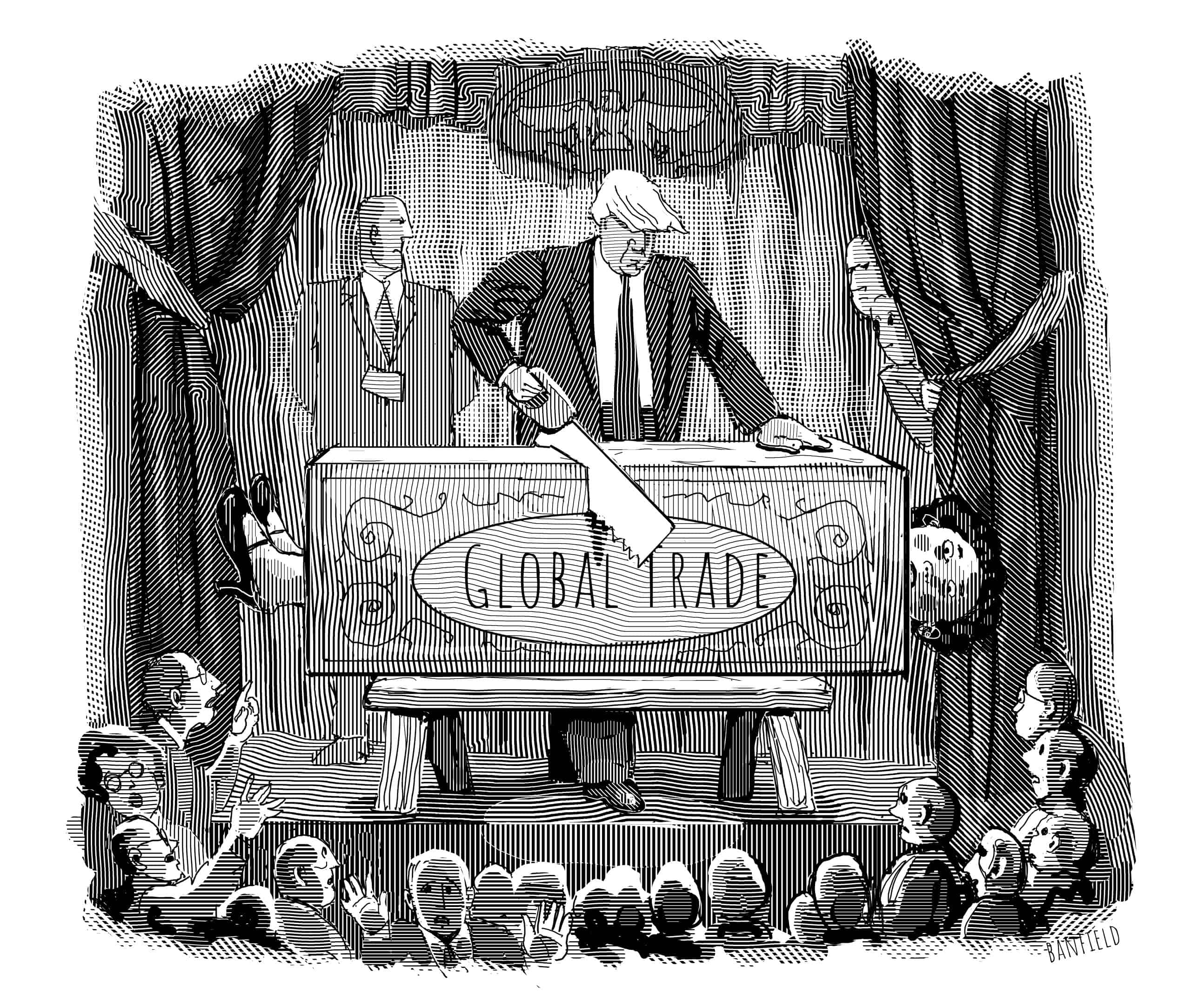
In the first months of 2025, Donald Trump played a game of Russian roulette with the American economy and survived. Although the president had never hidden his enthusiasm for tariffs, the way he went about implementing them on taking office sowed confusion. Targeting not just geostrategic competitors like China but also allies like Canada and Britain, issuing demands that economists struggled to explain, reversing world-shaping policies from one hour to the next, and doing all of this on doubtful constitutional authority, sent markets into a tailspin.
And just when the president had been enjoying a honeymoon. In the last days of January, a majority of Americans had declared themselves—for the first time—Trumpians. They were particularly optimistic about his economic plans. But their enthusiasm diminished as the rumble of artillery from the trade war grew louder. By mid-April, fewer than 40% backed the president’s policy, and Trump was less popular than he had been at the same point in his first term.
After a May meeting, the United States and China have stepped back from the astronomical tariffs that each imposed in the course of the spring. Western capitals and Western capital have calmed, and much of Trump’s trade plan is going into effect. But American voters have now experienced a sense of insecurity and arbitrariness that they will not soon forget. For a while, previously unthinkable things became thinkable: recession, depression, lost savings, a premature end to the second Trump Administration—in short, a host of confidence-sapping memories that may yet imperil the president’s ability to govern.
Chronology of a Crisis
A tariff is a government tax on an import. Although the authority to set tariffs belongs to Congress under Article I, Section 8 of the Constitution, Trump claims a 1977 law gives him the prerogative in emergencies. At the start of February, citing the flow of fentanyl and illegal immigrants, he imposed by executive order 25% tariffs on many Canadian and Mexican goods, and 10% tariffs on Chinese ones. China retaliated with tariffs of the same amount, showing a readiness for reprisals that threatened a trade war. Mainstream economy-watchers couldn’t wrap their heads around the idea that any modern nation might want such a thing. When Trump announced a 30-day pause on Canadian and Mexican tariffs, it was natural to assume he was looking for a face-saving way to climb down from a mistake.
He was not. At the start of March, back came the tariffs on Canada and Mexico. Canada retaliated. Mexico threatened to. Trump pulled back on automobile tariffs but bumped up the Chinese tariff by ten points. On April 2, which he billed as “Liberation Day,” Trump announced 10% tariffs on all imports, along with special “reciprocal” tariffs that varied from country to country. The total tariff came to 34% for China, which announced it would tariff U.S. goods at the same rate. Within a week Trump had changed the Chinese tariff to 125%, topped off with the remaining “fentanyl” tariff of 20%, for a total of 145%. China raised its tariff on American goods to 125%, stopped buying Boeing planes, and blocked the export of certain components crucial to American manufacturing.
The situation had turned into what journalists were calling a “bilateral embargo.” That spooked Trump officials. By mid-April, the S&P 500 had fallen 20% below its 2025 peak. The market for U.S. debt was softening, too, with ten-year borrowing rates climbing two-thirds of a point in just three days. Although stocks showed signs of recovery in the weeks that followed, business experts described the alarming ways that not just American shoppers but also American manufacturers were dependent on Chinese goods—here a factory that cannot obtain its compressors anywhere else, there a workshop that uses magnets made of rare earths on which China has cornered the market. Far from revivifying American industry, these experts warned, tariffs could endanger it, with apocalyptic consequences by summer if trade routes were not reopened. On April 22, Trump’s visibly uneasy Treasury secretary Scott Bessent described the situation as “unsustainable.” The White House sought to open channels with China. The countries met in Geneva on May 12, and agreed to dismantle the punitive tariffs for three months—reducing rates to 30% for the U.S. on China and 10% for China on the U.S. The rates were high by the standards of recent history, but survivable. The tariff crisis was over, for the time being.
Trump’s Point
Throughout the spring, the closer businessmen and bankers were to the center of negotiations—the more they knew about the workings of macroeconomics and international trade, the better they knew Donald Trump—the more uneasy they tended to be. The stakes are high. The United States is trying to pull off a feat that, since the Byzantine Empire, no world power has really managed—to use its understanding of history’s cycles to short-circuit the inevitable-seeming process of imperial decline.
The great appeal and the great effrontery of Trump’s plan is that it is built on age-old common sense. Like most people educated before the turn of this century, he believes it’s a bad sign when a country runs a trade deficit. The United States imports more stuff from elsewhere than foreigners import from America. In the old days, when currencies were worth a certain amount in gold, large trade deficits were a warning sign. Either your country would run down its stock of gold, or you would have to devalue your currency to keep it all from flowing out the door.
But we don’t live in that world anymore, most contemporary economists insist. In a world of fiat currencies, floating exchange rates, and financial engineering, trade deficits can even be the sign of something good. They are, among other things, a measure of the premium that the possessor of the reserve currency can demand from trade partners, not to mention lenders. It’s a tribute! Enjoy it! You deserve it!
That might have been true of the 1990 economy, but it sounds less believable now. The world has come spectacularly out of balance. The U.S. is everyone’s best customer. All but one of the world’s large countries has a trade surplus with us. (The exception is Britain, the ne plus ultra of de-industrialization and financialization, where a hundred thousand people invest the money of the world’s oligarchy while 30 million people pour cappuccinos for them.) Certain small economies (Mexico, Vietnam, Ireland) have huge trade surpluses with us, too. Worldwide, the American trade deficit now runs into the trillions ($1.2 trillion in 2024)—by far the largest in the history of the planet, and far too much to be paid for by skimming a bit of seigniorage. So, we borrow. Although a country’s trade deficit is not the same thing as its budget deficit, the two can run in tandem. Ours do. Our government debt now stands at $36 trillion.
China, by contrast, is the world’s factory. It has trade surpluses with everybody. It is developing the cutting-edge technologies that not only will power tomorrow’s economy but also can be converted to military production or other emergency uses. The Chinese and American roles are perfectly complementary, but one is the role of a rising country, the other of a declining one.
However much institutional economists and mainstream columnists may extol American leadership in the global economy and condemn Trump’s abdication from it, no other country wants the job. When China and the United States were at loggerheads in mid-April, China naturally found itself under selling pressure. Europeans could have obtained lots of toys, tech components, and appliances at bargain rates. Did it leap at the chance? Au contraire. European Union policymakers were panicked that the E.U. might drift into the role the U.S. seemed to be abandoning. They met for urgent discussions about how to keep China from “dumping” its goods on the Old Continent.
Over the past few years Europe has grown nervous about China. The 27-nation trading bloc, in which Germany is the dominant economy and German automobiles (Mercedes, BMW, Volkswagen) the dominant industry, has come under the sway of the futurologists who run the World Economic Forum in Davos and the child-prophet Greta Thunberg. Starting around the time of the finance crisis of 2008, the E.U. began billing itself as the world leader in the fight against global warming, pledging zero carbon emissions by 2050. In other words, it committed to sabotaging its own world-leading system for manufacturing fuel-powered cars (“burners,” as Germany’s press calls them) and replacing them with electric ones it does not yet know how to build.
Aside from Tesla, in fact, only China is building affordable e-vehicles at scale. (And Tesla itself makes half its cars in its Shanghai “gigafactory.”) In many branches of “clean energy” technology, China has taken what promises to be, as long as the global economy remains open, an insurmountable lead—even if the energy used in its green tech comes disproportionately from “dirty” fuels like coal. The largest polluter on the planet, China has designed, developed, and learned to mass-produce not just solar panels and heat pumps but also electric cars that perform almost up to the standards of European burners, and at a fraction of the price. Between 2020 and 2023, they rose from 4% to 25% of the European market, at which point Europe placed massive, Trump-sized tariffs on them, starting at 18% for China-built Teslas and rising to 45% for some Chinese brands. The E.U.’s plan—thus far unsuccessful—is to shelter European automakers from Chinese competition long enough to let them convert their production to electric. The Biden Administration pursued a similar strategy in its own 2022 green-energy bill, mislabeled the “Inflation Reduction Act,” using subsidies to ecological startups in place of tariffs.
The Trump philosophy is somewhat different. It is that, if the United States is going to be a loser in the so-called green transition, then there ain’t gonna be no green transition.
American Class War on a Global Stage
Trump is not pursuing a global trade policy so much as waging a domestic class war. The former is fallout from the latter. That’s the popular part of his program. The United States drew tremendous benefits from globalization in the decades after the Cold War, but those who divvied them up were a minority. Trump changed that in the first three years of his first term. Until COVID hit, per capita economic growth was lower than it had been under Barack Obama, but the growth was better shared. Those years brought the first sustained downward redistribution of income since the 20th century, with wages for workers in the lowest quarter rising at a rate of 5%. Perhaps this was due to the tightness of immigration policy.
Whether or not tariffs can have a similar effect, the attempt to use them for redistributing American economic power has a long history. Until a century ago, when the 16th Amendment allowed Woodrow Wilson to introduce an income tax, tariffs were the main economic issue in American politics, with high points in the Nullification Crisis that was brewing when Alexis de Tocqueville visited America in the 1830s, and in the arguments over bimetallism that marked the 1890s. The difference is that, back then, it was regions and industries that clashed: New York manufacturing (both its barons and its workers) wanted protection, while South Carolina cotton (both its gentleman farmers and its sharecroppers) wanted free trade. Today, the clashes are more straightforwardly class-based: the haves of the global economy face off against the have-nots.
Class conflict helps shore up what might otherwise have been a rickety presidential base. Trump is relying on the 1977 International Emergency Economic Powers Act (IEEPA) to address a number of intractable problems related to the international economy. Though immigration and fentanyl are emergencies of a sort, that act does not permit the president to seize Congress’s Article I powers and draw up an entire schedule of non-emergency tariffs. A number of pre-Trump judicial luminaries, led by prominent conservative Michael McConnell, have made that case powerfully in a judicial brief. Trump can apply the word “reciprocal” to tariffs that diverge widely from those which foreign countries impose, but that misnomer will not bring them into conformity with the New Deal-era Reciprocal Trade Agreements Act, under which Congress delegated to the president powers to negotiate—but not pass—tariffs.
That is where class conflict comes in. If Trump is out on a constitutional limb, most Americans don’t care. The demographer David Shor, the Democratic Party’s strategic wunderkind during the Obama Administration, has lately been on a mission to explain to older party strategists why talking about Donald Trump’s damage to “institutions” doesn’t help them. What brought Trump to power, he warns, is widespread discontent with the status quo. Shor recently asked voters, “What’s more important right now—preserving America’s institutions or delivering change that improves people’s lives?” They chose the change over the institutions by 78% to 18%. Procedural problems won’t doom Trump. Voters weren’t particularly wowed by the probity of the Biden Administration either. And that gives Trump a degree of insulation from the corruption allegations that would naturally arise from, say, his accepting a half-billion-dollar jet as a gift from the government of Qatar.
But economic anxiety is a different story. Trump has gotten into trouble by not being clear about what he intends his tariffs to accomplish. Traditionally, tariffs—which, again, are just a tax on imports—have three uses: 1) they can be a source of revenue, up to $2 billion a day, the president hopes; 2) they can be a means to strengthen domestic industries by protecting them from the competition of foreign ones; and 3) the prospect of tariffs can be used to coerce foreign countries into changing their policies. These goals are often mutually contradictory. If you seek too much tax revenue (goal 1), you can give domestic businesses too much protection, so they become slack and inefficient (undermining goal 2). Once you introduce a tariff to pursue goal 1 or 2, you can no longer use it as leverage to pursue goal 3. And so on. In Trump’s tariff oratory, these trade-offs are seldom apparent.
The closest thing to an overarching strategy was laid out in a 40-page paper that Trump’s chief economic adviser, Stephen Miran, wrote before he joined the administration. It linked trade policy to macro-economic policy. Miran believes reserve-currency status makes the dollar too strong. U.S. exports become too expensive for their traditional markets. But new avenues of influence arise for bankers and politicians. The result is the ineluctable financialization—or “hollowing out”—of the economy. Miran envisions using the threat of tariffs to force China and other countries with which the United States has deficits to durably revalue their currencies against the dollar. This is essentially what was done in the 1985 Plaza Accord: Japan—then seen as the systemic threat to American economic dominance—was prevailed upon to accept a rising yen that would boost domestic consumption and ease the pressure on American industry.
No country would do that today. The results for Japan were catastrophic. Rising purchasing power brought a real-estate bubble so extreme that, at one point, the land underneath the Imperial Palace in Tokyo was worth more than all the real estate in California. Starting in the 1990s, Japan suffered a real-estate crash and went into a deflation from which it has struggled to emerge, despite massive deficit spending. Trump is correct that the United States is such a desirable customer that any dominant export power—Japan a generation ago, China now—must accommodate it one way or another. But it can be dangerous to be too accommodating. And countries that export a lot to the United States have now had a lot of time to consider how they will respond to its demands.
The Complications of Disentanglement
China was ready for these tariffs. It’s not just that Trump had sprung 25% duties on a number of products in mid-2018. It is also that, after the Cold War, the United States acquired the habit of sanctioning countries of which it disapproved, frequently using for that purpose the very same 1977 International Emergency Economic Powers Act Trump believed he could use to reorder global trade. Ronald Reagan and George H.W. Bush used the act sparingly, but the Clinton Administration was enamored of sanctions in all their forms, reckoning that cutting off food and energy to countries that fall short of American progressive ideals is a branch of “peaceful” diplomacy. What began as a targeted way of pressuring Serbia over its crackdown on Kosovo in 1998, or blocking the export of “blood” diamonds from Sierra Leone in 2001 has now crept into general, non-geographic spheres of policymaking. Once George W. Bush had used the IEEPA against “terror” and Barack Obama used it against cybercrime, the prospect of a president using it to pursue migration policy and drug enforcement did not look so far-fetched.
Trump came to power on a wave of opinion that favors “decoupling” from China. This opinion has been built not just on sentiment but also on the newest thinking in trade economics, by MIT’s David Autor and others. But decoupling is more easily said than done. It is not just a matter of bringing factories “home.” China, as we have said, would be in a position to inflict real hardship on the United States if it chose. As Trump’s demands escalated, China signaled that it might so choose. And, since the last Sino-American spat over tariffs in 2018, the United States’ leverage over China has been diminishing.
Look at the COVID epidemic. Although U.S. health authorities were convinced that lives depended on the ability to mass-produce masks, U.S. industry and government never managed to get factories up and running. In the old days, this was not a project that would have required coordination from Washington or Silicon Valley; the homegrown brains and brawn you could find in Chicopee, Massachusetts; Utica, New York; or Dayton, Ohio would have sufficed. Yet America was dependent on iffy Chinese imports till the end of the epidemic.
After the Russian invasion of Ukraine in 2022, Joe Biden got another lesson in American decline. He attempted to bring the Russian economy to its knees with sanctions and boycotts, only to discover that the United States and Europe, even together, lacked the leverage to compel China and India to join them. “Backward” Russia has manufactured more shells in the course of the war than the advanced West. And now Donald Trump has discovered that China will not accept a trade war lying down.
The American position is delicate, because the United States still bears a double responsibility: it is not just a republic but also an empire of sorts, one that sets the rules for the global economy. Political polarization complicates both responsibilities. Republicans are the party of the republic, Democrats of the empire, and the election of Trump is a sign that a lot of Americans believe our “rules-based international order” to be a high-class scam. To people who believe this, the most commonly advanced criticism of Trump’s trade policy—that he risks wrecking the architecture of the global economy—is hardly a criticism at all. Wrecking that architecture is not a blunder. It is a campaign promise.
In a trade war, republic and empire find themselves at cross-purposes. The republic is unreliable. Really standing up to China would inevitably bring a deterioration in living standards over the short and medium term. It would thus require bipartisan solidarity and unity of national purpose, the prospect of which is so distant that its very mention will elicit a grim chuckle. And the empire is restless. Much as the world (outside of Western Europe) has rooted for Vladimir Putin throughout America’s proxy war against Russia, the world (with fewer exceptions) has been rooting for Xi Jinping as his disagreements with Donald Trump escalated into a trade war.
It was hard to say where the advantage lay. On one hand, Trump was right that the United States was less entangled with the global economy than China was, more capable of enduring a period of autarchy. On the other hand, that is true only on paper. In a trade war, economic statistics are less important than a leader’s ability to limit domestic dissent, and if that is right, then the United States is poorly prepared for the battle it has chosen.
Steady as Xi Goes
The 90-day pause declared in Geneva on May 12 caught observers by surprise. When the dust cleared on several nerve-racking weeks, during which Trump had undergone almost non-stop criticism, our protectionist president seemed to be in a winning position, with a new regime of light tariffs (10%) on most countries and somewhat heavier ones (nominally 39%) on China. Forecasters downgraded the likelihood of a recession. Markets stood roughly where they had before the new measures. China would start exporting those compressors and rare earths again. Most Americans were content with that. Trump’s polls floated back up toward their late-January highs.
That this might be a victory for Trump was naturally hard to acknowledge for journalists who had covered the ominous developments across the global economy with an ever-rising Schadenfreude: “China called Trump’s bluff,” wrote The Atlantic. “Playing a ‘Game of Chicken’ Over the Economy, Trump Is the First One to Swerve,” The New York Times headlined. And ascending almost to self-parody, The Wall Street Journal editorialized: “The President started a trade war with Adam Smith. He lost.”
Journalists were so dug in against Trump that they attacked him for his rather sensible misgivings about consumerism, materialism, and filling our houses with junk. “Well, maybe the children will have two dolls instead of 30 dolls,” the president had mused in late April, “and maybe the two dolls will cost a couple of bucks more.” How dare he! To the Journal’s evident relief, no sooner was the tariff truce announced than two China-based artificial-Christmas-tree factories announced they considered the 30% tariffs “a level with which they can work.”
The idea that he had cowed China into submission was important to Trump. “China was being hurt very badly,” he said. But the victory was qualified. Trump had avoided outright economic panic only by acting against the whole logic of his trade war—exempting iPhones from his tariffs once credible reports emerged that they might drive the cost of this middle-class desideratum as high as $3,500. There were pundits who attributed the steadiness of markets to the “taco” trade—not an allusion to Mexican commercial practices but an acronym for Trump Always Chickens Out.
High though the remaining China tariff appears, more than half of it is accounted for by the punitive “fentanyl” tariff of 20%. In the aftermath of the Geneva negotiations, Treasury Secretary Bessent admitted, “The upside surprise for me from this weekend was the level of Chinese engagement on the fentanyl crisis.” That shouldn’t be surprising. China is not some Mexican crime family—alongside its export machine, the economic impact of fentanyl precursor chemicals is minuscule, and one can expect China to go to any lengths to dispel American worries. That is why, at the height of the conflict in April, China kept its tariffs at 125% rather than letting them rise to the American level of 145%—they wanted to preserve the idea of reciprocity, and the sense that the real tariff for a China cleared of fentanyl suspicions would be 20% lower than wherever the negotiations ended up. Should China cooperate, the United States will face a choice. It can either hypocritically persist with its “punitive” fentanyl tariffs, in defiance of the evidence. Or it can eliminate them, in which case our baseline tariff for China will be roughly what it is for the rest of the world. That is not much to show for an assault on the underpinnings of the $90-trillion global economy.
It is worrisome that Donald Trump has grown so dependent on crowing about his victories. For a man whose deepest conviction is that every human being is open to a deal, he pays strikingly little attention to other countries’ sense of honor—which is generally the value that statesmen are least willing to barter away. It is not Trump’s fault that Americans find themselves in a position where their future economic comfort is at least partly in the hands of Xi Jinping. But Americans are fortunate that Xi had the ability, the inclination, and the social standing in his own political culture to accompany the United States back from the brink. Had we been dealing with a more democratic adversary—one provided by the media with the same incentives American leaders have to whip up the passions and resentments of the public—the outcome could have been calamitously different.