Books Reviewed
Death holds the ultimate mystery for human beings, and consequently the question how best to live presents one with a darkness hardly less difficult to fathom. A good death is of course the fitting end to a good life—though Christians believe that deathbed conversion can absolve one of a life badly spent, as in Leo Tolstoy’s novella The Death of Ivan Ilyich. More and more modern persons, however, prefer to hold thoughts of death in abeyance, while they pursue happiness in the usual fashion, hoping to make good money so that they might enjoy good food and good drink and good loving: love and work the be-all and end-all, according to the most famous modern doctor, Sigmund Freud. This earthly life may well be all you have—indeed, many reckon it almost certainly is—so the odds on Pascal’s wager have flipped in favor of grabbing what pleasure you can while you still can and against worrying unduly about everlasting nothingness or everlasting fire. Such easygoing nihilism conceals temporarily the bitterness of the ending, which can be ignored for a very long while—but not forever.
Johann Wolfgang von Goethe (1749–1832) examined the gravest matters of living and dying from most every possible mental and spiritual vantage, and in so doing he revealed new layers to his own character. By his own admission—and by turns agnostic, polytheistic, pantheistic, and unconventionally monotheistic in his artistic creations as in his own variable creed—he never had a theological preference to promote; he created as a free spirit, bestowing imaginary life with the most generous hand.
***
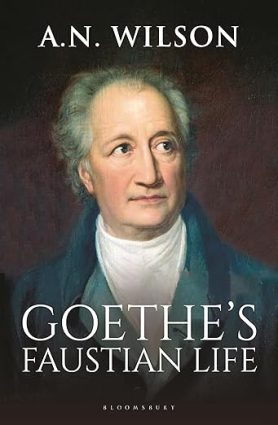
Goethe’s masterpiece is Faust, the play that he worked on for most of his long writing career; it is impossible to stage and is better read than seen, and it is subtitled A Tragedy but ends in heaven-sent salvation. In Goethe: His Faustian Life—The Extraordinary Story of Modern Germany, a Troubled Genius and the Poem That Made Our World, the accomplished English novelist and biographer A.N. Wilson professes to pursue a limited aim—to tell “the story of how Faust evolved.” But then that story implicates nearly every significant achievement of Goethe’s as poet, novelist, dramatist, autobiographer, anatomist, geologist, physicist, and statesman, not to mention his day-to-day vicissitudes as friend, lover, husband, father, courtier, collector, traveler, and sage universally acknowledged and revered. Wilson tries to take in all of it, and his is a riveting account.
Goethe’s was one of the most extraordinary lives ever, and one cannot but be grateful that such a man once lived as he did. As Wilson writes, “Goethe’s life is something we watch everlastingly being turned into literature…. [A]nd in Goethe’s case, the work and the man are inseparable; the man, and his emotional experiences, is himself a work of art [sic].” Like Faust, but without Faust’s lapses into extreme immoral ugliness, Goethe was the vollendete Mann, as Wilson calls him repeatedly—complete, even perfect in his unusual and complicated moral beauty, perennially eager for as much experience as he could fit into 83 years on earth. As his visionary contemporary the poet and painter William Blake knew, experience and the wisdom one hopes to gain from it are hard masters, which demand not less than everything.
At first glance Goethe’s experience doesn’t seem to have cost him so much. There appeared to be almost nothing he turned his hand to that he could not do winningly. Having made his name in his early twenties as dramatist and novelist, Goethe attracted the notice of the even younger Duke Karl August of Saxe-Weimar-Eisenach, a duchy of some 100,000 subjects. The roistering but ambitious young buck signed Goethe on as a member of his court, first as a companion roaring boy, then as a minister with every conceivable portfolio. Wilson quotes an embittered colleague’s lament: “So now he is Permanent Privy Councillor, President of the Chamber, President of the War Office, Inspector of Works down to roadbuilding, Director of Mines, also Directeur de Plaisirs, Court Poet, composer of lovely festivities, court operas, ballets, cabaret masques, inscriptions, works of art etc.” The list goes on. And Goethe excelled in feats of the body as well as those of the mind. According to his secretary Friedrich Riemar, Goethe’s youthful training in gymnastics, riding, dancing, and skating was evident in his graceful and powerful stride in middle age, even on treacherous icy ground.
***
Except for a yearlong journey to Italy, where he attempted to prove himself as a painter and found he really wasn’t one, Goethe would live in Weimar, a town of 6,000 people, for the rest of his life. There he completed some of his most famous writings, and conducted serious scientific researches, the most far-reaching leading to his theories of plant metamorphosis and of color, the former introducing the Urpflanze or primal plant, and the latter challenging Newtonian optics. His natural history collection numbered 18,000 rocks, plants, and preserved animal specimens. Prodigiousness was his byword.
Goethe understood how remarkably fortunate he was in his capacities: with a sort of penetrating drollery, he could attribute his excellence to “inborn merit,” the luck of the draw in the lottery of birth, which somehow was not so much a matter of chance as it was of true deserving. Yet nothing came to him without intense effort. Like Faust, as Wilson stresses, Goethe was a relentless striver, always looking to the next obstacle to be overcome, the next trial to shoulder his triumphant way through. What seemed on the surface the most enviable of artistic and intellectual careers, one splendid success after another, each apparently tossed off with casual élan, was in fact the endless acid test not only of genius but of will and endurance. Goethe’s unremitting outflow of energy exhausted him, so that he said toward the end of his life that he had not enjoyed a single day of contented ease. His travail produced our colossal cultural inheritance.
Had he written nothing but his lyric poetry, his master status would have been assured. In their startling variety these poems demonstrate Goethe’s protean spiritual nature. He takes on whatever belief his subject requires. In Ganymed Zeus’ cupbearer sings his ardent passion for his divine lover; the boy strives ever “Upwards to your bosom, / All-loving Father!” In Prometheus on the other hand, the proudest and most defiant of Titans advocates for painful human need and scorns the gods for their cruel indifference: “Have you ever eased the suffering / of him who is oppressed? / Have you ever dried the tears / of him who is troubled?” Erlkönig (often mistranslated as The Elf King) relates the murder of a young boy riding through the night with his father by a sexually seductive and malevolent specter. Wilson rightly sees here Goethe’s adoption for his purposes of “the dark, folkloric underbelly of pre-Enlightenment, very specifically non-Enlightenment Germany, which would be collected and chronicled by the Brothers Grimm.”
***
The uncanny and amoral in nature, “with soul or without soul,” fascinates Goethe. In his autobiography, From My Life: Poetry and Truth, he attempts to circumscribe the awesome, which he calls the dämonisch or daemonic, by saying what it is not: “It was not godlike, for it seemed unreasonable; not human, for it had no understanding; nor devilish, for it was beneficent; nor angelic, for it often betrayed a malicious pleasure.” Goethe was bemused by nature’s outbursts of irresistible force and admired such daemonic figures as Napoleon and Lord Byron, as Wilson writes: “We live in a world where landslides can utterly destroy a village, where human lives can be swept away by earthquakes and floods—and by the passions…Goethe saw no point in trying to impose pietistic, moralistic limits on daemonic energy.”
Goethe’s novel The Sorrows of Young Werther, which made him an international celebrity at 25, depicts a fatal love—touched by the daemonic—for a dear friend’s fiancée that consumes everything in its path, everything connecting Werther to contented normality: “There are no more prayers in me except prayers to her.” This love is the one thing needful, without which all else is useless: “I have so much, yet without her all of it is nothing.” Wilson tells us that Werther’s lovelorn suicide earned Goethe a reputation for wickedness, as though he were a diabolical promoter of lethal illicit passion. The world at large designated him expert in the exquisite monstrosities of love and death—a judgment laden with ambivalence for what Mario Praz called the Romantic agony, the exalted suffering of beings too extravagant in feeling for straitened bourgeois existence. Goethe’s own generation of artists and several more to come fit this description: his great friend Friedrich Schiller, as well as Hölderlin, Novalis, Schopenhauer, Byron, Nerval, Musset, and Baudelaire all knew such excruciating raptures. Art bled into life all too readily: Wilson writes that young Goethe, who seemed always to be unhappily in something like love with one woman or another, slept with a dagger next to his pillow, so he wouldn’t miss the opportunity should the desperate impulse strike him some midnight.
***
Yet the next novel he wrote, a far greater one, belongs not to the death-haunted psychic caverns and wastelands of anguished Romanticism but rather to the sunlit precincts of what became known as Weimar Classicism. The fundamental teaching of Wilhelm Meister’s Apprenticeship is summed up in the inscription upon the tomb of a paragon of practical wisdom, a founder of the Society of the Tower, the secret brotherhood of canny and benevolent men who guide young Wilhelm toward the life he is meant to live but has a hard time finding on his own: it reads simply “Think of living.” This is the most optimistic and heartening of great novels, and it had a momentous effect on the spirit of the age. The man of letters Friedrich Schlegel ranked it with the French Revolution and Johann Fichte’s Wissenschaftslehre (Theory of Science) as the three main events defining the epoch.
Wilhelm, son of a well-to-do household, has no use for the humdrum life of business like his father’s, and believes he is cut out for great things in love and in the theater, as actor, playwright, and director. From the first he is confident he has the love of his life in the beautiful actress Mariana; with her beside him he will take German drama to new heights. Nobility is what he wants most of all, and becoming a masterly actor seems the best way to acquire a superior mien and manner, which he thinks is the hallmark of the truly noble. But among theater folk he finds gross egotism, promiscuity, back-biting, money-grubbing, and general disorder: the chosen woman and the chosen vocation turn out to be not for him. As his life unfolds between chance and destiny, and as the genuinely noble overseers of his fate coax him toward a life worthy of the best in himself, every crooked path he stumbled along is made straight, and all his missteps are put right.
Wilson’s remarks about this novel, scattered here and there throughout this biography, are disappointingly perfunctory, and miss what makes it so alluring. Along with Mozart’s operas, Beethoven’s music, and Schiller’s plays and essays, Wilhelm Meister’s Apprenticeship honors the unprecedented possibilities of the emerging democratic age at its most aspirational, in which ordinary men and women for the first time have the chance to prove themselves equal to or better than born aristocrats. Not the accident of lofty birth but the strength of mind and heart in action is the distinguishing mark of this natural nobility. The Bildungsroman, the novel of education or self-development, would rarely be so joyous again: especially in France, with Stendhal’s The Red and the Black, Balzac’s Lost Illusions, and Flaubert’s Sentimental Education, it would dwell instead on the disenchantment of young men who grasp after worldly success in the most rarefied society, only to find nothing there worth the trouble. This sterling book of Goethe’s, so little known in the English-speaking world, deserves to be widely esteemed, particularly in America, where the longing for such heroic moral victory is flagging but not yet extinct.
***
And then there is Faust. The tale of the renowned Renaissance scholar who sells his soul to the devil for magical powers—made famous by Christopher Marlowe’s play The Tragicall History of Doctor Faustus—had traditionally seen Faust consigned to hell at the end. Goethe conceives his hero’s fate very differently. In the “Prologue in Heaven,” modeled on the Book of Job, Mephistopheles goads the Lord into a wager. The devil contends that the tormented, imperious, and dissatisfied professor will be easily lured into a hell-bent course under diabolical tutelage. God answers that men are prone to stray because they are continually striving, but in any case a good man will always find his way back to virtue. The game is on.
Faust possesses immense vitality and is driven by two irreconcilable souls in his breast, “one, lusting for the world with all its might” and the other full of heavenward yearning. He takes pride in never being satisfied, and the bargain he strikes with Mephistopheles turns on his endless desire. There is always something new he wants, and if he should ever stop craving novelty and call for the passing moment to linger, he has lost. His confidence that he cannot lose is unshakable, for he wants to experience the whole of life—to feel and to know everything a man can: “With every inch of me I’ll strive, I’ll never slacken.”
Faust is divided into two parts, the first published in 1808, the second not finished until 1832, the year Goethe died. Part I might almost legitimately be called A Tragedy. Faust’s seduction of the virginal young beauty Margarete leads to his murdering her outraged brother in a street brawl, her poisoning of her inconvenient mother, and her drowning of their infant daughter, for which the poor girl is condemned to be beheaded. With devilish magic Faust tries to spring her from prison, but she refuses to go with him, terrified by his unholiness. Her rejection reduces Faust to the ultimate remorse: “I wish I had never been born.” If there is a tragedy here, it is not Margarete’s but Faust’s: as Faust retreats, and as Mephistopheles declares her bound for hell, A Voice from above pronounces her soul’s salvation.
***
As part II begins, Faust’s heartbreak has been remedied by the healing beneficence of the spirit world and nature’s harmony, which Goethe evokes in a gorgeous pastoral idyll. Faust announces himself once again the epitome of heroic vigor and invincibility, vowing “[t]o strive after the highest existence always, forever.” And the plucky fellow does make out all right. He marries Helen of Troy, the most beautiful woman of all time, and fathers a frolicsome daemonic son by her, Euphorion, who embodies the union of classical and modern greatness, has a striking resemblance to Byron, and dies young from an excess of euphoria. Faust’s own high spirits take a murderous turn. Consumed by his titanic scheme to reclaim land from the sea, a featured undertaking of the modern scientific project for the conquest of nature, Faust once again becomes complicit in what most people would call evil, though Machiavelli prefers to call it the natural and ordinary desire to acquire: “This, this, is the worst torment, / To have so much, yet still want more.” Of necessity an innocent old couple burns to death in the furtherance of Faust’s all-too-human desire.
This enterprise completed, there is nothing more Faust wants, and his satisfaction kills him, as the pact with the devil specified. Mephistopheles is all set to welcome Faust’s soul to hell, but a flight of angels appears on the scene; while the sight of the boyish angelic buttocks distracts the devil from the task at hand, the airborne sacred host whisk Faust’s “immortal part” to heaven, declaiming as they fly:
“Who strives, and keeps on striving still,
For him there is salvation.”
And if love, pinnacled on high,
Has also watched out for him,
The angelic legions of the sky
Will fly round him in welcome.
Wilson prefers to ignore the first half of the angels’ summation and to believe only the second. “The salvation of Faust is achieved not, as he had supposed throughout the poem, by his striving, but by love.” Margarete’s soul sings with a chorus of heavenly penitents, and her love for Faust does appear to be an essential part of God’s own love for him. But why not credit the full account, explicit as it is?
***
Although A.N. Wilson states outright that he has little analysis to offer of the themes or teaching of Faust, his treatment of the work’s reception down the years among both civilized and uncivilized readers and spectators is richly suggestive. “The high-minded liberal Protestants of the nineteenth century who had wanted to see Faust as a fundamentally good man in a bad world, ‘striving’ towards enlightenment, were challenged by the truly terrifying reading which became popular in German during the 1920s and until 1945.” Wilson has some illuminating things to say about the 1936 novel Mephisto by Klaus Mann—Thomas Mann’s son, and like his father a fervent democrat—which retails the worldly rise and moral collapse of an actor famous for his Mephistopheles who becomes the darling of the Nazi high command. Wilson does not say so, but the most telling dramatic criticism of that era comes from one of Klaus Mann’s villains, a military grandee pretty much indistinguishable from Hermann Göring, who finds Faust’s soul inadequate to the needs of the current regime: “[Faust] would be a pushover for our many enemies! No, no—Mephisto, too is a German national hero. But it’s better not to go around telling people that.” In Wilson’s estimation, the Manns along with the likes of Göring were unfortunates “shackled by an ideology,” and thus less well equipped to understand Goethe’s subtle disinclination to point a conventional moral than “[t]hose of us who are post- even the post-modern” and feel at home beyond such mundane considerations as good and evil. It might be more appropriate to cite Victor Hugo here, who said Goethe let his indifference to good and evil go to his head.
It is disheartening that a biographer so emphatic in his admiration for his subject’s achievement should feel obliged to cut him down to size. Wilson labels Goethe “a functioning alcoholic,” whose heavy consumption made him emotionally volatile and caused him to leave many projects unfinished. But the Alcoholics Anonymous credo defines the alcoholic as “powerless over alcohol,” his life having become “unmanageable.” Like Winston Churchill, who also drank a great deal, Goethe managed to get along quite nicely, completed a mass of work astonishing in its sheer volume and its quality, and got the best out of alcohol rather than let it get the best of him. Wilson caps his contempt for the story’s hero by portraying the love of his life as a blowsy slattern who was exactly what he deserved. The “narcissist” that Goethe was, afraid of “a strong, superior woman,” naturally seized upon the young, uneducated, vulnerable, and all-too-common Christiane Vulpius as his lover, the mother of his children, and eventually his wife. When the malicious biddies of the Weimar court, thunderstruck by this misalliance, “saw in Christiane only a fat drunkard with no conversation, they overlooked the possibility that Goethe might actually enjoy the company of a fat drunkard.”
Wilson’s churlishness here disfigures a biography that otherwise merits a place among the more interesting recent studies of perhaps the greatest man of modern times.
Next in the spring 2025 Issue

Make Speech Free Again
The Waterloo of the Rebellion