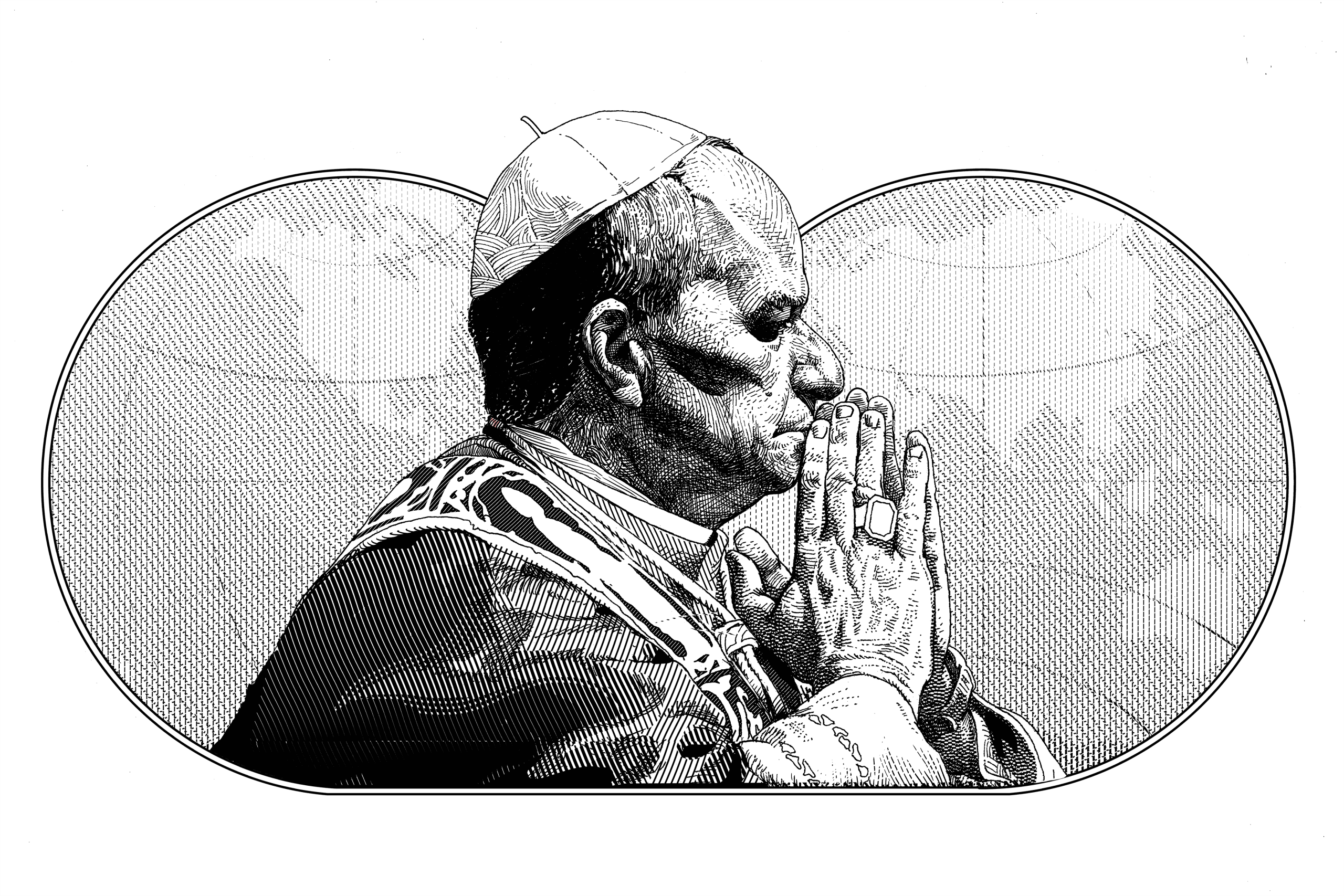
When Robert Prevost took the name Leo XIV in May 2025, he announced the mission of his pontificate. The last pope to hold that name, Leo XIII, had responded to social disruption by formulating modern Catholic social teaching at the turn of the 20th century. In documents such as Rerum novarum, he applied the Church’s unchanging principles to novel conditions. Now, Leo XIV has taken up a similar task. Two days after his election, he told a gathering of cardinals that just as his predecessor had “addressed the social question in the context of the first great industrial revolution,” so he sought to address “developments in the field of artificial intelligence that pose new challenges for the defense of human dignity, justice, and labor.”
People wondering whether Leo is up to this task will eagerly read the books that have appeared since his election. Elise Ann Allen, a Vatican correspondent who knew Leo when he was just Robert Prevost, has written Pope Leo XIV: The Biography, the most thoroughly reported of the bunch and the one most useful for tracing his career. Leo was born in 1955 in Chicago, Illinois at what would prove to be a high-water mark for the American Church. He attended Mass at a church that now stands empty and in disrepair but was then full of activity. He admired the priests he saw there and imitated them when he played, “consecrating” Necco wafers on an ironing board and distributing them to his brothers.
Prevost became a friar and then a priest in the Order of St. Augustine and ascended to high positions—first as head of the order, then as a bishop in Peru. (To hold the latter position, he had to be naturalized; he is thus a dual citizen of the United States and Peru.) The people who worked with him there were struck by his very American traits: love of driving, affection for the ’60s folk group the Mamas & the Papas—and efficiency. “Roberto is a gringo, a workaholic, and he is going to execute. He is a practical man about many things,” recalled one of his Peruvian collaborators. Throughout his career, Leo showed a willingness to stand up to secular leaders—backbone that he has once again displayed in his confrontation with Donald Trump.
Allen’s portrait of Leo is complemented by two other biographies—American Pontiff: Pope Leo XIV and His Plan to Heal the Church by Grove City College political scientist Paul Kengor and Leo XIV: The New Pope and Catholic Reform by Vatican reporter Christopher Altieri. Both authors write from a conservative perspective, but their focus is different. Kengor highlights the many public controversies that strained the Church during the Francis years and made cardinals eager for a less disruptive presence in the chair of Saint Peter. Altieri focuses on the challenges the pope faces in terms of the Vatican’s organization and financing. When it comes to the Church, Altieri says, “[a]mateurs talk doctrine; professionals talk governance.”
Both books bring out just how widespread exhaustion with Francis was. Even many of those who were sympathetic to his program were ready for a new approach by the end. Leo is providing it, by governing in a more regular manner and avoiding the vivid and frequently polarizing rhetoric that was a Francis trademark. Leo has run into controversy in his interactions with President Trump, but his focus on peace and A.I. is likely to prove less disruptive to the internal life of the Church than was Francis’s attempt to articulate new approaches to homosexuality and the divorced and remarried.
New Things
Even so, we await a biography of Leo that is equal to George Weigel’s Witness to Hope: The Biography of Pope John Paul II (1999). If it comes, it will have to address the central challenge of Leo’s papacy. Like his namesake, Leo faces not just economic disruptions, but far-reaching political changes. As its Latin title indicated, Leo XIII’s Rerum novarum was an attempt to deal with “new things.” These things included not just the Industrial Revolution but the French one of 1789. Leo XIII had begun drafting the encyclical in 1889, during the centenary of that revolution, and it was very much on his mind.
Leo XIII’s approach to post-revolutionary society contrasted with that of his predecessor, Pius IX. In the Syllabus of Errors, Pius had condemned the idea that the pope should “come to terms with progress, liberalism, and modern civilization.” Leo struck a different tone. He observed that “nothing is more useful than to look upon the world as it really is.” This realistic creed meant taking account of recent political developments and seeing how the Church could turn them toward the good.
Leo XIII was not interested in making the case for Catholic monarchy. In an 1892 address to his cardinals, he said that the Church should promote “faith embodied in the conscience of peoples rather than restoration of medieval institutions.” In an encyclical issued that same year, he dismissed the idea that any form of government could be “immutable,” since immutability belonged only to the governance of the Church. His argument ran counter to a long tradition of Catholic opposition to republican and democratic ideas. Leo insisted that legitimate government might “take this or that form” and that it was not “of itself wrong to prefer a democratic form of government.” In effect, Leo announced the Church’s indifference to the longstanding question of which type of regime is best. He did not deny that some type of regime might be preferable in the abstract, or that a different one might be best adapted to particular national circumstances, but he suggested that these questions were secondary to more pressing tasks.
In practical terms, Leo XIII urged French Catholics to join in the life of the secular republic by taking part in elections and organizing politically. In announcing this policy of ralliement, he observed that the French had experienced regime forms including empire, monarchy, and republic, and that “by giving one’s self up to abstractions, one could at length conclude which is the best of these.” Catholics, however, had an obligation to accept and work within the existing form of government. This didn’t mean accepting unjust laws. On the contrary, Catholics were called to participate in the politics of the secular republic so that they might combat unjust laws by all available means.
The World as It Is
Pope Leo XIV faces a political challenge not unlike the one confronted by his namesake. The Catholic Church is heavily invested in the postwar projects of international law, European integration, and human rights. Though these projects arose in response to political contingencies, the Church has championed them as ways to protect enduring values such as peace, freedom, and human dignity. That is why the populist challenge to the postwar order has often appeared—sometimes with good reason—as a direct threat to principles the Church is bound to uphold.
Pope Francis understood this threat implicitly, and so adopted a thoroughgoing anti-populist stance. In the first months of his pontificate, he visited Lampedusa, an island entry point to Europe for those fleeing Africa. His public interventions stressed the need to welcome migrants rather than matters of security, integration, and cultural stability. His encyclical Laudato si’ was not merely a call to fight climate change but a fundamental criticism of technological society, the most anti-modern statement by a pope since the Syllabus of Errors. Like Pius before him, Francis asserted important truths. But he failed to hold back change. Britain withdrew from the European Union. The United States elected Donald Trump. Populist parties made gains across the West.
More worryingly for Francis’s project, the establishment centrists with whom he had aligned began to shift away from the policies to which he had given his blessing. Angela Merkel, who welcomed the 2015 migrant wave to Europe, has been succeeded as head of Germany’s Christian Democrats by Friedrich Merz. When asked why he had spoken in favor of mass deportations, Merz replied, “Ask your daughters.” Mette Frederiksen, the left-wing leader of Denmark, joined with Italian prime minister Giorgia Meloni to criticize the European Court of Human Rights over its rulings in favor of migrants. Donald Tusk, the Polish prime minister who was celebrated in Brussels for defeating Poland’s right-wing populists, went on to suspend the right of migrants to apply for asylum—an affront to accepted notions of international law and human rights.
Francis’s efforts to uphold the postwar order, however noble in certain respects, resemble the Church’s attempts to shore up Catholic monarchies against the rising tide of liberalism and democracy. A new approach is needed. If Leo XIV is to be the true heir of Leo XIII, he must move on from Francis’s rejectionist stance. That means taking seriously the concerns of voters who see downsides to mass migration, or regard international institutions as a threat to popular sovereignty.
This reorientation goes beyond matters of policy. Catholic leaders are accustomed to explaining themselves to critics on the left. They are articulate in describing how the Catholic faith supports equality, promotes environmental concern, and fosters sympathy for migrants. But in ways few churchmen seem to understand, Western societies are changing. The desire for openness is giving way to the pursuit of belonging. Criticism of Christianity no longer comes overwhelmingly from the left. The Church must now confront critics on the right who accuse it of undermining human excellence and subverting political communities. It must deal with the fact that the postwar order is breaking down. Populist governments, many of which include Catholics in important positions, are helping to shape something new. Perhaps they would benefit from encouragement and guidance, as well as denunciation. Once again, a Leo has a chance to look on the world as it really is.
Next in the summer 2026 Issue
The Political Contradictions of Trumpism
Becoming Churchill