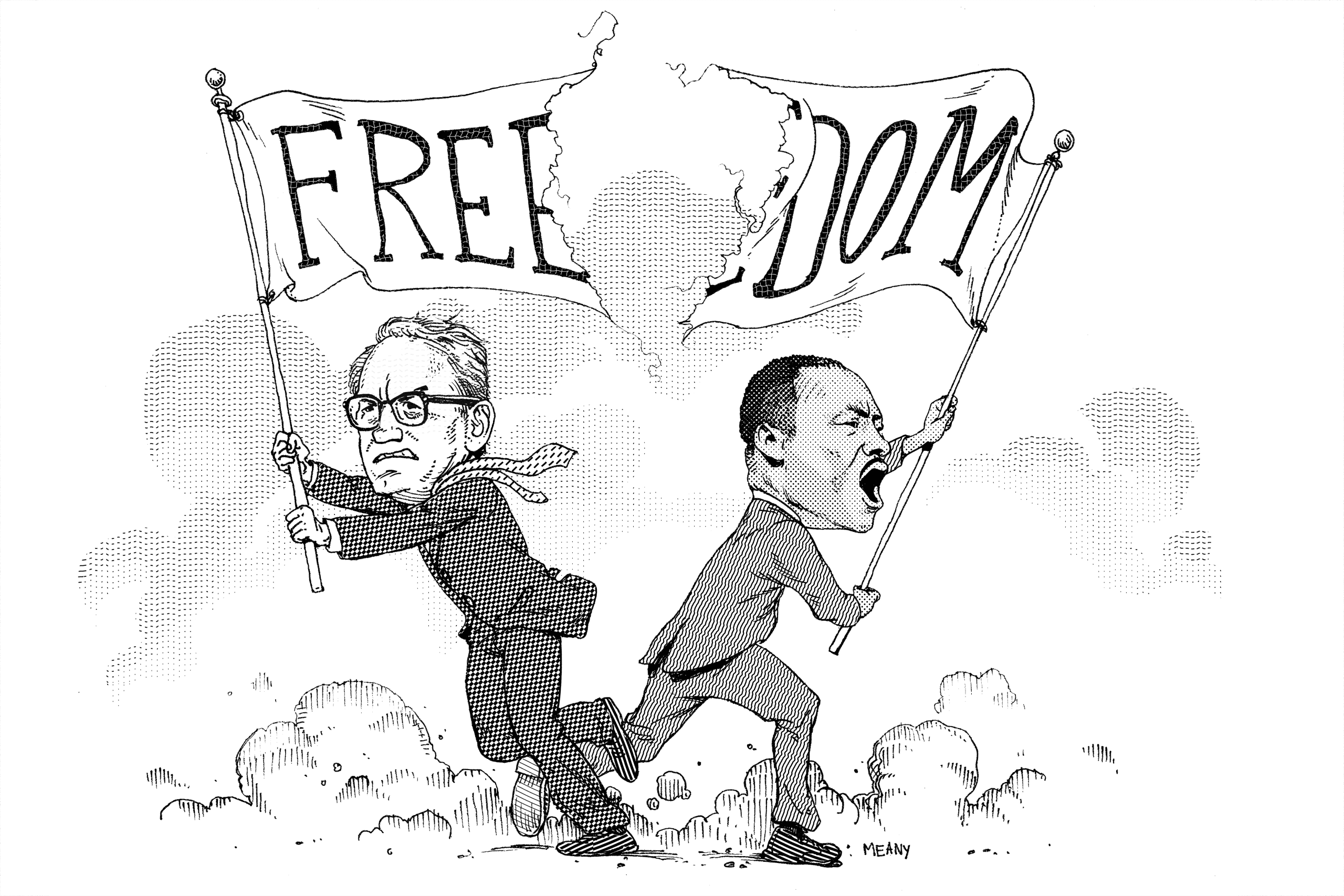
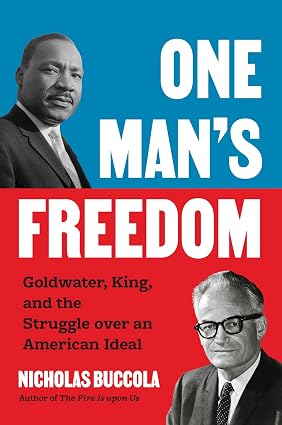
From the mid-1950s through the mid-1960s, Barry Goldwater and Martin Luther King, Jr. took increasingly prominent roles in American political life. Neither was president—though Goldwater made the attempt—but both led movements that transformed the country. In One Man’s Freedom, Nicholas Buccola draws a side-by-side picture of the two, juxtaposing especially their competing conceptions of freedom, the American principle at the center of each man’s political thought.
A professor of government and the Jules L. Whitehill Professor of Humanism and Ethics at Claremont McKenna College, Buccola forged a mold for this sort of dual intellectual biography in his previous book, The Fire Is Upon Us: James Baldwin, William F. Buckley Jr., and the Debate Over Race in America (2019). In One Man’s Freedom, Buccola begins with the 1955-56 Montgomery bus boycott, which elevated King to the leadership of the civil rights movement, and Goldwater’s early focus, as a freshman elected to the U.S. Senate from Arizona in 1952, on the labor movement’s excesses and the primacy of the individual. They were, at this point, “prophets rising.” Buccola then traces their course through Goldwater’s break with President Dwight Eisenhower, the publication of his bestselling Conscience of a Conservative (1960), and the rise of the movement to draft Goldwater
Next in the summer 2026 Issue

Saving Civics

Wine Lunacy