Books Reviewed

On Sunday, June 4, 1944, Winston Churchill invited Charles de Gaulle, the leader of the Free French, to lunch on his train along a siding at Portsmouth railway station. The prime minister wanted to brief the general about Operation Overlord, the Allied invasion of France that was scheduled for the next day (but which for reasons of weather had to be put back another 24 hours).
De Gaulle had been a guest of the British for two weeks short of four years, since his brave flight to England during the fall of France, when he had made his famous broadcast of June 18, 1940, announcing that his country would continue the fight against Hitler. Over those years, relations between the most English of Englishmen and the most French of Frenchmen had seen some extraordinary ups and downs, but that lunch was to witness easily the lowest of the downs.
De Gaulle was angry that he was only now learning the details of the invasion plans, with its vast armada of over 5,000 ships and over a million men, but the British, Canadians, and Americans had kept the project on a strict need-to-know basis, and the Free French were felt to be too leaky to be trusted. (Before the raid on Dakar in September 1940, Free French officers had attended dinner in a French restaurant in Liverpool and toasted, “To Dakar!”)
For his part, Churchill assumed that de Gaulle would be so pleased and so grateful for what was about to take place at D-Day that he would be in sympathy with General Dwight D. Eisenhower’s plans. De Gaulle’s cooperation was needed for administration, the recognition of a temporary Allied currency, the liberation of Paris, and so on. He would also need to broadcast over the BBC to encourage the French people to rise up and throw off the Nazi yoke. One major problem was that President Franklin Roosevelt loathed de Gaulle, whom he regarded as almost a fascist, and refused to recognize the Free French government headquartered in Algiers.
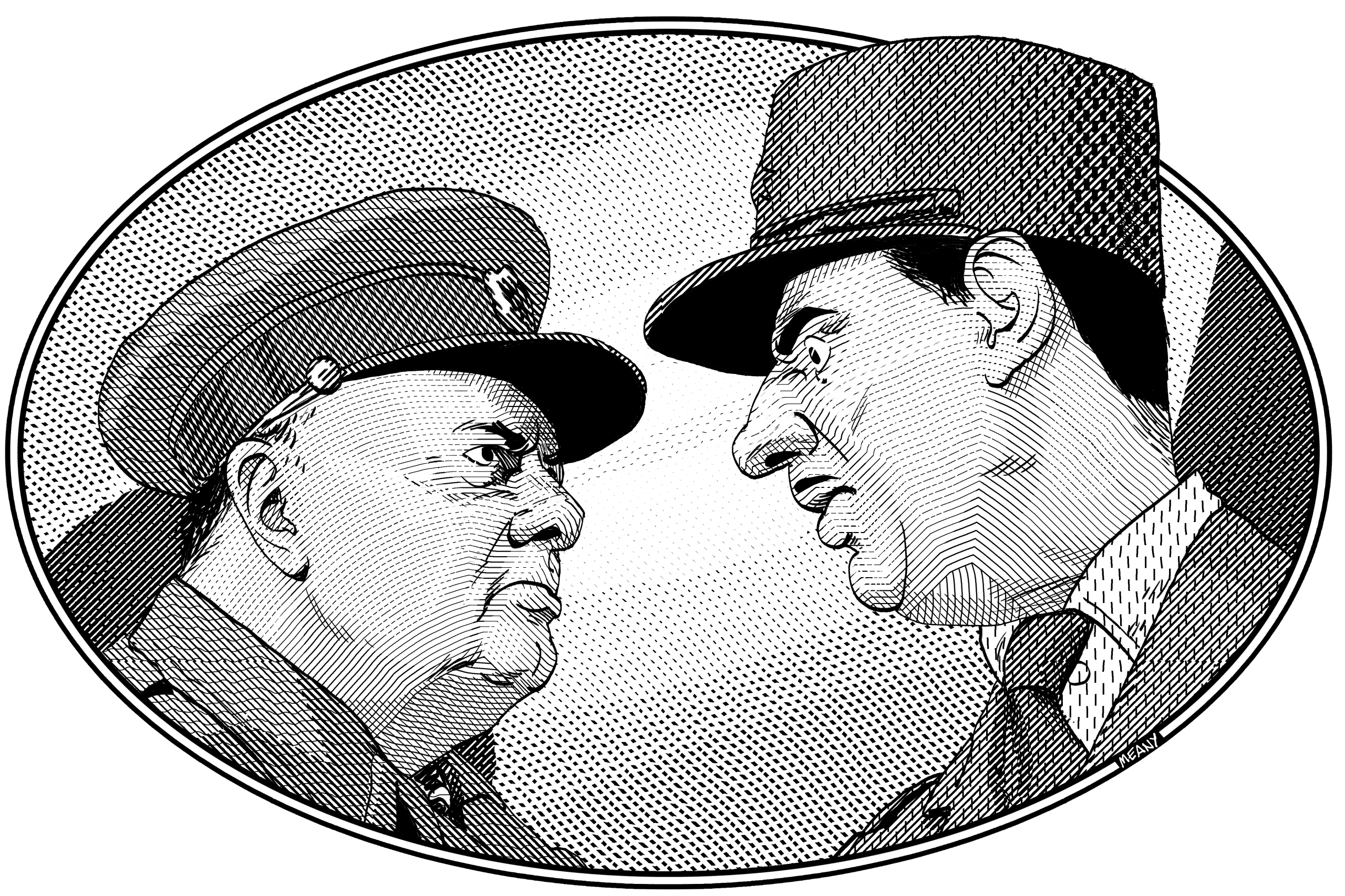
Churchill took it for granted that de Gaulle would fall in with Eisenhower’s requests and greeted the Frenchman heartily. He set out the military plans in some detail, which de Gaulle, a talented soldier who recognized the size and scope immediately, applauded. At the end of the lunch, however, Churchill proposed that they “talk politics,” whereupon de Gaulle visibly stiffened and said, “Politics? Why?” Churchill explained that he would like to bring Roosevelt and de Gaulle together in a way that would persuade Roosevelt to recognize de Gaulle’s government in Algiers.
De Gaulle suspected—quite wrongly—that this was an Anglo-American conspiracy to keep him out of power in France after the invasion. “Why do you seem to think that I am required to put myself up to Roosevelt as a candidate for power in France?” he exploded. “The French Government exists. I have nothing to ask of the United States of America, any more than I have of Great Britain.” He then stated, “The troops who are preparing to land have been furnished with French money which is absolutely unrecognized by the government of the Republic.” For good measure, he refused to make the broadcast.
***
Churchill then lost his temper. “How do you expect us, the British, to adopt a position separated from that of the United States?” he asked. “We are going to liberate Europe, but it is because the Americans are with us to do so. For get this quite clear, every time we have to decide between Europe and the open sea, it is always the open sea that we will choose. Every time I have to choose between you and Roosevelt, I shall always choose Roosevelt.”
The situation worsened the next day when de Gaulle refused Eisenhower’s personal request to send a Free French military mission to meet with the Allied units about to land in Normandy. Churchill said to the War Cabinet, “I told Eisenhower not to worry. If he won’t he won’t…. I’m nearly at the end of my tether—it doesn’t make the slightest difference to the outcome.” Alexander Cadogan, the permanent under-secretary in the Foreign Office, noted in his diary:
We endured the usual passionate anti-de G[aulle] harangue from the PM. On this subject, we get away from politics and diplomacy and even common sense…. Roosevelt, PM, and—it must be admitted de G.—all behave like girls approaching the age of puberty.
In the coming rows that continued right up until 4 a.m. on D-Day itself—after the landings had actually started—it was only the presence of Anthony Eden, the foreign secretary, and Pierre Viénot, the future French ambassador, that prevented Churchill and de Gaulle from coming to blows.
De Gaulle later called Churchill a gangster, denying the Allies the right to “occupy” France. “They wanted to trick me,” he told Viénot. “I will not be tricked, I deny their right to know that I shall speak to France!” When Viénot reported to Churchill that de Gaulle still refused to send a military mission, Churchill, according to the ambassador, “broke out in curses. He no longer took notice of any facts. It was an explosion of rage, and explosion of hatred for de Gaulle, who was accused of ‘treason at the height of battle.’” Ten times he told me that this was a monstrous failure to understand the sacrifice of the young Englishmen and Americans who were about to die for France. “It is blood that has no value for you.”
Churchill added that having known de Gaulle, “it seemed to him that the misfortunes of France were understandable and deserved.” Churchill was a lifelong Francophile who visited the country over a hundred times in his life, so for him to say something so cruel showed how furious he was. When Viénot reported Churchill’s anger to de Gaulle, “I could see both a shade of regret at having gone too far and an arrogant satisfaction.”
***
The relationship between Churchill and de Gaulle forms the kernel of Richard Vinen’s deeply researched, extremely well-written, and intellectually stimulating book, The Last Titans, but it is far from the whole. A professor of history at King’s College, London, Vinen has written a “parallel lives” cradle-to-grave book, which is no easy task considering the huge disparities in the two men’s careers and characters. “It is largely because of their differences,” he argues, “that the two men’s lives are worth studying alongside each other.” It worked for Plutarch, and surprisingly enough it works for Vinen, too.
Although Churchill and de Gaulle had some things in common, as men they were as utterly different as two statesmen could possibly be. “It is easier to make sense of Churchill’s complicated life when he is seen alongside de Gaulle,” Vinen suggests, “who had such a capacity for reducing every problem to its essentials.”
Both men started off as army officers and were to become fine writers. They had both been prisoners of war and had both hated the experience, with de Gaulle describing it as “like being a cuckold.” Churchill found fame early by escaping from his POW camp, but although de Gaulle attempted the same thing no fewer than five times, he never succeeded and was still less famous as a 48-year-old colonel in 1939 than Churchill had been at age 25.
De Gaulle never stood for parliament, whereas Churchill was a member of the House of Commons for nearly six decades, standing in 21 elections. De Gaulle had a very highly developed amour propre, whereas Churchill had virtually none. By 1941 de Gaulle was even referring to himself in the third person, telling Eden of the “exceptional elements” on which the Free French movement was founded, “The first—I must apologize for having to write this—the personal and symbolic role played by General de Gaulle.” (One might doubt the genuineness of the apology.)
***
Vinen points out that while de Gaulle had a phobia about being seen naked, Churchill would dictate notes while in the bath. “At intervals he turned a somersault, exactly like a porpoise,” recalled Bob Boothby, one of his private secretaries, “and when his head reappeared at the other end of the bath, he continued precisely where he had laid off.” Whereas Churchill loved receiving medals, de Gaulle rarely accepted them, making the magnificently haughty remark, “The State does not decorate itself.”
Both men had a talent for brilliant aperçus, and this book is full of them. Describing Albert Lebrun, the last president of the Third Republic, de Gaulle wrote, “As a head of state, he lacked two things—being a head and having a state.” Vinen is very good at truffling out interesting nuggets of information. On one occasion when Churchill broadcast on the BBC during the war, for example, the telephone exchange in Southampton did not have to field a single call for the entire 15 minutes of his speech. We also learn that de Gaulle was popular with the French prostitutes of London, and the painter Jean Oberlé recalled one who kept a photograph of the general above her bed. It must have been about as effective a detumescent as can be imagined.
For all the thanks it would get him, it was Churchill who ensured that de Gaulle went on the BBC on June 18, 1940 to tell the French people that “the flame of French resistance must not and will not go out.” This great speech, which was not heard by many Frenchmen, was broadcast on the same day as one of the greatest of all Churchill’s orations, the one which concluded, “This was their finest hour.”
By July only 6,000 Frenchmen had answered de Gaulle’s call for volunteers in Britain and 800 around the world, often under false names to save their families back in France from retribution. (That was why General Philippe de Hauteclocque, who led the French forces in the liberation of Paris, fought under the common French name Leclerc.) Even by September 1941, there were only 186 French pilots in the Royal Air Force in Britain, compared to 546 Czechs and 1,800 Poles.
When Churchill’s last private secretary, Sir Anthony Montague Browne (whom I knew well), was asked by de Gaulle what he would have done in 1940, Anthony replied that if he had been 17 he would have joined de Gaulle, but if he had been in his forties he would have stayed in France under the collaborationist president Marshal Pétain. “C’est un résponse,” shrugged de Gaulle.
***
One reason why The Last Titans is relevant today is that while there was and is no such thing as Churchillism, a good deal of present-day French foreign policy can be explained in terms of Gaullism. When President Macron insists on steering a separate, often anti-Anglo-Saxon, route for his country, it is not primarily to do with President Trump but out of admiration for “the General.” As Vinen notes, in the official portrait photograph of Macron as president, one of the books on his desk is de Gaulle’s War Memoirs.
Gaullism was the process of turning pride and perversity into a political program, in the face of geopolitical realities. When de Gaulle set up the Free French in 1940, his country was ruined—yet only five years later it was almost a great power again, occupying a zone in Germany and finding a permanent seat on the United Nations Security Council. Whereas Italy was run by the Allies, France was self-governing.
De Gaulle achieved this almost single-handedly through the constant deployment of ingratitude, intransigence, ferocious sarcasm, and eruptions of contempt. Put simply, despite having no cards to play, de Gaulle forced Churchill, Roosevelt, and later, Harry S. Truman to take him at his own, vastly overblown, estimation. Nor did he forget slights: in 1963 de Gaulle recalled Churchill’s remark about choosing the open sea when he said “Non” to British hopes of joining the European Economic Community, the forerunner to the European Union.
***
De Gaulle admitted to feeling “an anxious pride” in France, and well might he have felt so about a country that was wrecked so comprehensively by 1944. Yet being de Gaulle—and this comes out very strongly in his superb War Memoirs—he assumed that France needed greatness in order to be France, utterly regardless of the actual economic and strategic situation. The British diplomat Lord Gladwyn perceptively noted how, “Undoubtedly the General’s chief failing was to cast his country into a role which was beyond her power.”
This superiority complex conflicted with France’s inferior position, and that clash created Gaullism. No other political philosophy is so intimately bound up with the personality of its founder: adjectives describing Gaullism such as truculent, aloof, temperamental, brusque, and reserved all apply equally to the general. Today, Anglo-Saxons have to accept it on its own terms, just as Churchill and Roosevelt had to accept de Gaulle, infuriating as they both found him.
“You think I am interested in England winning the war,” de Gaulle told his British liaison officer General Sir Louis Spears. “I am not. I am only interested in France’s victory.” When Spears simply made the obvious rejoinder “They are the same,” de Gaulle replied: “Not at all; not at all in my view.” At the Hotel de Ville in Paris on August 25, 1944, he stated that the capital had been “liberated by itself, liberated by its people,” by “the true France, the eternal France,” as well as Leclerc’s Second Armored Division. Churchill is accused of creating wartime myths, but he was a rank beginner compared to de Gaulle.
***
Churchill changed his mind on important issues, just as he changed political parties twice. “Anyone can rat,” he joked, “but it takes a certain amount of ingenuity to re-rat.” Yet while Churchill’s changes of direction were (and by the revisionists still are) held against him—however much the facts had changed during his 60 years at the forefront of politics—somehow de Gaulle’s much more profound contradictions have simply become part of his myth.
“He was a soldier who spent much of his career in opposition to the army,” his biographer Julian Jackson has written of de Gaulle, “a conservative who embraced change, and a man of overweening ambition who twice renounced power voluntarily.” Jackson could also have mentioned that de Gaulle was an imperialist who withdrew France from Algeria, a fiscal conservative who nationalized banks, and a French patriot who nevertheless envisaged the army invading metropolitan France from Algeria in order to make him president in 1958. All these contradictions can be explained away, however, with a shrug and the single word: Gaullism.
At their last meeting, in Nice on October 23, 1960, de Gaulle was “charming and affectionate” toward the 85-year-old Churchill. He could afford to be, for as he put it, “Old age is shipwreck.” Five years later, he was a looming presence at Churchill’s funeral. When everyone else wore a black morning suit, he wore a huge brown military overcoat and kepi, distinctive to the end. Physically, as well as historically, he was a giant. As Richard Vinen ably reminds us, it was de Gaulle’s tragedy that in his attempt to show that France still had teeth, he was forced to bite the hands that fed him.
Next in the summer 2026 Issue

Wine Lunacy
Summer 2026 Correspondence