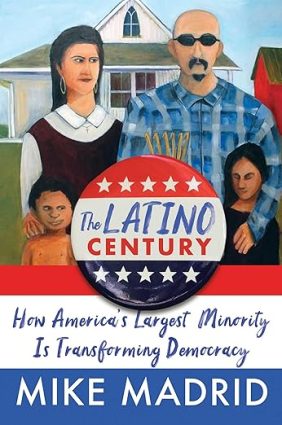
The Latino Century not only has a lot to say, as its subtitle indicates, about How America’s Largest Minority Is Transforming Democracy but also about how our democracy is shaping the differing political orientations and identity of Latinos—Mexicans, Puerto Ricans, Cubans, Venezuelans, and so forth. Its author, Mike Madrid, is an intriguing fellow. As a very young man, he began working in Republican politics in California and eventually became political director of the California Republican Party. He was then hired by Lionel Sosa, a Texas-based Mexican-American marketing executive, to help with George W. Bush’s presidential campaigns. But with Donald Trump’s election in 2016, Madrid drifted away from the Republican Party. In 2018 he was campaign consultant to the unsuccessful gubernatorial campaign of former Los Angeles mayor, Democrat Antonio Villaraigosa. And in 2019 he joined the Lincoln Project, launched by a handful of Republican political consultants dedicated to defeating Trump’s 2020 bid for reelection.
Critical of both progressives and Trump supporters, Madrid could conceivably play a key role in whatever efforts Democrats muster to overcome their humiliating loss to Trump last November. His book is an account of the recent past and future direction of Latino politics. But it also a political memoir, recounting his path into Republican politics as the son of Democratic-voting Mexican-American parents, both of whom were born and raised in the 1940s near downtown Los Angeles, where they were “hardened to the daily life of gangs and street crime.” Madrid himself was born there in 1971 but raised 50 miles away in unincorporated Moorpark in Ventura County, not far from what became the site of the Reagan Presidential Library in nearby Simi Valley.
It was in Moorpark that his parents bought their first home, with three bedrooms and two bathrooms, for less than $30,000, financed with a V.A. loan and 3% down. Madrid’s maternal grandmother, an illiterate immigrant descendant of Yaqui Indians, hated it. As Madrid quotes her saying,
You don’t see anybody. You don’t hear the children crying or laughing. You don’t see the dogs barking. You don’t see the old people walking. You just see people wave at each other and walk on. The houses are all the same. The rooftops are all the same. There’s no color here. There’s no life.
But to Madrid, his childhood neighborhood was “a tranquil setting dotted by orchards, open fields, and endless possibilities.” His first campaign experience was as a sophomore at Moorpark Community College, when he volunteered in the 1992 reelection campaign of the local congressman, Republican Elton Gallegly. He quickly realized he wanted to be a political consultant, because as he writes, “The real power was not with the politician, it was with the guy telling him what to do, what to think, what to wear, and what to say.”
***
Regrettably, at a time when many analysts point to the pervasive influence of such consultants as both symptom and cause of our dysfunctional politics, Madrid has little more to say on this topic, apart from opining about his work with the Lincoln Project that “[i]t’s a pretty scary state of affairs when a group of political consultants becomes the moral conscience of the Republican Party.” And so it is, particularly given his later observation that political consultants, who used to regard their craft as persuasion, now “believe that it’s okay to just blatantly lie.”
The Latino Century was published several months before the 2024 election, and the book warns Democrats and the media that Latinos are not “strangers in a strange land” and “are not all lying awake at night worrying about deportation.” On this last point, he might well see things differently today, though he would still maintain that both parties have misjudged the political orientation and direction of Latinos.
***
To Democrats, Madrid warns that the party that his working-class parents supported has “become a party of white, progressive, college-educated voters who prioritize cultural issues over blue-collar economic concerns.” Noting that “Latinos are aspirational voters, largely working poor, working-class and middle-class,” he adds that, “for the last decade Democrats have become more the party of economic extremes,” with majorities of the wealthy, and of the very poor, voting for them.
Democrats “have been losing Latino vote share,” he continues, because “[l]ocked into a pattern of seeing everything in terms of ‘minority’ politics, Democrats have too often conflated a politics of victimization onto all non-whites—a strategy whose shelf life looks finally to be expiring as the number of American-born Latinos continues to grow faster than any other segment of our community.” Driving home this last point, he reminds Democrats that as of 2019 over 67% of Latinos were U.S.-born. So, it makes no sense for the party to remain “stuck in addressing Latino issues as those of the immigrant (particularly the undocumented), while the vast majority of Latino voters are not immigrants, nor prioritize that experience as a primary concern when voting.”
On the other side of the aisle, Madrid acknowledges that “Republicans are increasingly becoming the party of the working class and middle class,” and that “Latinos in blue-collar industries are naturally gravitating toward the GOP’s protectionist and anti-regulatory message.” At the same time, he also insists that, in spite of these trends, Republicans under Trump “are addicted to white identity and race denialism.” He advises his former colleagues in the GOP to move past their nativism and acknowledge the legitimacy of Latino claims as an ethnic group much like previous immigrant groups. He further argues that Republicans must embrace a serious pro-worker agenda broad enough to include marginalized whites as well as the burgeoning Latino working class. As far as Madrid is concerned, Trump’s steadily increasing vote totals among Latinos—28% in 2016, 37% in 2020, 46% in 2024—reflect not so much their attraction to his style or his agenda as their drift away from Democrats, who have failed to address their concerns and interests.
In sum, Madrid is fed up with both his former Republican colleagues and his current Democratic ones. As he puts it: “White college-educated people are pulling the Democratic Party to the left and white non-college-educated people are pulling the Republican Party to the right, and Latinos are coming up in the middle saying, ‘I’m not really comfortable with either of you guys.’”
***
Unfortunately, Madrid does not quite manage to articulate a clear path between the two alternatives. At the core of his perspective—both rhetorically and analytically—is his insistence that Latinos are assimilating “into the broader political and social culture of the United States,” and specifically, “the blue-collar culture of America.” Recognizing that among Democrats the word “assimilation” is considered offensive, he doubles down: “In one sense, Latinos are like other groups, many ethnic Catholics, whose assimilation shaped the development of the United States at the turn of the last century.” Within three generations of their arrival here, Latinos are speaking English exclusively and intermarrying with non-Hispanic whites. And by the third or fourth generation, the children of such unions tend not to identify as Hispanic.
An important aspect of such assimilation is that Latinos have long tended to identify racially as white—Madrid reports that his mother identifies as both Hispanic and white. “Because Latinos comprise one of the fastest-growing segments of the non-college educated workforce,” he explains, “we should not be surprised that they are mirroring the attributes of their non-Hispanic white colleagues. This is especially true, as U.S.-born Hispanics don’t view themselves all that differently from a racial and ethnic perspective.”
Yet mindful of his grandmother’s Yaqui ancestry, Madrid also insists that Latinos “are living representatives of the Indigenous people who make up half of our bloodline.” As such, Latinos have endured a “history of very real oppression that continues in many nefarious if often more subtle ways.” Even so, as “a mixed heritage people—neither fully Indigenous nor fully white, representing every race…Latinos are redefining the mythology of the American melting pot. They are not, and don’t want to be, treated as victims, or even as minorities.” Consequently, Hispanics “are a voting group that identifies far more with being ‘a typical American’ than an aggrieved racial group, but that is also more politically responsive than non-Hispanics to attacks on immigrants and other people of color.”
For Madrid, a key point of comparison here is the experience of African Americans. Latinos, he emphasizes, are not a racial minority in the same sense:
We don’t have a legacy of slavery or even the need for government assistance to break through the current system. Despite the history of very real oppression that continues in many nefarious, if often more subtle ways, we have not endured the pernicious legacy of slavery, nor much of the systemic suffering that falls harder on Black Americans and endures to this day. We are, by most measures, achieving middle-class status generationally like so many groups before us.
***
Yet, on the vexed subject of race, Madrid seems unable to maintain a consistent perspective. Despite his cogent criticism of his Democratic compadres, he is more critical of the California Republicans he spent many years working with, because of their “racial and ethnic biases that I used to fight against until I didn’t want to fight anymore.” As he recounts, “Whenever I proposed recruiting more Latinos to the GOP, I would get one of three responses: I would get asked, ‘Why can’t we all just be Americans?’ Or I would get accused of ‘playing the race card.’ Or I would get ignored.”
During the period that Madrid recounts in the 1990s, I conducted field interviews for research on the political mobilization of Mexican Americans in Southern California, and subsequently lived and taught there. I, too, recall many frustrating conversations with Republicans who objected strenuously to any assertion of group claims, interests, or identities that violated their understanding of the individualist foundations of American politics. Any departure from such norms smacked to them of the corruption of big-city ethnic machine politics back east—or perhaps closer at hand, the abuses and excesses they associated with affirmative action and African-American politics. Yet however obtuse I may at times have found those I talked with, I would not have characterized them or their views as racist.
Not so Mike Madrid. As he elaborates, updating his observations to the present moment:
These GOP biases go all the way to the top of the party structure. They speak to an insular, sometimes bigoted GOP core that fears non-white voters precisely because they are different. At the core of the present-day Republican voter is a base fear: a fear of a changing America, a fear of loss of status, of income, of history.
***
The clearest example of Madrid’s inconsistency is his account of California’s “rabidly anti-immigrant Proposition 187,” which in 1994 passed overwhelmingly with almost 59% of the vote. Had it not been quickly struck down by a federal court, the measure would have denied undocumented immigrants in the state access to non-emergency public services, including education and health care. A positive outcome, according to Madrid, was that this “polarizing California ballot measure…catalyzed a generation of Latino politicians and activists to become more civically engaged.” Yet the critical point for him is that Prop 187 was motivated by “the fear of a changing America…that was becoming less white.”
Madrid reports in his book that “more than 30 percent of Latinos actually supported Proposition 187.” And he recalls that when he began working for Republican Congressman Gallegly, he found “a lot of Latino voters who had naturalized and become citizens who said they were angry at those who came here ‘illegally,’ who should wait their turn as they had.” He concludes that “[b]y the third generation, the Latinos I talked to mirrored almost precisely their white neighbors expressing concerns about taxpayer funding for services, growing crime, and overcrowded schools.”
Continuing in the same vein, Madrid adds, “From both a policy and a political perspective, it is not racist to prioritize services to the citizens of the state and country where you reside. It’s simply not. To argue that we should be paying for government services for the undocumented while also increasing the cost of services to taxpayers is not going to get you very far politically.” And he attributes California’s budget deficit during the early to mid-1990s to the burdens imposed by undocumented immigrants.
At one point, Madrid appears to acknowledge his contradictory views. While recalling his work with Gallegly, he writes:
I felt disgusted at agreeing with a lot of conservative whites. Even though we agreed on the policy solutions to the problem, it was shockingly clear what was motivating their beliefs—and it was straight racism. While I didn’t agree at all with the sentiment behind their beliefs, it was troubling to arrive at the same conclusions. Opposing illegal immigration isn’t racist.
Perhaps this unresolved contradiction explains why Madrid has virtually nothing to say about the inclusion of Latinos in controversial initiatives such as affirmative action programs, as well as voting rights legislation, that were originally intended for African Americans. And more to the point, why he has nothing to say about how such efforts have shaped Latinos’ self-understanding as well as how they are perceived by their fellow Americans. After all, however disputed and debated, such initiatives were intended to address long-standing, unaddressed historical grievances on the part of the descendants of slaves who have claims on all Americans—including immigrants and certainly their progeny.
***
Legitimate questions might therefore be raised as to whether such programs should include Hispanics, a group with indigenous origins in this country but overwhelmingly of immigrant stock. Alternatively, one might inquire about the prudence of admitting immigrants whose presence here leads to such historically unprecedented and contemporaneously divisive claims. After all, we have no choice about the burdens of our slave heritage. We do have choices about the immigrants we admit to our nation today.
Madrid’s failure to address such questions carries over into his predictions of the future. To his credit, he does address the looming challenge of whether Hispanic population growth means that non-Hispanic whites will eventually become a minority in their own country, transforming America into a “majority-minority” nation. He rightly questions the validity of such predictions, particularly their failure to take full account of increasing levels of intermarriage between Hispanics and non-Hispanic whites, which as noted earlier result over the course of generations in diminished identification as “Hispanic.” But apparently this could change, for as Madrid also suggests, “non-Latino Americans will be becoming as much or more like Latinos than Latinos are becoming like Americans.”
So once again, he is inconsistent. On the one hand, he envisions America as “a country of many shades of brown,…that at long last is moving beyond black and white.” On the other, he predicts a similar binary when he writes that on account of the “growing Latino numbers,…it’s impossible to believe that we can be anything other than forever altered by becoming a non-white-majority nation.” Further, he fails to address the possibility that this browning of America will increase, as opposed to obviate, the demand for divisive racial quotas. Most importantly, he does not consider where these demographic changes will leave African Americans, whose intermarriage rates may be on the rise but are generally quite low—particularly with Hispanics. And how uniform will this browning be? Will it further isolate non-Hispanic whites who do not regard themselves as part of it?
***
Finally, there is the role of college- and university-educated Hispanic leaders in the creation and maintenance of the racial-minority regime of which Madrid is so critical. Although higher education attendance rates of Hispanics are increasing, he notes that among America’s major racial-ethnic groups, they have the lowest rate of college completion. According to 2021 data, among Hispanic adults age 25 or older only 21% have a bachelor’s degree or higher, compared to 61% of Asians, 42% of whites, and 28% of blacks.
To be sure, this cohort of educated Hispanics will likely grow relatively larger and more influential. So, it is possible, as Madrid predicts, that “as Latinos age, get college degrees, become homeowners, interracially marry, and work increasingly in high-tech, white-collar, college-educated jobs, they will become more Republican.” But it also seems likely that many of these university-educated Hispanics will adopt the same progressive views of the foundations, media, and advocacy groups that sustain the racial-minority regime that, in Madrid’s own forceful and accurate analysis, does not serve the emergent needs and demands of the growing cohort of blue-collar Hispanics.
Mike Madrid’s life and career are an example of what is still possible in America. He is part of a story far more complicated than the platitudes Americans often rely on to understand and interpret our history as a nation of immigrants. Madrid is grappling with such matters at a time when immigration is one of several issues threatening to tear us apart. So, while his book has various flaws and inconsistencies, it also contains striking and illuminating insights that are essential to the task of holding us together.