Books Reviewed
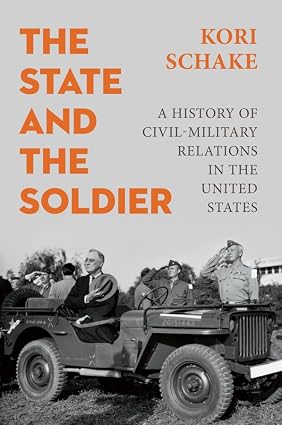
There has long been a need for a single-volume history of the relationship between America’s military and civilian sectors. I was working on one for several years, but distractions and changing conditions prevented my completing the project. Now I don’t need to, thanks to Kori Schake, whose The State and the Soldier: A History of Civil-Military Relations in the United States is a very fine book and probably better than the one I would have written. Schake’s impressive resume includes distinguished service in government, academia, and think tanks. She is currently the director of Foreign and Defense Policy Studies for the American Enterprise Institute (AEI). The State and the Soldier is very gracefully written, superbly sourced, and timely, giving some much-needed historical context to the debate that has raged under Presidents Biden and Trump over the distribution of political and military power. Schake seeks to answer a question that should concern us all intensely: “How is it that a country founded in fear of a standing army would come to think of its military as a bulwark of democracy?”
The empirical domain of civil-military relations is vast. It includes the direct and indirect dealings of ordinary citizens and institutions with the military; negotiations among the military, Congress, and the executive branch concerning the funding, regulation, and employment of the military instrument; and complex bargaining between civilian and military elites to define and pursue national security objectives. Within this broad arena, Schake chooses to focus on the allocation of prerogatives and responsibilities between uniformed military personnel and civilian leaders. The central paradox is what Duke University political scientist Peter Feaver calls the civil-military problématique. It requires any given polity to balance two concerns. On the one hand, it must create a military establishment strong and effective enough to protect the state. On the other hand, it must somehow ensure that this same military establishment does not turn on the state that created it.
***
As Schake notes, standard academic theory would predict a high likelihood of a coup or state capture in a country with America’s constitutional structure, which places enormous trust in a standing military to subordinate itself to elected representatives. But for 250 years, there has been no organized attempt by the military to overthrow the U.S. government. She attributes this fortunate state of affairs to several factors: political culture and the structure of republican government; geography and a relatively benign international environment; a remarkable founding figure, George Washington, whose exceptional virtue established healthy norms and allowed them to develop; and a subsequent parade of skillful politicians. As Schake observes, the American experience has proven enviable but hard to emulate. To account for it, The State and the Soldier takes readers on a tour d’horizon of civilian-military affairs from the American Founding to the Trump presidency. Schake profiles not only the leaders who established the precedents which guide us today—Washington, Abraham Lincoln, Ulysses S. Grant—but also those who, she argues, undermined healthy civil-military relations—Aaron Burr, the scoundrel James Wilkinson (who was a paid Spanish agent while serving as general-in-chief of the army), Presidents Andrew Jackson and Andrew Johnson. She concludes with some sound suggestions for maintaining healthy norms.
As regards the current state of affairs, Schake is harshly critical of Donald Trump. She counts him among those who, by feuding publicly with generals he dislikes, has eroded and threatened historic standards of protocol. Trump’s former secretary of defense, James Mattis, who opposed the president’s Middle East policy, ranks for Schake among the defenders of our best military traditions. Yet her research makes it clear that although Trump’s actions may be controversial, they are neither unprecedented nor unconstitutional. Indeed, her guided tour of the historical record can help correct the widespread misperception that the current state of civil-military affairs represents a historic meltdown.
In reality, tensions between the military and the government are nothing new. They can be traced to the beginnings of the republic. George Washington had to put down a nascent uprising among his soldiers at Newburgh, New York, when Congress was late paying wages. Federalists and Republicans strenuously debated the prudence of creating a military establishment at all. Andrew Jackson made an unauthorized incursion into Spanish Florida in 1818. Whig generals clashed very publicly with a Democratic president during the Mexican War, as Lincoln did with General George McClellan during the Civil War. Andrew Johnson locked horns with Congress during Reconstruction; prominent military men involved themselves in the “Preparedness Movement,” drilling for entry into World War I even when President Woodrow Wilson had adopted a policy of neutrality. In general, disputes such as these do not pit civilians against the military per se, but rather one civil-military faction against another. Neither the civilian side nor the military side is monolithic. At a minimum, the civilian side is divided between the executive and the legislative branches. The public at large and the press also weigh in on issues affecting the military.
For example, in the late 1940s, partisans of airpower advocated the creation of a separate U.S. Air Force, while others maintained that the navy should remain America’s first line of defense. This debate was carried out in Congress and the press. And when President Harry S. Truman decided to fire Douglas MacArthur, both Generals George Marshall and Dwight Eisenhower supported the president while congressional Republicans supported MacArthur. All too often, observers assume that if the United States does not face the prospect of a Latin-American- or African-style coup d’état by the military, then all is well. But Schake makes clear that, even though the United States has never faced the serious threat of a coup, it has periodically suffered from unhealthy civil-military tensions.
***
The military is not always right, either, even when it comes to strictly military affairs. During the Civil War, for example, Lincoln constantly prodded General McClellan to take the offensive in Virginia in 1862. McClellan just as constantly complained about insufficient forces. And despite the projected image of civil-military comity during World War II, there were many differences between Franklin Roosevelt and his military advisers. George Marshall, the greatest soldier-statesman since Washington, opposed arms shipments to Great Britain in 1940 and argued for a cross-channel invasion before the United States was ready. History has vindicated Lincoln and Roosevelt.
That being said, it’s also important to remember that dissent is not disobedience. Military officers have an obligation to present their best advice forcefully, but not a right to insist that their advice be followed. From the founding until the early 20th century, most officers were openly partisan and often in opposition to the chief executive. There is nothing in the Constitution that requires a non-partisan military. Nonetheless, to keep things orderly amid inevitable disagreements, there must be what the civil-military relations scholar Don Snider calls a “calculus of dissent” that extends beyond the stark choice of either “salute and obey” or “exit.” Like so much else in civil-military relations, this is as much a matter of culture as it is of law. The task is not simply to follow a set of written rules but to maintain a set of standards and habits that has prevailed, with some flexibility, since the founding.
***
This is why Donald Trump poses a problem for Schake. She describes the president as an “unprincipled principal,” someone with “no normative or moral commitments.” But as she has shown throughout her book, few of the things he has done as president are unprecedented. That doesn’t make them right, but it does undercut the argument by his critics that he has blundered into uncharted and dangerous civil-military territory. At the beginning of her book, Schake lists three tenets of healthy civil-military relations: the military is loyal to the Constitution, it is subordinate to both the president as commander-in-chief and to the Congress, and it is obligated to execute lawful orders or resign. She also offers two tests of healthy civil-military relations: Can the president fire military officers with impunity? Will military officers execute orders with which they disagree? By these standards, civil-military relations remain healthy under Trump.
Of course, Trump has done things that degrade civil-military norms. Among other things, he has excoriated both active and retired military leaders who have criticized him, impugning their character and competence purely for political reasons. He lavishes praise on active-duty military voters if he believes they support him. But his tendency to fire officers when he suspects they will not execute his policies is actually, by Schake’s own standards, an indicator of healthy civil-military relations. The fact is that the major sources of civil-military friction during the Trump presidencies have been his critics, both inside and outside of the government, including retired officers who employed abusive language for which they could still be charged under the Uniform Code of Military Justice. Trump’s opponents have slow-rolled the implementation of policies they dislike, leaked to the press in an effort to undermine public confidence, and simply ignored direct commands from the chief executive.
***
Schake rightly condemns “praetorianism,” the idea that the military and not civilian leaders should guide national policy in the manner of the Roman emperors’ Praetorian Guard. Yet she does not note how much of the resistance to Trump has often been praetorian in character. Right after his inauguration, Georgetown Law professor Rosa Brooks, a senior Pentagon appointee from 2009 to 2011, wrote in Foreign Policy that Trump’s “first week as president has made it all too clear [that] he is as crazy as everyone feared. [One] possibility is one that until recently I would have said was unthinkable in the United States of America: a military coup, or at least a refusal by military leaders to obey certain orders.” For the first time, Brooks wrote, she could “imagine plausible scenarios in which senior military officials might simply tell the president: ‘No, sir. We’re not doing that.’”
Schake also fails to reckon with the deformation of the military via the importation of race- and sex-based ideology from the civilian sector. In his landmark 1957 book, The Soldier and the State, political scientist Samuel Huntington argued that whatever else we may ask it to do, deterring, fighting, and winning wars remains the military’s core purpose. Huntington called this the “functional imperative.” The most dangerous threat to the functional imperative, Huntington continued, was an ingrained hostility toward the military on the part of liberals. When external threats are low, liberals seek “extirpation,” the virtual elimination of military forces. When external threats are higher, liberals pursue a policy of “transmutation,” refashioning the military along their preferred lines by stripping it of its “particularly military characteristics.”
Schake doesn’t think too highly of Huntington, and she makes some sound criticisms of him: he was indeed wrong about a number of historical issues, and elements of his normative theory have had to be refined. But in his general thesis, Huntington has been spectacularly vindicated in recent years by the military’s submission to the ideology of “diversity, equity, and inclusion.” DEI is transmutation on steroids. By suggesting that justice is a function of attributes such as sex and skin color, rather than of individual excellence, DEI undermines military effectiveness, which depends on cohesion born of trust among those who operate together.
History illustrates that the consequences of unhealthy, unbalanced civil-military relations can be serious. Healthy civil-military relations—and by extension, effective policy, good decisions, and positive outcomes—require mutual respect, candor, collaboration, cooperation, and ultimately subordination. The role of the military is to advise and then carry out lawful policies, not to make them. The key is trust. And it is trust that has been missing over the past few years, resulting in toxic civil-military relations. Yet, despite her blind spots when it comes to Trump, Schake’s superb historical overview demonstrates the resiliency of America’s civil-military structure throughout the history of the republic. In that, there is hope for the future.
Next in the summer 2026 Issue
Pedro Sánchez’s Kingdom
Summer 2026 Correspondence