In the July 1870 issue of The Galaxy magazine, Mark Twain published a sketch, “The Late Benjamin Franklin.” Getting quickly to his theme, Twain wrote: “The subject of this memoir was of a vicious disposition, and early prostituted his talents to the invention of maxims and aphorisms calculated to inflict suffering upon the rising generation of all subsequent ages.” This “son of a soap-boiler” contrived to have his simplest acts held up for the emulation of boys forever—“boys who might otherwise have been happy.”
With malevolence unrivalled in the annals of crime, this Franklin would work all day and pretend to study algebra all night by candlelight. He would live on bread and water and study astronomy at mealtimes, all so that millions of boys could have his name thrown up at them by fathers who had read his “pernicious biography.” The result was that boys could no longer follow a single natural instinct without having one of Franklin’s maxims quoted to them: “early to bed and early to rise” had brought the young Twain sorrow beyond reckoning and was primarily responsible for his “present state of general debility, indigence, and mental aberration.”
Franklin’s fame in Twain’s day was emphatically the fame of the Autobiography and Poor Richard’s maxims. Franklin was, indeed, as he tells the world in his account, the youngest son (born in 1706) and 15th child (of 17) of a soap-boiler, and the youngest son of the youngest son going back five generations. He does paint the picture of himself starting with nothing, working ostentatiously all day and pretending to stay up working diligently all night, and making a great success of his life, which he presents for emulation. And he tells the true story of his efforts to carry out “the bold and arduous Project of arriving at moral Perfection.”
Franklin published the first Poor Richard’s Almanack in 1732 and turned out an almanac every year for 25 years, while becoming the most influential printer in colonial America. These widely read almanacs were presented to readers as written by one “Richard Saunders, Philomath,” a poor, impractical astrologer, a meek and humble henpecked husband whose proud wife had no patience for his impracticality. Most of these almanacs opened with a prefatory skit. For the 1758 edition, his grand finale, Franklin wrote a preface that was ten times longer than usual. It was soon published separately under the title Father Abraham’s Speech to a Great Number of People, at a Vendue of Merchant-Goods, but it gained immortal fame under the title The Way to Wealth.
The scene is Richard Saunders—Poor Richard, familiar now for 25 years—telling his readers that he was riding on horseback one day when he came upon an auction, or vendue, of merchant goods with people waiting for the sale to begin. He hears the people complaining of the badness of the times—“heavy taxes”!—and he hears them invite one of the company, an old man with white locks addressed as Father Abraham, to tell them what he thinks of these bad times. Father Abraham responds with a speech on the benefits of industry and frugality that manages to pull together the sayings of Poor Richard from all the previous almanacs and to add a few new ones:
God helps them that help themselves….
Lost time is never found again….
He that lives on hope will die fasting….
Industry need not wish….
Plough deep while sluggards sleep….
There are no gains without pains….
Diligence is the mother of good luck….
One today is worth two tomorrows….
There will be sleeping enough in the grave….
Poor Richard’s vanity is gratified to hear himself quoted so prodigiously. Then when the speech is over and the listeners have “approved the doctrine,” the auction opens and they all immediately go out and enthusiastically practice the contrary, just as if they had been attending “a common sermon.”
Image of America
Franklin comments in his Autobiography that The Way to Wealth was “universally approved” and published “in all the Newspapers of the [North American] Continent.” It was translated into French in 1777 as La science du bonhomme Richard, ou, Moyen facile de payer les impôts. In a few years, it became the most widely read American work in France. Its popularity continued to soar after Franklin’s death in 1790: at least 145 editions were published before 1800; over 1,100 editions in 26 languages before 1850. By the turn of the 20th century, Paul Leicester Ford’s Franklin Bibliography: A List of Books Written By, Or Relating to Benjamin Franklin (1899) listed 56 pages of editions. A project to digitize the massive bibliography is currently underway.
Franklin wrote his Autobiography off and on over 18 years. He wrote Part One and an outline of the work in 1771, when he was 65 and living in England as the colonial agent for Pennsylvania, New Jersey, Georgia, and Massachusetts. In 1784, residing in France and just having helped negotiate the Treaty of Paris to end the American War of Independence, he resumed his efforts and wrote the short, and most famous, Part Two. Back home in Philadelphia, after attending the Constitutional Convention in summer 1787, he wrote Part Three in 1788-89, and in 1789-90 he wrote the brief Part Four before he died on April 17. To the end he was revising the whole.
The inspiration for Franklin’s completing the Autobiography, which he had laid aside for over a decade after finishing the first part, came from letters he received in France in the early 1780s from two friends urging him to complete it. Franklin includes the letters of these friends, the American Abel James and the Englishman Benjamin Vaughan, to introduce Part Two of the autobiography, where he narrates his amusing—and real!—project of arriving at moral perfection. Abel James tells him that his work will be “useful and entertaining not only to a few, but to millions,” and it will “promote a greater Spirit of Industry and early Attention to Business, Frugality and Temperance with the American Youth.” Benjamin Vaughan goes further. He writes his friend that his life is “connected with the detail of the manners and situation of a rising people.” His Autobiography will give him a chance to contribute to “the forming of future great men.” From this work, “the wisest man will receive lights and improve his progress, by seeing detailed the conduct of another wise man…it will be worth all Plutarch’s Lives put together” and will better “the whole race of men.”
Unauthorized selections from the Autobiography began to appear in America soon after Franklin’s death. In 1791, a French translation of the first part was published in France; 22 editions were published between 1794 and 1828. The Autobiography and The Way to Wealth were then, and remain, Franklin’s most widely read writings. It became common for editors to publish them together. Parson Weems published extracts from both, and then wrote a biography of Franklin (1817)—very much in the spirit of his hagiography of George Washington—that may have been even more widely read than the Autobiography itself. So, Twain had plenty of material to work with. Two examples, out of countless millions:
- In 1811, because of reading Franklin’s Autobiography, James Harper left the family farm on Long Island when he was 16 to become a printer, like Franklin. He and his brothers became the founders of Harper and Brothers publishers, and he became mayor of New York.
- In 1828, after reading Franklin’s Autobiography, 14-year-old Thomas Mellon decided not to be a farmer like his father, but to follow Franklin’s example, who “by industry, thrift and frugality had become learned and wise, and elevated to wealth and fame.” After a career in law, he founded T. Mellon & Sons’ Bank in Pittsburgh, the same year Twain published his memoir on Franklin, and had a life-sized statue of Franklin placed above the entrance. Late in life he bought 1,000 copies of Franklin’s Autobiography to give to ambitious young men. He became the patriarch of a family that remains one of the wealthiest dynasties in America.
Iron Cage
What inspired Harper and Mellon and millions of other young men, and the caricature of which Twain laughed at so effectively, became such an authoritative image of America and the American, that American writers and intellectuals felt conscience-bound for more than a century to mock it, deplore it, or in any case ponder it. James Fenimore Cooper, Nathaniel Hawthorne, Edgar Allan Poe, Henry David Thoreau, Ralph Waldo Emerson, Herman Melville, Sinclair Lewis, and F. Scott Fitzgerald, to name a few, all responded to this image in one way or another.
The two most well-known 20th-century critics of Franklin and Franklin’s America, Max Weber and D.H. Lawrence, were not Americans. But they write very much within Mark Twain’s horizon, though without the benefit of humor. Weber did not cite The Way to Wealth in his The Protestant Ethic and the Spirit of Capitalism (first published as a two-part essay in 1904-05; translated into English by Talcott Parsons in 1930), but his influential book may be said to begin and end with and be all about Benjamin Franklin. He quotes Franklin at length and finds in Franklin’s maxims the spirit—the “Protestant ethic”—of capitalism expressed with “almost classical purity.” Twain humorously found Franklin’s “early to bed, early to rise” maxims repressive of all a boy’s joyous natural instincts. With dour, value-free social science, Weber saw Franklin’s way to wealth as having nothing to do with “natural instincts”—not even with the stirring acquisitive instincts. But he agreed with Twain that there was no happiness in it. For Weber, Poor Richard’s ethic of acquisitiveness descended upon him with the weight of joyless obedience to a calling:
the summum bonum of this ethic, the earning of more and more money, combined with the strict avoidance of all spontaneous enjoyment of life, is above all completely devoid of any eudaemonistic, not to say hedonistic, admixture. It is thought of so purely as an end in itself, that from the point of view of the happiness of, or utility to, the single individual, it appears entirely transcendental and absolutely irrational. Man is dominated by the making of money, by acquisition as the ultimate purpose of his life.
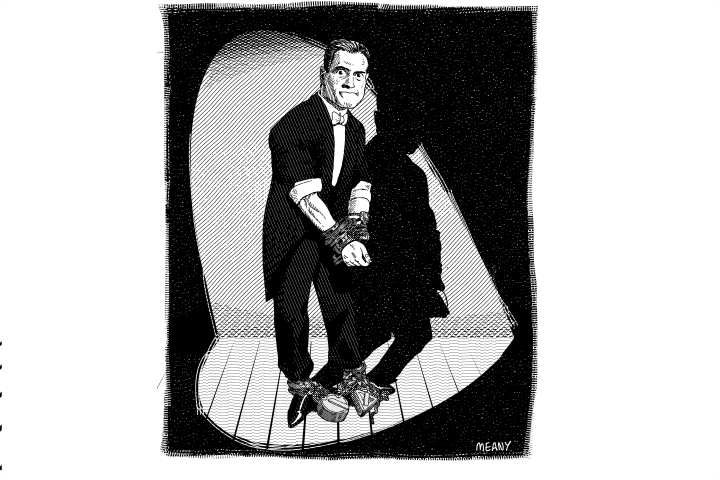
Arising from this joyless spirit, as Weber understood the matter, was the tremendous cosmos of the modern capitalist economic order, a mechanism into which we are all fated to be born. We are born into it as if into an “iron cage” (in the Talcott Parsons translation), the “cage of the future.” America, animated by Franklin’s grim maxims, is this iron cage—the most developed form of modernity. Here, at this stage of cultural development, Weber scientifically concludes, men become “specialists without spirit, sensualists without heart; this nullity imagines that it has attained a level of civilization never before achieved.” This bleak—Franklinian-American—fate, according to Weber, is the “fate of our time.” But he quickly adds, true to his value-free science, that we have no rational grounds for judging whether it is better or worse than any other fate. Still, repelled at the idea of being such a “nullity,” and having no rational grounds for preferring an alternative, Weber is driven, as Leo Strauss points out, to live by the commandment, “Thou shalt live passionately”—which brings us to D.H. Lawrence, famed author of Sons and Lovers (1913), Lady Chatterley’s Lover (1928; banned for obscenity in the United States until 1959), and of the most widely read criticism of Benjamin Franklin.
Dark Forest
Like Weber, Lawrence took Franklin to be representative of the American Dream and the American Dream to be representative of something deplorable, even horrifying, in modernity. Lawrence published his first criticism of Franklin in the English Review (1918), then the more well-known version in his often-cited book Studies in Classic American Literature (1923).
Lawrence is horrified by Franklin’s reasonableness, his small-souled calculation of interest and advantage, that knows nothing of the soul’s great raging authentic passions. Franklin can clean a street and fix a lamp but he knows nothing of the “dark forest” within the hearts of all men where deep mysterious longings prowl.
For Lawrence, it is impious presumption to choose how to live. His central claim is that “[i]t is necessary to insist for ever that the source of creation is central within the human soul, and the issue from that source proceeds without any choice or knowledge on our part.” But the pilgrim fathers killed off all “spontaneous impulses and appetites of the self,” as America moved forward in one “line of inexorable repression.” America was creating “a standardized humanity, machine-perfect.” This was the working out of the “ideal Reason of the eighteenth century.” Franklin’s “self-determined man” was a Frankenstein monster.
Lawrence is dismayed to find Franklin’s aphorisms still circulating in London bookstores “for the poor and vulgar to profit by.” Against Franklin, like Twain, but without the laughter, Lawrence wanted to exalt the spontaneous, mysterious, impulsive, instinctive, extravagant element in man. “[M]ystic, spontaneous freedom” is what Lawrence wants, not reasonable choice of a good life. “Creative mystery” is primal in every man. Lawrence wants to “yield to the mystery.”
Renowned British writer and critic V.S. Pritchett got it about right when he wrote of D.H. Lawrence: “Before Franklin’s irony, urbanity and benevolence, Lawrence cuts an absurd figure, rather like a Sunday School teacher who has gone to a Social dressed up as a howling dervish, when fancy dress was not requested.” Still, despite the unhinged passionate intensity of the one and the scientistic delusions of the other, there is some truth in Lawrence and Weber’s criticism of Franklin. Franklin’s Autobiography did pave the way for respect for the working man and acknowledgment of the dignity of working for a living. Enterprise, industry, frugality, making it, taking the main chance, and getting ahead were made respectable by Franklin’s example and his precepts. In this way, he did represent a New Man for a New World, and the world rightly understood this man to be the American. In the Old World, a man was born into his place. In the New World being forged in America, a man made his own way. Franklin was glad to offer this moral lesson. To his own son and grandson he gave the advice to make a living and depend on no office to be given to them. William Cavendish, fifth Duke of Devonshire (1748–1811), said of one of his cousins, “he is not a gentleman; he works.” The American, in this sense, was no gentleman.
Fathers and Sons
No doubt, “work” in the Franklin manner has little part in the equipment of the classical Aristotelian gentleman. Benjamin Franklin was, nonetheless, a gentleman, with an American twist, in the classical sense of the term. In imagining his “Society of the Free and Easy” in his Autobiography, Franklin did mean by free, particularly, “free from Debt, which exposes a Man to Confinement and a Species of Slavery to his Creditors.” This freedom one acquired through the practice of industry and frugality. But he more generally meant “free, as being by the general Practice and Habit of the Virtues, free from the Dominion of Vice.” This was classical Aristotle. In any case, Aristotle certainly held that man by nature has a work, an ergon, and that to do his work required practical wisdom and moral virtue—virtue to direct him to the right end, and practical wisdom to choose the right means. Franklin lived by that understanding. From early days, as he records in his Autobiography, Franklin taught and lived his life according to the principle that, “the Nature of Man alone considered,” it is “every one’s Interest to be virtuous, who wished to be happy even in this World.” Franklin joined Aristotle in thinking some courses of life are better than others, men are capable of choosing the better over the worse, and virtue can best be acquired through habit. In its fullness, Franklin thought, virtue becomes a fixed part of one’s character and is intrinsically the source of happiness. As Poor Richard put it: “Pitch upon that course of life which is most excellent, and custom will make it the most delightful.” D.H. Lawrence reviled Franklin and Poor Richard for this Aristotelianism.
George Washington with all his gravitas affirmed the classical Aristotelian idea in his First Inaugural Address in the often-quoted line: “there exists in the economy and course of nature, an indissoluble union between virtue and happiness.” For a half-century already, Franklin had been living according to that maxim, and preaching it eloquently, though he seldom said anything with Washingtonian gravitas. Franklin was explicit and emphatic about seeking the good for himself and for others in life. The primacy of the good could be said to be his governing motto. A life of mere acquisition of wealth would have seemed to him not worth living. Starting from scratch, Franklin created a thriving printing business while arranging to clean and light the streets of Philadelphia, conceive a fire department, a police force, and a lending library, found the American Philosophical Society, and explain lightning. He retired at the age of 42, literally halfway through his life, and lived the remaining 42 years of his life using his freedom, in both senses of the word, to serve his country and mankind, and to pursue the truth with friends all over the world. He took lively pleasure in all of this.
Franklin’s great fellow revolutionary and sometime nemesis, John Adams, offers a more complete picture of Franklin than was possible in the Autobiography, which ends in the year 1758. In a long letter to the Boston Patriot 20 years after Franklin’s death, Adams wrote about Franklin’s fame:
His reputation was more universal than that of Leibnitz or Newton, Frederick or Voltaire, and his character more beloved and esteemed than any or all of them…. Franklin’s fame was universal. His name was familiar to government and people, to kings, courtiers, nobility, clergy, and philosophers, as well as plebeians, to such a degree that there was scarcely a peasant or a citizen, a valet de chambre, coachman or footman, a lady’s chambermaid or a scullion in the kitchen, who was not familiar with it, and who did not consider him as a friend of humankind. When they spoke of him, they seemed to think he was to restore the golden age…. He was considered as a citizen of the world, a friend to all men and an enemy to none…. [He enjoyed] the entire esteem and affection of all the philosophers of every denomination, [and] he was not less regarded by all the sects and denominations of Christians…. Indeed, all sects considered him, and I believe justly, a friend to unlimited toleration in matters of religion.
Adams was jealous of this fame and couldn’t refrain from suggesting that, however real it was, it was “exaggerated.” But in his justice and candor Adams wrote not only of Franklin’s fame, but of his gifts. Adams joined Thomas Jefferson in considering Franklin “an honor to human nature.”
Franklin had a great genius, original, sagacious, and inventive, capable of discoveries in science no less than of improvements in the fine arts and the mechanic arts. He had a vast imagination, equal to the comprehension of the greatest objects, and capable of a steady and cool comprehension of them. He had wit at will. He had humor that, when he pleased, was delicate and delightful. He had a satire that was good-natured or caustic, Horace or Juvenal, Swift or Rabelais, at his pleasure. He had talents for irony, allegory, and fable, that he could adapt with great skill to the promotion of moral and political truth. He was master of that infantine simplicity which the French call naïveté, which never fails to charm, in Phædrus and La Fontaine, from the cradle to the grave.
The 250th anniversary of American independence is a good time to try to remember the Ben Franklin who, before Alexander Hamilton was even born, was the leading champion for American greatness within the British Empire. When the British Empire decided it could do without American greatness, Franklin became the boldest of the American revolutionaries and was known in England as the “chief of the rebels.” In Paris between his 71st and 80th year he was as indispensable abroad as George Washington was at home in winning the war for American independence. He was the most gifted, most charming, and most modern of our founding fathers, a humorist and a satirist of the first order, lighting the way for Mark Twain. It is not too much to say that he was the happiest founding father, in the rich Aristotelian sense of the word.
By the time his Autobiography ends in 1758, Benjamin Franklin was already the most famous American in the world, primarily because of his scientific discoveries. His contemporary Immanuel Kant called him “the Prometheus of modern times.” In the next 30 years, he would become perhaps the most famous man in the world—not just the man who snatched the lightning from heaven, but the man who snatched the scepter from tyrants. There is much more to Franklin than can be found in his Autobiography. Still, fathers shouldn’t let Twain’s jokes or Weber’s or Lawrence’s frettings worry them. They should look forward eagerly to sharing with their sons that wonderful American classic. The experience will not stifle any healthy natural instincts and is apt to inspire many.
Next in the summer 2026 Issue
Pedro Sánchez’s Kingdom

Summer 2026 Correspondence