Books Reviewed


Listen to this article
Shortly after leaving the White House, President Jimmy Carter traveled to give a commencement address at a college near Osaka, Japan. He told a short joke to open the speech and waited anxiously while the interpreter translated it into Japanese. To Carter’s surprise, the audience roared with laughter. Later, when he asked the translator how he had reproduced the punch line so effectively, the man kept dodging the question. “He was very evasive,” Carter recalled on David Letterman’s Late Show. But at last the translator broke down and explained: “I told the audience, President Carter told a funny story. Everyone must laugh.”
Translators are in an odd position. People sometimes think of them as humble messengers who ferry meaning between the main parties in an exchange—President Carter and his Japanese audience, a Chinese investor and a Silicon Valley CEO, the author of an international novel and his readers. But like trusted courtiers or highly-placed assistants, translators wield serious power in their apparently subordinate role. They are basically engaged at all times in a two-way conspiracy, intercepting high-stakes messages before their recipients can understand them and passing them along on frequencies only certain listeners can pick up. All translators are also interpreters, charged with plotting a route from the original words to what seems like their intended effect. And, like Carter’s man in Japan, they sometimes use their autonomy to take extraordinary liberties.
This leaves the rest of us uncomfortably vulnerable. Anyone who relies on a translation—which is everyone, sometimes—is at the mercy of a third party’s executive decisions about what is linguistically, culturally, or even morally appropriate. A famous case is Catullus 16, one of the raunchiest poems in an extravagantly smutty collection by the enfant terrible of the late Roman republic. Catullus, acting shocked that his two buddies have questioned his personal virtue on the basis of his verse, responds by threatening in neatly metrical lines to punish them with oral and anal assault. Pedicabo ego vos et irrumabo, he writes in Latin. “I’ll f–k you up the -ss and in the mouth,” would be a tolerably accurate English rendition into iambic pentameter. It’s fun to debate whether the poem’s speaker really means what he says or is just telling his pals, basically, to stuff it. But however you look at it, the Latin says what it says.
This used to create a nasty predicament for anyone who tried to relay Catullus’ message in a modern language. “Until recently,” wrote the classicist Thomas Nelson Winter in 1973, “English as forthright as the Latin could never be printed.” Even today, a few demure hyphens like the ones above seem necessary in a family publication. But at least we can tell what’s being said; earlier generations found themselves obliged to leave the meaning almost totally obscure. An 1894 edition of Catullus, quite daring for its time, came with one option in verse and one in prose. Captain Richard F. Burton, the rakish adventurer best known for his translation from Arabic of The Book of the Thousand Nights and a Night (a.k.a., The Arabian Nights), resorted to blanking out Catullus’ words: “I’ll — — you twain and — —.” His collaborator Leonard C. Smithers, in a prose alternative, used delicately abstruse derivatives of the Latin verbs: “I will paedicate and irrumate you.” Later efforts included oblique gestures at the original such as “I’ll work your / own perversions on you and your persons.”
It is impossible to make Catullus intelligible here without making him obscene. But obscenity might have a different heft, and different consequences, in English. When Burton and Smithers were writing, the sale of anything as scandalous as an unvarnished Catullus would have been a statutory offence. What sounded to a Roman socialite like erudite machismo would have sounded to a 19th-century English gentleman like abject perversion. “It’s proper for a reverential poet / to be clean in life—in verse, no need!” Catullus wrote. Fair enough, except that verse changes how people live, especially if it enters the canon and helps move the bounds of acceptable dinner conversation. Experts fluent in Latin might be trusted to understand that the past is another country. But to make the offending lines available in English was to confront the general public with the disorienting reality that there were once civilized men who considered it acceptable to trade literary jokes about this sort of thing. Burton and Smithers, in keeping with the adventuresome ethos of France’s and Britain’s scandalous “decadent movement,” were already pushing it with their edition of Catullus. It was about as racy as it could be given the law. But to many of their contemporaries, the past seemed too dangerously strange to be represented accurately in the present. Exact translation, in this instance, was simply too great a risk to take.
We might be tempted to ask who gave the Crown, or the translators, the right to make such a decision. That would probably be the wrong question. It’s the kind of decision that someone is always in a position to make. Reading a translation invariably means entrusting the translator with ethical and aesthetic judgments. There’s no getting out of submitting to that necessity at least some of the time, short of learning every one of the over 7,000 languages in the world. A.I. technology might seem to hold out the hope of impersonal or even “neutral” translation, without the intrusion of an elite minority’s personal preferences, but of course that’s an illusion: it’s people who write the code, and they get to deliberate on behalf of the rest of us. In the 2010s there was a minor uproar over the sexism of Google Translate, which defaulted to the assumption that doctors were male. In Turkish, the pronoun o means either “he” or “she,” so a listener has to decide from context whether o bir doktor means “he is a doctor” or “she is a doctor.” Google’s program always chose “he,” until designers intervened to build a “rewriter,” grafting an add-on to the code which detected ambiguities and offered users a choice. Today, if you type “o bir doktor” into the Google Translate widget and set it to go from Turkish to English, the output splits into two possible renditions, female and male. If at some point the people in charge decide that justice demands non-binary options, the language models—and the English-speaking population—may be subjected to retraining.
A Taste for the Exotic
Even Google’s double-speak, though, doesn’t resolve the sensitive case of Turkish doctors. A list of options isn’t really a translation. Presenting a suite of possible things a sentence might be saying isn’t the same thing as communicating what the sentence means. To do that, a translator has to make some decisions. Even the simplest words and sentences in any “source” language (the one being translated from) are bursting with possible implications and ambiguities. Only some of those possibilities can be preserved in the “target” language (the one being translated into). Translators have to pick what’s important and what they get across. In his essay collection Mouse or Rat?: Translation as Negotiation (2003), novelist Umberto Eco points out that Italians typically use a single word in everyday speech—topo—to identify both pet mice and plague rats. So, when Shakespeare’s Hamlet says “How now! a rat?” and stabs Polonius for spying, his Italian translators have to figure out how to make topo sound more contemptuous than cuddly.
The British writer Daniel Hahn’s new book, If This Be Magic: The Unlikely Art of Shakespeare in Translation, is filled with delightful examples of how fraught the questions involved can be. Some of the challenges are almost purely technical: in The Merchant of Venice, when Bassanio compares his wife, Portia, to the sun, she replies, “Let me give light, but let me not be light; / For a light wife doth make a heavy husband.” The Japanese translator Shoichiro Kawai managed to turn this into a pun with two adjectives—akarui, meaning “bright,” and karui, meaning “not heavy.” If he had used the noun for “light” (hikari), it wouldn’t have worked half as well. But the Japanese can’t hop nimbly, as the English does, from giving light (noun) to being light (adjective). Kawai found the essence of what the lines were about and left the rest behind. Even so, the Japanese wordplay comes across as carefully wrought where Portia’s sounds almost effortless. It’s a magnificent but imperfect solution, which is about as good as it gets (though sometimes you strike gold: Hahn notes in passing that, since choix in French means “choice” and chapeau means “hat,” the “Sorting Hat” in the Harry Potter series becomes the choixpeau in French).
Now take a more culturally intricate problem, like the one presented by Shakespeare’s beloved Sonnet 18. “Shall I compare thee to a summer’s day?” it begins, “Thou art more lovely and more temperate: / Rough winds do shake the darling buds of May, / And summer’s lease hath all too short a date.” To advanced speakers of English, these lines may feel straightforward enough. But try changing them into Portuguese, and it suddenly becomes an issue that May isn’t when flowers start to blossom in every part of the world. In Brazil, or anywhere else in the Southern hemisphere, it’s more like the darling buds of September. That might not rhyme, though. Still more importantly, the question becomes whether to invite Brazilians into a strange land where spring happens in their winter months, or bring the romance to them and let Shakespeare’s English roses bloom on Rio time.
The Biblical translator Saint Jerome, hearkening back to Cicero, distinguished between “word-for-word” translation that seeks to retain each verbal detail point for point, and “sense-for-sense” translation that may dispense with exact lexical fidelity to get at the underlying meaning. Moderns sometimes talk about the difference between “exoticizing” and “domesticating” translation. An exoticizing (or “foreignizing”) translator leaves unfamiliar elements as intact as possible, assuming that part of the pleasure in reading foreign books is seeing how the world looks to people in other times and places. If you’re a Brazilian reading an exoticizing translation of Sonnet 18 then, as Hahn puts it, “as long as you’re in this sonnet, May is spring.” A domesticated translation is more like a Renaissance painting that shows characters from the Gospels dressed up as early modern aristocrats, or a Japanese icon of the Virgin Mary that presents her to worshippers in a kimono. Then the implication is that something universal lives under the surface of the conventional trappings, such that God or man can be embodied just as well in a berobed Italian as in a Middle-Eastern Jew. Spring is spring—fragrant, bright, and sensual—even if it starts in September.
It’s not unlike when Americans debate whether their country should be defined as a set of abstract ideas or as a particular land with its own irreplaceable cultural and racial history. Translators have to ask how far they can separate the thoughts they find expressed in the source language from the details of when, where, and to whom those thoughts occurred. Every possible answer has its drawbacks. One Anglo-Saxon scholar wrote in the 9th century that translating felt to him like journeying into the heart of a forest and gathering wood, picking up “as many of the most beautiful trees as I could carry” from source to target. “I never carried a single load home without wishing I could take the whole forest with me.” His advice, therefore, was for everyone who can to learn Latin and go move amid the lovely shadows of the woods for himself.
That might have been a good solution when proficiency in Latin was acknowledged as the main skill Europeans needed to get by in learned circles. Even today, an exhortation to study the classical languages never goes amiss. But one thing that Latin can no longer do is eliminate the need for translation in high society, which became multilingual centuries ago and is now thoroughly global. That means translation in the 21st century remains an indispensable but precarious highwire act. Arguably the stakes get higher as more people come to rely on software like Google Translate, giving developers a chance to set protocols that will determine how well or badly entire populations understand each other. Human translators, too, still wield their strange informal influence. No one, at least in the West, quite knows how much English Xi Jinping speaks. Probably it suits him not to let on. In any case, he always brings a translator to communicate with the president of the United States. Donald Trump is unlikely to learn Mandarin any time soon, so the interpreters at those meetings are doing one of the most important jobs in the world. A lot is riding on how effectively they conceal, or reveal, what their bosses have to say.
The Biblical story about the Tower of Babel has many meanings, but one of its central insights is that people who don’t understand each other can’t form a community. When the one speech of Babel’s city planners splits into many, their effort to found a civilization goes hopelessly awry. It’s a political crisis: “So the Lord scattered them from where they were over all the earth, and they gave up building the city.” Dante Alighieri, reflecting on the story in the fractured light of Europe’s many dialects, concluded that the tower-builders must have lost the ability to communicate when they focused too narrowly on their own parts of the job. The sculptors used one argot, the bricklayers another, the designers a third, and so on: “only those engaged in the same project kept the same way of speaking.” One of the surest confirmations that the Carolingian empire was disintegrating into separate kingdoms was the Oaths of Strasbourg, a treaty signed in A.D. 842 by two heirs of Charlemagne in early forms of French and German for the benefit of readers who could no longer understand one common tongue. It is the oldest surviving official document written entirely in a Romance language. Shared speech is the sign and seal of a shared project, a framework of mutual understanding. Once it’s gone, translators become ambassadors between two otherwise alien peoples. The project of civilizational continuity is in their hands.
It’s Complicated
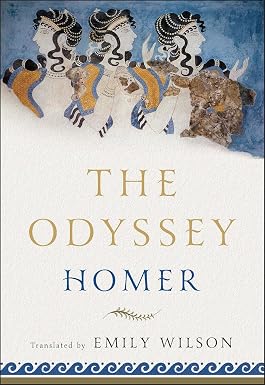
All this helps explain why the theory and practice of translation, obscurely academic though it may seem, can occasionally stir up fierce controversy. In 2025, when director Christopher Nolan mentioned in an interview that he had consulted Emily Wilson’s translation of Homer’s Odyssey for his much-anticipated screen adaptation, he didn’t seem to realize he was setting off a firestorm. But for a certain kind of viewer, that one comment doomed the film before it ever appeared in theaters. Wilson’s Odyssey, widely acclaimed and constantly cited as the first English version by a woman, has provoked steadily mounting debate ever since it first appeared in 2017. Some felt that it brought fresh verve and relevance to Homer’s ancient Greek. Others viewed it as an act of “desecration,” to use a word applied by Elon Musk to Nolan’s movie in advance of its release. “Emily Wilson completely changes the meaning of Homer’s Odyssey,” wrote the critic Liza Libes when the movie came out. “She downplays the glorious language in Homer’s original…. This is the translation that Nolan used, and this explains everything you didn’t like about the movie.”
That last sentence may have been overstating the case somewhat—Nolan mentioned Wilson only in passing and seems to have looked at a variety of other English versions, including E.V. Rieu’s rather staid prose and Robert Fagles’s high-flying verse. But it’s true that Wilson’s is the only rendition Nolan quoted: “I think it’s the Emily Wilson translation that begins, ‘Tell me about a complicated man’,” he said. “Complicated” is probably the most hotly disputed word in Wilson’s Odyssey. It translates polytropos, a layered epithet meaning something like “of many ways.” Detractors argue that “a complicated man” (rather than, say, “a man of twists and turns”) sounds more like a toxic ex-boyfriend than an epic hero. Some take it as a signal of Wilson’s intention—evident throughout the poem—to turn Odysseus from a swashbuckling adventurer into a conniving marauder.
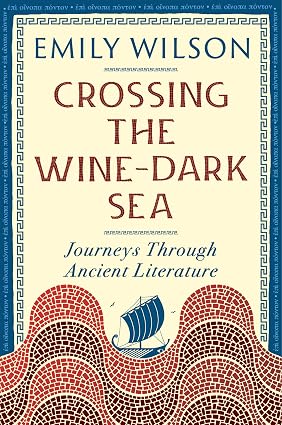
My own assessment of Wilson’s approach is not favorable (see “Homer Without Heroes,” Winter 2023/24). But “complicated” strikes me, at least in isolation, as one of her more defensible choices. She argues well for it in Crossing the Wine-Dark Sea, a new collection of mostly republished essays. Both Odysseus and his story transform over the course of the narrative in ways that can be fairly described as complicated. The word may strike the ear as unduly blunt, but it’s not entirely unreasonable. “To me,” writes Wilson, “‘complicated’ does not suggest either ‘good guy’ or ‘bad guy’: it is rather a promise that this poem will not stoop to those implausible simplifications.” This is from “Translating the Odyssey,” an essay stitched together from refurbished twitter threads in which, as Wilson puts it in her introduction, “I comb closely through the translatorly choices of several different translators of Homer.”
The real problem is twofold. First, as phrases like “comb closely” and “the translatorly choices of several different translators” suggest, Wilson is just not a very good writer. Her diction is reliably insipid, both in her translations and in her original prose. At one point, introducing an essay on translations of Homer “by non-classicists,” Wilson announces that “perhaps the most powerful example is Christopher Logue’s War Music [1981–2005]—a powerful poetic reimagining of the Iliad.” One certainly gets the impression from this sentence that Logue’s writing is powerful. Wilson’s, less so.
The second, more serious issue is that Wilson really does harbor disdain for many key figures from the ancient world and the ideals expressed in their works. This comes through both in some of her more dubious translations and in the tenor of her work as a whole. Crossing the Wine-Dark Sea is an intriguing hodgepodge of subtle close readings and egregious over-generalizations about the moral failings of classical authors. At one point, describing Aeschylus’ intricately plotted trilogy of tragedies about blood guilt and civic justice, the Oresteia, Wilson asserts, “most fundamentally, the trilogy uses all these interwoven narratives to tell a story that justifies the triumph of men over women.” That same extravagantly dismissive attitude is on display when she intervenes to save Homer’s female characters from their supposed misrepresentation by male translators.
In the Odyssey, for example, when Helen of Troy is remembering how the Greeks went to war for her, Wilson has her say that “they made my face the cause that hounded them”—as if the fault is with the men for being so smitten that they killed and died. The word Helen actually uses in Greek is kunōpis, a slur often applied to cheating lovers, and it means “dog-faced.” Helen’s psychology is—if you like—complicated. But there’s no good reason to doubt that the person she’s blaming in this moment is herself. Even in the scholar Ruby Blondell’s feminist reading, entitled “Bitch That I Am,” Helen is most free precisely when she most insists on her own accountability: “though no man within the epic blames her, she is free, as a subject, to reproach herself.” In her eagerness to shield Helen from judgment she considers unfair, Wilson deprives the character of her agency and willfully mistranslates the Greek, all at one stroke.
Wilson has now announced her intention to re-translate the entire Odyssey from scratch—which, like republishing tweets, sounds like a great way to sell more copies of old material. But it seems unlikely she’ll be much kinder to the men of Homer in the new version. Even Nolan’s Odyssey was far too kind to its main character to merit Wilson’s approval. In a scathing assessment for the London Review of Books, she castigated Nolan for filming in “the occupied territory of Western Sahara, thus normalising the ongoing violence against the indigenous Sahrawi people…. Nolan used this land simply as a visually striking backdrop for a film that centres, aggrandises and redeems the hero of a territorial war.” Perhaps critics were a bit too quick to associate Nolan so closely with Wilson, then. But they weren’t wrong to be passionately invested in which version of Homer he used for his film, or to mistrust Wilson’s motives as a translator. The Odyssey is a foundational work of what Wilson, using scare-quotes, calls “‘western civilization,’ whatever that may be.” Among other things, Western civilization is a shared wisdom tradition that depends for its transmission on its literary culture, which means translators of its core texts have the responsibility of making the West intelligible to future generations.
No one is obligated to like or agree with every strain of thought in the Homeric poems—no one even could. But Wilson is so disgusted by the attitudes expressed in ancient Greek literature that she regularly intervenes to shield readers from them. In this respect, she is little better than the eminent Victorians who censored Catullus to keep him from giving people the wrong ideas, or the Japanese handler who took it upon himself to intercept Jimmy Carter’s joke before it bombed. It’s one thing to make judgment calls on difficult edge cases in good faith; it’s another to override the original author’s intention altogether just to indulge your own personal hang-ups. Translators who take advantage of their privileged position as interpreters to distort or redact their source material are, quite simply, abusing their power.
The Wretched of the Earth
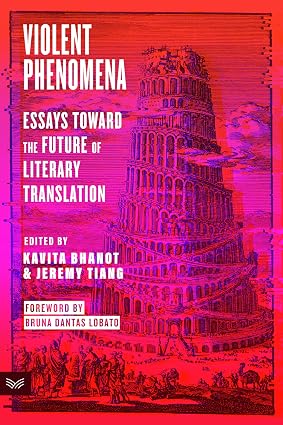
The attitude that justifies meddling in someone else’s work like this is one of extreme moral superiority. It may seem foolish now to bowdlerize Catullus, because the scruples of British imperialists have fallen out of favor. But the professional theorists of translation today have their own forms of high-handed self-certainty. These emerge clearly in Violent Phenomena, an edited volume of academic papers and addresses on “decolonizing” the practice of translation. The general consensus among the authors seems to be that it’s wrong for powerful Westerners to tamper with the literature of indigenous peoples, but righteous for the marginalized to reclaim and rework once-authoritative sources, whatever their provenance. “The feminist translator allows for the lived experience of women and non-binary folk to inform the translation process and the language used, in order to dismantle patriarchy as the normative mode of life and living,” writes Sofia Rehman in an essay on translating the Koran into English. In her work, Rehman acts on the assumption “that the core messages of the Qur’an are the unity of God and the imperative to strive for the establishment of social justice. If the texts do not aid in the establishment of social justice, then either the sacredness of such statements must be questioned, or the process of interpretation that they have undergone must be scrutinised to identify the shortcomings and mistakes that have led [sic] an incongruous reading.”
The logic is wonderfully airtight: feminists are correct about what is good and true; the Koran is supposed to be a divinely good and true book; therefore, if the Koran seems to say things feminists don’t like, then either it doesn’t really say those things or it isn’t really divine. How the actual intended meaning of the Koran is supposed to break through, should it ever contradict what Rehman believes, is unclear. The natural conclusion would be that “women and non-binary folk” should simply issue treatises of their own authorship, each with the title My Qur’an. The phrase Violent Phenomena, taken from Frantz Fanon’s 1961 manifesto, The Wretched of the Earth, suggests something a bit like this. “Decolonisation is always a violent phenomenon,” wrote Fanon. Like a downtrodden people besieging the strongholds of their taskmasters, the freedom fighters on the bleeding edge of translation studies understand it as their calling to ransack the hallowed shelves of ancient libraries and wield the borrowed prestige of well-respected books in support of the cause.
“Translation is a fundamentally political act,” write the editors of Violent Phenomena in their introduction. They are absolutely right about this, and they understand at a fundamental level that they are engaged in power politics. This is what makes their work destructive rather than just silly. It’s also why lay readers get so incensed about a bad translation of the Odyssey: they can tell that something of paramount importance is being withheld from them by dishonest actors. People who seize control of an inherited civilization and reshape it to fit a new moral vision are called revolutionaries. If it’s fair to say that the cohesion and perpetuation of global Islam depend on accurate translation of the Koran, then it’s no less true that Western civilization, which spans many centuries and continents, depends in part on the fidelity of translators to keep it together. Translators who believe no such civilization exists, and would be inclined to dismantle it if it did, are unlikely to be good stewards of their charge. The world will be ill-served by the politics of Babel.