Books Reviewed
Against the Machine: On the Unmaking of Humanity,
by Paul Kingsnorth. Thesis, 368 pages, $32
The historian of science E.J. Dijksterhuis memorably characterized the scientific revolution of the early modern period as a “mechanization of the world picture.” What did this amount to? And what was the character of the previous world picture this mechanization replaced?
The medievals, following common sense and Aristotle alike, took the world to comprise a vast diversity of irreducibly different kinds—water, stone, gold, lead, grass, trees, birds, fish, clouds, stars, planets, people, and so on. Each was a substance sharply demarcated from other substances. Each had a defining nature or essence that united it to other members of its kind and set it apart from other kinds. Each had, by virtue of its nature, a distinctive teleology or final causality—a built-in directedness toward certain ends. Water by its nature was directed toward being liquid at room temperature, stone toward being solid. Trees by nature were directed toward sinking roots into the ground, and birds toward building nests. Human beings, by nature rational animals, were directed toward knowing the natures of things.
These natures and the final causes they entailed provided a basis for conceiving of goodness and badness as objective features of the world. Because trees are by nature directed toward sinking roots into the ground, a tree that does so is to that extent a good tree, in the sense of a good specimen or flourishing instance of “treeness.” A tree that failed to sink roots into the ground, or whose roots were sickly, would be a bad tree in the sense of an unhealthy or defective specimen of treeness. A human being who acquired knowledge of the natures of things would to that extent be a good or healthy specimen of humanness, whereas to fall into error made one to that extent defective or unhealthy. This account of value made possible, in turn, an objective foundation for ethics. Because human beings can know the natures of things, they can know their own nature—and thus can also know what is, as a matter of objective fact, good or bad for them given that nature.
The “mechanization” referred to by Dijksterhuis entirely subverted this picture of the world. Water, stone, trees, and birds were no longer seen as sharply demarcated substances, but instead as mere aggregates of unobservable particles that are all fundamentally of the same kind. The differences between everyday objects were no longer seen as reflecting distinct crisply defined essences, but rather as relatively superficial variations in the ways these homogeneous particles might be arranged. Many of the qualities that everyday perception presents its objects as having (color, sound, taste, odor, heat, and cold as we ordinarily experience them) were reinterpreted as mere projections of the human mind, resembling nothing in the objects themselves.
Teleology or final causality was dismissed as a further projection of the mind, corresponding to nothing intrinsic to nature. Devoid of any inherent directedness to any ends or purposes, natural processes could no longer be described as either succeeding or failing to realize such ends or purposes. Hence, goodness and badness could no longer be seen as objective features of nature, and they too came widely to be reinterpreted as projections of the mind. For the mechanical world picture, the only positive characterization we can give of the natural world is afforded by the language of mathematics—as when we give a mathematical description of the sizes, shapes, and motions of basic particles, and capture the physical laws that govern them in mathematical formulae.
In short, for the mechanistic conception of nature, the physical world is made up of nothing more than colorless, odorless, soundless, tasteless, meaningless particles in motion, pushing each other about to no purpose, in lawlike patterns by which more complex objects and systems of objects are generated. Science affords us a mathematically rigorous description of this mechanistic order of things, by which its behavior can be predicted and its hidden regularities uncovered and exploited for technological application.
***
The original version of this mechanical world picture—hammered out by the likes of Galileo Galilei, René Descartes, Robert Boyle, and Isaac Newton—was modified considerably in the centuries that followed. The strange mathematical constructs of 20th-century physics have left the crude “billiard ball” model of particles and their interactions far behind. But certain elements have stayed constant. Mathematics remains the language in which science’s description of matter is formulated. The natural world is still taken to be devoid of any built-in teleology or purposes. And the sharp boundaries between kinds that ordinary perception and common sense see in nature are still taken to be largely illusory.
Where do human beings fit into this picture? For Descartes, the self is an immaterial substance radically demarcated from the body and, more generally, from the mechanistic world described by physics. In it alone can be found the thought and purpose of which matter is devoid. In John Locke, the self loses its substantial character, dissolving into a stream of memories and other conscious episodes that could in principle jump from one substance to another (body to body, or even soul to soul). Thomas Hobbes and Gottfried Wilhelm Leibniz, meanwhile, developed early versions of the thesis that thinking is just a kind of computation—something which later thinkers showed could be carried out by a machine running the right sort of algorithms. These early modern ingredients would by the 20th century congeal into the model of the human mind as a kind of software, and of the brain as one among many kinds of hardware on which this software might be run.
This model allows for the synthesis of what might seem to be two radically different conceptions of human nature. On the one hand, it entirely assimilates human beings into the mechanical world picture. The human mind no less than the body is just one part of the world machine alongside the others, no more special or exempt from physical law than the programs you run on your laptop or the apps you download onto your cell phone. On the other hand, if the self is a kind of software, its separation from the body remains nearly as radical as Descartes and Locke took it to be. It might in principle be moved into a new body, or even into a robotic form or a computer.
***
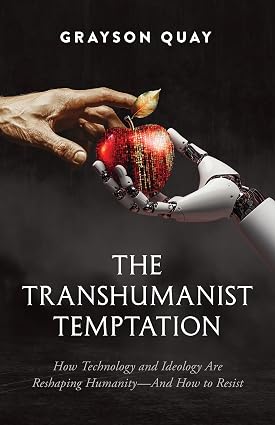
It is to the mechanical world picture and the computational theory of the mind that we can trace the contemporary phenomenon of transhumanism, the subject of illuminating new books by Grayson Quay and Paul Kingsnorth. The basic conceit of transhumanism is that human beings, not only in theory but now also in practice, can and ought to transcend the limitations of their nature. On the view of the world that the mechanized world picture replaced, this would make no sense. Stone is stone, a bird is a bird, and a human being is a human being. Alter a human being however you want, all you will ever end up with is an altered human being, not some other kind of thing. But the mechanistic view of the world made things indefinitely malleable and their boundaries fuzzy. Stones, birds, and human bodies are just different waves on the same ocean of particles, no more discrete, sharply defined, or fixed than literal waves are. Or they are like different arrangements of Tinker Toys or Lego blocks, each differing from the others only in degree rather than kind, and where parts might be added, subtracted, or reconfigured as we see fit. Meanwhile, if the self is just software, it might not only be transferred from one machine to another, but also itself modified the way operating systems are. On this view, your mind might someday be updated as often as Microsoft Windows is.
As Quay, a former editor of The Week and The Daily Caller, argues in The Transhumanist Temptation, the transgender phenomenon reflects an essentially transhumanist mindset, but so too does the prevalence of birth control pills, in vitro fertilization, and dramatic body modification through cosmetic surgery. If the latter practices seem to many today to be less extreme than the former, that is because the basic presupposition of transhumanism—that there are no ends or purposes to which we are directed by nature, so that the only ends we need conform ourselves to are those we choose ourselves—has thoroughly permeated the modern Western mind. Transgenderism simply follows out its radical implications more consistently.
***
Both authors emphasize that liberal individualism was the moral and political corollary of the mechanistic world picture. If ends or purposes are not built into the natures of things, the only purposes things can have—including our own lives—are the ones we happen to give them. But our purposes are radically diverse. Hence there can be no common ends or purposes which all the members of a political community can be expected to pursue, except those to which they all happen to consent. The result is a public square from which religion and traditional moral assumptions have been increasingly excluded, and the hegemony of the market economy as satisfier of individual desires. The local and particular attachments that for most of human history defined ordinary human life—to family, church, tradition, local community, nation, even to the land itself—have largely been dissolved. The vacuum left behind has been filled by a consumer culture that reflects and reinforces this liberal individualism, corporations that profit from it, governments that enforce and spread its hegemony, and political parties that compete to administer it.
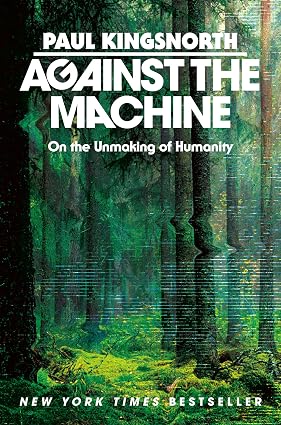
Kingsnorth, an essayist, poet, novelist, and former editor of The Ecologist, gives an apt name to this modern ideological, economic, and political order of things in Against the Machine: On the Unmaking of Humanity. On his telling, the “Machine” that was born with the scientific and liberal revolutions of the early modern period—and which, over the succeeding centuries, gradually spread throughout the world to absorb much of humanity into it—has now reached full maturity with the Information Age. It molds and manipulates us through literal machines—the cell phones, computers, and other black screens to which we have become addicted, which mediate information and opinion to us and monitor our movements, purchases, and web browsing habits. The tech gurus who dominate the Machine pursue the goal of developing ever more sophisticated forms of artificial intelligence, predicting with a mixture of foreboding and glee that it is only a matter of time before A.I. surpasses human intelligence. As Quay describes, the imagined end state will be a merging of our minds with this technology through “augmented reality” devices that filter and transform our perception of the physical objects that surround us, immersion in virtual worlds, and even the uploading of one’s consciousness into cyberspace.
What the Machine is attempting to construct through economic forces, political structures, and now technology is a new sort of human being, uprooted from nature, history, place, and even its own body, devoted to liberation from all limitations and all suffering and to the satisfaction of all desire through the self’s endless re-creation.
***
The stories Quay and Kingsnorth tell overlap considerably, but their books differ in emphasis and style. Quay’s focus is on recent technological and cultural developments, whereas Kingsnorth’s is on modernity’s centuries-long economic and social transformation. Quay writes like a journalist reporting the facts; Kingsnorth’s approach is more personal and meditative. Each book contains information and insights that add to what the other has to say, so that they nicely complement one another. Above all, they agree about the nature of our situation and its diagnosis.
Though the mechanistic world picture presents itself as a scientific discovery, it was not that at all. It was rather a new philosophical conception of nature, albeit one that has guided modern scientists in deciding what aspects of nature to study, and how to interpret their results. The thesis that the mind is a kind of software—which underlies both the attempt to assimilate human thought to the mechanistic view of nature and the idea that A.I. is literally intelligent—is also an entirely challengeable philosophical theory rather than a scientific fact. (I have made the case against both of these philosophical ideas in several places, most recently in my 2024 book, Immortal Souls.)
Even deeper than the philosophical issues, though, is the theological significance of what Kingsnorth calls the Machine. Its offer to us, our authors warn, is the same as the one the serpent made to our first parents in the Garden of Eden: “You shall be as gods.” The Machine represents an apostasy from the West’s Biblical and Christian roots, and their replacement with what amounts to a new and false religion. Both Kingsnorth and Quay go as far as to suggest that literal demonic influence may lay behind some of the more extreme manifestations of transhumanism.
***
Neither author sees much near-term hope in political resistance to the Machine. Its basic presuppositions are too deeply entrenched across the political spectrum (though Kingsnorth and Quay each appear to sympathize to some extent with postliberal thinkers like Patrick Deneen). For the foreseeable future, we will have to make do with limited and piecemeal political measures to resist transhumanism and other Machine values, and to shore up a traditional moral and religious view of the world. More importantly, we can and must revive and live by that worldview in the contexts of our families and small communities.
It is significant that many of the concerns voiced by Kingsnorth and Quay echo those raised by Pope Leo XIV in his encyclical Magnifica Humanitas. What Kingsnorth calls the Machine, Leo characterizes as a new Tower of Babel grounded in human pride. Like the pope, Quay sees in transhumanism a secular counterfeit of the Christian doctrine that, through divine grace, we can be raised to a heavenly end that is higher than our nature could achieve on its own. And like the pope, both authors appear to think that a widespread revival of Christian faith is necessary in order to counter the Machine. This may appear hopeless. But then, achieving ultimate victory in the face of apparent crushing defeat at the hands of worldly power is precisely the story of the early Church, and of her Founder.