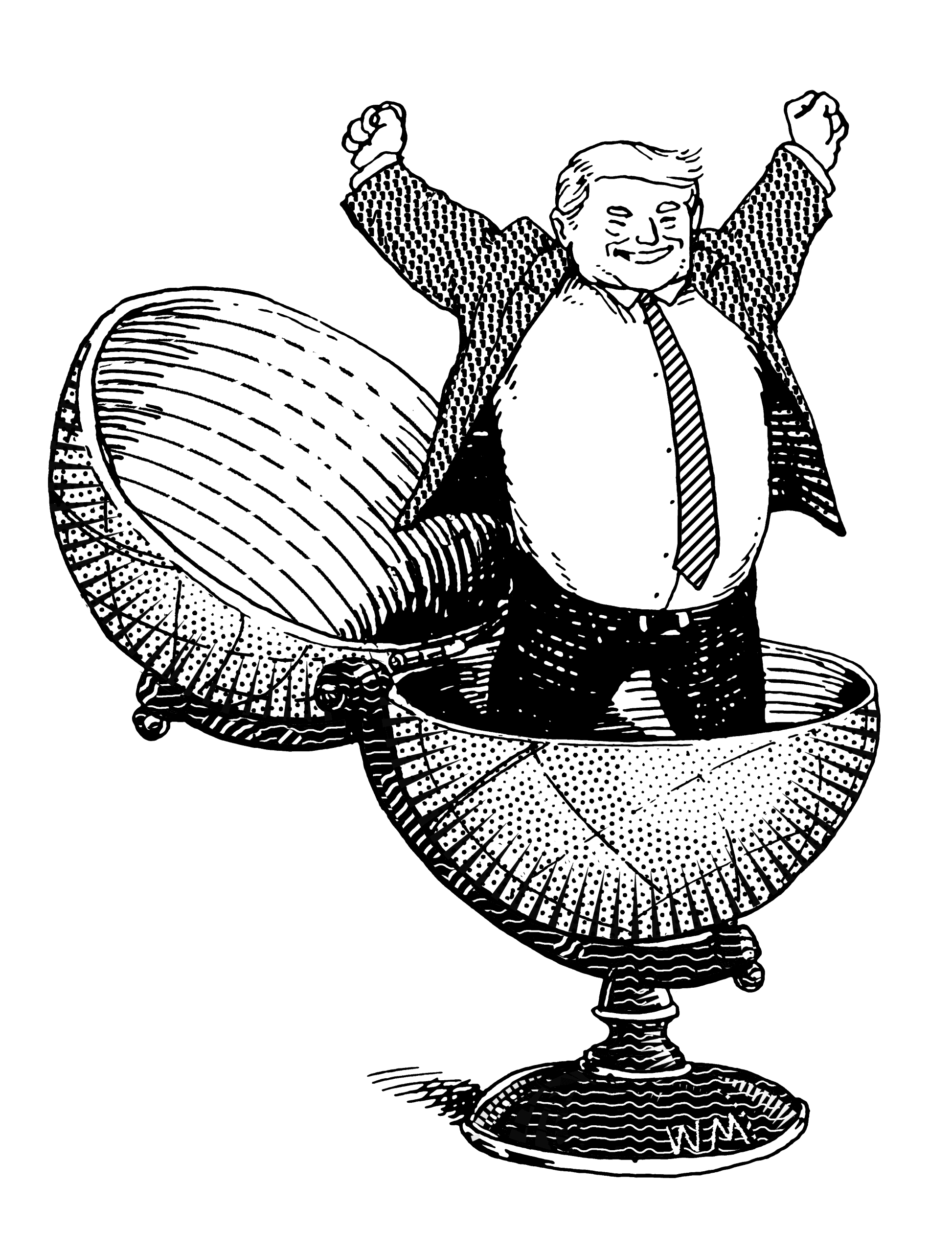

Half-way through his second term, it seems impossible to deny that Donald Trump has been a seismic force—a bulldozer in the china shop of our public life. He has smashed norms, overturned conventions, cast away shibboleths, and ground precedents to dust. Whether this tumult represents incipient despotism haltingly contained or a long overdue cleansing of our Augean stables depends—to quote the shrewd chiasmus coined during Trump’s first term—on whether you take the president seriously but not literally, or literally but not seriously.
Lee Harris is an independent author who made a name for himself after 9/11 with his political commentary and with his books Civilization and Its Enemies: The Next Stage of History (2004) and The Suicide of Reason: Radical Islam’s Threat to the West (2007). More recently, he’s focused on the culture war at home with The Next American Civil War: The Populist Revolt Against the Liberal Elite (2010) and What’s Wrong with the Right Side of History: Exposing the Roots of Progressive Pathology (2025). Now, in Lincoln, Roosevelt, Trump: Three Profiles in World-Historical Leadership, he asks whether the 45th and 47th president stands beside the 16th and 32nd in significance. Although Harris is right to draw the comparison, by adopting the term “world-historical,” weltgeschichtlich, a term of art from G.W.F. Hegel’s posthumously published Philosophy of History, his attempt ultimately produces more confusion than clarity.
Hegel believed that he had discovered the process by which rationality emerges in the course of human development, leading us toward an era of perfect freedom. He gave us the ideas of Progress and History with capital letters. In the German philosopher’s complex teaching, it is not easy to understand the role free will plays in the actions of citizens and statesmen, given that History unfolds in a definite way, and man only becomes fully rational, fully aware of himself and of his powers and dignity, when History has ended. Harris seems somewhat aware of this difficulty. He contrasts Hegel’s position with Thomas Carlyle’s belief that history is decisively shaped by great men and briefly grapples with this question of necessity versus choice. No individuals, Harris writes, “can shape history according to their own designs. The world-historical figure would never have succeeded if they [sic] had not been the unwitting agent of vaster historical forces.” At the same time, Harris also avers that such individuals “embark on a mission to replace a dying old order,” which seems to suggest a deliberate plan. He never uses the words “determinism” or “deterministic” (let alone the more abstruse word “historicism”), and after three pages simply drops the whole matter and moves on.
***
The book is padded with a good deal of historical trivia and boilerplate, and it takes Harris a while to get to the main points—almost half-way through, one still hasn’t learned what made Lincoln a world-historical figure! In addition to mangled metaphors and clichés (a great leader may “be ignored as a voice crying in the wilderness…. But the world-historical individual always has a rendezvous with Destiny”), Harris too often relies on vague buzzwords: “meritocratic elite” (32 times), “American exceptionalism” (43 times), “epochal crisis” or “epochal crises” (38 times). Other passages cause one to wince: George Floyd’s 2020 death in Minneapolis
became a cause célèbre virtually overnight. Yet it was a very odd cause célèbre. The Dreyfus Affair that shook France from 1894 to 1906 was one of the most famous causes célèbres in history. It divided the French people into two mutually hostile factions. This, in fact, is the norm of any cause célèbre. It is what makes them celebrated in the first place. People argue about them.
Although Harris presents himself as a populist, his descriptions of Trumpism read like uninspired pandering to what he regards as the aggrieved vanity of the MAGA base:
The establishment media could not insult [Trump’s] supporters enough. They were called ignorant rednecks, patriarchal Christian nationalists seeking to create a Handmaid’s Tale-like dystopia, reactionary racists motivated by a retrograde belief in white supremacy. They were white trash, hillbillies, hicks. The media could not resist trying the same approach with Trump himself. They ridiculed him for preferring a McDonald’s cheeseburger to a fancy meal at the posh restaurants where they were accustomed to dining. McDonald’s didn’t even have a wine list.
***
Lincoln, Roosevelt, Trump’s tour through American political history is too familiar to be enlightening and too pedestrian to be entertaining. Harris rehearses the highlights and low points of Trump’s first term, the interregnum, and his return to office: Charlottesville, Covid, the Mueller report, Uncle Joe and Queen Kamala—it’s all there, but with no driving purpose. What about Trump as a world-historical figure? After wading through 250 pages, the reader discovers with some dismay that there isn’t any payoff. Trump’s most notable accomplishment, the book lamely concludes, is “the restoration of the spirit of American exceptionalism.” Okay, but what exactly does that mean? We never get a clear explanation. On the one hand, we’re told that “reviving the original spirit of exceptionalism” is definitely not “a vain attempt to impose a new world order.” On the very same page, however, the author quotes opinion writer and establishment Never Trumper Peggy Noonan:
Donald Trump is what he wanted to be, a world-historical figure, and we have entered a new time. It sounds dangerous. This is what it looks like when establishments fail.
Harris then adds, “It sounds dangerous because it is dangerous. Indeed, it is always dangerous to replace an established order with a new one.” So, which is it? At one point, Harris suggests that restoring “the art of the deal” in place of “ideological” politics might be the essence of the new Trumpian zeitgeist. But even that unsatisfying answer only occupies the author for a few sentences before he moves on to his next unconnected thought.
***
In spite of all this, Lincoln, Roosevelt, Trump does raise (if not answer) a critically important question: What would establish Trump as a world-historical figure? What are—to use Hegel’s terminology—the thesis and antithesis of our current crisis, and what, if anything, could Trump achieve that would transcend this conflict? Hegel’s most important contribution to understanding our political dilemma (not addressed in Harris’s book) is the argument that History culminates in the “rational state.” This concept is far more serious and sophisticated than the feckless dreaminess of effete liberals, which Harris mocks. The rational state, and especially its self-justification in empirical science, is the thesis of our current crisis, while populism, perhaps the defining feature of Trumpism, represents the antithesis. Contrary to Harris’s reverse snobbery of consumer preferences, the key to populism is not McDonald’s or Walmart, but the question of self-government, particularly the principles of consent and political equality. Harris’s dogmatic pragmatism makes him allergic to such theoretical concepts, which is why his understanding of Trump’s historical significance is limited to fuzzy invocations of American exceptionalism.
Throughout the book, Harris uses the words “meritocracy” or “meritocratic elite” unironically to describe our ruling intellectual class, which grants it a far more elevated status than it deserves. The lack of irony derives from his cartoonish regular-Joe schtick. He disdains political distinction and individual excellence as pretexts for class warfare—empty nonsense from pseudo-aristocrats, which for Harris means anyone who doubts that the people en masse are consistently virtuous and wise. The events leading up to the Constitutional Convention of 1787, he writes, “led many of the ‘better sort’ to believe that the time had come to establish a new ruling class of aristocrats—not based on hereditary bloodlines, of course, but rather on merit.” James Madison’s “cunning strategy” at the convention, he tells us, without citing a single source, was widely regarded at the time as “nothing more than a coup d’état engineered by America’s gentry elite in order to crush the popular radicalism that threatened both their traditional social status and their wealth.” Harris pushes his leveling spirit to the point of overt anti-intellectualism, and comes very close to asserting that the framers’ classical education made them stupid. When these “learned men read of the patriotic heroes in Livy or in Plutarch, they never doubted the historical veracity of these accounts. Today, we take these stirring stories with a grain of salt, but the educated elites of eighteenth-century America never doubted for a moment that the restoration of ancient republican virtue was entirely possible in their own day.”
Though he doesn’t seem to realize it, his demagogic egalitarianism puts Harris in league with the DEI fanatics, who have transformed merit into yet another code word for racism. Precisely because they prize “equity” over ability, the experts are often incompetent, as Harris notes; yet he never probes any deeper. If they are so inept, how did they achieve such power, and how do they hold on to it? In point of fact, the bureaucratic rule of experts bases its legitimacy not on merit but on science—as Hegel authoritatively demonstrated.
***
To make sense of this, we must leave Harris to his hobbyhorses and turn to the work of scholars such as John Marini, John Wettergreen, Philip Hamburger, and others. Giving Trump the full benefit of the doubt, Marini has argued in Unmasking the Administrative State: The Crisis of American Politics in the Twenty-First Century (2019) and elsewhere that Trump is the first president—certainly the first since Richard Nixon—to directly challenge the legitimacy and authority of rational expertise. Fifty years ago, the FBI’s Mark Felt colluded with The Washington Post’s Bob Woodward and Carl Bernstein to vitiate the legitimacy of Nixon’s 1972 re-election. This prepared the way for the criminalization of political differences. The same tactics were attempted against Trump, this time (so far) unsuccessfully. (Lincoln, Roosevelt, Trump never mentions Watergate, and Nixon’s name appears only once, together with Andrew Johnson’s, in a passing reference to the impeachment process.) Marini has shown how Congress immediately capitalized on the weakened executive branch to implement sweeping new legislation, including the War Powers Resolution, the Impoundment Control Act, the Privacy Act, and the Federal Election Campaign Act, which not only centralized power in Washington, D.C. but formalized the authority of the bureaucracy. Henceforth, experts in the permanent government would co-operate with key congressional leaders to circumvent and contain the president—the only elected official who represents the will of a national majority.
What Marini demonstrates is that, while class snobbery plays a role—the elite universities are the training grounds of the knowledge class culturally as well as intellectually—the bureaucracy and its enablers see no need to obtain the consent of the citizens because consent has become superfluous. Hegel showed that all the fundamental moral questions have been answered, liberal democracy represents (as Francis Fukuyama argued in 1992) the “End of History,” and the remaining impediments to our complete subjective freedom are merely technical difficulties, best handled by those professionally trained in epidemiology, psychology, climate science, urban planning, criminology, etc. Science and history came to replace the founders’ reliance on nature as the foundation of just government. Prudent moral-political judgments made by citizens and statesmen were rendered obsolete by the scientific problem-solving of the new rationality, understood as empirical methodology.
***
As pundits have endlessly noted, Trump is no intellectual. If you gave him a copy of Philosophy of History, he would probably joke that Hegel’s Bagels would be a great name for a delicatessen. Nevertheless, his supporters and even many of his enemies recognize that he possesses an instinctive political cunning. The upside to his much-lamented crudity is that he has contempt for so-called intellectuals and is completely unimpressed by self-described experts. He seems to grasp that scientific progress is no guarantee of moral and political advancement. This attitude, along with his assaults on the questionable privileges of the Ivy League universities and DOGE’s exposure of the partisan misuse of taxpayer funds to subsidize the knowledge class through non-profit organizations, have contributed to greatly undermining the ruling elite’s credibility and its claims to superior rationality. Though Trump made several missteps early in the Covid epidemic, the public has also developed considerable skepticism about the authority of “science” in the wake of new information about a possible lab leak. Dr. Anthony Fauci’s reputation is greatly diminished, and grave doubts have emerged about whether the oppressive mandates regarding social distancing, masks, and vaccines were ever justified.
Finally, as Marini was one of the first to observe, in his July 2016 online essay for CRB, “Donald Trump and the American Crisis,” Trump’s campaign slogan—Make America Great Again—should not be underestimated:
Post-modern intellectuals have pronounced their historical judgment on America’s past, finding it to be morally indefensible. Every great human achievement of the past—whether in philosophy, religion, literature, or the humanities—came to be understood as a kind of exploitation of the powerless. Rather than allowing the past to be viewed in terms of its aspirations and accomplishments, it has been judged by its failures….
The most controversial aspect of Trump’s campaign, his slogan to “Make America Great Again,” goes to the heart of the problem. Trump’s view presupposes that the old America was good and established the conditions for its greatness. Is this true? Or is America something to be ashamed of, as the protestors against Trump have insisted, having accepted the teaching of post-modern cultural intellectuals?
Of course, we are still far from knowing how the next few years will go. The outcome of the war with Iran remains uncertain. That conflict is especially concerning to Trump’s base, who believe he violated one of his key promises by acceding to the wishes of the foreign policy establishment and getting the nation involved in another military entanglement far from America’s shores.
***
If, and it’s a big if, Trump finishes his second term more or less successfully—if he pushes hard to follow through on his promises, especially on immigration, and keeps hammering his key arguments—he may solidify some hard-to-reverse changes: delegitimizing the bureaucracy and its claims to rational expertise, affirming America as a sovereign nation with secure borders, and reawakening a belief in the American people that their consent cannot be taken for granted. Gavin Newsom could well win the White House and reverse many of Trump’s policy achievements. But it seems hard to believe the old uniparty establishment will ever regain the status it had under Bill Clinton and Barack Obama.
Politics is always a mixture of compulsion and persuasion. Even the world’s worst tyranny finds it useful to call itself the Democratic People’s Republic of Korea. If the Republicans lose the presidency as well as Congress in 2028, the radical Left will likely be seized with an uncontrollable lust for retribution, and will push the Democrats to implement immediately every element of its radical agenda. But Trump may have changed the country enough that the Democrats can only ram through so much before running up against the limits of their legitimacy, which they may not be willing to risk.
***
Two years into Trump’s first term, John Marini argued in an essay for The American Mind, “After Trump: The Political and Moral Legitimacy of American Government,” that what was at stake was the future of republican constitutionalism. His analysis is still, I think, essentially true.
It remains to be seen if the American people understand or will come to understand themselves as political citizens of the nation-state, or as administrative subjects of a rational global order. Much depends upon whether the American people have become so dependent upon the administrative state that the overthrow of the established order is not merely difficult, but undesirable. In that case, political self-government, and individual freedom, will cease to be important elements of the American regime.
The answer to those questions will determine whether Trump’s presidency is as consequential as Lincoln’s or FDR’s, and perhaps whether Trump himself is remembered as a world-historical figure.