Books Reviewed
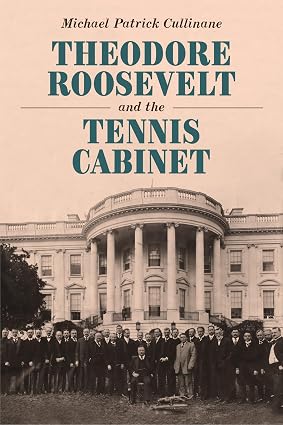
In Theodore Roosevelt and the Tennis Cabinet, Dickinson State University professor of history Michael Patrick Cullinane profiles T.R.’s informal circle of advisers—men whose clustering around the president, I would argue, reveals a style of governance both new and ancient.
The “Tennis Cabinet” got its name from those advising Roosevelt on matters of government before, after, and sometimes during matches with the president. So near to the president’s office was the court—commissioned by Roosevelt’s wife, Edith, during 1902 White House renovations—that personal secretary William Loeb could lean out the window, mid-game, to relay the contents of an urgent telegram.
The ability to play tennis was not, however, a prerequisite to membership. Seth Bullock, former “Rough Rider” in Roosevelt’s hand-picked cavalry regiment, did not play but rode and hiked with T.R. in Rock Creek Park, two alternative forms of exercise favored by the president.
Only Roosevelt and Loeb knew the Tennis Cabinet’s full membership. (Some non-members mistakenly believed themselves part of it.) It met as a complete group only once, for a celebratory lunch near the end of Roosevelt’s presidency, yet was sufficiently potent to give him “the capacity to change American politics.”
It was, Cullinane stresses, “people who have ideas, not an organization
Next in the fall 2026 Issue
Ghosts in the Machine
Earthly Paradise