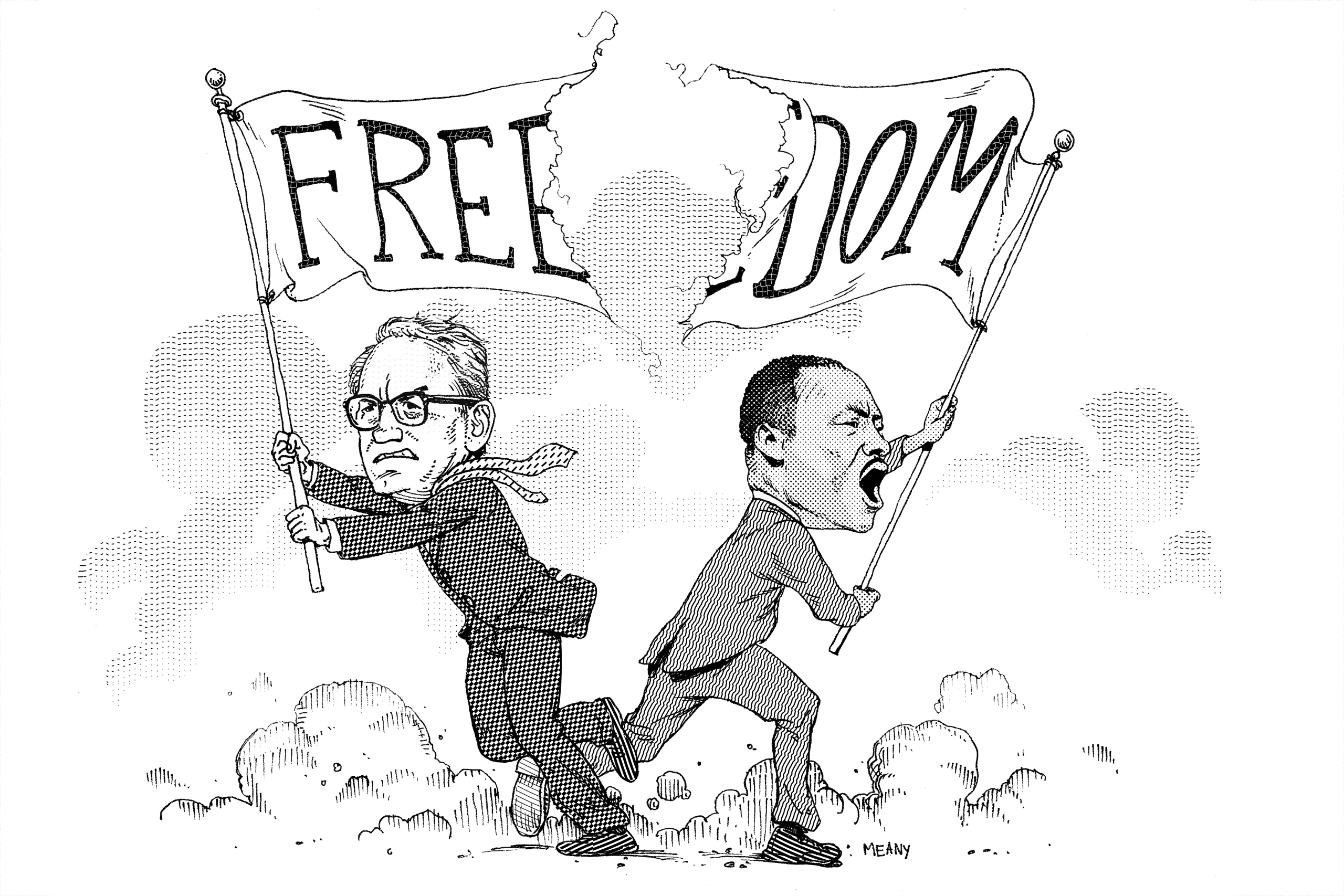
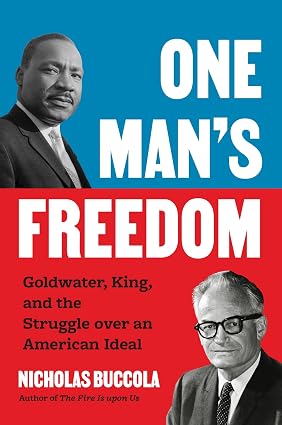
From the mid-1950s through the mid-1960s, Barry Goldwater and Martin Luther King, Jr. took increasingly prominent roles in American political life. Neither was president—though Goldwater made the attempt—but both led movements that transformed the country. In One Man’s Freedom, Nicholas Buccola draws a side-by-side picture of the two, juxtaposing especially their competing conceptions of freedom, the American principle at the center of each man’s political thought.
A professor of government and the Jules L. Whitehill Professor of Humanism and Ethics at Claremont McKenna College, Buccola forged a mold for this sort of dual intellectual biography in his previous book, The Fire Is Upon Us: James Baldwin, William F. Buckley Jr., and the Debate Over Race in America (2019). In One Man’s Freedom, Buccola begins with the 1955-56 Montgomery bus boycott, which elevated King to the leadership of the civil rights movement, and Goldwater’s early focus, as a freshman elected to the U.S. Senate from Arizona in 1952, on the labor movement’s excesses and the primacy of the individual. They were, at this point, “prophets rising.” Buccola then traces their course through Goldwater’s break with President Dwight Eisenhower, the publication of his bestselling Conscience of a Conservative (1960), and the rise of the movement to draft Goldwater for the GOP presidential nomination, which the senator turned aside in 1960 but which became the foundation of his 1964 campaign. Meanwhile, King’s parallel rise included the growing campaign of civil disobedience in Birmingham and elsewhere throughout the South, the 1963 March on Washington, and his increasing economic radicalism. The two crossed paths most directly in debates over the 1964 Civil Rights Act, which Goldwater voted against and King championed, and the 1964 presidential campaign, when King abandoned his customary electoral neutrality to take a firm stand against the Republican nominee.
***
Buccola makes a serious effort to understand Goldwater, in many ways giving him his due. Most importantly, he concludes that although Goldwater and King were opposed on many issues (including the 1964 Civil Rights Act), Goldwater was no racist. He undertook numerous actions that demonstrated his own personal distaste for segregation and racial prejudice. Some, but not all, of these instances are on ground well-plowed by previous biographers such as Lee Edwards. Buccola notes that Goldwater even expressed personal sympathy for the black protestors in Birmingham, declaring that if he were a Negro in Alabama, “Hell no, I wouldn’t be patient; I’d be damned impatient.”
Nevertheless, Buccola’s sympathies clearly lie with King, for whom Goldwater often serves as a foil. Readers are often asked to “interrogate” Goldwater from King’s standpoint, or that of a typical black in, for example, Mississippi. Given that Buccola acknowledges Goldwater was not personally racist, a large part of the book revolves around the question of how Goldwater nevertheless became an ally of Strom Thurmond and a hero of the unreconstructed South.
There were, of course, constitutional questions involved. From beginning to end, Goldwater’s genuine commitment to “states’ rights” put him on the same side as forces whose primary passion was to defend segregation, not the Constitution. He made a partial exception for federal action to protect voting rights, which were explicitly guaranteed in the 15th Amendment, accounting for his votes in favor of the Civil Rights Acts of 1957 and 1960. For his part, King took the constitutional position that the federal government had a legitimate authority to protect citizens’ rights, conveyed by the 14th Amendment, against state and local governments when they became abusive.
Another constitutional controversy culminated in the debate over the Civil Rights Act of 1964, concerning the extent of property rights and, ultimately, the scope of the Commerce Clause. Could private business owners be compelled to desegregate their facilities or open their doors to blacks altogether? King said yes. It might be private property, but it is property that has been opened for public use. In any event, King argued in a line of thinking going back to Theodore Roosevelt, “human rights” had to trump “property rights.” To Goldwater, property rights were a subset of human rights, not distinct from them. If the Commerce Clause could be stretched in the way King and the Act’s supporters would have it, there would be no security for property rights remaining, and no barrier to unlimited government.
***
Then, of course, came politics. Goldwater walked a delicate line, morally opposed to segregation but not wanting to disturb the burgeoning coalition on the right, which included its defenders. The “Solid South” had been an indispensable component of the New Deal coalition and Democrats’ subsequent status as the majority party. As it became increasingly clear that civil rights and segregation were putting the Southern white vote in play for the GOP, Goldwater in 1961 urged Republicans to “go hunting where the ducks are.” Apart from his home state of Arizona, the only ones he carried against Lyndon Johnson in 1964 were Alabama, Georgia, Louisiana, Mississippi, and South Carolina.
Buccola argues, further, that Goldwater simply had a blind spot that did not permit him to see the repression blacks were suffering under Jim Crow. His political principles had many strengths, but they were abstractions, and they did not account for some contrary realities. Centralization of power can facilitate tyranny, but what if the tyranny is local? Americans were free, but what if some were much less free than others? The businessmen he met in Atlanta were mostly interested in free enterprise, not segregation. But was that true of the county sheriff 50 miles down the road? Buccola notes that “Goldwater was genuinely surprised by those rare moments when he was faced with the real implications of his racial politics.” In the end, though, those moments could not compete with the principles in his mind. The upshot is that One Man’s Freedom neither (quite) condemns Goldwater nor exonerates him, but treats him as a complex human being.
It is a reasonable case as far as it goes. There are at least two ways in which the discussion could, however, be more complete.
***
First, there is an analytical asymmetry due to King’s focus on civil rights, which though never his sole concern, clearly was his dominant one. For Goldwater, civil rights was not only the issue where his views have aged poorly, but one that he treated as a second- or third-order problem compared to the Cold War and other constitutional questions. Had the focus of the book been reversed, say, emphasizing Goldwater’s foreign policy or his economic principles and treating King’s views on civil rights as incidental, the picture might have been quite different. At the least, a different treatment might have led to some parallel and illuminating interrogations of King.
After all, wasn’t Goldwater right about the potential for the rapidly growing welfare state to get out of control and bankrupt the country? Didn’t Goldwater have a point when he feared that America’s move toward social democracy in the 1960s, which King criticized as too stingy, might lead to a corruption of morals and a breakdown of family life with consequences especially catastrophic for the poor? At the onset of the Great Society, the illegitimacy rate, a variable strongly correlated with bad educational and economic outcomes, was around 20% for black Americans. Today it hovers near 70%.
Didn’t economic policies that downgraded Goldwater’s fiscal sobriety also contribute heavily to subsequent stagflation which hurt the poor and middle classes the most? Was Goldwater obviously wrong in fearing programs that put too much discretionary enforcement power in the hands of the executive branch? What would King be saying about this today?
If it is true, as King himself acknowledged, that over-centralization of government could lead to tyranny, where would he draw the line? If he understood the danger in theory, he never found a point in practice where he was willing to say “this far is too far,” even in the midst of perhaps the greatest burst of centralization in the history of the United States. King’s conception of positive economic rights, like FDR’s and LBJ’s, came without any hint of a limiting principle.
Likewise, why did King think his theory of non-violence was a viable international strategy against regimes that rejected both the religious/moral underpinnings of the West and the political principles of liberal democracy? Goldwater’s foreign policy, elucidated in his 1962 book Why Not Victory?, became Ronald Reagan’s foreign policy, which ended the Cold War and liberated the Soviet empire. How would King explain that? For that matter, how would King square his conception of freedom with his willingness, not yet apparent in 1964, to accept the subjugation of the people of Indochina by Vietnamese and Cambodian Stalinists?
Even on the friendlier terrain of civil rights, there are questions for King. Was Goldwater really wrong to be concerned about the long-term consequences for freedom of permitting government to regulate private business practices in the name of civil rights? One day, the lunch counter at Woolworth’s. The next, Masterpiece Cakeshop.
None of this is to say that King would have had no answers. In the latter case, he might have argued that the danger was real but distant, while the abuses the law was meant to combat were immediate and degrading. He might also have pointed out that it was a state agency that harassed the Colorado bakers, and the U.S. Supreme Court which vindicated their rights—not a reverse image of civil rights in the 1960s, but an exact replica.
It would have been edifying to see Buccola pose such questions and interrogate King’s political assumptions. It might well become apparent that Goldwater was not the only one with a blind spot.
***
Second, Buccola dismisses too easily conservatives’ embrace of King in recent years as based on “a profound misunderstanding and abuse of his ideas.” Yes, conservatives should regret how they approached King and race in the 1960s. Goldwater himself regretted voting against the Civil Rights Act of 1964. But Buccola leaves underexamined the possibility that King’s goal of long-term persuasion was largely successful as it regarded race. King’s commonalities with Goldwater, perceptively drawn out by One Man’s Freedom, suggests the basis for a more nuanced judgment than the one Buccola advances. Both Goldwater and King, for example, were deeply committed to the dignity of the individual, which among other things led to their rejection of the doctrines of Communism. This focus was rooted in a common appreciation for the spiritual nature of man. Goldwater’s conservatism was based on an understanding of man as a spiritual, not purely material, being. King’s liberation movement likewise operated in the realm of the spiritual.
The two men also seemed to share a similar philosophical understanding of human nature. Both found much to admire in God’s human handiwork, including a capacity for self-government. They were not Calvinists, but neither were they utopians, and both warned of man’s inherent capacity for evil and abuse. They rejected moral relativism in principle, a stance made clear both in King’s Letter from a Birmingham Jail and Goldwater’s morality campaign in 1964.
Goldwater, of course, put the principles of the Declaration of Independence and the U.S. Constitution front and center throughout his political career. In his major addresses, Goldwater made prominent references to America’s founding documents and the ideas they represented. King did the same; in his most celebrated rhetorical efforts, including Letter from a Birmingham Jail, the “I Have a Dream” speech, and many other speeches and writings, King extolled the Declaration and the Constitution, as Frederick Douglass had done a century before. King was no Malcolm X, Ibram X. Kendi, or Nikole Hannah-Jones, denigrating the founding. He wanted its promise fully realized, not demonized or dismissed.
Indeed, both King and Goldwater recurred to James Madison’s ideas, even when they did not cite him. King relied on Madison’s fear of majority faction and his solution of a continental republic capable of protecting rights. Goldwater argued that a key purpose of government is to “protect the diversity that men can achieve from the base of their God given equality,” a notion akin to Madison’s contention that protection of “the diversity in the faculties of men, from which the rights of property originate,” is the “first object of government.”
***
It is worth considering whether the advance of Critical Race Theory, intersectionality, and moral relativism over the last three decades has made conservatives more genuinely appreciative of these commonalities. In 1964, they hardly stood out, since few in political life were explicitly hostile to the founding or rejected the Judeo-Christian moral basis of society. That has changed in alarming ways.
Above all, for many conservatives, King’s call for a society in which his children would “not be judged by the color of their skin but by the content of their character,” ties these themes together. They have embraced it not merely as a convenient weapon, but as the vision of a genuinely desirable society that respects the dignity of individuals, is grounded in a spiritual conception of man, and fulfills the promise of the Declaration and the Constitution. Perhaps the increasingly aggressive and sinister racial collectivism that has emerged in our own era has thrown into sharper relief both the evils King fought against and the superiority of his alternative. Buccola points out that King stood against black nationalism “because of its tendency to adopt the moral presuppositions (and mistakes) of other forms of nationalism and simply reverse the power positions.” That sounds a lot like the contemporary conservative argument that Critical Race Theory seeks to invert rather than subvert past racial hierarchies. Perhaps conservatives’ newfound respect for King is more than a ploy.