Books Reviewed
Listen to this article
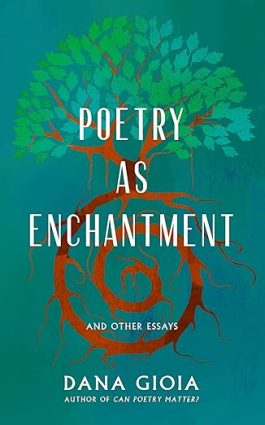
The question Dana Gioia asks in his new book of essays, Poetry as Enchantment, is straightforward, and one that poets themselves have all too often, as he knows, disdained to ask: What happened to poetry in the 20th century, to set it so far from the experience and the love of ordinary people? That is, how did poetry go from its obvious popularity in the days of Longfellow and Tennyson, to its current irrelevance even among the well-educated? Where did poets and critics go wrong?
Gioia, himself a poet of great talent, former poet laureate of his home state of California, and one of the most forceful advocates for poetry in our time, gives several answers, each of them accurate in its diagnosis and related to one another. The first error, from which the other errors flow, is that we have forgotten what language is. “Poetic language expresses itself as a totality,” he observes, “not as a transparent vessel for conceptual content.” Poetry appeals to a human being in full, and not simply to a gatherer or sifter of information. No one reads as information William Blake’s famous address to that ferocious beast, “Tyger Tyger, burning bright, / In the forests of the night,” about which Gioia rightly notes that people “respond with pleasure and exhilaration to the experience the poem affords.” They know what it means before they know what it means, feeling its powerful call to enter a world of imagination that does not shy away from reality but immerses us more mysteriously within it. Merely conceptual meaning floats on the surface.
***
Thus, Gioia is eager to show us, in the various essays that compose the book, one poet after another who steeps us in that mystery, and usually not with words that are self-consciously poetical. Robert Frost, one of his heroes, boasted of having used in his poems “language absolutely unliterary,” with the effect not of drabness but of reticence, fit for the flinty New England soil that reared up his characters, such as the husband and wife in their smoldering anger and hurt in “Home Burial.” What, after all, does it “mean,” what “information” do we obtain, when we read the final line of that poem, the husband’s threat as his wife leaves the house, “I’ll follow and bring you back by force. I will!–”? All interpretation that evades the profound sorrow and alienation of these two young people who have just buried their first-born baby is not interpretation of truly human language, but a reduction of that language to something manageable and convenient.
This reduction will include, I say, evasions that dress themselves in political garb. That too is to reduce language to slogans. So, it is refreshing that no poet is praised or condemned in Gioia’s book for saying what the author finds politically amenable. Indeed, about Philip Larkin—tart-tongued, womanizing, children-despising, “a curmudgeon burdened by old and dishonorable prejudices”—Gioia admits that “a better man would probably not have written so well.” That is because the “special power of Larkin’s poetry is that it earns its joy, humor, and compassion by working through equal measures of pain, depression, and resentment.” It is a human being appealing to us as a human being, with all his irreducible experience of life.
This brings us to the second cause of poetry’s being sidelined. Gioia calls it, shrewdly alluding to Robert Frost, “the road not taken.” It is that poets stopped telling stories. “The narrative mode,” Gioia laments, “which had stood at the center of traditional poetic expression since Homer, suddenly seemed marginal with the advent of Modernism.” Frost—and his “perennially neglected” counterpart, Edwin Arlington Robinson—stood athwart this reduction of all poetic modes to the lyric. Frost told stories, often in a form that Gioia calls the “dramatic narrative,” to distinguish them from dramatic monologues and from straight narratives properly speaking. Gioia is superb at showing us Frost’s remarkable originality in this regard. Unfortunately for the state of poetry then and since, poets have not generally taken his lead. It is, after all, hard to tell a story. You have to invent characters, a dramatic situation, a series of events leading to their climax, as Frost does in such poems as “The Witch of Coös” and “The Death of the Hired Man.” Yet here, it is the poet who ought to have more to teach the writer of prose fiction than the other way around, if poets themselves can be brought round to remember with what concision and imaginative power a character can be summoned up in a few poetic lines from the abyss of unmeaning—think of Lorenzo and Jessica looking up at the stars in The Merchant of Venice. As for plot, think of Milton’s perfect touch in summing up the fall of Satan and his minions in a single spare and devastating line: “O how unlike the place from whence they fell!” Jesus taught in parables, and so did Plato—though Gioia doesn’t forgive him for banishing the old poets from his imaginary republic. “Let me tell you a story,” someone says, and we all stop and listen.
***
But to what will we listen? Here, in a third blunder, the poets have aimed the shotgun at their own feet. Just as a world of tools for their own sake was being built up around us, with man ordering his life by machine rather than the reverse, poets decided—or the ambience in which they lived decided it for them—to abandon music. They forgot to sing. I find it nearly impossible to impress upon people how central a part of life it was, this poetry as song. Poetry, writes Gioia quite correctly, “is the primal form of all literature,” for “there is no human society, however isolated, that has not developed and employed poetry as a cultural practice.” The poet was a “sacred or tribal singer.” How did people preserve their lore, how did they remember from generation to generation? They chanted it, they sang it, they wove about it the mystical spell of music. I recall here the account Bede tells of the night when the cowherd Cædmon was with his fellows at the beer-drinking, and the harp went round the table, with one illiterate cowherd after the other singing a song of his choosing—that is, singing a poem, in the old heroic manner of Anglo-Saxon poetry. Cædmon left the table before the harp came to him. More of that in a moment. The point here is that what the cowherds did was like what the Greek boys at the gymnasion did when they learned to chant the poetry of Homer. “Poetry speaks most effectively,” argues Gioia, “when it recognizes its connection—without apology—to its musical and ritualistic origins.”
***
And that brings us to the fourth sin against poetry’s soul, the worst and most profound of all. The highest form of song is in praise of the divine. There is no Bach, no Michelangelo, and—I haven’t the opportunity to demonstrate it here—no Shakespeare without the orientation of man toward God. This does not mean that poets must be religious. Yet Gioia is especially careful to note the poet’s openness to speech that, if it does not enter the cathedral, at least lingers in its vicinity, as Larkin does in his ironical and elegiac “Church Going.” And then there is poetry specifically and straightforwardly religious; as Gioia gives us a charming account of the poet Donald Davie, teaching 18th-century English literature at Stanford, and including in his syllabus almost nothing of the Augustans such as Swift and Pope, but a great deal by the great hymn writers Isaac Watts, the Wesleys, and William Cowper. Gioia also includes an account of, and an appreciation for, the Jewish poet Samuel Menashe, whose terse poems in terse lines speak a language filled with the fire of Scripture, and in English form, for, notes Gioia, “if Menashe’s spiritual roots were Hebrew, the soil that nourished them was the English language, especially as it was embodied in the King James Bible.” Gioia himself, I might add, is Roman Catholic, and has written religious poetry of his own. And Cædmon, that illiterate cowherd, retired to the cattle shed to sleep, and there he had a dream, wherein the angel of the Lord said to him, “Cædmon, sing me something.” At which point, for the first time in Christian history, the faith was embodied in the poetic forms of an ancient people who had been without written letters, and a great tradition began.
How to address the problem? Do not expect help from the academy. Gioia’s principal academic villain is the New Criticism, those methods of close reading which provided students with a powerful analytic tool to use on the small features of a poem’s verbal structure, but which tended by its dissection to murder the love of poetry. “For thousands of years,” notes Gioia, “poetry was taught badly, and consequently it was immensely popular.” That is to say, for thousands of years it was not taught in any way that aspired to the condition of the scientific, and therefore it was presented to human beings as a human creation, with all the mysteries that accompany the human. And what about now, when those methods of close reading which such critics as Cleanth Brooks taught are no longer practiced, but have been superseded by analyses that situate a poem in its political or economic or sexual context—the poem as the petrified spoor of a beast unconscious of the deterministic forces about him? Then we have the worst of worlds, critics who see neither forest nor tree, neither the whole of a work of poetic art nor the fineness of a line or a word. That is what confronts us now.
***
Yet Gioia is not discouraged. He asks us to consider the national poetry-reciting contest he spearheaded when he was chairman of the National Endowment for the Arts from 2003 to 2009. No one in the bureaucracy thought it would succeed, but Gioia went ahead anyway, and it was a smashing success, far beyond his hopes. That shows, he suggests, that the thirst for poetry is still there, ineradicable from our being human. I agree, though I am less sanguine about its current state and its near future. Gioia does not expressly condemn free verse, nor should he, but free verse has flung the door open to a great deal of dull, self-indulgent stuff. It is too easy to do it badly. Poetry in rhyme and meter is hard to write, even badly, so that most lousy would-be poets in the old forms—Joyce Kilmer was a notable exception, as Gioia shows in his comments on the jingly war poem “Rouge Bouquet”—simply give it up. Call it the Law of the Bad Violin. Unless you play it very well at least, you will not play it at all.
Perhaps we can agree that if poetry is to revive, poets must drink from the springs of the past, reaching behind their own age to recover and adapt the songs of singers neglected or forgotten. That recovery is, after all, what characterizes every rejuvenation in the arts: Mozart reaching behind his age to the then-neglected Bach, and Mendelssohn doing the like, and with his usual amiable fervor; Donatello literally unearthing Roman copies of Greek statuary, to inspire what the Greeks themselves could not have done, such as his prophet Habakkuk; Wordsworth and Coleridge going behind the staid formalism of neoclassical poetry to recover the popular ballad; A.W.N. Pugin recovering the Gothic in architecture; and so on.
In any case, this is a conversation all poets and teachers of poetry must have, and Dana Gioia’s Poetry as Enchantment is a fine place to start.