Books Reviewed
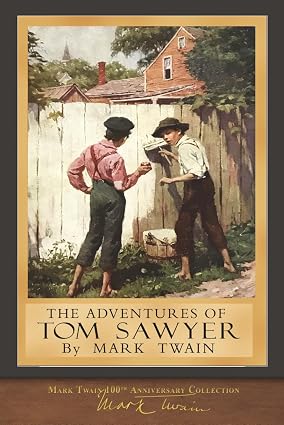
The Adventures of Tom Sawyer marks its 150th anniversary this year. It was first published in 1876, the centennial year of the American Founding. The novel itself marked its own kind of founding moment for American literature, which had been laboring—to borrow a phrase from The Federalist—under the “arrogant pretensions of the European.” America may have broken free of Great Britain in 1776, but we remained enthralled to Europe culturally for much longer. In his 1837 essay “The American Scholar,” Ralph Waldo Emerson lamented that American writers had “listened too long to the courtly muses of Europe” and scraped by on the “sere remains of foreign harvests.”
Emerson then issued what Oliver Wendell Holmes, Sr. dubbed an “Intellectual Declaration of Independence.” For Emerson, “genius looks forward.” He wanted to find, as he put it in his 1844 essay “The Poet,” the Homer of America—a bard “with a tyrannous eye” who “knew the value of our incomparable materials, and saw, in the barbarism and materialism of the times, another carnival of the same gods whose picture [one] so much admires in Homer.” In much the same spirit, Walt Whitman longed for a “democratic literature” filled with “archetypal poems” that could thicken America’s cultural “marrow.”
American men of letters such as James Fenimore Cooper, Edgar Allan Poe, Nathaniel Hawthorne, Herman Melville, and Henry Wadsworth Longfellow each made their contributions in the struggle to pull away culturally from Europe. But it was Samuel Clemens—Mark Twain—who made the decisive revolutionary break. In the words of the critic William Dean Howells, “I knew them all…our sages, poets, seers, critics, humorists; they were like one another and like other literary men; but Clemens was sole, incomparable, the Lincoln of our literature.”
With The Adventures of Tom Sawyer, his first novel, Twain offered a new archetypal hero for democracy. He replaced the squeaky-clean “model boys” that tended to star in mid-19th century serials like McGuffey’s Eclectic Readers and Peter Parley’s Magazine, to which Twain’s father had subscribed. Tom is an altogether more vivid, more fully realized kind of boy. He leaps off the page from the very first word of the novel, which is his name, printed in huge capital letters: “‘TOM!’” yells his Aunt Polly. “‘What’s gone with that boy, I wonder? You, TOM!” An early review from England criticized the “queer Americanizing of the language.”
The frontier vernacular was part of the point, however, as distinctive as the behavior of the boy hero. In the first chapter, on day one alone, Tom hides in a closet gorging on forbidden jam, runs away from Aunt Polly’s whipping, plays hooky from school to go swimming, opportunistically steals sugar at the dinner table, lies to his aunt about being in school, and gets into a fight with a new boy in town because he is well-dressed and wearing shoes. Twain announces outright that Tom “was not the Model Boy of the village.” He reinforces this theme so well throughout the novel that the Brooklyn Public Library excluded The Adventures of Tom Sawyer from their reading room upon its publication.
Other reactions were more appreciative and far-seeing. Moncure Conway, Twain’s friend and literary agent in London, observed: “The book will no doubt be a favorite with boys, for whom it must in good part have been intended; but next to boys we should say that it might be most prized by philosophers and poets!” Conway was among the few (even to this day) to grasp the deeper import of the novel, which is often wrongfully dismissed as simply a humorously nostalgic tale for children. But one philosopher who seems to have appreciated Tom Sawyer’s many subtleties was Friedrich Nietzsche. He wrote to his friend Franz Overbeck in 1879 that his mother had been reading it to him so he could rest his strained eyes. In another letter, this one to the novelist Paul Rée, he declared that he preferred Mark Twain’s American “silliness” to German “cleverness.”
The Mischief-Maker of Missouri
Perhaps there is a Nietzschean streak to Tom. He certainly delights in upending the staid morality of St. Petersburg, Missouri, whose inhabitants Twain describes as “grave, unromantic men.” They are locked into the drab ritual formalities of what Leo Strauss called the joyless pursuit of joy: grinding labor without much delight in profit; dutiful rote piety without genuine religious passion. Tom shocks and offends the sensibilities of almost everyone around him, but he also enlivens their world and broadens their horizons, turning the dour solemnities of the town into a backdrop for his playfully mischievous imagination. The most famous scene in the book is the one in which Aunt Polly punishes Tom for playing hooky by making him whitewash her fence on a Saturday morning. In late edits, Twain enhanced the fence from four feet high to mythic proportions—a forbidding structure nine feet tall and 30 yards wide. Yet Tom somehow convinces the other boys in town that whitewashing may not be work after all.
“What do you call work?” Tom asks his peer Ben Rogers. “Why ain’t that work?” replies Ben. “Well, maybe it is, and maybe it ain’t,” says Tom. “All I know, is, it suits Tom Sawyer.” Tom neither denies nor affirms that whitewashing is work, shrouding the act in an air of mystery and bending reality by the sheer force of his will until his friends look with envy at a dull chore. An engrossed Tom refuses Ben’s initial pleas to take a turn by telling him Aunt Polly is very particular about this fence, lying that he had to turn away his half-brother, Sid, and the enslaved Jim, who wanted to try. Soon the boys pour out all their worldly goods at Tom’s feet, essentially paying him for their own labor and putting three fine coats of paint on the entire fence.
Twain calls this a “slaughter of innocents,” in which Tom discovers “it’s not such a hollow world after all.” He learns, writes Twain, that “Work consists of whatever a body is obliged to do and that Play consists of whatever a body is not obliged to do.” He resolves Karl Marx’s problem of the manual worker’s alienation from his labor, yet he still makes a good capitalist profit. It’s a win-win. Harry V. Jaffa, in his definitive 1972 essay on the novel, “Tom Sawyer: Hero of Middle America” (collected in The Conditions of Freedom: Essays in Political Philosophy, 1975), captures the enormity of Tom’s ruse: “What he realizes is pure profit, purer profit indeed than Karl Marx ever imagined in his wildest polemics, against the iniquity of surplus value.”
The whitewashing episode is just the first of Tom’s many successful bids to jolt his quiet town into levity. He is at his impish best in church. As Alexis de Tocqueville recognized, Americans’ religious zeal can sometimes be “so methodical, so calculated that it would seem that the head rather than the heart leads them to the foot of the altar.” St. Petersburg’s congregants labor under the weight of sermons that “[deal] in limitless fire and brimstone and [thin] the predestined elect down to a company so small as to be hardly worth saving.”
Tom comes to the rescue, however, and finds a way to relieve the ceaseless fretting over predestination. He uses the loot he got from the whitewashing incident to buy Bible verse tickets, given to children in exchange for memorizing verses. Tom, who rattles off dialogue from The Merry Adventures of Robin Hood by heart, goes to church “snarling” and struggles to recite so much as a sentence from the Beatitudes. So, what a surprise—“the most stunning surprise of the decade”—when he presents enough tickets to claim the coveted prize of an illustrated Doré Bible, awarded to the pupil for memorizing 2,000 verses.
The revered local celebrity, Judge Thatcher, gives a predictably moralistic lecture forecasting that when Tom becomes a great man he’ll owe it all to the lessons of his Sunday School days. Then the judge asks Tom to name the first two apostles. Tom hesitates but finally offers: “David and Goliath.” Still, despite the obvious fraud, Judge Thatcher eventually conceives a “high opinion” of Tom for some of his more gallant exploits. By the end of the novel, he reiterates his prediction that Tom will be a great man on a par even with George Washington. (You can almost hear Nietzsche laughing out loud.)
But nothing revives the church as much as Tom’s triumphant return from the dead. He, Huck Finn, and Joe Harper have absconded to Jackson’s Island, where they play pirates and Indians, smoke pipes, swim, and soon grow homesick. Tom, aware from a secret scouting expedition that the town is in mourning, devises an elaborate plan for the gang to attend their own funeral the following Sunday. When the boys appear, a packed church rejoices and sings the Doxology “with a triumphant burst” that “[shakes] the rafters.” The congregants know they’ve been hoaxed, but they don’t care: Tom’s antics have inspired an ecstasy that the pastor’s droning sermons never could. “As the ‘sold’ congregation trooped out they said they would almost be willing to be made ridiculous again to hear Old Hundred sung like that once more.”
A Knight in a Scoundrel’s Clothing
Work and death, damnation and salvation—Tom has a way of bringing lightness and laughter to even these weighty topics. That he does this largely through deception doesn’t seem to matter much to the town folk, who are more than willing to go along. To be sure, many critics are troubled by Tom’s brazenly manipulative fictions. Yet all of his lies in the novel are well received. What’s more, some of them are noble and chivalrous. He saves his sweetheart, Judge Thatcher’s daughter, Becky, by taking the blame (and the whipping) when she tears out a page of their teacher’s secretive anatomy book. Judge Thatcher calls this a “noble, generous, magnanimous lie,” right up there, he says, with Parson Weems’s invented fable about Washington and the cherry tree.
This element of knightly valor takes Tom beyond the bounds of pure Nietzschean transgression. He is something more than a charming rascal. He is also courageous—a “modern-day warrior,” as the rock band Rush called him in their 1981 hit song “Tom Sawyer.” Tom not only brightens the town with his whimsical rebellion but also defends it with his heroic deeds. His minor transgressions are in service of a higher, more virtuous code. He is truthful when courage, not pedantry, demands it: he testifies in court against the villainous Injun Joe, saving the wrongly accused drunkard Muff Potter from either a hanging or a lynching. Tom has thumos, a vital fighting spirit in a town where few adult men show much derring-do. As Joe Harper puts it, “Tom’s true-blue.”
One act of daring that gets overlooked by most commentators is Tom’s decision to swim back to St. Petersburg from Jackson Island alone and in secret. Before he sets off on his dangerous nighttime swim, Tom writes a note for Joe Harper and leaves it with his most treasured possessions (a lump of chalk, marbles, fishhooks, etc.) under Joe’s hat. The note indicates that if Tom is not back by breakfast the next morning, the possessions go to Joe and Huck—a sort of last will and testament in case Tom doesn’t make it back from his excursion.
Drowning must have been a very real concern for Tom. In his 1883 memoir Life on the Mississippi, Twain describes the river as “lawless” and “villainous,” with “channels…for ever dodging and shirking.” He recalls a childhood friend who drowned while swimming in the Mississippi at age ten. I myself grew up in the riverside town of Cape Girardeau, Missouri; I can personally attest that everyone knew never to swim in those muddy, eddying waters. To me and any reader with firsthand experience, Tom’s nighttime solo swim to St. Petersburg is clearly filled with harrowing risk. Yet he plunges in, courting the “advantages of difficulty and dangers” to increase the glory of the deed.
Of course, the most famous instance of this bravery is his adventure in an enormous cave outside town. Tom and Becky wander for three days and three nights through the cave’s labyrinthine bowels, pockmarked with treacherous pits some hundred feet deep. Most of the adults, even those appointed to the search party, give the children up for dead. To make matters worse, Tom stumbles within 20 yards of Injun Joe. With “a choking sensation in his throat,” he leaves Becky in hiding and searches for a way out using a kite-line he has in his pocket (perhaps from Billy Fisher’s kite, traded earlier for a chance to whitewash the fence). Tom gropes down passages on his hands and knees until he sees a blue speck of sky. And to top off that adventure, he returns with Huck to the cave to find the treasure that Injun Joe hid there, making both boys rich.
These are the rewards of daring, and they point to the true moral of Tom Sawyer—far more subtle and humane than the schoolmarmish platitudes of the old model boys, far more revealing and true to the American spirit. In the end Tom is something greater than either an intrepid Boy Scout or an imperious Nietzschean superman. He is an Arthurian knight in a scoundrel’s clothing, a rebel with a cause: he pushes the boundaries, but ultimately affirms the conventions of St. Petersburg while infusing them with life. He breaks the letter of the law only to revitalize its spirit.
Tom Sawyer transcended the world of fiction to become a figure that generations of Americans revered and have aspired to emulate. Even the much-vaunted companion novel, Adventures of Huckleberry Finn (1884), hasn’t surpassed the original in this key sense. The structure of Tom Sawyer’s plot itself is loose and the summer timeline stretches beyond the wildest dreams of any child. Its two sequels, Tom Sawyer Abroad (1894) and Tom Sawyer, Detective (1896), don’t live up to the original. But none of this seems to matter much—as the literary scholar Bernard DeVoto observed, the novel, however imperfect, “transcends realism, transcends its narrative, transcends its character and becomes mythology.” Twain called it a “hymn.”
America’s Homer
The Adventures of Tom Sawyer captured, as only poetry could, something essential about the American character. That the novel is shrouded in nostalgia only intensifies its mythic quality. Twain answered Emerson’s call and became America’s Homer. A country like ours, built on the cold quarry of enlightenment reason and windswept by the chilly faith of the Protestant reformers, needs its Tom Sawyers as much as the town of St. Petersburg did. European countries have their own mythic figures, mighty demigods and warriors that inspired their cultures—Siegfried and Hildebrand, Achilles and Odysseus, Beowulf and Scyld Scefing. But America has its backwoods, barefoot boy hero, Tom Sawyer. He beats up the boy who “dresses so fine and is aristocracy,” swims in dangerous waters for glory, confronts evil when he sees it, and, to top it all off, speaks in nonstop double-negatives.
It is Tom’s indomitable spirit, buoyed by the “excitement of new enterprises” and his “ambition to be a discoverer” that captures the possibilities of America at her best. Indeed, Tom seems real to us because, to paraphrase historian David McCullough, he is in our hearts. Americans learn something about themselves and America through him. Ronald Reagan, our most optimistic and successful modern-day president, related to Tom. Director Frank Capra put a copy of the novel in the hands of the guardian angel Clarence, who passes it off to the hero George Bailey at the end of It’s a Wonderful Life. Walt Disney personally designed the attraction Tom Sawyer Island, which opened at Disneyland in 1956. Tom dreams big and, unlike other boys, doesn’t rest until his dreams are realized. He “gives hue,” as Whitman put it, to American democracy.
For all that, one can’t help wondering whether Twain’s novel will continue to resonate with young Americans, boys or girls, long past the country’s 250th year. Can American teenage boys, who average ten to twelve hours a week playing video games on top of five to eight hours a day on their phones, relate to Tom’s fascination with an inchworm crawling up his leg on Jackson Island? Or the joys of playing pirates and Robin Hood in the woods? Can American girls appreciate Tom’s insistent courtship of Becky, or will they see this as a case of “toxic masculinity”? With regular church attendance dramatically reduced (to 21%, per Gallup), do most Americans even know what the Doxology is? Can they imagine what it would be like to hear it sung up to the rafters?
To be sure, even when Twain wrote about his childhood in Missouri, it was already with a sense of nostalgia for the lost past. Through Tom Sawyer, however, Twain was able to capture certain American qualities so they could live on to inspire men like Ronald Reagan, Frank Capra, and Walt Disney. DeVoto captured it best when he observed that in Tom, “something from America lives as it lives nowhere else.” But one fears we may be on the verge of letting that something, that American spirit, slip from our fingers. To our great detriment, Tom Sawyer may cease to defy the grave as he did on that summer day swimming back home from Jackson Island. If we’re not careful, we may soon find ourselves asking, like Aunt Polly: “What’s gone with that boy, I wonder?”