Books Reviewed
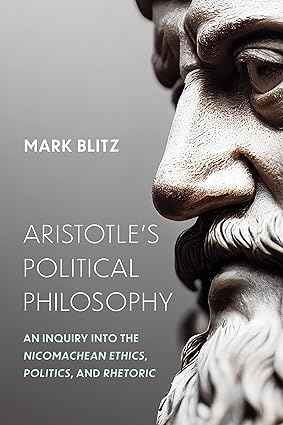
Aristotle was the first true political scientist. Unlike many moderns who claim that title, he was keenly aware that scientific knowledge has inherent limits. Though he is still unsurpassed as a systematic analyst, he also wisely refrained in his works from forcing human action into a theoretical straitjacket. He combined searching philosophical inquiry with common sense and practical wisdom. The Aristotelian spirit is alive in every political thinker, statesman, tradition, and regime that aims to infuse free politics with decency, moderation, and virtue. These are the features of Aristotle’s thought that Claremont McKenna College’s accomplished Fletcher Jones Professor of Political Philosophy Mark Blitz ably illuminates in his penetrating new book, Aristotle’s Political Philosophy: An Inquiry Into the Nicomachean Ethics, Politics, and Rhetoric. Aristotle’s view of ethics and politics, writes Blitz, remains “powerful because it uncovers what still, or necessarily, belongs to common understanding and action.” It is a precious and permanent contribution to humanity’s political self-understanding.
Aristotle took his bearings from human nature as it comes to sight in practical life, through the speeches and deeds of citizens and statesmen. As Blitz puts it, Aristotle knew as well as anyone before or after him that “ordinary perceptions and ordinary opinions are unlikely to be altogether false.” The three books Blitz focuses on are the so-called “practical” works, dealing with matters that permeate everyday human affairs: ethics, politics, and rhetoric. In these areas, Aristotle eschewed abstract theories, and attempted instead to clarify and deepen the best insights of those who had gone before him.
With Aristotle, we are on the golden middle ground between recklessly impatient activism and a merely “theoretical” concern with notional ideals. He aims to land on methods for putting ethical reasoning into practice. He is the inveterate foe of both debased freedom (what we used to call “license”) and the radical negation of political life that is tyranny or despotism. As Blitz puts it, Aristotle “at once elevates and calms our expectations. He raises the nobility of ethical virtue while subtly showing its dependence on others, and, therefore its limits, and he reminds his educated readers, students, potential statesmen, teachers, and fathers how arguments that clarify and extol virtues need to gain trust through specific discussions in which words match deeds.”
***
Blitz previously displayed his impressive grasp of political philosophy in three splendid books: Plato’s Political Philosophy (2010), Conserving Liberty (2011), and especially Reason and Politics: The Nature of Political Phenomena (2021). In this new work, he displays a magisterial command of Aristotle’s thought and writings. His treatment is organized nicely into three parts: “Virtue,” “Politics,” and “Speech.” Together, these provide a comprehensive framework for understanding the common enterprise that Aristotle called politikē, which can be rendered as both “statesmanship” and “political science.”
Aristotle’s science of human affairs, writes Blitz, does not begin “by looking…first toward economic affairs, loose psychological generalities, statistically significant patterns of behavior, or similar matters.” Nor does it begin with “mere preference[s] or assertion[s],” nor even with the study of sacred texts—much less with ill-defined “values” that are at once relative and subjective. It begins instead with close attention to common sense and ordinary experience, and to what human beings and political actors say about their motives and judgments. Ultimately, the political scientist may travel beyond the reach of common sense, but he will never leave it behind or upend it altogether.
Morally serious people “begin their actions” by identifying reasons for acting. These reasons point toward the various goods, means, and ends that inform actual political choices. The comprehensive or “architectonic” skill that Aristotle calls politikē has responsibility for organizing both intellectually and actually the myriad good ends that orient and enrich human life. For Aristotle, the goods of life are not merely “objects that we happen to desire,” arbitrary ideals, or “projects” that we impose on a stubbornly resistant world. Those are the misguided procedures of modern political science and various illiberal modern ideologies. For Aristotle, writes Blitz, the human good cannot be severed from the “happiness that is virtue”—virtue that is intrinsically “noble” because it is chosen for its own sake. The noble (to kalon) is at once fitting, beautiful, and fine. It is marked by both measure (metron) and elevation, and allows us to complete or perfect the various worthy activities that make up our human work.
***
To be sure, these are also matters of dispute and contestation. But the fact that “noble and good things are disputable…does not mean that choice is arbitrary.” The imprecision built into moral life by its changing circumstances, and the variety of political regimes with their competing claims about justice, make it impossible to take one’s bearings simply from “universal rules” that are absolutely binding, regardless of time and place. But Aristotle has justified confidence in the reliability of “reflective choice” (a concept he introduces early in his Ethics), precisely because it begins “from common sense, from what is known to ‘us’ when we are brought up nobly.” Because Aristotle never imposes rigid theoretical absolutes onto the inherently variable realm of human action, he never succumbs to the temptations of subjectivism or relativism which entice modern political scientists when they fail to achieve their vaunted mathematical certainty.
Instead of mutilating reality on the Procrustean bed of his own theoretical expectations, Aristotle keeps his eye on the goal of happiness, that state of being which all reasonable human beings hope to attain. Using his characteristic “dialectical” approach or “endoxic method,” he surveys what men generally take to be happiness and works toward a reasoned synthesis of whatever is good in each view. The most vulgar view identifies happiness with bodily pleasures, and in the most extreme cases with the “Sardanapalian” extravagance of the insatiable tyrant (named after a particularly decadent 7th-century B.C. Assyrian king). This debased and hedonistic view of human happiness entails a woefully carnal idea of both happiness and pleasure. It is the way of cattle.
Still, Blitz points out, though Aristotle dismisses “the view that happiness consists of bodily pleasure,” he in no way “ignores pleasure.” Pleasure and desire, like everything else, must be given their due. But moderation or temperance (sōphrosunē) equips one to reasonably direct and limit bodily appetites, preventing them from debasing one’s character and undermining the capacity for rational self-direction. Moreover, Aristotle readily acknowledges, in Blitz’s words, that “both ethical and intellectual virtue are pleasant in their own way.” But unlike modern hedonists who believe “that pleasures are all commensurable,” Aristotle argues that “pleasures are differentiated by the activity that brings them.” Degrading pleasures like those of Sardanapalus are ultimately destructive of true happiness, since they come at the cost of self-abasement. Happiness, rooted in an active life of ethical and intellectual virtue, is richer and deeper—more spiritually satisfying, one might suggest—than the mere pursuit of pleasure.
***
A second, more elevated view identifies happiness with honor. But honor itself has a measure, Blitz observes: “honor (or reputation) can be given by the wrong people for the wrong reason.” The intellectual virtues of prudence (especially) and wisdom must control ethical virtue to keep it from losing its bearings and integrity. With some qualifications, Aristotle finally identifies happiness most completely and reliably with “theoretical activity,” in large part because contemplating the nature of things is a delight independent of others’ approval and thus “unable to be taken from one.” But contemplative reflection by no means exhausts virtue, and a life without ethical virtue would be a very impoverished one indeed.
In fact, Aristotle envisions the happy life as a more varied, gentlemanly, and pacific kind of existence than do many later philosophers. He famously remarks, in contradistinction to a position later defended by Stoics and Christians, that “a man cannot be happy on the rack.” This leads to the suspicion that his position on happiness does not, and cannot, encompass the serenity of the Christian martyr or the noble heroism of the man who would rather suffer death than accommodate himself to evil. Aristotle readily acknowledges the nobility of such sacrifice, but not its happiness.
In contrast, the Roman moralist Cicero adamantly refuses in his On Duties to identify “the desirability of things by either pleasure or the absence of pain.” Though himself an Academic Skeptic in the Platonic tradition, Cicero was far more sympathetic to the Stoics than to their rivals, the Epicureans, whom he despised for their tendency to make virtue a mere slave of pleasure. With these considerations in mind, Cicero might wonder if Aristotle, for all his finely calibrated distinctions on the subject, conceded too much to the role of pleasure in human life and even within virtue itself.
Indeed, the moral virtues as Aristotle describes them are genteel, even aristocratic—though not necessarily in a social sense. In another notorious contrast to Christianity, Aristotle suggests that moral goodness requires some financial resources. But it also mandates the generous dispensation of those resources. Liberality of this sort entails the benign and generous use of “external goods.”
***
After his illuminating analysis of Aristotle’s ethical virtues, Blitz turns to the central virtues of justice and prudence—the first an ethical virtue of great importance, the second an intellectual one indispensable for guiding the application of ethical virtues in action. His discussion of natural right or natural justice in Aristotle is particularly suggestive. On one hand, natural right guides human beings in the exercise of all “judgment and choice,” providing a non-arbitrary standard for evaluating the decisions of statesmen and citizens. At the same time, Aristotle famously (and enigmatically) claims that this indispensable standard is “changeable,” since it seems to be inseparable from what is contingent and conventional—from the particularities of time and place.
Although every political regime or constitution contains some common features, each has practices and circumstances that are unique to it. Yet natural right, which Blitz ties to the best regime or “the city in prayer or wish” invoked in the Politics, remains “the standard for evaluating the justice of other regimes that exist or that one might try to bring about.” The inherent imprecision of political matters necessitates prudence, an intellectual virtue which mediates between principle and the particularities of any people or regime. Blitz discusses prudence at some length, “because it constitutes the knowledge that both virtue and the statesman require.” It is the political virtue par excellence.
The great 18th-century statesman Edmund Burke—himself a quasi-Aristotelian—called prudence “the god of this lower world.” Aristotle never goes quite so far, but he still recognizes prudence as essential to a good human life and political community. In Book 6 of his Ethics, Aristotle distinguishes between science (epistēmē), which deals with what cannot be changed and proceeds “by induction” from first principles, and art (technē), which works out best practices “according to true reason” (meta logou alēthous). Prudence for Aristotle, Blitz tells us, is “neither a science nor an art: it deliberates but does not demonstrate, and it acts but does not make.” The wise person proceeds from first principles; the prudent statesman from “the best we can attain through action.” Prudence must deal with and conjugate, so to speak, particulars and universals.
***
As Blitz points out, prudent statesmen are also the ones most fit to exercise the art of epideictic oratory—the rhetoric of blame and praise discussed in Book I, chapter 9 of the Rhetoric. This was the skill displayed so memorably by Abraham Lincoln at Gettysburg on November 19, 1863, by Winston Churchill in his “Finest Hour” speech of June 18, 1940, and by President Ronald Reagan in his D-Day Address in Normandy on June 6, 1984. Such memorable exercises in political rhetoric “appeal beyond interest and necessity to the animating principle or ‘cause’ and to the character of those who embody (and ennoble) it.” In speeches such as these, we see noble rhetoric at the service of free and decent politics.
Famously, the ability to use language in this way is what makes man a “political animal” (zōon politikon) in Aristotle’s sense of the term. Other animals have a certain kind of voice—they can twitter or squeak to communicate pain and pleasure—but only humans can use words to “reveal the advantageous and harmful and hence also the just and unjust.” Man is the political animal because he is the logos-bearing animal, the one who can see more deeply into the world’s underlying logic than any other. He can foresee what would be advantageous to him and his fellows, collaborate to provide for that common advantage, and distribute or apportion burdens and rewards in keeping with standards of justice. The capacity for logos gives a unique dignity to human beings, as human beings. This is the essential basis and starting point of Aristotle’s political science. It is what his less competent emulators and competitors usually ignore.
Bad political scientists and ludicrous “theorists” have been around for many millennia. In Book 2 of the Politics, Blitz highlights the brilliant but superficial intellectuals Phaleas of Chalcedon and Hippodamus of Miletus, who approached politics in a reductively scientistic way. Phaleas thought the equalization of property could eliminate civic strife and the temptation of tyranny, as if human desire or ambition could be stamped out so easily. Hippodamus, who dressed the same way (flamboyantly so) through the different seasons of the year, wanted to impose a rationalistic scheme on Greek cities by dividing everything in the community into threes. He also wanted to reward those who came up with innovative changes to the law. Like many leftist reformers today, he felt sure that innovation would spur improvement—but he forgot that the public’s respect for the law is inspired in part by its stability and by the steady habit of law-abiding generations. This point is renewed to impressive effect by James Madison in The Federalist.
***
In contrast with the highly abstract and disruptive “rationalism” of Phaleas and Hippodamus, Aristotle’s approach tends toward practical conservatism. As Blitz notes, he is quite capable of philosophically intrepid, even “radical” ventures in thought. But he always tempers this daring with caution, moderation, and respect for the constants of human nature. For example, Blitz shows how in Book III, chapter 9 of the Politics, Aristotle adjudicates between the democratic freedom and equality favored by the masses, on the one hand, and the sophisticated virtues emphasized by wealthy aristocrats, on the other. Political philosophy alone can do justice to the competing claims of natural human equality and the inequalities (e.g., of birth, wealth, and excellence) which must be given their due in any adequate account of political justice.
Perhaps above all, Aristotle was concerned to stave off the various “beasts” of human nature. Blitz discusses Aristotle’s remarkable account of how tyrannies are preserved. One method is through proto-totalitarian control, a vicious kind of rule that Aristotle adamantly condemns. It involves cutting off the heads of men of high spirit (metaphorically or literally), stationing spies everywhere to keep the people suspicious of one another, and further atomizing them by prohibiting common meals, activities, or endeavors. The second kind of tyranny is a more humane one that Aristotle actually seems to recommend: tyrants, he suggests, can become moderate “half-kings” out of self-interest. Blitz, following Sir David Ross in his generally excellent 1923 book on Aristotle, calls this second suggestion “outrageous.” Ross portrayed it as Machiavellianism avant la lettre. But I am more inclined to read Aristotle here as slyly working to coax the more decent tyrants (already “half-kings”) toward a more benign rule, by portraying leniency as a form of rational self-interest for rulers. In following Aristotle’s suggestion, the less-than-fully bad tyrant is actually liable to be cured of Machiavellianism.
Three features of Blitz’s approach make it truly exceptional. First, like his friend and teacher Harvey C. Mansfield, he believes that the political philosopher has much to learn from politics and not just the other way around. As Blitz and Aristotle present him, the political philosopher is not a god among men, with no need of the wisdom that can be found by examining, clarifying, and strengthening the insights of thoughtful citizens. Second, Blitz follows the example of Aristotle himself in recognizing that the political scientist must not only be “immersed in common experience” but also ethically virtuous: “Nothing suggests that the teacher of legislators lacks courage, moderation, liberality, or even proper anger.” The Aristotelian political philosopher does not exempt himself from the ethical requirements of what it means to be a human being. He can only be a teacher of moral and intellectual virtue if he partakes of it in a meaningful way.
***
Finally, Blitz never identifies philosophy with atheism, or, more subtly, dismisses the theological dimensions of Aristotle’s philosophical reflection as mere posturing to conceal an “esoteric” core of atheism. What is highest in human beings points to the reality of the divine, simply. To be sure, we are a long way from the Creator God of Jews and Christians, but are still within the horizon of a broadly philosophical piety, as Mary P. Nichols argues in Aristotle’s Discovery of the Human (2023), her recent book on the Ethics. More circumspectly than Nichols, Blitz insists that a full human life depends upon the cultivation of “reverence.” The truly reverent will avoid the twin extremes of religious fundamentalism and callous disregard for the divine.
As Blitz shows, Aristotle resolutely “opposes the view,” all too common today, “that we can reduce thoughts and actions to their physical or chemical conditions or to psychological factors over which we have limited control.” The soul is no mere poetic metaphor. It is alive and active in every facet of human life. Aristotle’s political science is richly empirical and therefore admirably open to the things of the spirit as they actually make themselves manifest in our experience. Political science so understood shows the limits, indeed the falsehood, of materialism and reductionism. Blitz points in a more truthful and salutary direction, by doing justice to all the qualities of the human soul brought to light by Aristotle’s exemplary ethical and political philosophy.