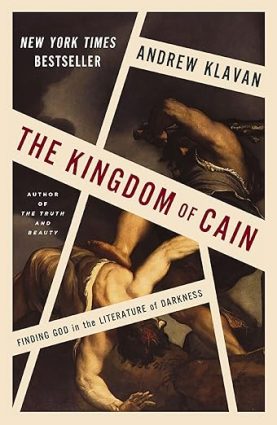
“We shall know nothing,” wrote Albert Camus, “until we know whether we have the right to kill our fellow men.” Andrew Klavan cites this comment in his splendid new book, The Kingdom of Cain: Finding God in the Literature of Darkness. The kingdom of Cain is the world in which humanity has dwelled since Adam and Eve’s eldest son, the first person born after the fall, committed the first murder. Violent crime has haunted us ever since. Not only do we suffer from it, but we are also inclined to commit it. Humanity is its own worst enemy.
Still worse, we have devised countless ways to justify crime. We have even denied its existence. Since the Enlightenment, thinker after thinker has purportedly demonstrated that the very idea of crime depends on outmoded concepts, such as free will, the soul, and the infinite value of each person made in the image of God. Good and evil, we are told, are nothing more than social constructs with no basis beyond convention.
And so, away with such prejudices! Only then could people be free and realize their true selves! Narcissism presents itself as authenticity. If crime is a myth, there is no reason to refrain from it when there is no danger of being held accountable. Is it any wonder that the years since 1914 have been history’s bloodiest? No regimes have ever been crueler to its own citizens than the Marxist-Leninist ones that in the name of materialism and atheism promised to leap, as Friedrich Engels himself put it, from “the kingdom of necessity to the kingdom of freedom.”
***
An award-winning crime novelist and screenwriter, Andrew Klavan reflects on these disturbing developments in modern thought by focusing on examples in literature and film, and the real events that inspired them. The first murderer was Cain, of course, but Klavan explains that he cannot “write about the works of art inspired by Cain’s actions, because in some sense all art is inspired by his actions” since “all history flows out of him.”
And so Klavan begins with Pierre François Lacenaire’s 1834 killing of a con man and his mother. A handsome and sophisticated French poet, Lacenaire fascinated the cultural elite, who came to visit him in prison and repeated his sayings. Considering himself too sensitive for ordinary people to appreciate, Lacenaire lived, he said, as “one man alone against the world.” As Klavan paraphrases his memoirs: “His crimes weren’t crimes, they were a rebellion” against society. “I never strove for my personal gain but for revenge,” Lacenaire explained. “I wanted my revenge to be as huge as my hatred. Do you think the blood of ten or twenty would have sufficed me? Never. It was the social structure I wanted to strike at, in its foundations.”
Lacenaire’s musings became one inspiration for Fyodor Dostoevsky’s Crime and Punishment and the murderer Raskolnikov’s “Napoleonic” theory of “extraordinary people” who have “the right to transgress” if that will help spread their ideas. Aware that morality is nothing but social convention, these geniuses regard unenlightened ordinary people as worthless beings who serve only to reproduce their kind. And one does not have to be as great as Napoleon to have the right to transgress: superiority comes in degrees. The detective Porfiry Petrovich in Crime and Punishment remarks that with another theory Raskolnikov could have wound up taking many more lives. That is, he might have become a revolutionary, and his friend Razumikhin suspects that he actually did.
As Klavan points out, Friedrich Nietzsche, who regarded Dostoevsky as the only psychologist to teach him anything worthwhile, developed the idea of superior people. It soon became widespread, as Klavan illustrates with the famous 1924 case of Leopold and Loeb, two university students who, inspired by Nietzsche’s Übermensch, killed a 14-year-old boy just to show their superiority. When arrested, Leopold told The Chicago Tribune: “It was just an experiment…. [I]t is as easy for us to justify as an entomologist in impaling a beetle on a pin.” The British novelist Patrick Hamilton fictionalized these events in the play Rope, which in turn became the basis for Alfred Hitchcock’s innovative 1948 film. Woody Allen continued the argument in his Crimes and Misdemeanors (1989) and again in Match Point (2005). Whereas “Dostoevsky understood that God must live, or love would be an illusion,” Klavan observes, “[f]or Woody Allen, God, spiritual love and morality are all mere fictions, fanciful social constructions built atop material realities; vapors of the animal brain.”
Klavan traces a similar sequence from real crime to fiction to film with the gruesome case of Ed Gein. When a local Wisconsin woman’s disappearance in 1957 implicated Gein, investigators discovered a real-life house of horrors: gutted women’s corpses, bowls made of skulls, and lampshades of human skin. Gein liked to dress himself in masks made from his victims’ faces and costumes fashioned from their torsos. These crimes inspired Robert Bloch’s novel Psycho (1959) and Hitchcock’s famous film based on it, the cult slasher film The Texas Chainsaw Massacre (1974), as well as Thomas Harris’s thriller The Silence of the Lambs (1988) and the 1991 adaptation that swept the Academy Awards.
***
Klavan draws his key questions from Dostoevsky, who addressed moral nihilism with the greatest acuity. Not only did his novels examine criminality and evil more profoundly than any writer who ever lived, he was also the only 19th-century thinker to foresee totalitarianism, not just in principle but in the excruciating detail outlined in his novel The Possessed by the revolutionary Pyotr Stepanovich. Pyotr Stepanovich’s nonchalant prediction that socialism would claim “a hundred million heads” turned out to be an underestimate.
As Klavan notes, the heroes of Dostoevsky’s novels ask: if there is nothing beyond the material world described by the laws of nature, and if people are nothing but matter, where do good and evil come from? Raskolnikov in Crime and Punishment and Ivan in The Brothers Karamazov are both torn by contradictory beliefs: they accept the materialist paradigm yet cannot help recognizing unjust human suffering as just plain evil.
The Kingdom of Cain’s first epigraph is a passage from The Brothers Karamazov in which the smug but shallow liberal Miusov paraphrases something that Ivan has said:
[I]f you were to destroy in mankind the belief in immortality, not only love but every living force maintaining the world would at once be dried up. Moreover, nothing then would be immoral, everything would be permitted, even cannibalism. That’s not all. He ended by asserting that for every individual like ourselves, who does not believe in God or immortality, the moral law of nature must immediately be changed into the exact contrary of the former religious law, and that egoism, even to crime, must become, not only permitted, but even recognized as the inevitable, the most rational, even honorable outcome of his position.
Like so many contented atheists, Miusov regards Ivan’s train of thought as ridiculous (“paradoxical”). The wise monk Father Zossima does not. He recognizes that Ivan appreciates the implications of the materialist worldview. If there is no immortality—that is, nothing beyond this world—then we are only what modern economic theory and 19th-century utilitarianism tell us we are: egoists pursuing our own well-being. Love becomes nothing more than an economic bargain, pleasure given so that it can at some point be received. Friendship, too, becomes a contract.
***
Once people come to believe the laws of nature have nothing to do with morality, they will inevitably draw the conclusion that “all is permitted.” They will even accept cannibalism, the prototypical materialist crime because it literally turns people into so much meat. What’s more, meaning—“every living force maintaining the life of the world”—must disappear along with good and evil.
Logically speaking, there should be no moral imperatives at all, so what does Ivan mean by declaring that the former religious law should not be abolished but reversed? If there is no longer any such thing as honor, how could crime become “honorable”? The fact is, all these consequences actually came to pass in the Soviet Union, as Dostoevsky foresaw.
Consider Soviet morality, which above all based itself on atheism. Rejecting traditional virtues such as compassion and benevolence as so much twaddle, the Bolsheviks adopted not amoralism but precisely reverse morality. Compassion actually became a vice, because it might lead one to spare a class enemy. For Lenin, cruelty was a first resort. He utterly rejected the morality of some other revolutionaries who maintained that murder was permitted when necessary. To think that way, he insisted, was to retain some vestige of the religious worldview that human life is somehow sacred, whereas, in fact, people, like everything else, are nothing but matter. Trotsky famously urged Bolsheviks to “put an end once and for all to the papist-Quaker babble about the sanctity of human life…. Execute mercilessly.” “Merciless”—one of Lenin’s favorite words—became a compliment.
Lenin always insisted on the most violent possible measures. By the end of 1917, he had already set up the Cheka—the secret police—to terrorize the population. Cheka units developed their own forms of torture: one specialized in burning alive, another in scalping, a third in impaling people, a fourth in crucifixion, a fifth in killing children in front of their parents, a sixth in locking people in cells covered with corpses. “When we are reproached with cruelty,” Lenin famously explained, “we wonder how people can forget the most elementary Marxism.”
***
Andrew Klavan started reading atheist philosophers out of gratitude for an atheist psychoanalyst who saved him from madness. When he realized where atheism led, though, he became a Christian—a conversion that involved just one leap of faith, which he called “the Great Speculation.” As he explains, “This is the self-evident truth that other people are as real to themselves as you are to you and all are equally dear to God. I can’t prove these two assertions, but if you remove the first one, you have no basis for acting morally, and if you remove the second one, you have no reason for it.”
Atheist thinkers routinely explain altruism as an evolutionary advantage, but to show why our ancestors acquired the ability to care for others is no reason at all for us to do so, any more than our inherited capacity for cruelty and murder is a reason for us to torture and kill. How we came to certain impulses is entirely irrelevant to whether we should follow them. Klavan recognizes that all such explanations for morality—and there are many more—actually explain it away.
He found only one atheist thinker who was willing to follow premises where they led: the Marquis de Sade. As it happens, Dostoevsky was fascinated by Sade for the same reason. In The Possessed, Shatov questions the debauched, immoralist Stavrogin:
Is it true that when you were in Petersburg you belonged to a secret society for practicing beastial sensuality? Is it true that you could teach the Marquis de Sade a thing or two? Is it true that you decoyed and corrupted children? …Is it true that you declared that you saw no distinction in beauty between some brutal obscene action and any great exploit, even the sacrifice of life for the good of humanity? Is it true that you have found identical beauty, equal enjoyment, in both extremes?
Sade in fact did recommend extremes—even torture—as goads to sensuality. No one had a keener appreciation than Sade of what Dostoevsky considered an especially vile human quality, the connection between cruelty and sensuality. In The Brothers Karamazov, the vicious profligate Fyodor Pavlovich teases his pious son Alyosha:
At Mokroe I was talking to an old man, and he told me: “There’s nothing we like so much as sentencing girls to be thrashed, and we always give the lads the job of thrashing them. And the girl he has thrashed today, the young man will ask in marriage tomorrow. So it quite suits the girls, too,” he said. There’s a set of de Sades for you!
Several of Dostoevsky’s atheists repeat Sade’s arguments. Having fully appreciated that people are nothing but matter, they try to live for sensuality. As Svidrigailov explains in Crime and Punishment, “my only hope is in anatomy.” Because such pleasures soon grow tiresome, one must seek ever stronger stimulants, which is why both Svidrigailov and Stavrogin wind up destroying children.
One reason Fyodor Pavlovich married Alyosha’s mother is that she was wholly pious and totally innocent, so he could always derive the pleasure of shocking her with his vice. That, too, was a favorite plot device of Sade: the eponymous heroine of Justine remains wholly virtuous and innocent despite all the vice she witnesses and injustices she suffers, so others can always derive pleasure from shocking her. One can read Justine (if one reads it at all) as a sort of Bildungsroman in reverse, because the heroine never learns anything.
***
For Dostoevsky, Sade’s key point was not just atheist materialism, which was already a commonplace. It was the conclusions Sade drew from making the only standard of morality “nature.” Those conclusions differ radically from those drawn by Jean-Jacques Rousseau, William Wordsworth, and many environmentalists who equate “the natural” with the good. We take that equation for granted. I have never seen food packaging proclaiming “no natural ingredients!” or heard people justify behavior by calling it unnatural. But as Aldous Huxley pointed out in his celebrated essay “Wordsworth in the Tropics,” the nature we like to worship is an “already conquered enemy.” It is nature that has been denatured. If Wordsworth had left the Lake District and traveled to the tropics where dangers and disease still lurk, Huxley surmises, he might not have been so ready to see nature as harmless. He would not have filled it with reassuring Anglicanism or, as we would say today, with liberalism. After all, plague, typhus, and venom all exist in nature, while antibiotics, the polio vaccine, and surgery under anesthesia were human inventions. God preserve us from “natural” dentistry! Curing diseases does not for the most part happen naturally, which is why we have to spend so much money on research to do so. All technology is about overcoming nature. We romanticize nature by imagining it as friendly and furry, but it isn’t really like that.
***
Sade’s nature, like that of post-Darwinian thinkers, was red in tooth and claw. “Nature should be our only guide,” he insisted, and then pointed out that “Nature teaches us both vice and virtue”—mostly vice. Should murder be permitted? Well, don’t animals kill each other? Nature actually favors death, since it is necessary for more life. When people die, their bodies are simply transformed and become food for maggots and worms, who are no less nature’s children than we are. Then why not help nature along?
By nature, we all seek sensual pleasure. And sensual pleasure, the character Dolmancé points out in Sade’s Philosophy in the Bedroom, is increased by “exposing our nervous system to the most violent possible shock.” Because we are more affected by pain than pleasure, we “will put the animal spirits more violently into circulation” by hurting others. And since it is “in accordance with natural impulsions” for people “to prefer what they feel to what they do not feel,” why should we care what others endure if their agonies afford us delight? “For what reason then ought we to go softly with an individual who feels one thing while we feel another? Why should we spare him a torment that will cost us never a tear, when it is certain that from this suffering a very great pleasure for us will be born? Have we ever felt a single natural impulse advising us to prefer others to ourselves, and is each of us not alone, and for himself in this world?”
Like Nietzsche a century later, Sade attributes benevolent impulses to the unnatural distortions of Christianity. He asserts, as Nietzsche was to do, that the strong should dominate the weak. When Christians preach otherwise, they propagate what both thinkers called a “slave morality.” As Sade explained, “Never does a strong man take it into his head to speak that language.”
Not only is cruelty no vice, it is a positive virtue because (this is how Sade always argues) it is natural. In fact, it “is the first sentiment Nature injects in us all. The infant breaks his toy, bites his nurse’s breast, strangles his canary long before he is able to reason.” Savages, who are closer to nature than we are, are even more cruel, and animals crueler still. If what is natural is good, and cruelty is natural, then cruelty must be good. Call it Sade’s syllogism.
Dostoevsky concluded, and Klavan agrees, that Sade was correct to draw such conclusions from the premise that nature should be our only guide. That is precisely why we need to acknowledge a world beyond nature!
When Alyosha asks Ivan whether any person has the moral right “to look at other people and decide which is worthy to live?,” Ivan replies: “Why bring in the question of worth? The matter is most often decided in men’s hearts on other grounds much more natural.” So it is, and that is precisely why we must acknowledge something supernatural. That is Dostoevsky’s conclusion and the basis of Klavan’s “Great Speculation.”
***
Robert Bloch’s Psycho invoked fashionable Freudian explanations for psychotic behavior. Klavan is no Freud hater, and he credits a psychoanalyst’s use of the talking cure Freud invented with restoring his sanity. But he also finds in Sigmund Freud’s theories “a concerted attempt to replace the Christian vision with a scientistic one. In Freud’s worldview, human motivations are no longer seen as a matter of sin and atonement…. They are now revealed to be a struggle between socially acceptable behaviors and the erotic impulses society has repressed.” Although Freud himself regarded repression as the price we must pay for civilization, some of his followers (the “Freudian Left”) developed his ideas into a justification for sexual license, especially during what we have come to call the sexual revolution. “Whatever Freud’s personal preference,” Klavan argues,
this shame-free attitude toward sex is inherent in his materialism…. If, after all, we are nothing but bodies, the desires of our bodies are the salients of our authentic selves. Those desires must be served in order for us to exist as we truly are. Sexual behavior…must be removed from any moral context aside from that of consent and harm
Klavan shrewdly replies: If we are nothing but bodies, why should consent matter? Do we ask consent of stones? Sade and Lenin both saw this point perfectly clearly. “Even the moral requirement of consent,” Klavan explains, “assumes an inner being who has a free will to consent with. Even the prohibition against doing harm assumes something sacred in the lives of others.” He again endorses “what Dostoevsky understood,” that in the final analysis, “we must choose between Jesus Christ and the Marquis de Sade.”
***
When Klavan was 19, Michel Foucault and other postmodernists were just becoming popular in academia. “These philosophers seemed to me like men with X-Ray vision…. Nothing is right or wrong, they chanted. Nothing is real but flesh and power. Nothing is evil but hierarchy.” And yet, some saving instinct told Klavan that all these glittering justifications for villainy were wrong. It was at this point that he read Crime and Punishment. When he came to Raskolnikov’s murder of the poor, meek Lizaveta, Klavan’s “instinct was confirmed. I read that passage and, not only felt, I knew from then on that Foucault and the others were simply wrong.” It was Klavan’s first step to becoming a Christian.
He knew, however, that his career as “an aspiring writer” would run more smoothly if he embraced “fashionable unbelief. But when Raskolnikov confessed to the prostitute Sonia, when Sonia cried out to him, ‘What have you done? What have you done to yourself?’ I put the novel down on the desktop and I buried my face in my hands.”
Klavan’s book offers an alternative to the materialist vision that—although he does not say so—again resembles Dostoevsky’s. In The Brothers Karamazov, Father Zossima rejects the sort of Christianity represented by his monastic rival Father Ferapont, who equates piety with mortification of the flesh. Zossima regards matter not as something vile but as God’s creation made for our joy. We must therefore love the earth, be tender to animals, and rejoice in the beauty of birds, he explains to Alyosha. We must delight in human joy. Zossima’s matter is not that of the materialists because it is not mere matter. It is matter that points to the divine. It is both what it is in itself and a sign of what lies beyond it. Klavan discovers this view of matter in the Christian ritual of communion.
After Zossima dies, Alyosha’s faith is briefly shaken. He recovers it when hearing the Gospel read over Zossima’s coffin. The story Dostoevsky chooses for this scene is the marriage at Cana, where Jesus turns water into wine. Pause to consider how odd that choice is: Jesus’s prosaic miracle, as He explicitly says, has nothing to do with His mission. The incident appears in only one of the four Gospels. What’s more, the miracle is almost entirely hidden: even the governor of the feast doesn’t detect it.
As Alyosha hears the story read, he reflects: “Ah, that sweet miracle! It was not men’s grief, but their joy Christ visited. He worked his first miracle to help men’s gladness.” He recalls Zossima saying, “He who loves men loves their gladness too.” Alyosha calls this “one of his leading ideas.” At Cana Jesus concerned himself with “the gladness of some poor, very poor people.” His mother knew “that His heart was open even to the simple, artless merry-making of some obscure and unlearned people…. ‘Mine hour is not yet come,’ He said with a soft smile…. And indeed was it to make wine abundant at a poor wedding that He had come down to earth?”
In a sense it was. Klavan quotes C.S. Lewis:
There is no good trying to be more spiritual than God. God never meant man to be a purely spiritual creature. That is why He uses material things like bread and wine to put the new life into us…. He likes matter. He invented it.
Klavan reflects:
Life. Joy. Things. His first miracle was turning water into wine at a wedding. What did he think the wedding guests would do if not make merry? What did he think the bride and groom would do when they stumbled off to bed? The Song of Solomon is also the word of God.
Sex properly understood, matter seen as God’s creation, and art that becomes a form through which the spiritual shines: this is Andrew Klavan’s understanding of our fallen universe. Yes, “we live in the kingdom of murder. We live in the kingdom of Cain,” he writes. But we are all invited to the wedding feast at Cana of Galilee.