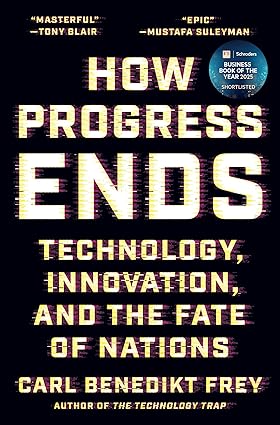
Amid fashionable prophesies of technological nirvana or artificial superintelligence, actual data portend global economic decline. So contends Carl Benedikt Frey’s How Progress Ends: Technology, Innovation, and the Fate of Nations. It makes a detailed case that we are headed not toward a “singularity,” where humanity merges with machines, or a robot utopia, in which androids take over menial labor, but a “productivity plateau” and economic slump.
Why might this be, asks Frey, a historian, economist, and associate professor of A.I. and Work at the Oxford Internet Institute. How Progress Ends has been featured as a “book of the year” in Bloomberg, the Financial Times, and numerous other prestigious outlets. It is a unique and exhaustive history of human progress and its possible decline.
Frey quotes economic Nobel laureate Joel Mokyr: “[M]ost societies that have been technologically creative have been so for relatively short periods…. It is as if technological creativity was like a torch too hot to hold for long.” From there, Frey argues that to escape this dynamic and keep the innovation going, global commerce—perhaps even the dreaded “globalism”—remains vital. Prosperity requires economic change and disruption that span across borders. The evidence shows that mercantilism and protectionism (i.e., those tempting tariffs and immigration quotas) tend to thwart progress everywhere.
***
Frey backs up this claim with a detailed analytical account of the world economy over the last two millennia and more. He marches authoritatively from the high courts of China’s Western Zhou Dynasty (1046–771 B.C.) through the Roman and British Empires, scrutinizing industrial revolutions along the way from Germany, Spain, and Poland to Japan, Hong Kong, and Taiwan. He concludes with incisive and prophetic insights on A.I. and hyper-computing today. His unorthodox assessment of the present situation is that until the rise of Xi Jinping in 2012, China had been moving for decades toward greater openness while the U.S. was shutting down and freezing up.
Central to this analysis is Frey’s deeply informed and contrarian view of China. Even under the Chinese Communist Party (CCP), he argues, China may well harbor freer markets in the key technologies of the future than does the increasingly nationalist, bureaucratic, and mercantilist West. Between 1980 and 2015, China expanded private wealth as a share of national income by a factor of 400% while the U.S. wallowed in a regulatory morass. During this period, China grew its private sector faster than any other country in the world.
To explain China’s ascent, Frey points to the pivotal impact of British imperialism as manifested in Hong Kong. In the 1980s, Premier Deng Xiaoping discovered the unique prosperity of Hong Kong among all Chinese cities and created special economic zones along the Eastern coast of China, mimicking the British protectorate. After 1993, the government erased 43%—some 33 million—of the jobs in the previously dominant state-owned enterprises. Premier Zhu Rongji told laid-off workers to “find jobs on the private labor market,” and most did. “Between 1992 and 2007,” notes Frey, “urban private employment rose from 11 to 79 million, in the countryside, it passed 110 million jobs.”
Under Xi, however, China has been tempted to tighten government control again using newer and more powerful technology. Xi has initiated a crackdown on speech and entrepreneurial independence, marked by a national network of “red phones” with a direct line to the party on the desks of most business executives. The proportion of private companies with CCP cells has risen to over 70% of the total, and the CCP has purchased “Golden Shares” in the leading Chinese corporations, such as Alibaba (e-commerce), Tencent (video games and A.I.), and Baidu (A.I.). Included among the Communists are about 300 executives at Disneyland Shanghai, where Mickey Mouse is appropriately required to devote much of his Saturday to the study of Xi’s speeches.
Xi’s “Document 9,” an internal CCP circular, imposes bans on any reference to constitutional democracy, freedom of the press, or “civil society.” In February, Hong Kong press tycoon Jimmy Lai was given 20 years’ imprisonment for criticizing the CCP. Google, YouTube, Facebook, and The New York Times are barred behind a great firewall built with Cisco filters, online markets (crucially cash-free), and “social credit scores” based on internet posts and purchases. Frey quotes Alibaba co-founder Jack Ma: “With the help of artificial intelligence…big data will make the market smarter and make it possible to plan and predict market forces so as to allow us to finally achieve a planned economy.”
***
According to Frey, however, these plans don’t factor in key limitations of A.I. A critical obstacle is the Austrian computer scientist Hans Moravec’s paradox, which Frey summarizes: “tasks that are simple for humans, such as hiking, are incredibly difficult for robots and AI systems, while activities that require extensive human reasoning, like playing chess at a grandmaster level, can be more easily executed by computers.” A.I.’s prowess in linguistic regularities, determinist logic, and mathematical algorithms blinds it to the murky, multifaceted maelstrom of the actual world in all its unfathomable complexity and inconsistency. A.I.’s promise does not obviate human intellect but depends on it to explore the world.
Frey cites the findings of François Chollet, creator of Keras, an open-source deep learning library adopted by over 2.5 million software developers. In 2019, Chollet published “On the Measure of Intelligence,” introducing an “Abstraction and Reasoning Corpus (ARC)” test for Artificial General Intelligence (AGI) to evaluate whether machines have attained or exceeded human levels of cognitive ability. Chollet’s test measures what he calls “fluid intelligence,” or skill acquisition for unknown tasks. Existing skills can be imparted to machines by training them based on previous human knowledge.
New skills and new technologies, however, entail creativity, measured by surprising anomalies rather than by voluminous averages. Between 2019 and 2024, the large language models (LLMs) of A.I. scaled ten thousandfold in size. But performance on Chollet’s ARC test remained close to zero. OpenAI’s much-vaunted breakthrough program GPT-4.0 scored around 5%.
Summing up his theory of progress, Frey quotes the late Yale political scientist and anthropologist James C. Scott: “that most characteristic of human institutions, language, is the best model” for the kind of system in which innovation flourishes. Language exemplifies “a structure of meaning and continuity,” i.e., one with definite formal rules that is nonetheless “never still and ever open to the improvisations of all its speakers.” How Progress Ends cites some astonishing examples of the deadly measures taken by closed societies to suppress linguistic creativity. Frey tells the story of Wang Xihou, a 64-year-old lexicographer in the 18th-century Qing Dynasty, who, while industry and innovation erupted in the West, was rewarded for his efforts to reform Chinese dictionaries by a public execution, followed by the enslavement of all his sons and 21 other family members.
***
The necessity of innovation, however, does not mean that centralization and industrial organization have no role to play in human progress. “[C]entralized bureaucratic management,” Frey writes at the outset, “is most advantageous for exploiting low-hanging technological fruit and spearheading technological catch-up, while decentralized systems are better for exploring new technological trajectories, which is the only way to make progress once the technological frontier is reached.” To state the problem clearly: “Innovation demands breaking rules, but efficient execution relies on following them.” Economic growth is largely a struggle between the past and the future within a structure of law.
When the relative shares of innovation and obedience fall out of whack, the usual method of righting them—according to Frey’s provocative thesis—has been war. Excesses of democracy, he shows, congeal all too often into elite control, sclerosis, and zero-sum paranoia. In history, the remedy for these propensities is often military conflict, which breaks down barriers to progress by discrediting predatory elites and complacent despots. Frey believes we need a better path. To secure enduring wealth, he argues, we must combine powerful government bureaucracy with a creative entrepreneurial class, such that the balance of power between the two can shift depending on the condition of the economy.
Best of luck with that! Overrating the power of government to manage innovation without crushing it, his chapter on “Growth with Gulags,” for example, conveys the usual history of the USSR and China under central planning. He accepts the story—also swallowed whole by the CIA in the U.S.—of an initial surge in economic growth under totalitarian control after World War II. The data, though, consist mostly of party claims and figments. The total meltdown of both nations in the 1970s makes all the economic statistics questionable.
***
According to Frey, central planning constituted a basic trade-off: no creative destruction but greater investment in infrastructure, education, and industrial scale. Maybe not. In most cases, the infrastructure included neither housing nor nutritious meals, and the output was not adapted to people’s real needs, making the growth largely spurious.
Frey ignores “time prices.” Conceived by Yale Nobel Laureate economist William Nordhaus, time prices gauge real growth over millennia by the hours and minutes a typical worker has to spend to earn goods and services. In Superabundance (2022), international relations specialist Marian Tupy and economist Gale Pooley apply time prices over the centuries to debunk most prevailing government data. Their results suggest that before the long surge of world-leading economic growth in China beginning in the 1990s, workers in the Communist Third World after World War II got less and less for increasing expenditures of their time.
Frey also accepts implicitly what I call the materialist superstition, i.e., the belief that resources are finite and running out—strained by excessive population, imperiled by runaway technological change, and in need of constant regulation by experts. He accepts without question the fashionable supposition that the very carbon dioxide which sustains our lives and planetary vegetation and fuels our production of food is a source of imminent doom.
If we lived in a determinist material universe, it might indeed be possible (in theory) for omniscient experts to orchestrate “perfect competition,” neatly arranging all products and factors in optimal ways. Science, however, does not consist of one monolithic system of proven or verified truths uncovered one after another in logical progression. Instead, like economic progress, science proceeds through shocks of surprise and transformation. In physics, we found that atoms are not “massy, hard, impenetrable, moveable particles,” as Isaac Newton supposed, but complex arenas of quantum information. In biology, we discovered that the cell is not “a simple lump of protoplasm,” as Ernst Haeckel imagined, but a microcosmic data processor and synthesizer of proteins at supercomputer speeds. And no amount of advancement in physics, chemistry, or biology has yielded the slightest insight into the origins of life, the processes of computation, the sources of consciousness, the nature of intelligence, or the causes of economic growth. Growth derives from learning—the discovery of surprises, the fruits of genius.
***
Frey sees that many innovations, “from Wikipedia to [online education platform] Khan Academy,” have zero price and thus escape national income accounts. But he fails to follow up on this insight. A book on how progress ends should address the evidence furnished by time prices that progress has been vastly more rapid and pervasive across the world, while population rose, from under 1 billion to 8 billion, than Frey’s conventional statistics would suggest. In a book on how progress ends, he might well have focused on the current widespread collapse of human population growth rather than on the benign expansion of CO2. He also fails to account for the extreme mental inequality that makes progress a function of intellectual elites and individual genius rather than government power.
Despite its occasional stumbles into conventional wisdom, Carl Frey’s book fortunately scintillates with the surprising insights of genuine originality and historical truth. But if it doesn’t quite arrive at a satisfying account of how progress ends, perhaps that’s because Frey’s not clear about how progress begins. Progress is the fruit of inequality, rather than equality, of outcomes. Freedom is therefore essential to progress because it enables genius and creativity. Without that insight, no amount of expertise or scientific data can keep us from careening toward the productivity plateau.
Next in the summer 2026 Issue

Three Declarations, Three Revolutions

Saving Civics