Books Reviewed
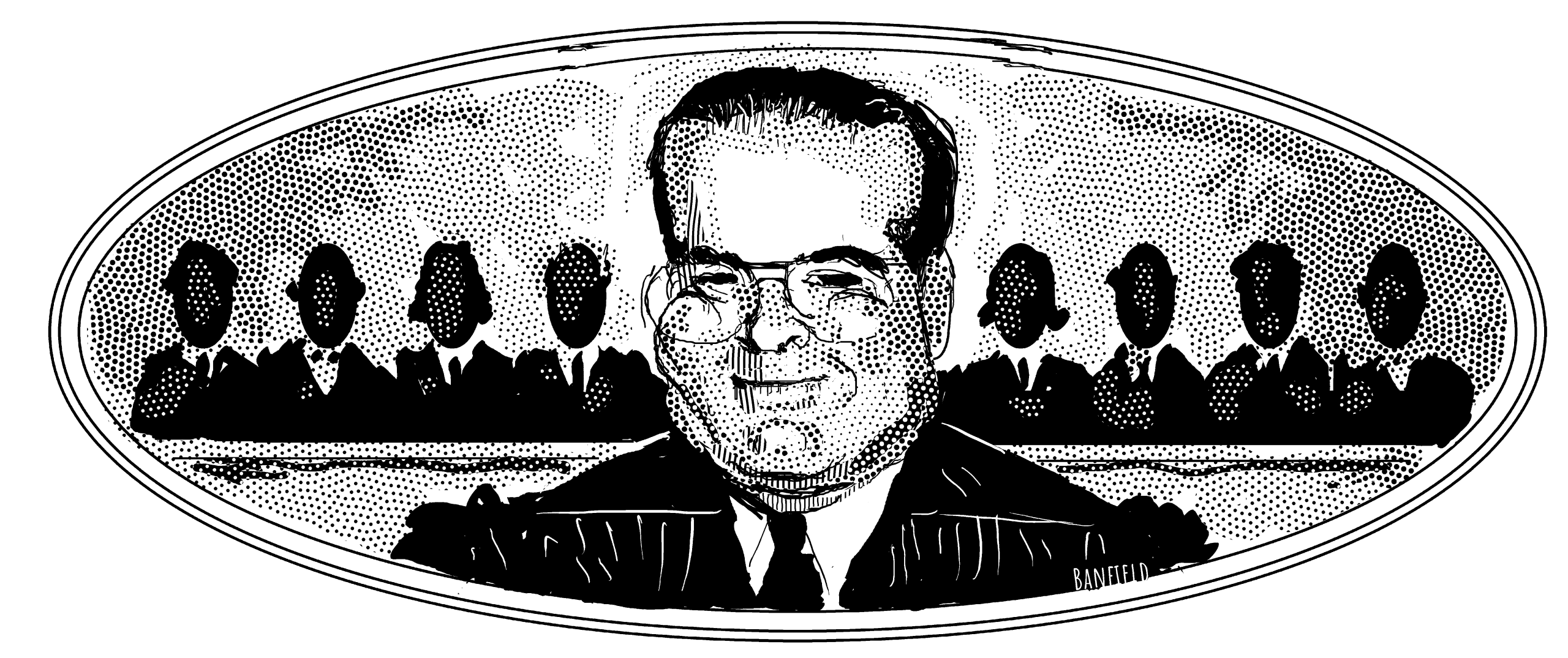
A dissent, Antonin Scalia once said, “is never a winner.” That’s a revealing line, not because Scalia disliked dissenting—no justice in modern memory did more to make dissent an art form—but because it reminds us how much of his Supreme Court career consisted of losing beautifully, usefully, and, in the end, not quite permanently.
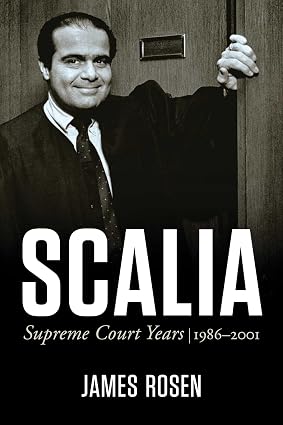
James Rosen’s Scalia: Supreme Court Years, 1986–2001, the second installment of a projected three-volume biography, is thus largely not the story of Scalia triumphant but of Scalia frustrated: by colleagues who wouldn’t argue, conservatives who wouldn’t conserve, friends who wouldn’t follow, reporters who wouldn’t understand, and precedents that wouldn’t die. The first volume—which I also reviewed in these pages (“Nino the Great,” Fall 2023)—carried Nino from Queens to the Marble Temple. Volume two shows what happened when he got inside and discovered that the place was not, in fact, a seminar room.
Rosen, a historian and chief Washington correspondent for Newsmax, catches the initial shock well. The work was great, Scalia told a friend, but sometimes like being “locked up in a vault.” He had loved the D.C. Circuit’s intellectual give-and-take, the casual drop-ins, the drafting exchanges, the sense that judges were engaged in a common enterprise even when they disagreed. The Supreme Court was different. Conference wasn’t a conference so much as a sequential unveiling of priors. Scalia fumed that the justices did nothing but “vote, vote, vote! It’s like being in a parliament!”
That may be the most characteristic complaint imaginable. Other men dream of power and wake disappointed to find responsibility. Scalia got the power but wanted more argument.
***
The book’s best early chapters aren’t about famous cases, but institutional culture. Rosen is very good on the anthropology of the Supreme Court: the rituals, the memos, the clerks, the cert pool, the dining room, the handshakes, the silently circulating drafts, the way judicial personalities survive through marginalia. The courtroom itself almost becomes a character: mahogany, crimson curtains, Roman numerals, and enough solemnity to make a whisper feel like a violation of Article III.
Into this world came Scalia, not as a bomb thrower exactly, but as a man who believed that if lawyers were assembled in a room to discuss legal questions, somebody ought to discuss them. His first oral argument was a takings case (Hodel v. Irving, decided in 1987) obscure enough to prove the man’s seriousness. He kept pressing standing until the government’s position began to wobble. Justice Lewis Powell, watching the new justice pursue a point, leaned toward Justice Thurgood Marshall and wondered whether Scalia knew the rest of them were there.
That’s both funny and clarifying. Scalia’s arrival wasn’t merely ideological. It was temperamental. He was loud in the way a clarinet is loud in an elevator: not necessarily wrong, but impossible to ignore. Rosen’s great service is to show that the standard story—Scalia as bullying, coalition-destroying egoist—is too facile (and wrong). Yes, he could be cutting. Yes, he could overdo it. Yes, he was often incapable of leaving bad reasoning undisturbed merely because good manners recommended silence. But he wasn’t trying to make himself more conservative than everyone else, or more colorful. He was trying to make judging more legal.
That’s why Scalia’s relationship with Justice William Brennan is so revealing. Personally, Scalia adored the old liberal master. But when Brennan’s clerks laid out a trail of placards marking his greatest opinions as part of a birthday celebration, Scalia followed behind and delivered the perfect tribute-insult: “My Lord, Bill, have you got a lot to answer for!” Brennan represented everything Scalia had come to undo: legislative history, elastic rights, opinion-bargaining, the pragmatic jurist as genial ward boss. Rosen nicely captures the asymmetry. Scalia could admire Brennan personally while rejecting his judicial method root and branch. Brennan, for his part, seems to have understood that the cheerful Italian-American wasn’t merely a colleague but a counterrevolutionary.
Scalia’s explanation of why he couldn’t play Brennan’s game is devastating: “I have nothing to trade.” A living constitutionalist like Brennan can haggle over how far an invented principle should extend. A textualist can’t give away half the text and call the result statesmanship. That was the source of Scalia’s power—and his limitation. He could persuade, sting, inspire, clarify, and expose. But he couldn’t barter.
***
Rosen is also alert to the uglier side of the Court’s supposedly genteel world. Justice Harry Blackmun comes off particularly poorly. Long before Scalia joined the Court, Blackmun had watched him argue and reduced him in private notes to a physical caricature (“plump, dark”). Later, in Blackmun’s chambers, Scalia’s clerks were treated as ideological pathogens. Steven Calabresi, now an esteemed law professor at Northwestern University, wrote a cert-pool memo that was branded with a fatal identifying mark: federalist (referring to the Federalist Society, which Calabresi co-founded as a law student, with Scalia as faculty adviser). One sees here the early institutionalization of a habit that has since become drearily familiar in elite circles: treating membership in the conservative legal movement as evidence of intellectual contamination.
That makes Scalia’s caustic style look somewhat different. He didn’t invent hard feelings at the Court; he made them readable.
The centerpiece, inevitably, is Scalia’s dissent against the independent-counsel statute in Morrison v. Olson (1988), which challenged the notion that a special prosecutor could be independent of the executive branch—almost certainly the most vindicated solo opinion of the late 20th century. Rosen understands why the case mattered to him. For Scalia, separation of powers wasn’t an abstraction from civics class but the machinery that made liberty possible. He warned that this wolf didn’t come in sheep’s clothing but that “this wolf comes as a wolf.” That line has become so famous that it risks becoming merely decorative, but Rosen restores its stakes. The independent counsel wasn’t just bad policy. It was precisely the kind of attractive irregularity—public-spirited, righteous, anti-corruption—that tempts constitutional systems into self-harm.
The deep cut here isn’t merely that Scalia was right. It’s that he was right against Chief Justice William Rehnquist. Conservatives often remember the Rehnquist Court as if the chief and Scalia were harmonizing from the same hymnal. Rosen shows otherwise. Rehnquist was conservative, but Scalia was jurisprudentially radical in the word’s Latin sense: he wanted to return to roots. Rehnquist often cared about sound outcomes and institutional manageability; Scalia cared about finding the rule that made the outcome legitimate. That difference mattered most when the author of the wrong opinion wasn’t Brennan or Blackmun but Rehnquist, Scalia’s friend, ally, and predecessor at the Justice Department’s Office of Legal Counsel.
On abortion, Rosen shows Scalia at once morally intense and jurisprudentially disciplined. In Webster v. Reproductive Health Services (1989), he saw Justices Sandra Day O’Connor and Anthony Kennedy’s First Amendment anxieties over state-employed doctors as constitutional camouflage. The supposed speech problem, he wrote internally, was “really Roe v. Wade in bad disguise.” His later line about O’Connor’s refusal to reconsider Roe became one of the great intra-Court wounds of the era: her argument “cannot be taken seriously.” Rosen is careful to note that Scalia attacked her reasoning, not her person. Washington, being Washington, ignored the distinction.
***
Still, Rosen doesn’t turn Scalia into a marble statue. He had a temper. He could be socially oblivious. He could convince himself that because he was attacking ideas, no one should feel bruised. But that’s not how human beings work, even when they wear robes. The O’Connor relationship is one of the book’s most nuanced achievements. Their jurisprudential conflict was real and consequential, especially over abortion. Yet when O’Connor underwent surgery for breast cancer, she called Scalia from her hospital bed and broke down. The emotional refuge she found in her “chief tormentor” is one of Rosen’s finest human details. Scalia’s wife, Maureen, supplies the counterpoint. Nino, she thought, saw O’Connor as insufficiently passionate about law and too focused on outcomes. In the Scalia household, the worst accusation was “results-oriented.”
What made Scalia unpredictable to the casual conservative was that he meant it. His originalism and textualism weren’t Republican politics translated into legalese. He supplied the decisive fifth vote to protect flag-burning in Texas v. Johnson (1989). He wrote the majority opinion in R.A.V. v. City of St. Paul (1992), invalidating a hate-speech ordinance in a cross-burning case. He also wrote Employment Division v. Smith (1990), which angers many religious conservatives to this day. He dissented in BMW v. Gore (1996), refusing to constitutionalize his distaste for runaway punitive damages. Again and again, Rosen shows a justice willing to reach results he disliked because the legal rule required it.
***
That’s why the common charge that Scalia himself was results-oriented has always been so strange. He could be many things—combative, theatrical, impatient, excessive—but he wasn’t results-oriented. In Employment Division v. Smith, he rejected a free-exercise claim brought by men denied unemployment benefits after using peyote in a Native American Church ritual. If they wanted a religious accommodation from state law, he argued, they’d have to seek it from the legislature. The logic was Scalia through and through: neutral laws of general applicability could not be made hostage to judgment-by-judgment religious balancing. He resisted not religion but ad hoc exemptions administered by judicial fiat. For Scalia, a “balancing test” was often just a confession that the judge had misplaced the law and was rummaging through policy preferences.
The same principle animated R.A.V. v. St. Paul. The facts were hideous: a burning cross in the yard of a black family. But the ordinance at issue didn’t just punish intimidation or trespass or arson; it selected disfavored viewpoints within a category of speech. Minnesota could punish the deed. What it couldn’t do was turn the First Amendment into a zoning code for approved and unapproved hatreds. Scalia understood that constitutional law often protects scoundrels not because scoundrels are admirable but because government power is dangerous.
Rosen is especially good when he slows down to show Scalia the writer at work. In Lamb’s Chapel v. Center Moriches Union Free School District (1993), Scalia’s concurrence against the unwieldy “Lemon test” (introduced by the Court in 1971’s Lemon v. Kurtzman) called out the Establishment Clause doctrine’s undead “ghoul” (which the Court finally re-interred a few years ago in Kennedy v. Bremerton School District [2002]). In MCI v. AT&T (1994), Scalia mocked the idea that a statute allowing the FCC to “modify” a statutory rule permitted the agency to eliminate a rate-publishing requirement. It became known as “the dictionary case,” as Scalia marched through several lexicographical tomes on the way to a conclusion that the statute authorized only limited changes. He explained that the French Revolution could be said to have “modified” the status of the nobility, but only if one had a taste for understatement or sarcasm.
This wasn’t self-indulgent ornamentation but clarifying illustration. It was analysis made memorable. Scalia wrote for lawyers and judges, to be sure, but also for law students, future judges, congressional staffers, and the intelligent citizen who suspected that constitutional law need not be a priestly mystery divined from oracular pronouncements.
***
The human asides are equally satisfying. When there was no Jewish justice on the Court, Scalia appointed himself guardian of the relevant heritage, correcting Rehnquist’s pronunciation of yeshiva and explaining the term to his colleagues. His friendship with Justice Ruth Bader Ginsburg isn’t overplayed here, thank goodness. Rosen treats it not as a civic fable about how opera and elephant-riding can heal America, but as a genuine intellectual relationship between two serious people who could disagree without demanding mutual excommunication. That feels less like nostalgia now than science fiction, but it happens to be true.
The travel episodes are even funnier and more revealing than the standard Nino-and-RBG just-so tales. In Armenia, Scalia toured monasteries, inspected constitutionalism, and, in an unforgettable scene, found himself chasing a moving van while holding a pig-fouled shoe. Later, when asked to distribute evaluation forms at a conference, he threw them in the trash and announced, “I don’t get reviewed!” It was imperious and hilarious—which is to say, vintage Scalia. The best part is that when the conference organizer confronted him—the reviews were of the conference, not the justice—Scalia apologized. A lesser biography would use the episode either to canonize or cancel him. Rosen lets it stand: a great man behaving badly, then recovering the humility to make amends.
This is where Rosen’s reporting pays off. Other writers have mined published opinions and professional papers; Rosen mines the lives around them. He’s examined letters, diaries, interviews, clerks’ recollections, marginalia, forgotten profiles, and institutional lore. Sometimes one feels that he’s reported not only what happened but what everyone had for lunch afterward. That abundance can be taxing, but it’s also the reason the book works.
***
The book ends with Bush v. Gore (2000). Rosen’s treatment is valuable because he resists two pieties: the Left’s claim that Scalia personally stole the election, and the Right’s temptation to pretend the case was just another day at the office. Bush v. Gore was rushed, globally consequential, and the font of modern judicial wars. But Rosen’s review of the internal record complicates the myth. Justices Kennedy, O’Connor, and Rehnquist mattered more to the final product than the cartoon version would have us believe. Scalia became the face of the decision largely because he had become the face of conservative jurisprudence itself. Critics saw Nino’s fingerprints even where the record shows other hands holding the pen.
That may be the deepest irony of this volume. Scalia lost constantly. He lost on the independent counsel, at least at first. He lost on abortion in Planned Parenthood v. Casey (1992). He lost on the Court’s invented dignity jurisprudence, its Establishment Clause fog, its willingness to place judges at the center of moral controversies the Constitution had left to the people. He was too much for some colleagues, not enough for others, and often too early for the country.
Yet by the end of the period covered in James Rosen’s book, Scalia had grown so large in the public imagination that even decisions he didn’t principally shape were treated as his babies. He didn’t always persuade his colleagues, but he taught the rest of us to expect more from them.
After the Court stayed the Florida recounts, a stranger thanked him at a club. Scalia replied, “Just a lawyer doing his work.” That’s both true and inadequate. Antonin Scalia was just a lawyer in the sense that Winston Churchill was just a parliamentarian. The tools were ordinary—words, reasons, rules, votes—but the force behind them was not. He changed how lawyers argue, how judges write, how statutes are read, and how constitutional claims must be defended. He didn’t complete that work in the years Rosen covers here, but he made the old evasions harder to maintain.