Books Reviewed

Listen to this article
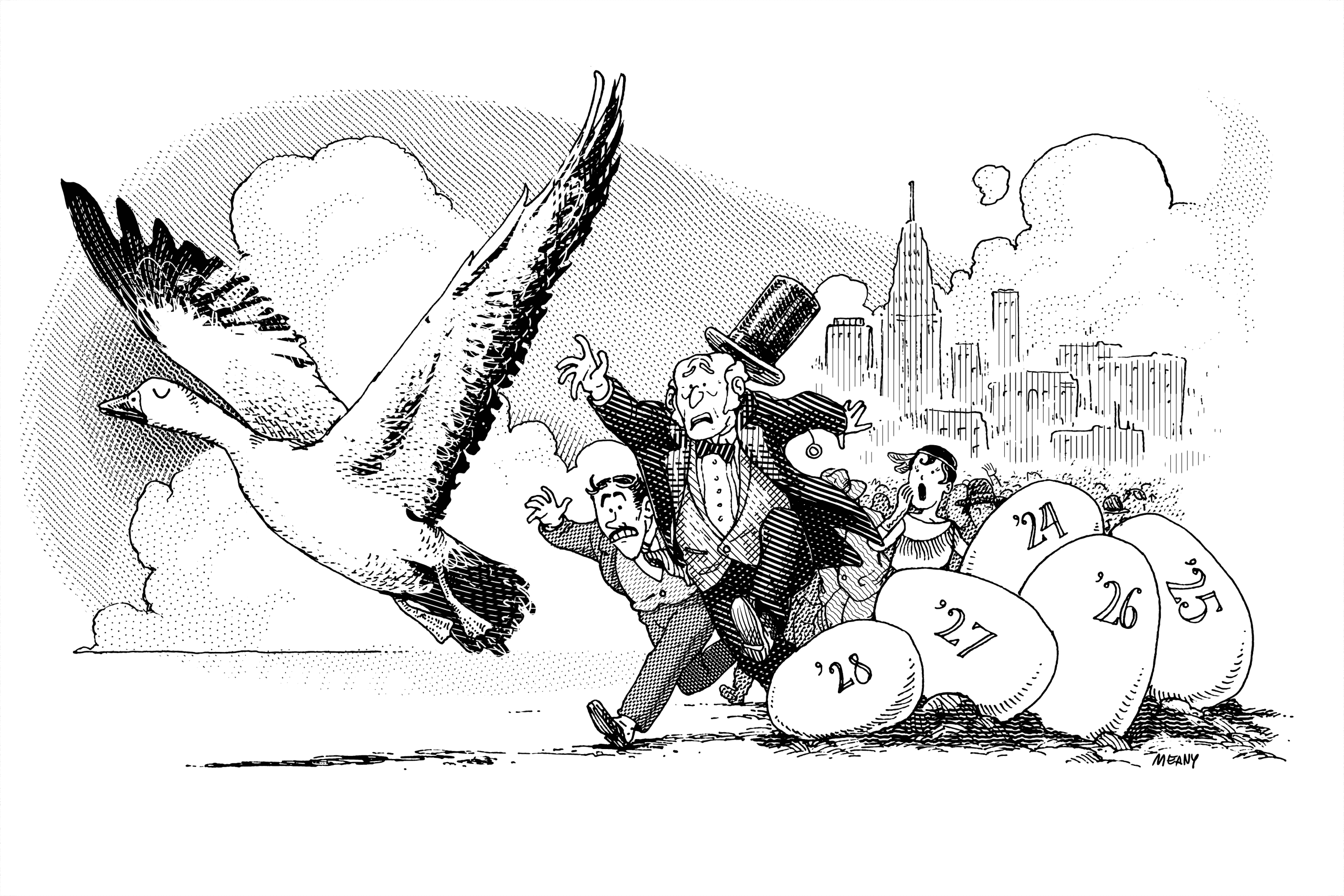
There are two surprises in Andrew Ross Sorkin’s 1929: Inside the Greatest Crash in Wall Street History—and How It Shattered a Nation. One is immediately obvious: his book has appeared a full four years before the centennial, posing a challenge for the publicity team. The other may be apparent only to its close readers. For the story Sorkin tells in 1929 implicitly undermines the conventional wisdom, which he explicitly endorses, about what his subtitle calls “the Greatest Crash in Wall Street History.”
Though the percentage decline in stock prices on October 29, 1929 has been surpassed since—on October 19, 1987 and March 16, 2020—neither swoon was followed by anything like the decade-long Great Depression that “Black Tuesday” is supposed to have made inevitable. Yet the conventional wisdom persists. It was propagated by the highly publicized Pecora hearings (named for the investigation’s fourth and final chief counsel, Ferdinand Pecora) in the early 1930s and by President Franklin Roosevelt’s inaugural speech in 1933, by the admiring New Deal histories of the 1950s and ’60s, and perhaps most effectively by the witty economist John Kenneth Galbraith’s The Great Crash 1929, published in 1955 and never out of print. In this view, the 1920s were a drunken party, full of frivolity and chicanery, followed by the extended—and deserved—hangover of the Great Depression. Wall Street operators, motivated by greed, defrauded gullible naifs and enriched themselves, often through thievery and fraud. Amid the mass suffering, the moneychangers were expelled from the temple—in FDR’s phrase—and reforms passed by Congress and administered by the likes of stock manipulator Joseph P. Kennedy brought American public policy into the 20th century.
***
On the surface, Sorkin—a financial columnist at The New York Times and author of Too Big to Fail, a bestseller about the 2008 financial crisis—echoes this view. He calls Galbraith’s account “canonical,” repeats caricatures of Calvin Coolidge “quietly reading papers at his desk” and “telling people no before they’d even managed to articulate a question,” and describes Treasury Secretary Andrew Mellon as a “resolute, unwavering” advocate of “business.” He laments the “bifurcation” of the economy—although vibrant growth inevitably means some sectors grow faster than others—and doesn’t have much to say about the longstanding economic and cultural gulf, far wider than anything today, between the industrial North and the stagnant, underdeveloped South. That gulf helps to explain Virginia Senator Carter Glass’s glee at the Black Tuesday losses and his North Carolina colleague Furnifold Simmons’s denunciation of an “orgy of speculation.”
Sorkin also takes only passing notice of the 1920-21 recession with its plunging stock market (down more in 1921 than in 1929) which began the decade. That sharp downturn, as James Grant argues in The Forgotten Depression (2014), was largely ignored by policymakers at the newly created Federal Reserve and by the bedridden President Woodrow Wilson and his successor Warren Harding. But the Fed’s increased interest rates and the presidents’ balanced budgets—the opposite of the Galbraithian conventional wisdom—were quickly followed by dazzling economic innovation and impressive job growth.
In recounting how stock prices surged in the 1920s, Sorkin does not hide the fact that they reflected genuine economic growth. The technological innovations from 1865 to 1914 were translated into products that improved—and transformed—Americans’ daily lives. The 1920s was the decade when the vast majority of Americans came to enjoy indoor plumbing and indoor electricity, when they could afford new wonders like refrigerators and radios and automobiles. For the first time, the 1920 Census reported, the majority of Americans lived in cities, with the great immigrant-swollen metropolises spreading out over radial avenues and subway lines into the countryside. It was a nation where people could buy cars on credit, a convenience pioneered by John J. Raskob, the DuPont executive who ran General Motors and boosted sales with car loans, and a nation where an increasing number—some 3 million out of a population of more than 120 million—were buying common stocks, often on credit as well.
***
This useful background, passed over in much New Deal hagiography, is presented as the product of serious research by a journalist whose commitments to The New York Times, its DealBook offshoot, and to CNBC would seem to leave little time for research. But Sorkin was inspired to immerse himself in the America of (almost) a century ago, as he writes in his acknowledgments and source notes, by his serendipitous visits to the papers of J.P. Morgan partner Thomas Lamont at Harvard, the National City Bank’s Charles Mitchell at Princeton, and Raskob at Notre Dame, as well as by his access to hitherto unavailable Federal Reserve meeting notes. He resolved “to do for 1929 what I had done for 2008 in Too Big to Fail—to write a fly-on-the-wall narrative that immerses readers in the moment.” Readers of 1929 will not encounter much in the way of macroeconomic analysis but will revel in its vivid, balanced narrative dominated by the words and responses of individuals once celebrated but little known today.
One example is Raskob, who not only ran General Motors for its DuPont owners but also chaired Al Smith’s 1928 presidential campaign. Bitter at Smith’s loss, as chairman of the Democratic National Committee in early 1929 Raskob hired journalist Charles Michelson to bash the victorious but politically tone-deaf Herbert Hoover, while Raskob and Smith built the Empire State Building (in 13 months!).
Another innovator, who figures larger than anyone else in Sorkin’s narrative, is Charles Mitchell. Mitchell worked his way through Amherst College, became president of National City Bank (the ancestor of Citibank) in 1921 at age 43, and spurred it to become the nation’s largest bank, mainly by extending credit to small borrowers. He made it, Sorkin writes, “the ‘Bank for All,’ a modern, diversified financial services corporation, with an emphasis on adding average Americans rather than Wall Street insiders to its customer base.” Or, as James Freeman and Vern McKinley put it in their history of the bank, Borrowed Time (2018), Mitchell built “a sort of financial Walmart for America’s growing middle class.” Just as General Motors and Sears and RCA made it possible to buy cars and refrigerators and radios on credit, Mitchell made it possible for middle-class savers to buy stocks and share in capitalism’s bounteous growth. In the process, he paid himself as much as $1 million in yearly bonuses. When the bank’s stock price cratered in October 1929, he bought huge numbers of shares to keep the bank from failing, then sold the stock to his wife to create (legal) tax losses.
A different perspective comes from Thomas Lamont, who, overshadowing J.P. Morgan, Jr., operated as the lead partner in the House of Morgan and as the firm’s ambassador to the White House (to FDR as well as to Coolidge and Hoover) and the outer world. On those days of dizzying price drops, when the ticker tape fell hours behind trades, it was to Lamont’s office that the heads of big financial firms traipsed in the hope of avoiding a cascade of failures, just as they had marched to the senior Morgan’s library during the Panic of 1907.
***
“The crash of ’29 was really the first domino of a series of dominoes that led to the Great Depression,” Sorkin told economist Tyler Cowen in a February podcast interview, but the narrative in his book undercuts the inevitability that his metaphor suggests. Lamont, Mitchell, and others were able to prevent the Great Crash from immediately producing the Great Depression. After their big spring and summer gains, stocks fell just 17% for the year, far less than in 1921. But other events obtruded, some of which Sorkin recounts in a series of chapters focusing on widely separate dates running into 1933. One was the failure in 1931 of the misleadingly named Bank of United States, New York’s third largest bank with 62 branches serving the upwardly mobile immigrants who had moved from the Lower East Side to the Bronx and Brooklyn. That heavily publicized failure was followed by bank closures across the country.
Sorkin does not grapple with the trenchant argument of economists Milton Friedman and Anna Schwartz that reductions in the money supply resulting from foolish Federal Reserve policies accounted for the macroeconomic disaster; or with the argument of Amity Shlaes and others that precisely Hoover’s and FDR’s attempts to buoy prices and wages prevented the quick recovery that Wilson’s and Harding’s more laissez-faire responses had secured after the crash of 1920-21. Sorkin has only scorn for Treasury Secretary Mellon’s advice to “liquidate” everything, and ignores the fact that, as a young man, Mellon had observed his banker father buying liquidated property at low prices in the Panic of 1873 or that, as head of the Mellon firm in the Depression of 1893, the thirty-something Mellon, in the words of his biographer David Cannadine, “made some notable strategic decisions…that would accrue great long-term advantage.”
***
This dismissal of Mellon contrasts with Sorkin’s treatment of Charles Mitchell, who refused to declare bankruptcy and paid off his creditors, was acquitted in one of the vengeful Hoover and Roosevelt prosecutions of Wall Street figures and, after losing his grand houses, built a successful brokerage business. Sorkin also punctures some conventional wisdom on New Deal legislation. Deposit insurance was opposed by Roosevelt as by Hoover for fear of moral hazard and was included in the banking bill Roosevelt signed in June 1936 after being pushed by Michigan Republican Senator Arthur Vandenberg (Detroit banks all closed in February 1933) and by Vice President John Nance Garner, a Texan who shared the Southern suspicion of banks that loaned out more money than the gold in their vaults.
That bill also contained the Glass-Steagall provisions separating commercial and investment banking, the repeal of which in the 1990s was blamed (wrongly, in my view) for the crisis Sorkin chronicled in Too Big to Fail. Sorkin points out that Senate co-sponsor Carter Glass, who opposed deposit insurance, was skeptical of separation; House co-sponsor Henry Steagall was a cipher. And the decline of National City Bank’s investment affiliate did not bring down the commercial bank, because of the way it was structured by Mitchell. The crucial support for Glass-Steagall came from Chase National Bank executive Winthrop Aldrich, brother-in-law of John D. Rockefeller, Jr. As Sorkin told Cowen in their podcast, the bill “was written by effectively a member of the Rockefeller family who owned Chase, and it was done in large part to shiv, if you will, J.P. Morgan, its competitor.” The House of Morgan had been a key player in the rise and consolidation of one giant new corporation after another in the years between the economic crashes of 1893 and 1929. With investment banks separated from the hordes of cash of commercial banks, and with the affluent middle class queasy about supposedly dangerous common stocks, the list of giant corporations remained remarkably stable from the 1930s until the deregulatory 1970s and the “predators” of the 1980s.
***
“The 1929 stock prices right before the crash—were they really a bubble?” Cowen asked Sorkin at the beginning of their podcast. The question is a direct attack on the Galbraithian conventional wisdom that the 1920s stock boom was nothing but froth. It clearly flustered Sorkin, who replied, “Oh goodness, what a place to start. Yes and no.” But of course he knows, as he admits, that U.S. stock portfolios grow robustly over every 30-year period, even one that begins on October 29, 1929.
Another person who realized this is a character that appears periodically in 1929, and who just happened to be in the gallery witnessing what was happening at the New York Stock Exchange on that antepenultimate day of the antepenultimate month of the 1920s: Winston Churchill. His investments, always insufficient to support his style of living, fell in value that day, but he was struck on this as on other trips to his mother’s homeland of Americans’ “unshakeable faith in a golden future.” He did not see one day’s crashing prices as a revelation of the rot underlying a frothy American economy. Instead, he appreciated its strengths. Churchill had seen not just the speculators and skyscrapers of Manhattan, within whose geography almost all the action of 1929 takes place, but also the steel mills of Pittsburgh and Gary, Indiana, the steel and auto factories of Detroit and Cleveland, and the vast sweeps of farmland and pasture—the sinews and strength of America, built up over decades of investment, none of it froth. So, when he heard, a dozen years later, the news of the attack on Pearl Harbor, “now at this very moment,” he wrote, “I knew the United States was in the war, up to the neck and in to the death. So we had won after all!”
Next in the summer 2026 Issue
Becoming Churchill

Saving Civics