Books Reviewed

Listen to this article
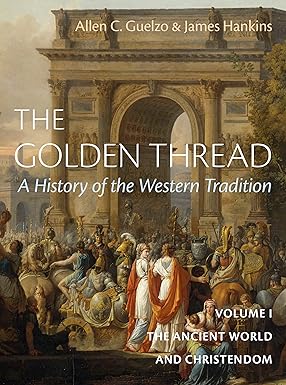
When Allen C. Guelzo and James Hankins began writing The Golden Thread, their two-volume History of the Western Tradition, they were both Ivy League professors. By the time it was published, neither of them was. Hankins, whose first volume on The Ancient World and Christendom sweeps from Greco-Roman and Jewish antiquity to the European Renaissance, gave his last lecture as a history professor at Harvard late last year. Guelzo, whose second volume on The Modern and Contemporary West begins with the Protestant Reformation and ends hauntingly with images of the World Trade Center shortly before its destruction, left Princeton last fall. Both authors are now faculty members at the University of Florida’s Hamilton School for Classical and Civic Education, established in 2022. The Golden Thread is a momentous achievement. It’s also a landmark event in the history of American letters. Its appearance signals that the country’s most prestigious universities have all but given up on maintaining the intellectual foundations of the West. For the time being, perhaps, the stewards of civilization will have to do their work outside the gates of the old academy. They will have to build something new.
***
“Few students or teachers have retained a sense that they are inheritors of a great legacy handed down via the classical and Christian traditions,” wrote Hankins last December in Compact magazine, in an article titled “Why I’m Leaving Harvard.” “When you don’t teach the young what civilization is, it turns out, people become uncivilized.” Maybe the simplest way of explaining what this means is to point out that civilization, among other things, is a kind of belonging. A civis, in Latin, is a citizen. To become civilized is to become a member of a society and a participant in a shared history. People who become uncivilized, then, become enemies. They are set in opposition to each other and to their ancestors. As Guelzo and Hankins put it in their introduction to Volume II of The Golden Thread, “Voices from outside and inside the Western tradition have condemned Westerners as oppressors, imperialists, colonizers, and appropriators.”
The term “Western civilization” encompasses the combined cultural inheritance of “Athens”—shorthand here for the pagan literary and philosophical traditions of antiquity—and “Jerusalem”—meaning the Scriptural and theological traditions of Israel and Christendom. This, at least, is what Leo Strauss argued in “Jerusalem and Athens: Some Introductory Reflections” for Commentary magazine in 1967: “Western man became what he is, and is what he is, through the coming together of biblical faith and Greek thought.” Guelzo and Hankins are well aware that this account of things took shape fairly recently. In 1869, when the English critic Matthew Arnold identified “Hebraism and Hellenism” as the twin wellsprings of European thought, he was already defending them both against what he called “the disparagers of culture” who “make its motive mere exclusiveness and vanity.” It was amid the catastrophic turmoil of the First World War that the German philosopher Oswald Spengler foretold in The Decline of the West. In some sense, then, the West only became fully self-aware when its inheritors were already worrying about its demise and laboring to shore up a common identity.
***
“It is true,” write Guelzo and Hankins in their joint introduction to The Golden Thread, “that the expression ‘Western civilization’ was hardly used before the twentieth century. It became popular in the era of the two world wars as a way to draw North Americans and overseas Britons closer to Europe and to encourage them to take responsibility for their common heritage.” All the same, “the thing denoted by the term ‘Western civilization’ was, emphatically, no invention.” In his chapter on “The Birth of Europe,” Hankins quotes the 12th-century historian Otto of Freising’s judgment that “learning was transferred from Egypt to the Greeks, then to the Romans, and finally to the Gauls and the Spaniards.” Otto may not have used the phrase “Western civilization,” but he was aware of himself as passing down the thing that would later travel under that name. “The great intellectual lights of the twelfth century,” writes Hankins, were “convinced that human reason, illuminated by revelation, was capable of building a world of order and justice, a world pleasing to God.” Like a proprietary house wine made by blending elements that can be found elsewhere—a little Grenache from over here, a little Mourvèdre from over there—the West can be seen as a set of disparate traditions fused in a unique combination. The searching reason of the Greeks and the blazing revelation of the Jews together informed the Christian faith, which in turn animated the Roman Empire’s successor states and fed the cultures that eventually produced—among other things—America.
This last part is what the so-called “culture wars” have always been about. The culture in question is Western culture. Just as the world wars helped crystallize the modern definition of the West, their outcome thrust America into the position of the world’s most powerful Western nation. So, the critics of the West became critics, first and foremost, of America. The student protesters of the 1960s were most directly incensed by what they saw as the twin injustices of anti-Communist death-dealing abroad and racial segregation at home. But they further learned to interpret those injustices as evidence that the postwar account of Western history, which presented America as a product of glorious ancient legacies, was founded on self-interest and lies. In truth, they concluded, America was only the latest in a long line of predatory super-states dating back to the Romans. Public outrage over the Vietnam War, and the killing of four unarmed anti-draft protestors at Kent State University, helped radicals to advance a wholesale case against the West. But when the war ended, the case kept advancing. A breaking point came in 1987 when Jesse Jackson, in between his two presidential campaigns, made an appearance at Stanford University and marched among 500-odd students as they repeated a now-famous chant: “Hey hey, ho ho, Western culture’s got to go.”
***
It went. Freshmen at Stanford were previously obligated to sit through a single survey of Western literature. The university had already dropped this requirement once, amid the first wave of protests in the ’60s, only to reinstate it half-heartedly even as humanities budgets continued drying up everywhere. The second round of demonstrations in the ’80s put an end to the course for good. In any case, surveys like Stanford’s were themselves only the last vestiges of what had once been a far more robust, confident kind of pedagogy. “Western History” in this context was really a catch-all term for the various subjects that used to make up remedial history, as in the basic sequence of major events that every educated American needed to understand. In the ’50s, Harvard’s history department offered a suite of entry-level courses on Greece, Rome, the Middle Ages, and Early Modern Europe. By the ’90s, James Hankins had to pack all those subjects into a single term of required instruction, under the heading of “Western Civilization.” It ran for less than ten years before his colleagues voted to let it go.
The end of Western culture at Stanford is often portrayed as the first in a cascade of similar changes at other colleges and universities. But it was equally the last stage of a long cultural project. Critics spent decades poking holes in the story Westerners told about themselves, until it was so flimsy it could be swept away with one last flick of the wrist. By the time Western Civ classes in America started vanishing, their detractors had already succeeded at calling into question whether “the West” is even a legitimate category, ranging as it does over an array of breathtakingly various but suspiciously pale-skinned peoples and their nations. And since cultures reinforce their identities by teaching history to young people, picking apart the curriculum that explained what held the West together was almost the same thing as picking apart the West itself. “Western culture’s got to go” meant two things at once: it was a rejection of Western culture, the civics course. But it was also necessarily an assault on Western culture, the phenomenon.
By 2016, New York University professor Kwame Anthony Appiah could argue in The Guardian that “[t]here is no such thing as western civilisation.” His point was that ancient pagans, for example, had very little in common with the modern Europeans and Americans who wanted to claim the supposedly glorious heritage of Greece and Rome by roping them into a joint project called “the West.” The resulting marriage of convenience among various disparate powers “lumps a whole lot of extremely different societies together, while delicately carving around Australians and New Zealanders and white South Africans, so that ‘western’ here can look simply like a euphemism for white.” This is the attitude that has almost utterly prevailed at the Ivies and their peer institutions.
***
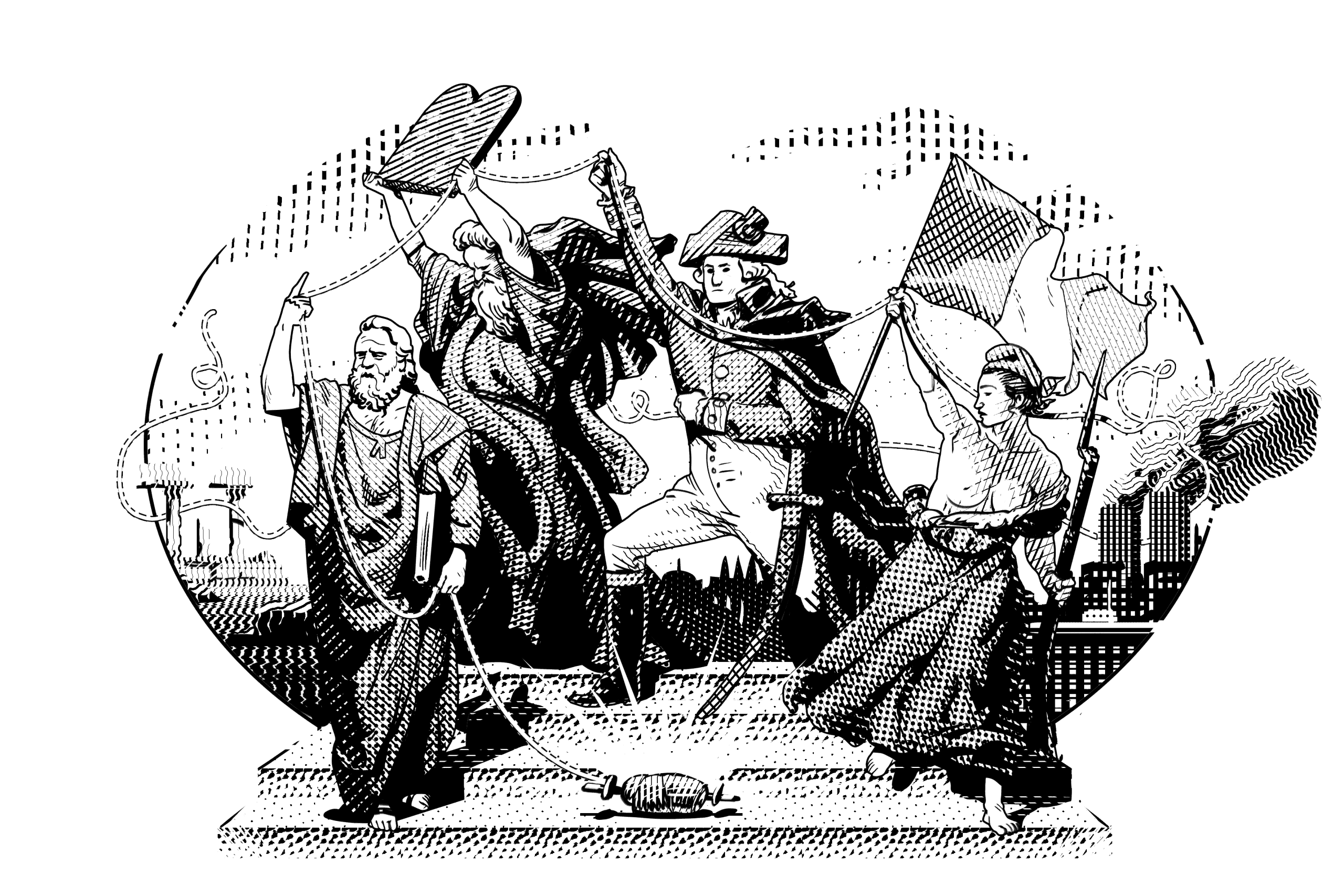
The Golden Thread therefore puts forward what is now the alternative point of view. It presents Western civilization as something real and worthy of being carried forward. The West isn’t the only great civilization on earth, Guelzo and Hankins argue, but it is great, and it is ours. The strands of history that hold it together are delicate, like the spool of golden thread that Princess Ariadne gave to the Greek hero Theseus so he could wend his way through Daedalus’ labyrinth and slay the minotaur without getting lost. “We want our readers to understand just how fragile our tradition is,” write the authors, “and how many times in the three-thousand-year-long history of the West the golden thread that ties us to our past and enriches us beyond measure has come close to snapping.” These two thick books are meant to reinforce the fraying cords that keep us bound to one another.
This means Guelzo and Hankins have at least two very finnicky tasks. They have to narrate three millennia of complex history without glossing over painful episodes like the persistence of the Roman slave trade in Christian Europe, or the British one in post-revolutionary America. But they also have to show in detail how the whole thing adds up to a coherent whole that, for all its blemishes, deserves admiration. To lace their story together, they punctuate it with rich color illustrations, timelines of major periods (“chronologies”), character sketches of important or emblematic figures (“biographies”), and meditations on common themes (“threads”). The publishers at Encounter Books clearly mean the volumes to stand alongside Wilfred M. McClay’s earlier history of the United States, Land of Hope: An Invitation to the Great American Story (2019), as what the historian Thucydides called a ktēma es aiei—a possession for all time.
***
Like Land of Hope, The Golden Thread is also intended as a corrective against what the late Roger Scruton called “oikophobia,” or hatred of one’s own traditions in favor of others with more multicultural cachet. For cutting against the grain of contemporary scholarship, Guelzo and Hankins have inevitably been written off as embittered reactionaries and crypto-fascists (one detractor on X accused Hankins of “contributing to the intellectual window dressing that has makes [sic] ICE’s current reign of terror”). By the nature of their subject matter, they were always bound to be faulted out of hand for chauvinism and oversimplification. So, it was important that their erudition be such as to put their attackers to shame. It is. Their credentials as historians—Hankins of the European Renaissance, Guelzo of 19th-century America—are unimpeachable. They have been trading notes since they were friends in high school. As a pair, they somehow manage to come across as both intimidatingly learned and disarmingly winsome. Neither of them is anything like a Trump apologist, and both of them come naturally by a sincere appreciation of other cultures. They may be two of the only people alive who could pull off a project like this with such a light touch.
In essence, the story they tell is a traditional one. Hankins opens it with the Battle of Marathon, which “pitted the mighty Persian Empire, stretching thousands of miles across central Asia and down into Egypt, against the city of Athens and the small allied town of Plataea.” Greece’s victory in the subsequent Persian wars made it possible for Athens to become the home of democracy and drama, history and philosophy. John Stuart Mill observed in the 19th century that “the Battle of Marathon, even as an event in British history, is more important than the Battle of Hastings,” which brought Norman and French rule to England. It’s perhaps a sign of the times that, to make this aphorism land today, you have to explain what happened at Marathon, connect it to what happened at Hastings, and indicate why a modern might care. Volume I of The Golden Thread does all three.
***
This is more than just a rehearsal of the standard episodes that used to be covered by the surveys, though. New students will get a grounding in the basic framework of Western history, but experienced readers will find plenty of surprises worth contemplating. One of the most original and subtle aspects of Hankins’s volume is the argument he works out, over the course of 1,100 pages, about the distinctively Western interplay between church and state power. It was the Jewish historian Josephus who coined the term “theocracy”—not to denounce an injustice, but simply to describe the Israelite system of government, which took revealed scripture as an authority for legal reasoning. Since medieval Catholic popes had a similar view of the Bible’s moral authority to inform secular law, one typical story people tell is that the backward-facing theocracy of the Church blocked the clear lights of science and reason until modernity let them shine forth. But Hankins shows, first of all, that the Church was neither particularly backward nor exclusively theocratic. From very early on, Christian jurists and theologians began to tease apart the responsibilities of temporal power—which kept public order—and sacred authority—which was responsible for the care of souls.
Early Christian luminaries like Saint Augustine “distinguished between imposing an exterior legal framework to support orthodoxy, which was the responsibility of the state, and the interior conversion of individual wills, which was the work of God’s grace.” In medieval Europe this idea evolved to create a “dyarchy” or parallel system of rule, in which popes and Holy Roman emperors oversaw distinct but complementary fields of human life—in principle, at least. In practice, this often meant that Church and empire took opposing sides in regional disputes over law and justice. The resulting situation of rambunctious and often violent competitive experimentation, within a loose overarching framework, created the necessary conditions for political freedom.
***
“In this way,” writes Hankins, “the medieval period produced what looks like a paradox from the modern point of view.” Because the Church recognized the legitimate authority of secular political leaders in their sphere, it could very readily take up the defense of early representative governments against the more exclusively aristocratic states sometimes favored by the emperors. In 12th- and 13th-century Italy, for example, popes often supported cities in which “popular communes” resisted knightly rule. “The sanction given by the papacy to the popular commune turned out to be critical to the survival of political liberty in Italy,” Hankins points out. Italy’s popular communes, in turn, became key precursors of modern republics like ours in the U.S.
It was chiefly in response to the encroaching threat of imperial Muslim caliphates that the papacy steadily tightened its grip, defending against its Islamic rivals by imitating them. “What the papacy…took from Islam,” writes Hankins, “was theocracy, a highly intrusive kind of religious law, and holy war.” All the same, in another grand irony, the papacy undermined its own moral authority by insisting on it too harshly. The states that bucked under harsh canon law in the Reformation were the ones “where modern political liberties, economic freedoms, and our immense power to control nature through experimental science first emerged onto the stage of world history.” Yet if the Swiss, the Germans, and the English bristled at being too sternly handled even by sacred governors, wasn’t that because of the very instincts instilled in them by their Western heritage? Weren’t they only practicing the liberties of soul and conscience that the Church itself had helped teach them fiercely to defend?
Hankins further points out that the confused and enervated state of modern Western societies makes it an open question whether the demise of political Christendom was as entirely salutary as the champions of the Enlightenment made it out to be: “It is by now clear to almost everyone that the many-sided freedoms and power over nature that have come to modern Westerners since Christian authorities were made to relax their grip on our moral and intellectual lives are by no means unqualified goods.” If the end of papal authority was a natural outgrowth of the West’s most humane traditions, it also posed new and acute challenges to them. “At the present moment,” writes Hankins, “it is all too obvious that we moderns are fully capable of destroying our natural environment and thoughtlessly discarding three thousand years of cultural achievement…. Whether we should be grateful for Christendom’s failures is thus a question about how our own story will end.”
***
That question leads into Allen Guelzo’s story of the more recent past. The Golden Thread’s second volume opens with scenes from Europe’s gory wars of religion, as full of petty venery as they are of high principle and romantic glamour on all sides. The Reformation established religious pluralism among the states of the West at an excruciatingly high cost. “It has to be said,” writes Guelzo, “that the savagery and butchery that European Christians visited on each other in the name of the same God and Jesus Christ…threw the claims of all of them into disrepute.” The disintegration of Christendom let loose an explosion of political, artistic, and scientific energy. It also dissolved the bonds of religion and law that previously made sense of Europe’s political and spiritual project. Not since the fall of the Roman Empire had the West faced such a severe crisis of identity. We are still living with its consequences.
Maybe no one saw this situation more clearly, or earlier on, than William Shakespeare. Guelzo offers a lovely reading of Shakespeare as a consummate artist of the modern West, finding in his plays “a blend of classical and Christian virtues” that proved durable as old certainties fell to pieces and new theaters of conflict opened up. Even amid “religious conflict, imperial warfare, and the unreflective trade across the Atlantic Ocean in slaves,” the Bard gave what one of his characters called “a local habitation and a name” to the otherwise “airy” ideas that Westerners were always straining to realize. One of these ideas, in Guelzo’s words, was “that the fundamental human identity is personal and inward rather than ethnic or national.” Yet another was “that authority and tradition cannot be abandoned without pulling down the entire cultural house.” The tension between these two principles—order and liberty, the irreplaceable individual and the legitimate claims of ancestral civilization—would propel the West through the turmoil of the coming generations.
This helps explain why the American and the French revolutions are at the core of Guelzo’s narrative. Much of our subsequent history can be read as a high-stakes debate over which of these two great upheavals represents the more legitimate expression of modern Western thought. Though the American Founders certainly set themselves against the monarchies of the old world, they saw their right to do so as “endowed by their Creator” as well as “self-evident” to reason. They came to their conclusions by way of both Athens and Jerusalem. In France, by contrast, philosophes like Voltaire and Diderot looked upon the Catholic Church as l’infâme—the “hateful thing” that had stifled reason with its false and corrupting claims to revelation. That meant the West could only be purified by being radically transformed: “Only by sweeping away the whole structure of prerevolutionary society,” writes Guelzo, “would the revolutionaries be confident that the demands of virtue had been satisfied.”
***
The terror and bloodshed that followed haunted the memory of 19th-century liberals. John Quincy Adams, quoting Shakespeare, had predicted that the drama of America’s war for independence would be “acted o’er / In states unborn, and accents yet unknown.” But was it France’s Revolution or America’s that was scheduled for a repeat performance? The revolutionary spirit spread like fire, alright, but it was hard to tell in advance just how much of the past it would burn down. Modern liberalism came to be characterized, as Guelzo tells it, by an “instinctive attempt to complete the work which the Enlightenment had begun, which the American Revolution had realized, and of which the French Revolution and Napoleon’s armies had made such a wreck.”
And then? It depends on whom you ask. For some, the liberals went entirely too far, casting aside age-old doctrines of religion and morality in the name of reckless hedonism and doctrinaire rationalism. For others, the liberals failed to go far enough, leaving Europe and America mired in crude prejudice and unthinking self-regard. The West scraped through two world wars and survived a face-off with Soviet Communism only to find itself severely rattled by the rise of Arab terrorists for whom, as Guelzo puts it, “the keystone of the sinful West was the United States.” Osama bin Laden looked on America and saw only a godless monstrosity grown fat and slovenly in its imperial greed. Jesse Jackson’s acolytes looked at it and saw an exploitative ethno-state living off the stolen valor of its victims at home and abroad. All seemed convinced the West had lost its way; many seemed ready to dispense with it altogether. Hey hey, ho ho, Western culture’s got to go.
***
Fewer and fewer people could explain why it should stay. Guelzo doesn’t cover the 21st century, but its ongoing perma-crises of debt and mass migration have not evinced a sterling self-confidence on the part of Western nations. Nor have the derangements of Covid or the racial angst following the death of George Floyd. One is reminded of Whittaker Chambers’s glum insistence to William F. Buckley, Jr. that “it is idle to talk about preventing the wreck of western civilization. It is already a wreck from within.” Without a unifying ideological opponent in the form of the Soviet Union, Chambers predicted, the West would buckle under the weight of its own internal contradictions and weaknesses. Its defenders could only shore up fragments against their ruin: “we can hope to do little more now than snatch a fingernail of a saint from the rack or a handful of ashes from the faggots, and bury them secretly in some flowerpot against the day, ages hence, when a few men begin again to dare to believe that there was once something else.”
That’s arguably a bleak but fitting description of what Guelzo and Hankins are trying to do with The Golden Thread. In an extraordinary article last year for Compact, titled “The Lost Generation,” the writer Jacob Savage described how well-reputed faculties across the country have made it almost impossible, in ways official and unofficial, for young academics to rise in the ranks by studying Western history. Humanities departments adopted covert ideological criteria for new hires, stopped opening up new jobs in classic fields, or simply agreed together not to appoint even excellent scholars with the wrong research agenda. “Hanging over it all was an invisible curriculum, the political assumptions about what should and should not be studied,” observed Savage. One graduate student at a top university told him about a friend with expertise in Roman military history. “And I just thought you are hopeless, there is no way anyone is going to hire you…. He almost wasn’t schooled properly. If he had been…he would just drop all that about military history, because he’d know that’s white and European and male and dead.”
***
These are the kinds of dynamics that make a man like James Hankins despair of doing his work within the Ivies. He wrote for Compact that his department at Harvard “has lost eight senior historians in Western fields—all major figures—through death, retirement, or departure for other universities. I will be the ninth, and I am not expecting to be replaced.” Under those conditions, Hankins is not the only one to conclude that the research and teaching which sustains the West will have to be done in scrappier, more countercultural institutions. The new Hamilton School for Classical and Civic Education, where he and Guelzo now teach, is dedicated to “research and teaching focused on the foundations of democratic citizenship and the great works of Western and American thought.” The University of Austin, Texas, where I teach Greek literature, is a start-up in its second year whose arts and letters program professes a similar mission. There are other schools, colleges like Hillsdale, Ralston, and Thomas Aquinas, offering instruction in the same vein. As the old academy has shut its doors against lovers of the canon, this new one has started to take shape and attract first-rate students. The Golden Thread is likely to become a cornerstone of the curriculum taught by a parallel American education system.
The next question is whether the renegade academy will succeed. By far the better part of the resources and prestige are still on the side of the old guard. But much of the country’s academic energy and talent is rapidly bleeding out of big-name schools and into more innovative ones. That makes for a challenging but not a hopeless prospect. After all, the birth of new institutions amid the rubble of old ones is a leitmotif of The Golden Thread. When the Byzantine Empire fell to the Ottoman Turks, for example, refugee scholars had to pack up centuries’ worth of accumulated cultural capital from the Greek world and bring it bit by bit to Rome. “O famous Greece, behold now your end!” wrote Pope Pius II. “Greek letters, I believe, are finished.” Hankins translates this passage and then describes how the literary and intellectual elite of Athens, deprived of their ancestral home, made their way steadily westward in search of other ivory towers. “The physical survival of texts, of course, was (and is) not sufficient by itself to preserve the memory of ancient civilizations,” he writes. “What kept the ancient Western languages alive were many generations of scholars who believed passionately in their value.”
***
“We are part of one civilization—Western Civilization,” Secretary of State Marco Rubio told a gathering of European leaders at the Munich Security Conference in February of this year. Not long before that, a pro-Palestinian student group at Columbia published a statement saying that “We are Westerners fighting for the total eradication of Western civilization.” America’s 250th anniversary finds it locked in an internal struggle over whether to revive its Western heritage or dismantle it from within. The outcome will depend in large part on which academy triumphs, which kind of history young people learn. If the old academy has suffered a hostile takeover, as the Byzantine one did, the new one will have to be built steadily amid its ruins by people committed to the painstaking work of doing so. But then, the Western tradition has always had to keep itself alive amid self-doubt and existential threat. It has arguably been fending off disaster from the beginning, since the Greeks fought at Marathon. Through it all, the inheritors of Athens and Jerusalem have always had this one major advantage: our great works of art and literature truly are great, as are the civilizations that produced them. Handing them down is the work of our true scholars—whether they find themselves tenured or exiled. The Golden Thread is a history of near-run survivals and improbable resurrections. It’s also a noble part of that history, as are its authors. They can count their job well done.