Books Reviewed
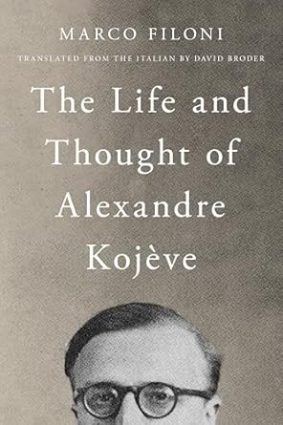
Alexandre Kojève believed history had ended—and then went to work for the French state. Philosopher of the master/slave dialectic, confidant of Leo Strauss, sometime Stalinist, Resistance member, architect of the postwar European order, weekend metaphysician, and likely KGB informant, Kojève led a life that reads like a philosophical roman noir. In The Life and Thought of Alexandre Kojève, Marco Filoni, an associate professor of political philosophy at Link Campus University, Rome, reconstructs this remarkable career with clarity and admiration—though not always with the critical distance that Kojève’s more extravagant claims demand.
Filoni’s book is part of a growing body of work dedicated to understanding a thinker who blurred the lines between philosophy, politics, and power. More than three decades after Francis Fukuyama famously drew on Kojève to proclaim “the end of history” in the twilight of the Cold War, Kojève’s ideas continue to provoke. In recent years, a steady stream of his unpublished writings has emerged from the archives, including his World War II works and early essays on atheism, metaphysics, and physics. The most striking is Sophia, Tome I: Philosophie et phénoménologie, the long-lost first installment of a massive study addressed directly to Stalin. Written during World War II’s darkest years, the manuscript seeks to synthesize philosophy, geopolitics, and the Soviet mission into a unified historical vision. That Kojève, whose work with the French Ministry of Economic Affairs in rebuilding postwar Europe would help lay the groundwork for the European Union, could offer such a document to a totalitarian ruler—without ceasing to see himself as a philosopher—is just one of the paradoxes that define his legacy.
***
Born Aleksandr Vladimirovich Kozhevnikov in Moscow in 1902, Kojève came of age amid the ruins of the Russian Empire and the upheaval of the Bolshevik Revolution. Descended from a wealthy, cultivated family—his uncle was the painter Wassily Kandinsky—he was intellectually precocious and unafraid of risk. In the early 1920s he was arrested for trafficking in black-market soap, an offense that, in Bolshevik Russia, could easily have led to execution. His salvation was a family connection: his mother, drawing on her pre-Revolutionary ties, appealed to Lenin’s personal physician, who intervened to secure his release.
Kojève soon fled the Soviet Union, despite his revolutionary sympathies. Had he stayed, his mother later told him, he “would have been shot at least five times over.” He made his way to Germany, living off family jewels, and enrolled at the University of Heidelberg to study philosophy, though he also spent considerable time swept up in the bohemian ferment of Weimar Berlin. He attended lectures by Karl Jaspers at Heidelberg University and immersed himself in the thought of Immanuel Kant, G.W.F. Hegel, and Eastern traditions.
During this period, Kojève began to see philosophy not as an abstract exercise but as a world-shaping force, a conviction that animated his later reading of Hegel as herald of the future. In 1926 he defended his dissertation, written under Jaspers’s supervision, on the Russian religious philosopher Vladimir Solovyov. But his gaze was already shifting westward, toward a rationalist, secular vision of politics and modernity.
That same year Kojève moved to Paris, where he remained for the rest of his life—and where he left his most significant intellectual imprint. His decisive turn came in 1933, when he was invited to take over Alexandre Koyré’s seminar on Hegel’s religious thought at the École Pratique des Hautes Études. Over the next six years, Kojève delivered a series of lectures on Hegel’s Phenomenology of Spirit that became an event in French intellectual life, sparking a Hegel renaissance. His audience included Jacques Lacan, Georges Bataille, Maurice Merleau-Ponty, Raymond Aron, the Jesuit priest Gaston Fessard, and novelist Raymond Queneau. “Kojève’s course exhausted me, annihilated me, killed me ten times over,” Bataille recalled. As Filoni puts it, “the best of postwar French culture bowed to a Russian exile who impressed on them his image of Hegel’s system.”
***
Queneau later compiled the lecture notes, transcriptions, and course descriptions into a single volume, published in 1947 as Introduction à la lecture de Hegel—a book that solidified Kojève’s legacy as the man who brought Hegel to Paris. A condensed English edition, edited by Allan Bloom and translated by James H. Nichols, Jr., appeared in 1969.
At the heart of Kojève’s lectures was a radical reinterpretation of the master/slave dialectic, a relatively minor episode in Hegel’s Phenomenology of Spirit that Kojève elevated into the driving force of human development. Drawing on Karl Marx and Martin Heidegger as well as Hegel, Kojève argued that man is defined by desire—not just for material things like food or sex, which any animal seeks, but for recognition by another consciousness. This desire leads to a life-and-death struggle in which one party submits and becomes the slave, while the other—willing to risk everything for a non-material demand—becomes master. But this only opens the story of history. The slave, through labor and the internalization of fear, begins to transform the world and over time acquires self-consciousness and knowledge, ultimately overtaking the master. History, in this telling, is the progressive building of a world based on mutual recognition.
This progression points toward a final synthesis: the realization of universal recognition in what Kojève called the “universal and homogeneous state.” In this final state all human desires are satisfied, and the fundamental struggle that defines historical existence reaches its culmination. During the 1930s, Kojève didn’t claim that this end had been achieved, but suggested it was on the horizon and could be accelerated by revolution. Hegel had seen Napoleon’s arrival in Jena in 1806 as the realization of Spirit in political form. For Kojève, Stalin stood—grimly—as the leading edge of that realization, the sovereign master marching the historical process to its rational conclusion, however cruel the means. This interpretation of Hegel—who in some respects was a conservative thinker—made Hegel more of an anticipatory Marxist than he was.
***
Kojève’s “end of history” seems less a utopia than a philosophical tombstone. Man’s fundamental drama would be over. What would remain, Kojève claimed, was a post-historical being without inner contradiction or heroic purpose, living in comfort, perhaps, but also in spiritual enervation. In some passages, he pictured the future as populated by bureaucrats administering rational order; in others, by artists playfully reenacting bygone struggles. At the summit of this world would not be the philosopher but the sage, a figure who no longer seeks wisdom but embodies it, whose role is not to question but to preserve and guide the completed historical order. Most disturbingly, Kojève also imagined a completely post-human future: “Animals of the species Homo sapiens,” he predicted of such a state, “would react by conditioned reflexes to vocal signals or sign ‘language,’ and thus their so-called ‘discourses’ would be like what is supposed to be the ‘language’ of bees.”
After the Second World War, Kojève began to see a convergence between the democratic-capitalist West and the Soviet bloc. Both, in his view, were evolving toward the same post-historical condition: a rationalized, bureaucratic society in which economic administration replaced ideological struggle. This universal and homogeneous state could wear a tie or a commissar’s cap. In a provocative aside in a 1957 lecture on colonialism, he even called Henry Ford “the only great, authentic Marxist of the twentieth century”—not because Ford was a revolutionary, but because the assembly line, mass production, and high worker wages had peacefully achieved what Marx envisioned could only happen through violent conflict.
Later still, in a strange footnote added to Introduction à la lecture de Hegel, Kojève claimed to have found in a 1959 trip to Japan another possible model of post-historical life. Japan’s rigid cultural formalism, devotion to ritual, and aestheticized daily life—“snobbery,” as Kojève called it—represented, for him, a society that had exited the historical stage without reverting to animality. “[W]hat Japan teaches us, is that one can democratize snobbery,” he noted in a 1968 interview. “Japan is eighty million snobs.”
***
Kojève’s war years were shadowy, marked by ambiguity and danger. In 1940, he reportedly fled south from German-occupied Paris and was briefly captured by the Nazis—only to escape a firing squad, Filoni reports, by talking his way out of captivity. Recognizing the regimental commander as a former Munich art curator, Kojève invoked his visits to the gallery and his family tie to Kandinsky. The two, “both men of culture,” bonded over art, and Kojève persuaded the officer to let him go. Though never a fighter, Kojève maintained ties to Resistance networks and lived modestly during the occupation, continuing to write even as France descended into repression and collaboration.
It was during this period—cut off from teaching and political engagement—that Kojève drafted some of his most conceptually dense philosophical writings, including meditations on authority, justice, and the legal foundations of the state. He even speculated whether the Vichy regime, for all its moral compromises, might evolve into a rational post-liberal order. These wartime texts, published posthumously, reveal a philosopher grappling with the disintegration of European civilization and trying to imagine the form its rational reconstruction might take.
Kojève entered government service in 1945, joining the French Ministry of Economic Affairs. There, he helped shape the legal and economic institutions of postwar Europe. Fluent in several languages, he became an influential behind-the-scenes figure in the reconstruction of France’s trade policy and the early stages of European integration into what would become the European Union—a globalist avant la lettre. To colleagues, he was a formidable technocrat; to those who knew his intellectual past, it was as if the philosopher of the end of history had taken up residence inside the machinery of the administrative state that he once prophesied. Filoni recounts the striking shift in Kojève’s trajectory: “When his friend Raymond Aron asked him why he had left philosophy behind, or at least publicly done so, in favor of a role in the administration, Kojève answered, ‘I wanted to know how to make history.’”
Even as he toiled to construct the universal state in that growing bureaucracy, Kojève did not abandon philosophy. He reserved Sundays for writing and continued to reflect on history, authority, and the meaning of political life. It was during this period that he entered into his most famous intellectual confrontation: a debate with his friend Leo Strauss over tyranny, philosophy, and human nature. Their exchange, centered on Strauss’s 1948 commentary on Xenophon’s Hiero, became a proxy war between ancient and modern thought—between Strauss’s defense of timeless philosophical questions and Kojève’s insistence that history had rendered those questions obsolete. For Kojève, the true philosophical life ends with the end of history; for Strauss, that claim betrayed philosophy’s very essence as a critical, questioning power.
***
Kojève died suddenly in 1968, collapsing in Brussels shortly after delivering a lecture on international trade—an appropriate final scene for the thinker-bureaucrat. Only after his death did suspicions intensify that he may have worked as a KGB informant. French intelligence had long kept him under scrutiny, and later archival discoveries suggested he may have passed information to Soviet contacts. The truth remains elusive, like much else in Kojève’s life.
One clue Kojève left behind—deliberately or not—came during a conversation with the young scholar Pierre Hassner, as related by Filoni. When Hassner visited Kojève with Aron, the philosopher advised them that anyone who wished to understand politics should read The Man Who Was Thursday, G.K. Chesterton’s metaphysical detective novel. The book follows a London police chief investigating a cabal of seven anarchists plotting to bomb the city. One by one, six get unmasked—and each turns out to be an undercover agent. In the final twist, the seventh anarchist is revealed to be none other than the police chief himself, orchestrating the entire affair. “Perhaps Kojève found it attractive, indeed logical, to advise both sides,” Hassner later observed, “especially since for him they were two different paths to the same universal and homogeneous state.” It’s a fitting coda for Kojève, whose life unfolded like a philosophical riddle: the man who lectured on history’s end, worked on tariffs by day, and may have passed secrets between Cold War empires, all while seeing himself, like Chesterton’s investigator, as the incarnation of the cunning of reason.
***
Marco Filoni’s thoughtful book doesn’t resolve the question it implicitly raises: does Kojève deserve his lasting influence? Kojève’s thesis of the end of history remains dubious. It assumes that political and philosophical striving can be resolved in a final synthesis of recognition and rational administration. But history is not governed by a single principle like the master-slave dialectic. It is pluralistic, contingent, and shaped by freedom—which keeps it open-ended, defined more by ruptures than resolution. Today’s world looks increasingly un-Kojèvian, fragmented into rival civilizational models: China’s surveillance capitalism, technocratic Europe, populist democracies, theocratic regimes, and whatever the United States is in 2025. Rather than converging on one rational order, modernity splinters. History continues: unpredictable, restless, often violent. Progress, as real as it can be in technological domains, has not overcome the human condition.
Kojève imagined that mutual recognition would bring rest. But that assumes the human desire for meaning can be satisfied by comfort or refined taste. Strauss, in their exchange on tyranny and philosophy, countered with a more powerful view: the timeless questions of justice and the good life persist, rooted in the nature of the soul. Man is not made for contentment alone. Alexandre Kojève leaves us, then, with a stark question: is man wholly shaped by history, or does something in him always escape?