Books Reviewed

All the recent breakthroughs in “machine learning” and “artificial intelligence”—from goofy chatbots to revolutionary medical tools—have relied on the computing power supplied by a single American company. The Santa Clara tech firm Nvidia makes microchips that can handle the sheer volume of data required for training A.I. models to imitate patterns in human speech and images. That one product has made Nvidia the most valuable company on earth. Its CEO, Jensen Huang, is one of the most important men in tech. He is also one of the most fascinating.
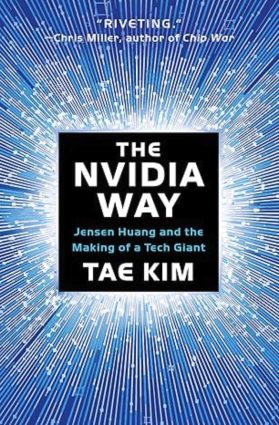
Two recent books illuminate the significance of Huang’s work: Tae Kim’s The Nvidia Way: Jensen Huang and the Making of a Tech Giant and Stephen Witt’s The Thinking Machine: Jensen Huang, Nvidia, and the World’s Most Coveted Microchip. Kim, a senior writer at Barron’s who has covered the tech sector for decades, draws a portrait of Huang as a maverick CEO by outlining the suite of habits, strategies, and sayings that have fostered Nvidia’s success. Witt, whose book emerged from a New Yorker profile, provides a more holistic account of Huang’s biography and its relationship to his company. Taken together, the two books reveal a great deal about the hopes and fears surrounding the A.I. boom. They also serve as a tribute to the sheer force of personality that characterizes American titans of industry like Huang.
***
A microchip is a tiny set of electronic circuits carved into silicon. Silicon is a “semiconductor,” meaning that the flow of electricity through it can be modulated with extreme precision. You can fit billions of electric components onto a microchip the size of a fingernail, and so you can encode a vast amount of information onto a very small space by representing it in patterns of electric stimulus. Carved onto the square face of every chip runs a latticework of circuits that convert electricity into problem-solving power. The chips Nvidia pioneered—Graphics Processing Units, or GPUs—have the unique ability to perform the kinds of tasks required for A.I.
In 2008, Huang hired the team from the TV show MythBusters to create a visual representation of what sets a GPU apart from its sister technology, the Central Processing Unit (CPU). When working on a problem, CPUs move in a direct, linear fashion, solving one piece of the puzzle at a time. GPUs, on the other hand, use parallel computing to perform a suite of smaller tasks all at once. To represent this, MythBusters had two paintball machines paint a picture. The machine representing the CPU shot one ball at a time to render a smiling face, a process that took around a minute and a half. The paintball machine that represented the GPU, meanwhile, shot thousands of singular paintballs, all of different colors, at the same time. It painted the Mona Lisa in 80 milliseconds.
***
Huang has helmed Nvidia since forming it in 1993 with business partners Curtis Priem and Chris Malachowsky, at a Denny’s pocked with bullet holes on the shabby side of San Jose. The three entrepreneurs initially conceived microchips as tools for running better, more detailed videogames on personal computers. They were betting, against conventional wisdom, that a robust market existed for P.C. videogame hardware. There was no such industry to speak of at the time, and Sun Microsystems, the men’s former employer, had no interest in pursuing the lead.
It was a major risk, to say the least, but Huang, Priem, and Malachowsky managed to secure funding. Then Huang began his painful education in running a business. Nvidia almost failed out of the gate; its first two chips tanked. The first, NV1, was a disaster because it tried to do too much by storing both visual and audio data at once. Its audio rarely worked and needed constant patching. The over-engineered graphics component could run the newer 3D games, but it wasn’t “backward compatible,” i.e., capable of running the older 2D games—and back then, those made up the vast majority of computer games. Nvidia’s first product both failed to work and walled them off from potential consumers.
The follow-up, NV2, succeeded only by a margin. According to Kim, Nvidia had inked a sweetheart deal to supply chips to the Japanese gaming company Sega. But while Nvidia developed the NV2, a little company called id Software launched its flagship game, DOOM, which exploited 2D graphics cards to look nearly 3D. DOOM, a first-person shooter in which the player controls a marine shooting demons on a Martian hellscape, was a revolution in gaming. It not only looked great, it managed to make its inventive heavy metal score sound great, all while relying on the standard audio card. In other words, it didn’t need any of what the NV2 offered. Worse, the NV2 couldn’t run DOOM, which quickly became a runaway seller. Seeing what it assumed was the writing on the wall, Sega then stepped out of the deal with Nvidia except for the contracted NV2 chip, which debuted in a now-largely forgotten console called the Sega Saturn. Sega promptly abandoned the chip upon receipt, having found it unsuitable for its console. Nvidia reeled backward on the ropes, bleeding cash, stuffed with top-tier talent and bottom-tier product.
***
The picture darkened. Nvidia’s biggest competitor, 3dfx, soared ahead of them while id Software released Quake, another leap forward that brought gaming fully into three dimensions. Nvidia’s fate seemed sealed because 3dfx decided to forgo an acquisition, figuring they could snatch up all of Nvidia’s talent for pennies on the dollar after they filed for bankruptcy. To pull the company back from the brink, Huang had to lay off staff and then drive his demoralized troops to pull off a miracle. So he returned to first principles. What did consumers really want? They didn’t care about excellent coding or elegant design. They wanted a cheap, fast, and dazzling graphics card. Less show, more go. Identifying problems and then working ruthlessly to remedy them is a strength of Huang’s that both Witt and Kim cover well.
But Huang’s ability to grind out solutions was far from his only gift. The business world teems with smart, relentlessly dedicated people. Huang, meanwhile, possesses another rare trait: an appetite for wild risks disciplined by rigorous extrapolation from first principles. Back in the 1990s, one of the most time-consuming parts of chip design was testing if the chip actually worked. This slow, hands-on process required ’round-the-clock work. But time was exactly what Huang didn’t have. So he risked most of the money Nvidia had left on a chip emulator, which simulated and thus sped up the testing process. This, he hoped, would cut down on man-hours and speed up the delivery timeline. It was a calculated gamble, and it worked. Nvidia released the mammoth RIVA 128 chip, the biggest and most impressive graphics card the world had seen to date, in 1997. Gamers loved it. Even better, the chip could run Quake beautifully.
Nvidia kept perfecting its chips to render the game, ultimately resulting in a new category of chip altogether: the GPU. David Kirk, one of Huang’s smartest hires, speculated that the best way to serve customers would be to develop graphics cards that relied on parallel computing. This meant taking complex tasks, like rendering the elaborate lighting effects in Quake, and breaking them up into smaller tasks that could then be executed simultaneously. It was another huge risk. Silicon Valley was strewn with the corpses of parallel computing companies that had failed. But Huang realized, before any of his competitors, that whoever figured out how to render Quake’s 3D graphics better would dominate the entire graphics industry. Young consumers’ appetite for immersion in 3D visuals was boundless. Kids wanted to disappear into the Matrix. Nvidia’s parallel computing chip, TNT, would serve as the Matrix’s brick and mortar—even more so than its creators knew. Within these chips lived the yet-unexploited secret to revolutionizing humanity’s relationship with technology.
***
As Witt observes, the phrase “disruption” has become such an industry cliché that its meaning has more or less dissolved. But to Huang, disruption meant something very specific. He’d picked up the word from Clayton Christensen’s The Innovator’s Dilemma (1997), which examined Honda as a company that had paradigmatically changed the automotive industry. Honda started with its Super Cub dirt bikes, a product so attractive to teen boys that the Beach Boys wrote a song about it. By cornering a smaller, cheaper market, Honda honed its skills and then parlayed its new abilities into overtaking its competition in the auto market. The incumbents didn’t see this coming because they were more concerned about selling cars to businessmen than dirt bikes to their sons.
Huang took this lesson as gospel, and even hired Christensen as an advisor for a while. Disruption was his roadmap for overtaking first 3dfx, his nearest competitor, and then Intel, the incumbent, which was more concerned with selling business terminals to executives than graphics cards to their kids. Huang also made another crucial decision around this time. Nvidia’s European chip fabricator kept delivering shoddy work, so he eventually got ahold of Morris Chang at the Taiwanese Semiconductor Manufacturing Company. TSMC is something like the global foundry for the global chip industry. As chips grew more complex, it became too difficult for one company to “vertically integrate” their production by both designing and making them in-house. TSMC, under Chang’s savvy leadership, capitalized on this split and turned his country into the key hardware supplier for our computerized world. Nvidia was a small fish when Huang first met with Chang, but Chang saw something in Huang and his scrappy company. So, they inked a deal which secured Nvidia’s supply of well-made chips.
Combining his brute-force iteration schedule with high-quality chips, Huang soon overcame all his competitors and poached their best talent from them. Nvidia was ascendant. Yet, in the late 2000s, Huang turned his attention to a seemingly futile endeavor: he started promoting a free programming language that runs exclusively on Nvidia hardware. The resulting package is known as Compute Unified Domain Architecture (CUDA). Huang directed billions toward CUDA, providing the soft- and hardware backbone for all kinds of new scientific research. The only problem was these scientific endeavors didn’t pay. To board members, it looked like Huang was burning through cash for an obscure software add-on that only a few hundred people downloaded every year. They nearly mounted a coup, and Huang had to defend himself from a hostile takeover.
***
What looked like derangement was in fact a talent search. Huang wanted to find the next Honda Super Cub, so to speak. If any one of the programmers using CUDA developed code that triggered a scientific watershed, then the entire existence of a major new technology would be premised on Nvidia’s hardware and software. What Huang hoped for was a renegade batch of scientists who could revolutionize the world with a couple of Nvidia GPUs in their bedrooms running around the clock. To everyone’s surprise, the bet paid off. In the early 2010s, researchers on the frontiers of what would become the A.I. industry unlocked the secret to making image recognition accurate via “machine learning” techniques. Both Kim and Witt spend time unpacking the technical mechanics here—Kim with slightly more economy and technical detail, and Witt with a broader perspective on how nigh-on miraculous it was that Huang bet right. In short, there would be no A.I. if not for Nvidia, whose GPUs and coding architecture made it possible in the first place. At present, it feels almost impossible to overstate the impact of Huang’s gamble. Nvidia is currently worth over $3 trillion. In the first quarter of 2025, the company raked in over $44 billion in revenue. It has become the most important stock in the world.
Of course, none of this could have happened without Huang’s leadership. Kim’s book provides the clearer view of this. One telling aspect of Huang’s style is his insistence that all presentations must be done on a dry-erase board, exclusively using a particular brand of marker found only in Taiwan. Anyone familiar with white-collar meetings should be able to intuit what’s powerful about this: presenters cannot rely on a glossy slide deck, but must manually map out their pitch, idea, or strategy. The format exposes all proposals to fruitful criticism, saves time on the presentation, and strips out fluff.
***
Kim also captures the crushing demands Huang makes on his team—demands for uninterrupted excellence and long, long hours. “People who train for the Olympics grumble about training early in the morning, too,” Huang tells one grumbler. He has also made an ethos out of dressing people down in public. No one is ever screamed at in private, because Huang believes that everyone can benefit from someone’s public humiliation. He isn’t shy about firing people, either. Kim describes his “up or out” approach, wherein “people either get promoted on a regular cadence” or get “pushed out to make room for someone with greater potential.” However harsh these approaches appear, Huang balances them with a communal ethos that “no one loses alone” and a fierce loyalty to those who stick around.
This speaks to Huang’s character, about which Witt proves the more illuminating. In a way, there’s something old-school about Huang’s sensibilities. Witt contrasts them with those of Elon Musk: Huang values loyalty, Musk does not. “Huang maintained a stable marriage and spoke of [his wife] Lori with great affection,” whereas Musk has sired 14 children with four women; Huang has never donated to a cause or so much as voiced a partisan political opinion, in stark contrast to Musk. Moreover, Huang has never been fond of stock buybacks or other gimmicks to pump up his profits. Nvidia’s purpose is excellence—whatever the cost.
Witt, far more than Kim, identifies the challenge men like Huang pose to society. Throughout the book, Witt expresses his ambivalence about the A.I. revolution. Will it make writers like him obsolete? Are we entering a stranger, perhaps more inhuman or even inhumane world, as in the poet Richard Brautigan’s eerie 1960s vision of a society where we are “all watched over by machines of loving grace”? In interviews, Huang dismisses Witt’s concerns. To him, A.I. is yet another tool in the human arsenal, like a calculator or a turbine. This doesn’t lessen the intensity of his devotion to perfecting it, though. At the very end of the book, when Witt confronts Huang one final time about the societal implications of A.I., Huang explodes in frustration. “This cannot be a ridiculous sci-fi story,” he tells Witt. “We are serious people, doing serious work. And—it’s just a serious company, and I’m a serious person, just doing serious work.”
***
If Huang doesn’t see Witt’s questions about A.I.’s social impact as “serious,” perhaps that speaks to the single-mindedness with which tech innovators pursue their aims. Yet those aims do inevitably have a major effect not just on the global economy but on the direction of the world’s major civilizations. Nvidia is in fact a case in point. The company has a vested interest in selling its chips to China, and last year it ended up embroiled in controversy when, by dint of technicalities, it ducked an embargo on sales to America’s Communist rival. Huang views selling chips to China as something more than a boon to his own bottom line. “With half of the world’s A.I. researchers based there, the platform that wins China is positioned to lead globally,” Huang said on a recent Nvidia earnings call. He emphasized that “shielding Chinese chip makers from U.S. competition only strengthens them abroad.”
Yet Huang has also signaled his support for Donald Trump’s broader trade policy. A few days after that earnings call, he described Trump’s use of tariffs as an incentive to re-industrialize and re-invest in the United States as “incredible” and “bold.” It’s hard to pair these views with Huang’s insistence on openness toward China, just as it’s hard to treat his business like any old profit-making venture. This venture, specifically, is already working profound changes in American and human life. That’s the unique challenge that outsized figures like Huang pose: their unrelenting pursuit of their goals is what raises them to the level of excellence in their field. But it also makes them chafe against the bounds of allegiance to their country.
American greatness in the 21st century will depend in part on men like Jensen Huang. The question is whether they will choose to put American greatness above their own. And whether or not our leadership recognizes both the opportunities and challenges Nvidia poses for America. In August, Nvidia inked a deal to give the American government 15% of the money it makes from selling A.I. chips to China. Unwise.