Books Reviewed
“The right to property is the guardian of every other right, and to deprive a people of this, is in fact to deprive them of their liberty,” wrote Arthur Lee of revolutionary Virginia. Today, this sentiment must seem incomprehensible to many of our fellow citizens, who not only reduce property to a number (income, assets, credit score) but often see the inequality that property enables as a threat to liberty. These are the same people most likely to flirt with socialism, apparently believing in its promises of justice and happiness. But every American Founder—including James Madison, who later wrote that freedom of the press is the “guardian of every other right”—held that people “have a property in [their] rights.” Can people who do not understand property possibly understand their liberty or rights?
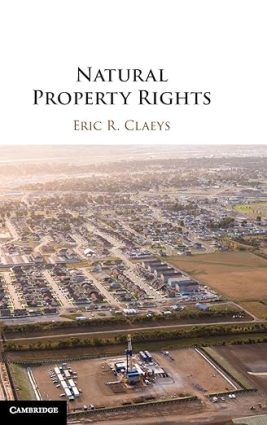
Eric R. Claeys’s excellent new book, Natural Property Rights, is a thorough and painstaking effort to ground the law of property in the theory of natural rights. It is essential reading for anyone interested in restoring America’s civic order. A professor of law at the Antonin Scalia Law School of George Mason University, Claeys writes with a double purpose: to provide a moral foundation for property rights in natural law, and to explicate the Anglo-American common law of property in light of natural rights reasoning. This is no small undertaking, and since Claeys integrates law and analytical philosophy to achieve his aims, the result is not after-dinner armchair reading. But if you have the stamina to work through the book’s careful argumentation, you will see that Claeys has developed an account of property that lawyers and judges will ignore at their peril. If the book receives the attention it deserves, it will not only bring clarity to a dangerously confused area of law but also provide guidance to legislators and judges on issues that touch everyone’s life.
***
In his introduction, Claeys promises ultimately to explain what is wrong with the Supreme Court’s decision in Kelo v. City of New London. This 2005 case upheld a city’s use of its eminent domain power to condemn homes in an older neighborhood and sell the land, in part, to Pfizer for a pharmaceutical plant. At the same time, Claeys promises that his approach will justify the government in forcing property owners to pool their mineral rights so that frackers can recover oil gathered underground in sand or shale. He also defends the commonsense rule of “snow dibs,” the right of car owners who shovel out their vehicles after a blizzard to protect their spots until the snow melts. “Natural property rights” can explain what is just in all three situations, and much more besides.
In his defense of natural property rights, Claeys often reiterates the arguments of John Locke. But his concept of natural law reasoning itself comes from Aristotle and Thomas Aquinas, not from Locke’s contemporary Thomas Hobbes. Natural law reasoning in Claeys’s view is fundamentally about the rights and duties necessary to foster the good life for human beings. Although “[p]hilosophically, the rights are not more fundamental than the duties…in practice…it makes sense to focus politics and social life more on the rights than on the duties.” Perhaps this is because natural law accords to individuals a substantial degree of agency to decide how they plan to flourish and to act accordingly. There is a common good, which includes the formation of a closed political community empowered to make laws. But the common good is not conceived in such a way as to “require extensive sacrifice” from its members. Rather, it is what enables the individual members to achieve their own good—that is, their interests. A good community flourishes by allowing people “spheres of freedom” in which they can seek happiness as they choose: “Rights protect people’s prerogatives to pursue the activities they enjoy and excel at.”
***
If this seems a bit abstract, that is by design. Within the general structure of natural law, individuals are free to make their own specific choices, and societies to make their own specific laws to secure natural rights. Choice is governed by practical reason, which both specifies general principles in particular circumstances and determines which way to proceed in matters left to the decision-maker’s discretion. Natural law is not so rigid as to force different jurisdictions into one uniform set of customs, projects, and laws. But neither is it so permissive as to allow just anything to qualify as “good” based on majority whim or personal desire. What it demands is that people act reasonably as individuals and that their laws be rationally justified.
For Claeys, property rights belong to persons and apply to things that are separable from them. “The point of property is to help people put separable resources to use,” Claeys writes. He does not, like Locke, start with property in one’s body. In part this serves to rule out chattel slavery more clearly than Locke does. From there, however, any item distinct from the human person—from tangible natural items like land and water, to intangible things like intellectual property—falls under property law. Like Locke, Claeys assumes that every member of a community “is entitled to a reasonable opportunity to access” the “commons,” or the general stock of natural resources available for survival. Yet he also recognizes, with Locke, that “enclosure”—assigning individuals property rights in some portion—will usually ensure much better development of those resources than leaving them in common. The question, of course, is how to decide or justify who gets what.
Claeys writes that there are four steps to settle questions of property rights—two qualifications for ownership, and two limitations on it. First, there is a requirement that owners, to take possession of a natural resource, must make productive use of it. This principle can help resolve thorny questions that arise when new technologies develop which themselves might require new resources (e.g., “rare earths” for computers). Second, property owners must achieve effective “claim communication”; that is, they need to mark the extent of their ownership so that others can know what they will be obliged to respect. These two principles readily enough allow ownership of the earth’s surface. They explain why and how an old common-law rule, which permitted ownership of the air space above the land as far as heaven (ad coelum), could be modified suitably after the invention of the airplane. The basic rule, according to Claeys, is that property owners make their own judgment about how to use their land and their things. The law guarantees their property and generally does not scrutinize its use, provided that such use does not harm their neighbors or interfere with their property rights. Property rights in this way are fundamentally egalitarian: you get yours if others get theirs.
***
There are, however, two constraints on the rights of property. The first is necessity: A boat in a storm can use a dock without permission. A man in desperate need can claim water, food, and shelter. Familiar as this proviso is, its function is limited in an advanced society where charitable provision is available for the least fortunate. The second proviso is more interesting in an advanced economy. The “sufficiency proviso” requires, as Locke put it, “enough and as good left for others.” It ensures that opportunities remain for non-owners to acquire property for themselves, undergirding laws against monopoly and affecting many other areas from riparian rights (in flowing water) to development rights in an urban environment. Property often entails the negative right to exclude others from using a thing, but more essentially it entails usufruct, the positive right to use it. Use can be shared and sometimes has to be. For similar reasons, the law can sometimes legitimately forbid a man from destroying what he has built.
Claeys has to contend with several alternative accounts of property law. To begin with, there are radical libertarians who claim that rights of ownership are absolute and established by first occupancy or by invention. Those who take this position, however, cannot refute the claim—implicit in contemporary “land acknowledgments”—that America’s land was stolen from its first occupants. On this question, though not as bold as settlers who asserted rights of the civilized against the savage, Claeys does assert that “the sufficiency proviso undermines first possession norms.” Because he recognizes the naturalness of political communities, his argument is better able to justify our ancestral settlers than the arguments of individual rights absolutists—even if it does not entirely quiet the conscience.
Claeys’s most mainstream opponents, however, are often (though not only) on the left. They are the utilitarians. By and large, they believe that property is not a single reality but a “bundle of rights” over a certain thing, so that each right can be treated separately—and either respected or discounted—in each case. In many areas of law, natural rights advocates have gotten the better of utilitarians. On questions of property, however, utilitarianism and its cousin pragmatism reign supreme. According to Claeys, this is not because utilitarians have advanced good affirmative arguments for their own positions, but because they have launched powerful attacks against natural property rights, claiming that they are either intellectually incoherent or corrosive of the common good. Doctrine by doctrine and case by case, though, Claeys shows that his natural law theory of property rights both coheres philosophically and protects public interests. He reminds his friends in law and economics that property rights protect more than just the economic value of assets; different ideas about human flourishing are not simply different strategies for acquiring money or different plans for its expenditure.
***
In the final section of the book, Claeys turns to the broader questions of land use, public regulation, and eminent domain. Here he defends the common law of nuisance, sic utere tuo ut alienum non laedas: so use your own as not to injure another’s. This principle can provide a check on the modern tendency to give government a blank check to define the common good and issue whatever regulations it sees fit. Claeys aims to restore the original understanding of the police power as vindicating, not overriding, property rights: regulations are just when they supply determinacy to rights, when they enforce the duty not to harm others, and sometimes when, as in the fracking issue, they secure “average reciprocities of advantage”—i.e., when exerting an absolute right to exclude others’ use of the resource would thwart its productive use.
As for eminent domain, it is justified only when title to the property taken goes to the public in the form of something like a road or a park. The government cannot seize land simply to satisfy the vision of some city planner whose aesthetic sensibility is offended by the way actual people choose to live, or (as in the Kelo case) to cut a deal with big business and pad the state’s bottom line. Claeys’s point throughout is not that property rights dictate an answer to every regulatory question, but that they provide coherent guidance to law- and policymakers who wish to do justice as well as to achieve some other end. Individuals in a free society deserve “broad spheres of discretion,” both in ordering their own lives and in governing their communities. Confident like Locke and Adam Smith that private property and the common wealth rise or fall together, Eric Claeys not only makes that general observation but works out its details so that the devil has little place to hide.
Few could deny that preserving natural property rights against unjust imposition was part of the spirit and the rationale of the American Revolution. “No taxation without representation” meant no taking away property without consent. Claeys’s theory protects both ownership and opportunity, both individualism and community, both development and democracy, charting a moderate path that is principled as well as prudent. If it proves too much for the armchair, buy a copy for a lawyer, a professor, or a judge.
Next in the fall 2025 Issue
Ancient and Modern
JQA’s Ambition