Books Reviewed
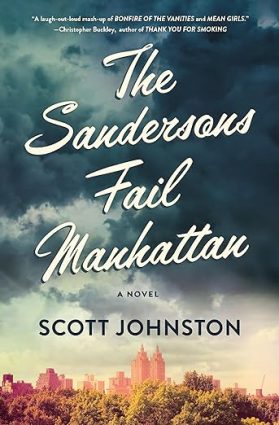
A question haunts the mind when reading Scott Johnston’s The Sandersons Fail Manhattan, a satire of the college admissions racket: is this a work of historical fiction or of current reportage? Until just yesterday, the novel’s targets—the elites’ self-abasement before the gatekeepers of higher education and the pitiless social hierarchies enforced by those gatekeepers—seemed like unshakable traits of America’s ruling classes and institutions.
Recently, however, a possibility has arisen that the entire apparatus of academic identity politics and its real-world offshoots, including the veneration of manufactured victimhood and the scapegoating of whites, may be dismantled by Donald Trump’s executive actions. If so, then The Sandersons Fail Manhattan can be read as an artifact of an era just concluded, all the more important for chronicling the group hysteria that so many would prefer to forget. Sadly, however, the chances are good that the novel will remain relevant for years to come.
Johnston’s acclaimed first novel, Campusland (2019), ridiculed the #MeToo movement as it played out on a New England campus. This time, Johnston turns his sights on the incestuous relationship between Ivy League institutions and the private Manhattan day schools that have traditionally served as a conveyor belt into the Ivies. The results are even more hilarious.
***
Like many great satirists, Johnston’s subject matter is the human lust for power, riches, and prestige. The Sandersons Fail Manhattan explores that lust as it plays out in the competition to credentialize one’s child with an Ivy League degree.
William Sanderson, an affluent, third-generation Yale alumnus, is desperate to get his eldest daughter, Ginny, into Yale. “Sandersons always go to Yale” is his watchword. He is almost equally desperate to land a contract to manage $5 billion of California’s gargantuan public pension fund, CalPERS. Doing so will earn him a place on the executive committee of his wealth management firm, Bedrock Capital, and catapult him into that empyrean where, as the novel puts it, one no longer updates one’s LinkedIn profile but erases it entirely.
Meanwhile, Ginny’s exclusive girls day school, Lenox, has itself just vaulted into greatness by enrolling the Manhattan private school sector’s first trans student. The Sandersons Fail Manhattan is set at the dawn of the tectonic shift that dethroned blacks from the top of the oppression totem pole, replacing them with claimants to trans and other “gender-nonconforming” identities. Lenox secured its enrollment coup by giving away the store to the trans student’s parents, who bargained ruthlessly for tuition breaks and other privileges after instigating their child’s valuable new identity. Now, however, the student has disappeared, mobilizing a massive apparatus of advocacy-group agitation and ecstatic victimhood promotion.
***
Beneath the book’s humor lies a revelatory analysis of the economy of elite power and prestige. That economy is almost infinitely fluid: its players can be dominant one moment and subservient the next, master one moment and slave the next, depending on the identity of their trading partner. Only one entity—the Ivy League college—occupies a permanent position of power, controlling the currency of status and dictating the terms under which supplicants may approach, terms it can change at will.
Thanks to the academy’s pursuit of “diversity,” the admissions slots available to the once-traditional Ivy League student—a well-off, “heteronormative” WASP—are shrinking to a nullity, driving the value of those admissions slots to ever more dizzying heights. The scarcity of status currency has given the colleges power to shape American childhood. Selective universities determine what young children study, what they do with their free time, and how they define themselves.
Orbiting around these suns of royal dispensation are vassal institutions, including such traditional prep schools as Andover, Brearley, and Dalton. Their prestige depends on how many of their students are accepted into the celestial realm. The colleges dictate what the prep schools teach and whom they admit.
A former headmistress from Ginny’s school, Lenox, learned in her annual pilgrimage to the Holy of Holies—the Yale admissions office—that Lenox’s curriculum had become unsatisfactory, needing “More Maya, less Milton.” Its student body also no longer met Yale’s needs. Yale was now in the trans market, and Lenox had no trans tokens to trade.
Naturally, all required changes were made. Lenox jettisoned the former headmistress, along with her atavistic commitment to teaching Latin, and brought in an Indian-American, Padma Minali. Padma (headmistresses go by first names at Lenox) is not just committed to the intersectional agenda, she is driven by it. She favors girls schools over co-ed or boys schools because girls are “susceptible to social activation.”
But while the private schools grovel before their academic masters, they are as tyrannical in their own realm as the universities. One might think that a contract between a school and parents would obligate the school to educate the parents’ children up to a high standard. Instead, it is the parents who sign contracts to conform to the equity agenda fostered by the school, since it is the gatekeeper to the ultimate gatekeeper, the college admissions officer. Parents count on their children getting into the private feeder schools to boost those children’s admissions chances, and they depend on the school’s college counselor for the make-or-break letter of recommendation. Kremlinologists would have appreciated the nuances in those recommendations: downgrading a “brilliant” to “intelligent” will kill off any hope for cocktail party bragging rights.
***
The p.c. prep school deals with dissident parents efficiently. A Lenox parent rebels during a school board meeting devoted to land acknowledgments and confessions of white genocide. Required to “share” how he “identifies,” the retrograde father responds, “I identify as Bob.” Worse, he declares that his “sexuality,” or, as he puts it, “who I like to sleep with,” is none of the school’s business. Bob, his mortified wife, and his daughter are immediately disappeared from the school roster. Equally Stalinesque is the redoubled fear and conformity among the parents who remain.
In order to enter America’s most exclusive institutions, would-be votaries must declare their undying fealty to a pseudo-egalitarian leveling. Occasionally, the contradiction in those two positions becomes especially acute. One of Johnston’s most audacious scenes is a conversation between Padma and William Sanderson over his daughter’s chances of Yale admission. These are not good, thanks to Yale’s efforts to “make opportunities available to a wider set of applicants,” as Padma puts it. “We’re all for that. We all value diversity,” Sanderson responds. “But I’d also like my daughter to get into Yale.”
Tired of beating around the bush, Sanderson asks: “What’s the number?” Padma’s response is a masterpiece of euphemism overlaid upon the crassest of greed. “I don’t know that they like to get too specific about these things, but the number [X] did come up.” (I omit the amount to preserve the shock value.) Actually, there are two numbers—one buys a “second look” for an application before it is discarded in the too white, too able-bodied, too heterosexual pile. The other “remove[s] as much uncertainty [regarding admission] as possible,” according to Padma. That number is fivefold the already enormous second-look figure.
“Those greedy sons of bitches,” a stunned Sandereson replies. He had been assuming, with charming naïveté, that his annual $10,000 alumni gift would unlock the doors to the kingdom. Sanderson is right about Yale’s greed, of course, but it is his and his peers’ lust for status that enables Ivy League extortion in the first place.
***
Pecuniary greed confers similarly disproportionate power in the financial world. CalPERS, which is dangling the $5 billion contract before Sanderson’s firm, can dictate wildly irrelevant terms to its suitors—in this case, possession of at least one gay member on a management firm’s executive committee. Bedrock Capital’s previous inclusivity efforts—its early hiring of a DEI director, its keffiyeh-wearing Qatari board member—avail nothing before this new demand.
The Bedrock CEO’s response to the LGBTQ condition creates one of the novel’s several moral polarities, reminiscent of Charles Dickens. Whereas the banished Lenox parent Bob had insisted on maintaining a zone of privacy, Bedrock’s CEO orders Sanderson to produce the required gay offering. “If they want to know who we’re f—ing, we’re going to tell them who we’re f—ing.” But CalPERS is itself subservient to elite opinion to certify its social justice bona fides, which is why it makes its ESG demands in the first place.
Johnston’s writing has been compared to Tom Wolfe’s, specifically to his The Bonfire of the Vanities (1987). Johnston’s eye for Upper East Side folkways, honed by his upbringing there, is similarly piercing: he notes the magnanimous pity with which residents of westward-facing Fifth Avenue apartments gaze upon the elegant prewar behemoths of Central Park West, and the resignation with which Park Avenue dwellers accept the indignity of having to descend to Third Avenue to pick up their garaged cars. A reader learns with interest of the status difference between the St. John’s and Chanel brands.
***
Both Wolfe and Johnston disembowel the identity hustlers. Bonfire’s Reverend Bacon is replaced here by a feminist lawyer, Sylvia Haffred (modelled on feminist lawyer Gloria Allred, with a name change recalling a character in a Restoration drama). Haffred is as masterly as Bacon in mobilizing manufactured outrage, though the flashpoint of that outrage has shifted from race to “queer” identity, and social media have opened up a whole new arena for amplifying astroturf protest. Haffred can, on a moment’s notice, deliver scores of public union members in identical t-shirts and waving identical signs to the grateful cameras of a compliant press. A particularly madcap scene disgorges a busload of drag queens into the dining room of Sanderson’s Hamptons country club, where they proceed to perform lewd acts with the club’s signature lobster salad. The CalPERS representative, who had been invited to a round of golf to clinch the $5 billion deal with Bedrock Capital, deadpans: “Interesting club you have here, William. More inclusive than I imagined.”
The Sandersons Fail Manhattan is less dark and more antic than The Bonfire of the Vanities, however. It leaves no bitter aftertaste in the mouth. Its final section has the feel (in a good way) of a Looney Tunes cartoon, as the pace of action quickens and the subplots that Johnston has kept ingeniously woven together reach a climax of absurdity.
One yearns for the novel’s targets to read it. How would they respond to this evisceration of their own pretense? Most likely as one reviewer responded to Campusland and as academia responds to every charge of systemic leftism: “These are just non-representative, isolated, and exaggerated incidents that ignore the serious work of universities!”
Such a defense is preposterous, of course. The folly that Scott Johnston has satirized in his two novels and that conservatives attest to with data and with personal testimonial is endemic. The embrace of “diversity” is official policy, not a figment of conservative imagining. But even if self-recognition is rare, however much a satire has held the “mirror up to nature,” The Sandersons Fail Manhattan provides the comic underpinnings for the growing revolt against the tyranny of the elites and their hypocritical self-regard.
Next in the fall 2025 Issue
The Real Watergate Scandal

Never Trump After 2024