Books Reviewed
The New Atheist movement arose in the wake of the 9/11 attacks to argue that religion promotes violence, retards progress, and encourages credulity. It began with neuroscientist Sam Harris’s The End of Faith in 2004, and continued with a run of bestsellers from evolutionary biologist Richard Dawkins, journalist Christopher Hitchens, cognitive scientist Daniel Dennett, and political activist Ayaan Hirsi Ali. It ended in the early 2020s, when Hirsi Ali announced her conversion to Christianity in a much-discussed essay for UnHerd and Dawkins declared himself a “cultural Christian” in an interview with the British channel LBC.
As the New Atheism faded, something surprising arose in its place. Call it the New Theism. Like its predecessor, the New Theism is an elite phenomenon that may be a sign of broader changes. Rather than a self-conscious movement, it is an intellectual tendency with recognizable traits. Above all, it is a response to the decline of formal belief. Its members often seek to account for the fact that even as religious observance has decreased, spiritual experience has not. Surveying contemporary society, they also conclude that the decline of religion has not been invariably salutary.
***
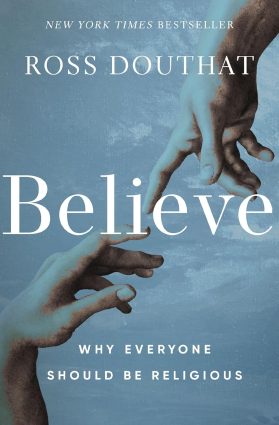
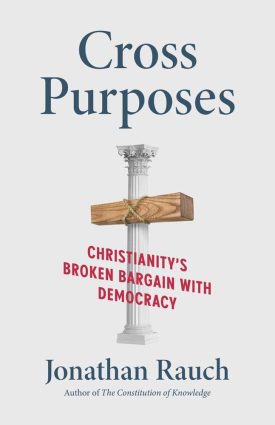
Two recent books—Ross Douthat’s Believe: Why Everyone Should Be Religious and Jonathan Rauch’s Cross Purposes: Christianity’s Broken Bargain with Democracy—represent distinct strands of the New Theism. Read together, they suggest that though religious observance may continue to fade in the years to come, something important about our intellectual culture has changed. Douthat, a conservative Catholic and New York Times columnist, argues gently but firmly that liberal skeptics should be more open to faith. Rauch, a fellow at the Brookings Institution and self-described “atheistic homosexual Jew,” explains that he has become convinced religion is necessary for sustaining American democracy, even though he himself does not believe. Both books attempt to reckon with the failures of the New Atheism and propose a sounder alternative, but only one is finally successful. To understand why, it is necessary to retrace the New Atheist movement’s rise and fall.
When the New Atheism emerged, its spokesmen denounced Islamist terrorism and the religiously inflected politics of George W. Bush as twin threats to individual freedom. It might seem a stretch to propose any similarity between Osama Bin Laden’s terror network and the Bush Administration’s Office of Faith-Based and Community Initiatives. But the suggestion that American evangelicalism led to the same dark place as radical Islamism seemed to resonate. A raft of political commentary books—four in 2006 alone (Damon Linker’s The Theocons, Kevin Phillips’s American Theocracy, Michelle Goldberg’s Kingdom Coming, Rabbi James Rudin’s The Baptizing of America)—encouraged the idea that a cornpone caliphate would soon force American women to wear long denim skirts.
None of that came to pass. Instead, denunciations of religious people helped to justify their exclusion from public life. Same-sex marriage became the defining social cause of the educated class in the mid-2000s, rivaled only by enthusiasm for Barack Obama’s presidential candidacy. Opponents of same-sex marriage warned that it would result in infringements of religious freedom, but these concerns were brushed off. “Bake the cake, bigot” became a popular refrain after Colorado baker Jack Phillips was sued for refusing to make a cake for a same-sex wedding.
In professional-class contexts, the same forces could be observed. It was not lost on religious believers that expressions of opposition to same-sex marriage, or of disapproval for same-sex acts, might be seen as creating a hostile work environment. Meanwhile, corporations sponsored pride events, issued public statements, and promoted intra-office displays of solidarity—all of which tended to discourage religious people from seeking employment or advancement.
***
Did the New Atheism help to speed religion’s decline? In terms of public opinion polling, its emergence looks like an inflection point. Between 1992 and 2003, at least 57% of respondents told Gallup that religion was very important in their lives. In 2004—the year in which Harris’s The End of Faith was published—that number began to decline. By 2023 it was 45%. The New Atheists would appear to have a great deal to celebrate. But the movement’s former champions no longer seem certain that spiritual experience is easy to dismiss, or that religion is entirely dispensable.
It was not the arguments of believers but the experiences of the atheists themselves that began to complicate their case for unbelief. For Sam Harris, it happened on a hill overlooking the Sea of Galilee. Resting at the place where Jesus is thought to have delivered the Sermon on the Mount, he felt a strange sense of peace. “It soon grew to a blissful stillness,” he recalled in his 2014 book, Waking Up. “In an instant, the sense of being a separate self—an ‘I’ or a ‘me’—vanished.” In a 2010 debate with Tony Blair, Christopher Hitchens suggested that such experiences can’t be explained in strictly material terms. “I’m a materialist,” Hitchens. “Yet there is something beyond the material, or not entirely consistent with it, what you could call the Numinous, the Transcendent, or at its best the Ecstatic.”
Around the same time as Harris described his spiritual experience, the atheist Barbara Ehrenreich wrote a memoir, Living with a Wild God (2014), recounting her run-ins with a distinctly personal, yet supernatural force. On one of these occasions, walking alone at dawn, she felt the whole world flame into life. “Something poured into me and I poured out into it,” she recalls. “This was not the passive beatific merger with ‘the All,’ as promised by the Eastern mystics. It was a furious encounter with a living substance that was coming at me through all things at once.” Nothing about these experiences proves the existence of God. But the fact that prominent voices of unbelief were speaking in apparently spiritual terms indicated the limits of the New Atheism. Its rationalism was too dry, its materialism too narrow, to give a satisfying account of reality.
***
The New Atheists also came to hold a higher view of Christianity as a cultural force. What they had previously viewed as a threat now began to appear indispensable. Tom Holland’s book Dominion (2019) proved to be influential in this regard. It argued that much of what is seemingly modern and progressive in Christian societies—their stress on individual freedom, the value they place on human rights, their pursuit of scientific knowledge—stems from Christianity itself. Ayaan Hirsi Ali credited Holland’s argument in explaining her own conversion. Having discovered that much of what she valued in Western civilization was a “legacy of the Judeo-Christian tradition,” she followed that insight to actual belief in Jesus Christ.
Richard Dawkins hasn’t gone quite so far, but he does now call himself a “cultural Christian” and even insists that Britain is a “Christian country.” In 2024, he told an interviewer about his love for hymns, Christmas carols, and the architectural legacy of belief. “It’s true that statistically the number of people who actually believe in Christianity is going down, and I’m happy with that. But I would not be happy if for example we lost all our cathedrals and our beautiful parish churches.” There is an obvious contradiction in this attitude. It took faith to erect those monuments, and without faith they cannot remain standing. As Dawkins surely realizes, Britain is not on its way to becoming a quietly unbelieving society, in which the strongest religious voice is heard in the dying strains of a half-remembered hymn. The younger a person is in Britain, the more likely he is to be Muslim. As Islam makes growing claims on British public life, the cultural inheritance Dawkins treasures will have to be sustained by something stronger than the former schoolboy’s nostalgic unbelief.
Of course, Dawkins is right to reject a form of belief that he views as irrational. This is why Ross Douthat’s book is so welcome. Leaning on the work of scholars such as the physicist Stephen Barr, the theologian David Bentley Hart, and the Biblical scholar Peter Williams, Douthat makes the case that faith is rational and that the Bible is a reliable witness to God’s work in history. Proceeding through various arguments for the existence of God, he shows how the discoveries of modern science (once assumed to undermine faith) in fact suggest that we live in a universe that “looks both made and made for us.”
***
Douthat’s book responds in its way to the first surprising realization of the New Atheist movement: that something very much like God, be it the transcendent, the numinous, or an unnamed “living substance,” speaks even to unbelievers. He is keenly aware of the fact that the decline of formal faith has not been accompanied by a disappearance of spirituality. Douthat describes the “groaning bookshelves selling works on witchcraft and Tarot and astrology” at his local Barnes & Noble. He remarks on the fact that people who take the psychedelic drug DMT “often report seeing the same kinds of beings—angelic, demonic, extraterrestrial or elven-seeming—even when they’re unaware of other people’s trips.” He recounts his own observations of apparently miraculous and mystical experiences at charismatic worship services.
In short, Douthat reminds the reader just how strange the world is, how what he calls “official knowledge” tends to overlook various aspects of reality. What makes Douthat so valuable as a writer, both in this book and in his contributions to The New York Times, is the fact that he steps outside the assumptions of his broadly liberal and non-religious readership, taking seriously the experiences and claims of Pentecostal worshippers and South American shamans. Despite being perhaps the most high-profile American intellectual publicly committed to dogmatic belief, he is far more open-minded than his interlocutors tend to be. Still, he draws distinctions among the trends he surveys. Believing that the divine should be sought along well-trod paths, he warns his readers against more experimental methods (those demon-haunted DMT trips). The great religious traditions, he argues, offer a fuller and more accurate picture of the truth than vague spirituality.
Which tradition offers this best? Douthat explains that a Catholic like himself can recognize a great deal of truth in Hinduism, Buddhism, Judaism, or Islam. But he sees these truths as achieving completeness, clarity, and proper ordering only within the Catholic faith. Every year around Easter he finds himself drawn once again to the Christian story, just as every time he reads the Gospels he is struck by the unique voice of Jesus Christ. These are the things that make him a Christian, rather than a person who merely believes in believing.
***
Whereas Douthat offers an argument for the plausibility and personal necessity of faith, Jonathan Rauch offers a brief for its social utility. Though Rauch once described himself as an “apatheist” who didn’t believe in God and took no interest in arguments over religion, he has become an advocate of religion’s practical benefits. “Liberalism requires outside sources of support and stability,” he writes, and in America the most important of these is Christianity. Rauch endorses John Adams’s claim that no government is capable of governing human passions “unbridled by morality and religion,” and he sees our political culture as a sad effect of the decline of belief. As religion has declined, Rauch believes, religious passions have been channeled into politics, increasing polarization and encouraging idolatrous devotion to false political messiahs.
Rauch’s belief that liberalism and faith can be mutually reinforcing puts him at odds with a group he calls the post-liberals, who he thinks exaggerate the errors of liberalism and underrate the failures of Christianity: “Post-liberalism’s descriptions of liberal societies resemble modern America about as much as Donald Trump’s descriptions of urban hell-scapes resemble actual U.S. cities.” He is right that critics of liberalism sometimes engage in exaggeration, as does Donald Trump. But it is also the case that American cities have grown less orderly and safe since 2020. Can something similar be said about the trajectory of liberal societies?
There is something brittle and narrow in Rauch’s defense of liberalism and democracy. He eloquently praises civility, but demonstrates very little of it when it comes to discussing Trump’s white evangelical supporters, whom he upbraids even more harshly than he does the post-liberals for their “embrace of partisanship, culture war, and bully-worship.” He repeatedly accuses these Christians of being excessively politicized, though the political scientist Ryan Burge has recently noted that “among Christians, liberals are way more politically engaged than conservatives,” and have been for the past ten years. Above all, Rauch resents white evangelicals’ support of Donald Trump, which he sees as an indication that they have betrayed their faith and broken their bargain with democracy. He reports that these voters are motivated by “fear of demographic change, and with it, ethnic or racial marginalization.” Are the non-white voters with whom Trump made historic gains in 2024 equally deserving of blame?
***
Rauch is right, though, that religion is necessary to sustain democracy, and his insistence on this fact should be welcomed by those who find some of his other judgments less sound. He describes religion as “important for stabilizing republican government, because it teaches virtue and thereby makes Americans more governable.” It would be better to say that it makes them more capable of self-government. Many American dissidents, from the Scottish Covenanters who opposed slavery to the leaders of the civil rights movement, have been motivated by faith to challenge unjust laws. At times, they indulged arguments not altogether unlike those of the post-liberals whom Rauch decries. There is something telling in the mistake. Rauch appears to want religious citizens who never threaten liberal hegemony. But if ours is a democratic government, the opinions of religious citizens have to count even when they strike people like Jonathan Rauch as manifestly unreasonable.
Like Dawkins, Rauch wants a goldilocks form of faith—something strong enough to support his vision of liberal society, but incapable of challenging or revising that society’s self-understanding. This more instrumental version of the New Theism is bound to fall short of its aims. Religion is less convenient than either Dawkins or Rauch would like it to be. As Barbara Ehrenreich sensed in her “furious encounter” at dawn, the divine tends to upset and transform those who come into contact with it. It demands a choice. This is what Ayaan Hirsi Ali acknowledged in her conversion to Christianity, and what Ross Douthat insists on in his own case for faith. Because they understand this, their brief for religion is finally more coherent and convincing than that advanced by those who cannot themselves believe.