Books Reviewed
About a month after Donald Trump’s first inauguration, a video went viral featuring a supercut of the new president saying the word “China” over and over again, with his characteristic suite of intonations. A bassist, deadpanning and visible on the right half of the screen, overdubbed himself playing the exact notes of Trump’s vocalizations. The implicit message was clear to liberal viewers: there was something ridiculous about Trump in general and something garish about his “Sinophobia” in particular.
Distasteful as it may have been to genteel multiculturalists, Trump’s early insistence on bringing up China played a key role in winning over blue-collar defectors from the Democratic base. First their party had spurned them culturally, neglecting bread-and-butter issues in favor of esoteric gender politics and race-mongering. Then the Democrats took to outright antagonizing the working class by celebrating deindustrialization. Out of work in coal country? Learn to code! Trump, meanwhile, possessed the instincts and the guts to say what was previously unsayable (by both parties): we’d cut a bad deal with China and made the working class foot the bill.
Scoffers finally caught up to President Trump’s view of China in 2020 when Covid escaped Wuhan and swept over the globe. When lockdowns kicked in, both the fragility of global supply chains and the weakness of American manufacturing became obvious. Dr. Anthony Fauci, soon to become notorious as the mask mandator extraordinaire, tried at first to dissuade the public from wearing masks because (embarrassingly) we did not make them at home, and so there was a shortage. The fact that the United States struggled to produce something as simple as hospital masks made globalization—once presented as a victory of capitalism and liberal democracy—look like a catastrophe of complacency and hubris.
America gave China its industrial base and manufacturing know-how; China gave America cheap goods. This deal worked until it didn’t. And as a result of the exchange, both regimes now face pressing legitimacy crises, and America may be permanently weakened. This is the story of how we got here.
Looking for Freedom
By 1989, when Baywatch star David Hasselhoff sang “Looking for Freedom” while suspended by a crane near Brandenburg Gate, American manufacturing had already suffered a tough stretch of years. While East Berliners sang along with the Hoff, the rubble of the Berlin Wall strewn about them, American manufacturers were reeling from years of stagflation, an energy crisis, the dawn of environmental law, and a drubbing from the Japanese.
It had seemed like only yesterday that the future of the world rolled off the assembly lines in Detroit. American companies performed untold feats of vertical integration, bringing whole industry sectors under one roof from nuts and bolts to finished products: Westinghouse Electric Company, for example, built nuclear reactors for utilities and then sold refrigerators that ran on the power those reactors produced. In the wake of World War II, these firms had grown accustomed to their own dominance.
But then, through efforts like the Marshall Plan, the federal government started investing in overseas economies—among other reasons, as a way of currying international favor. Gradually, American manufacturers found themselves struggling to compete. Asia, in particular, surged forward in the 1980s. Japan came up with what it called kanban, or “just-in-time” rapid supply techniques; China implemented state support for cheap labor. With the onset of the internet and the massive shipping containers that made bulk transit cost-effective, it was no longer so obviously advisable to concentrate production in one place as companies like Westinghouse had labored to do. Instead it seemed wiser to scatter different segments of the production line across the world, trusting each part of the process to the country that could do it best and cheapest. Why pay all those high-wage workers, maintain all that equipment, and own all that real estate when it was cheaper to train China’s workforce through third-party vendors?
The downfall of the Soviet Union greased the ideological skids for these changes. Champions of “shareholder capitalism” like Milton Friedman taught that businesses had no obligation beyond delivering profits to shareholders. Anyone who invoked “national interest” as a matter of economic concern seemed a fool; the very phrase “political economy” itself drew laughter. Capitalism had killed Communism—didn’t you see Hasselhoff at Brandenburg?—so America had no need to equip itself against hostile nations by maintaining the capacity to furnish necessary goods in-house.
American companies like Walmart, Motorola, Dell, and Compaq leveraged this new “globalized” reality. I put “globalized” in quotes because, as we will see, “global” ended up meaning “Chinese.” But Americans saw these developments in a positive light because they had learned to think of free trade as Communism’s Achilles’ heel. Foolish China! Couldn’t they see that our economic offering was a Trojan horse which, once accepted, would usher in liberal democracy? In the 1990s, the North American Free Trade Agreement signaled implicitly to American corporations that the political establishment didn’t care if manufacturers airlifted their capabilities off of U.S. soil and into a Communist regime an ocean away. Thus began a massive exodus of industry. But manufacturers weren’t the first to make the move. In fact, the personal computing industry had already learned how to do business in Beijing.
The New Marshall Plan
Apple, the company Steve Jobs founded in Cupertino, sent him packing in the late 1980s. He was too temperamental, and his fussy design proclivities had strangled profitability. Jobs, unlike his peers at other tech companies, insisted Apple build everything in America. Even after he left, leadership clung to this principle long after it had ceased to make any financial sense. Apple’s boutique operating system (O.S.) and pricey computer offerings had walled it out of competition with firms like IBM, Dell, and Compaq, which benefited from sharing Microsoft’s O.S. and leveraging Asian supply chains. Apple had to sell off one of its last remaining factories just to keep its lights on. In desperation, the company brought back the visionary Jobs, who threw all his formidable design talent into creating something beautiful—something people had to have. The project was called Columbus, but most people know it by the name on the box it came in: iMac. While other computers retained their boxy structure, the iMac sported globular, organic dimensions in vibrant colors. Jobs called it “lickable.”
The iMac resurrected Apple, selling a quarter of a million units in its first six weeks on the shelves in 1998. By Christmas that year, the number jumped to 800,000, lifting Apple’s quarterly revenue by 8% with $152 million in profits. But the difficulty in shaping the design and stamping it out at the quality level Jobs demanded bedeviled iMac production. Eventually, these manufacturing tribulations pushed Apple to work with Hon Hai Precision Industry Co., better known as Foxconn. Terry Gou, the company’s founder, had heard about Apple’s troubles and called an old buddy from Compaq, Tim Cook, who now handled logistics for Apple. Gou offered Cook a solution: teach us everything we need to know to meet your standards, and we’ll do it.
Gou had more than immediate profits in mind. No one liked working with Apple—the company always micromanaged production while demanding equipment updates and upgrades, which ate into vendors’ bottom line. Despite the foreseeable headaches, Gou sized up the situation and saw dollar signs dance before his eyes—not from Apple, but from the customers he could win after learning from Apple. Thus a triangle trade blossomed between Foxconn (Taiwan), Apple (America), and the factories Foxconn moved to Shenzhen (China). Eventually, Apple made agreements like the one with Foxconn de rigueur for third-party vendors in China.
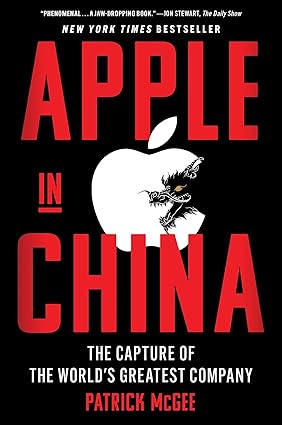
Journalist Patrick McGee, in his deeply researched book Apple in China: The Capture of the World’s Greatest Company, calls this the “Apple Squeeze.” “Apple’s engineering and operations teams would rigorously train local partners,” McGee writes, “in the process giving away manufacturing knowledge.” This is something people often miss about China’s development: its companies benefit from competing with Western peers, while Western firms like Tesla and Apple use their Chinese supply chain advantages to crush competitors at home. After Western firms train up third-party vendors, these vendors can then shop their new skills to Chinese firms. “They don’t care if all their US competitors lose. It’s actually better for them,” Harsh Parikh, former head of global supply management for Tesla explained to McGee. “But on the other side, all the Chinese companies win. They all get to step up and create a massive market where none previously existed.”
Apple invested in these relationships at mind-boggling scale, especially as Cupertino rolled out era-defining products like the iPod (2001) and iPhone (2007). Apple sank billions into training Chinese workers to meet their needs. Cupertino began flying an average of 55 people a day to its factories in China. Apple even went so far as to furnish their vendors with unprecedented amounts of high-end manufacturing equipment. McGee points out that, in today’s dollars, Apple invested into China more than double what America put into the Marshall Plan.
Fraternizing with the Enemy
A combination of ideological blindness and narrow self-interest let American firms like Apple slumber while training up a Communist country’s workforce. As one former Apple V.P. spoke to McGee over coffee, he expressed puzzlement over the author’s line of questioning. “Are you sure you’re not overthinking your thesis? You keep talking about geopolitics, but I was there in the 2000s when we were setting up production in China, and I can tell you, we weren’t thinking about geopolitics at all.”
Apple’s dependence on China extended beyond manufacturing when the iPhone hit Chinese shelves in 2009. Predictions indicated that few Chinese could afford the product. But it sold out instantaneously. Chinese consumers’ ravenous desire for the iPhone both overwhelmed and puzzled Apple. “Why would a humble Chinese mailman spend a third of his salary on an iPhone?” Cupertino marveled. Because, one mailman explained to a survey taker, when people saw his iPhone, he became more than just a mailman—an answer surprising only to those who already have money. Thanks to the iPhone and the Chinese market, Apple saw its revenues in the country rise from $1 billion in 2008 to $23 billion by 2012, making Apple one of the most valuable companies in the world.
What’s more, Apple store managers in China reported a noticeable difference in the younger generation of Chinese citizens with whom they worked. Unlike those scarred from Communist indoctrination, these younger people wanted to seize the reins of their lives and learn from the West. All around them, Apple workers saw China rising out of poverty. Could it be true? Could China’s openness to commerce end poverty and make political liberalization a reality?
Not quite. In 2013, Xi Jinping rose to the presidency. Unlike his predecessors, Xi harbored a more hostile view of the West. To his mind, Western companies had actually taken advantage of China. Moreover, he recognized his country’s vulnerability to America’s economy and technology. The 2012 financial crisis was a major wake-up call. Perhaps even more troublingly, Xi had witnessed the role American social media platforms played in fomenting the Arab Spring. The time for interdependence was over. China needed to go its own way.
In 2013, Chinese state media began to criticize Apple for screwing Chinese citizens over on warranties. Apple issued a statement saying that their warranty services were more or less identical all over the world—a perfect mistake. Chinese state media was exploiting an issue Apple has struggled to resolve, namely that bootleg Apple products and even stores had popped up all over China to deceive buyers. When bamboozled customers went to get their bootlegs fixed at actual stores, they were rejected. This situation allowed the Chinese media to make their own false claims about Apple service that painted Cupertino as a Western exploiter of Chinese consumers. Apple’s statement played directly into the hands of the CCP, allowing the media to double down and castigate the company as arrogant and insolent. It caught Apple completely off guard. They’d never faced this kind of problem before.
Why was China doing this if Apple was plunging billions into the Chinese economy and training its workforce? If anyone offered Beijing a great deal, surely it was Cupertino. But Beijing didn’t know that—not even Apple shareholders really knew that—because Apple had been highly secretive about its operations in China. Cupertino considered its Chinese supply chain a permanent edge over competitors, so long as no one knew about it—not even higher-ups in the CCP. But some 151 of 200 major suppliers for Apple called China home, which meant it was only a matter of time before Apple would have to bend the knee.
To alleviate tensions with Beijing, CEO Tim Cook deftly played his hand. All he had to do was demonstrate Apple’s commitment to China. Lucky for him, almost no other company on earth was more practically dependent on the Middle Kingdom. So, in 2016, Apple published a non-binding memorandum of understanding to invest $275 billion into China over five years. To be clear, this was not an expansion of Apple’s skills transfer and capital investment, but an extrapolation from its 2015 investments, some $55 billion, in China. “That was music to the ears of China,” one executive familiar with the talks told McGee.
Despite Cook’s masterstroke, issues persisted for Apple in China beyond its relationship with Beijing. The iPhone XR shocked the company when it flunked in 2018. While Apple’s leadership freaked out behind the scenes, Cook assured investors that the XR’s lukewarm sales reflected an overall cooling in the Chinese economy. What he didn’t say was that a Chinese “national champion” named Huawei had started putting out phones that out-paced Apple in design, features, and cost. The next year, Huawei overtook Apple in global sales, shipping 238.5 million phones—more “than Apple had shipped even in its peak year of 2015,” McGee notes. In 2020, Huawei became the world’s top smartphone company by sales. Cupertino had essentially trained up its new competitor.
There had been warning signs that this might happen, but if Apple had noticed, it hadn’t taken them to heart. It became common in the 2010s for Apple’s vendors to poach its talent. One executive recalled visiting a counterpart at Foxconn in 2012 and witnessing indigenous Chinese companies recruiting talent directly in front of the Foxconn facility. A top engineer who had just spoken to the recruiters recognized both executives and shook their hands. “It was a pleasure working with you,” he said. “I’m working for Huawei now.”
The two men, dumbstruck, stood in silence while the engineer walked off. The Apple executive then turned to the Foxconn executive and asked, “Who the f–k is Huawei?”
The House of Huawei
China’s introduction to modernity began in the 19th century. Its first lesson came by humiliation. The West claimed China’s ports for its own, flooded its streets with opium, and generally bullied the Middle Kingdom into submission. From the Qing dynasty onward, China struggled to adapt to the mechanized commercial world the West had brought into being, a world that seemed hostile to feudal, agrarian, and Confucian ways of life. How could China learn from the West to strengthen itself, pursue wealth and power, and restore its national pride? This question vexed rulers and intellectuals alike until China’s keenest student of modernity, Mao Zedong, arrived on the scene.
The Mao years were chaotic, murderous, brutal. They were also the means by which China’s Old World was purged, much as the World Wars obliterated the West’s Old World in a baptism of fire and blood. But it was left to Mao’s successors to put the country back together again. President Deng Xiaoping surveyed the scene and came to the sensible conclusion that China needed to open its economy. China needed to learn and earn. “Our fundamental task,” Deng explained in 1988, “must be to develop the productive forces, shake off poverty, build a strong, prosperous country, and improve the living conditions of the people.” The party would soon retire its anti-capitalist invectives and adopt new slogans to spur this change of direction. “To get rich,” proclaimed the party, “is glorious.”
China opened up, inviting Western firms to partner with domestic companies and build industry in a “Special Economic Zone” in the city of Shenzhen. The CCP put a particular emphasis on electronics and telecommunications. Their three-part policy was to import equipment, absorb design know-how, and lastly spur domestic firms (state-owned or otherwise) into becoming innovators and exporters. The CCP press organ Guangming Daily summarized China’s approach in 1985: “the first machine imported, the second made in China, and the third machine exported.”
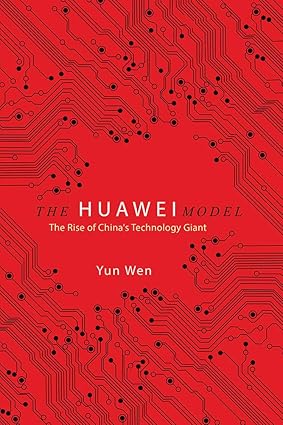
Between 1979 and 1985, Shenzhen’s electronics industry output skyrocketed. The number of firms leapt from one to 170, while, as economist Yun Wen writes in The Huawei Model: The Rise of China’s Technology Giant (2020), “the output of Shenzhen’s electronic industry had reached ¥1.4 billion, with a 113.5 percent increase from 1979.” But during the late 1980s and early 1990s, multinational corporations like Lucent (American), Fujitsu (Japanese), and Ericsson (Swedish) swooped in and cornered the Chinese telecommunications market. These firms both set the technical standards of telecom in China and charged through the nose for their services.
Huawei, founded by Ren Zhengfei in 1987, sprouted up in Shenzhen around this time. Ren had graduated college with an engineering degree just before the Cultural Revolution laid waste to Chinese higher education. During those grueling years of hunger, he spent time in the People’s Liberation Army. By the time he founded Huawei, Ren became dismayed by what he saw as the CCP’s lopsided approach to foreign investment. If China did not develop its own industrial titans, it would find itself in yet another form of economic subservience to the West. Ren even directly connected the Western telecommunications firms snapping up Chinese market share to the “Eight-Nation Alliance” of Western states that had dominated China in the 19th century. “It is painful to realize that without our own core technology the independence of our industry would be only an empty slogan,” Ren observed. “Without an independent national industry there would be no independence of a nation.”
Ren drew on his experience in the PLA to formulate his business plan. Repurposing the guerilla tactic of “encircling cities from the countryside,” Huawei packed the countryside with its salesforce and workers to connect China’s benighted rural communities to the rest of the country. With the cities encircled, the company could now break into China’s urban markets. Engineers adopted a “mattress culture,” pulling successive all-nighters with their mats beside their desks so they could grab quick naps. One engineer worked himself so hard he detached one of his retinas. Huawei’s salesforce, meanwhile, internalized a “wolf culture” of hungry, tireless work that sent them abroad to stand up infrastructure in chaotic developing countries. The trips became rites of passage for all leadership and transformed Huawei into a global titan.
Throughout this period of domestic and global growth, Huawei relied on Western firms and institutions to help them along. For example, Motorola became a key technology partner for Huawei, which ended up using exclusively Motorola chips. Western banks also filled in gaps that made up for the immaturity of Chinese financial institutions—a relationship that continues to this day. According to Huawei, 75% of the loans it received in 2018 came from “foreign banks lending on standard commercial terms.” This kind of cooperation would eventually branch out into research agreements with major universities like Stanford, U.C. Berkeley, and Oxford, helping Huawei become an innovator in telecommunications.
After 13 years of negotiation, China gained entry into the World Trade Organization (WTO) in 2001, catalyzing deeper interpenetration between Huawei and the West. President Bill Clinton had championed China’s potential entry in 2000, saying that human nature had taught him America could more positively influence China by “[welcoming] China into the world community instead of shutting it out.” “As Justice Earl Warren once said,” Clinton continued, “liberty is the most contagious force in the world. In the new century, liberty will spread by cell phone and cable modem.”
In between Clinton’s expressions of globalist Panglossianism and the WTO decision, 747s slammed into the World Trade Center. China shared a border with Afghanistan and boasted a tight relationship with Pakistan. Companies like Huawei served as major I.T. suppliers to the Middle East. These facts now made China even more attractive to America as it embarked upon the Global War on Terror. “This was something that really redefined the line of debate,” reflected Evan Feigenbaum, who served as a State Department official at the time. “Instead of having a classic Cold War-like balance-of-power debate about how to deal with China as a challenge to American power, the orientation in foreign policy shifted.” Fears of a Communist peer adversary dissolved into the background as the specter of Islamic terrorism glided into frame.
Made in China 2025
In 2007, Huawei also began to lay undersea cables. Like gas pipelines from one country to another, these data pipelines serve as extensions of national power as much as extensions of infrastructure. Globally, undersea cables carry 99% of internet traffic, making them a top interest for intelligence agencies. The same year Huawei went into the submarine cable business, it began to sell “managed services,” modeled on products offered by Western companies like Ericsson. “If a customer opted for managed services, Huawei helped run its networks for a fee,” explains journalist Eva Dou in her history of the company, House of Huawei. While such an offer sounds anodyne, managed services boosted Huawei’s geopolitical importance because they “put Huawei’s engineers at the controls of customers’ networks.” By 2011, Huawei ascended to become the number three vendor of wireless gear in the world, its annual revenue soaring to $27 billion. The company now raked in more than Google, McDonald’s, or Coca-Cola. Huawei’s commitment to plowing 10% of its annual sales into research and development was bearing fruit.
However, Huawei’s expansion into such infrastructure projects and its dealings with countries like North Korea and Iran began to raise alarm in D.C. In the late 2000s, the State Department flagged all Huawei employees as technological transfer risks (by this time, Huawei had already been involved in several I.P. theft suits with Western firms like Cisco and former partner Motorola). And by 2012, Huawei execs found themselves in the hot seat before the House Permanent Select Committee on Intelligence, which tried to parse Huawei’s murky relationship with the Chinese government.
Indeed, the House members wanted to better understand Huawei’s Communist Party committee, a unique feature of Chinese corporations. Think of it as an H.R. department that reports back to Beijing and can even call company leadership to the carpet for self-criticism sessions. Party committees are mandated by law and, in Huawei’s case, exert substantial power in hiring, firing, and management. Even Western firms like General Motors and Walmart have party committees in their Chinese operations.
Ultimately, the House committee wanted to know if China used its hardware to spy on users. Huawei claimed the answer to that question was no, though their insistence did little to assuage American concerns that Huawei’s tech could serve espionage purposes. In 2014, the world learned that a government could use Huawei’s tech in such a way—namely, that America had done so—when a security analyst named Edward Snowden leaked documents about state surveillance programs to Der Spiegel and The New York Times. These outlets reported that the National Security Agency had infiltrated Huawei, accessed its product source code, and used “Huawei’s infrastructure to listen in on targets around the globe.” Beijing immediately called for a rip-and-replace program to strip American components from key Chinese infrastructure.
Xi’s rise to power took place amid these increasing tensions. With his focus on the Belt and Road Initiative and “Made in China 2025,” as well as his post-Arab Spring security concerns, he made clear that the previous era of ambiguous openness in China was coming to an end. Huawei’s double game of serving Chinese interests while advertising itself as just another company appeared less and less compelling. To be clear, American domination of the tech space was, is, and has been an extension of U.S. power, despite the fictions we have tended to tell ourselves about our own interests. If anything, we’ve been forced into clarity about both ourselves and our new global rival by the rise of Xi.
That—and the rise of Xi’s American dance partner, President Donald J. Trump. In his first campaign, Trump expressed a view of the U.S.-China relationship symmetrical to Xi’s. Once in office, Trump did crack down on China, especially after Le Monde reported and the Australian Strategic Policy Institute confirmed that the African Union’s headquarters in Addis Ababa, Ethiopia was sending data to China via servers produced by Huawei. Trump signed a bill into law that banned all government agencies from buying and using equipment from Huawei and its domestic competitor ZTE. In 2019, President Trump declared a national telecommunications emergency and the Commerce Department announced sanctions on Huawei. Even so, thanks to Apple’s pedagogical impact on the Chinese workforce, Huawei began to outpace Cupertino both in terms of sales and technology.
Regardless, Trump’s hard-nosed approach to China has continued apace in his second term, wounding Huawei. “It is no longer expanding farther into the West but is instead defending its turf in emerging markets,” writes Dou. “The company has lost valuable R&D partnerships with US and European universities, which had helped drive its innovation.” This is not to say Huawei is down for good, just down for the count. Whether or not Beijing’s support and Huawei’s strong internal research and development abilities can vault the company into world-dominant status remains to be seen.
But questions linger about America’s ability to re-industrialize. It’s clear that tariffs aren’t enough. In many cases, they are counterproductive. Since President Trump’s Liberation Day tariff announcement, the manufacturing sector has seen job losses go on unabated month to month. The path forward remains clouded. How is it that we taught China to build, but can’t remember what we used to know? What has happened to America?
Lawyers vs. Engineers
To begin with, we mutated from masters of production to masters of obstruction. This change happened in the mid-20th century, as laid out by historian Paul Sabin in Public Citizens: The Attack on Big Government and the Remaking of American Liberalism (2021) and extrapolated upon by Dan Wang in Breakneck: China’s Quest to Engineer the Future. The dawn of environmental law began as a revolt within liberalism against the New Deal Order. Nader’s Raiders, the Natural Resources Defense Council, the Sierra Club, and various other NGO lawfare groups sought to neuter state capacity and replace it with a lawsuit mill dedicated to inhibiting economic growth. The results were immediate and convulsive for American industry. Many of these laws also possess state-level corollaries, adding yet more grievous burdens to building in America.
Moving to China, then, became a strategy of regulatory arbitrage for American corporations. And this slavish commitment to process and litigation, when coupled with our myopic devotion to shareholder value and quarterly earnings, has neutered our ability to deliver almost any industrial project whatsoever. Two humiliating examples come to mind. First is nuclear power, an industry we pioneered. Our most recent nuclear builds, two A.P.-1000 reactors in Georgia, cost over $30 billion and took 15 years, in part because America’s nuclear supply chain and workforce had totally atrophied. Meanwhile, in China, there are over 30 nuclear plants under construction. Eleven of them are expected collectively to cost as much as the two in Georgia. But perhaps the most prosaic example proves the most damning: in 2017 and 2018, China produced nearly 5 billion tons more cement than America did in the whole 20th century.
It’s easy to retort that we have majored in other things (innovation) rather than production. But the amount of skill lost in the process should worry anyone. This is what Wang is desperate for Americans to understand: technology isn’t objects. It’s people, or “process knowledge,” as he calls it. “Rather than seeing tools and blueprints as the ultimate ends of technological progress,” writes Wang, “I believe we should view them as milestones in the training of better scientists and manufacturers.” When a society loses process knowledge, the results can be brutal and even tragicomic. In one illustrative story from McGee’s book, Apple opened a Mac Pro factory in Texas which quickly became, as one engineer called it, “an unmitigated fiasco.” In China, Apple could order custom screws if they found out the type they were using was too short. The next day, a thousand screws of the desired type would be waiting for them. In Texas, that process took two months.
Of course, it’s not as if China is paradise. The “engineering society,” as Wang calls it, operates on brute-force principles. Its managers see everyone as an optimization problem. Public unrest? Crack down, then build a bridge or two. Economic turbulence? Here come five more bullet trains. Worried about overpopulation? Commence forced abortions and sterilizations by the millions. Covid got you down? Barricade people in their own homes for a couple years. The CCP retains a monopoly on political life that sends the wealthy packing for the West, if they can make it. And despite China’s commercial boom, millionaires are still vulnerable targets for the CCP. In 2024, 15,000 millionaires emigrated from China, 1,000 more than the year previous. But it’s not just the wealthy. From 2021 to 2024, the number of Chinese nationals apprehended by U.S. border officials jumped from 450 to 38,000.
To be sure, it is also true that former dissidents like artist Ai Weiwei, who took refuge in the West, have since returned without reprisal. Indeed, Ai’s stint in the West revealed to him the cold, atomizing malaise of contemporary Western society. And the social strictures of the Western art world, which has canceled some of his exhibitions for political reasons, revealed to him that the West is no longer the bastion of individualism and free speech it once was. The West possesses the culture of, in his words, “a society lacking a spiritual immune system. When a society cannot withstand diverse voices, it teeters on the brink of collapse.” I’m confident many readers of the CRB who survived the Great Awokening recognize what Ai describes. Regardless, it may be that China’s openness to Ai’s return indicates the nation’s growing self-confidence. Perhaps Beijing feels that because it is delivering on so many of its promises to the Chinese people, it can afford, to some degree, the risk of critical artists coming back home. For now.
This helps illuminate the spiritual dimension of China’s rise and America’s plateau. Throughout Wang’s book, he mentions the pride everyday people take in one of China’s many impressive bridges (despite the recent collapse of one last year), or one of the new and (usually) profitable train lines erected, or some other way in which industrial production has tangibly improved people’s lives. The benefits are obvious, whatever the drawbacks. The same cannot be said for America’s lawyerly society, which seems to serve elites, the most powerful minority group, best.
Historical Nihilism
Despite China’s centralized government and mutant state capitalism, its social safety net is threadbare and three-quarters of the Chinese population live and work tax-free. Contrast that with America’s current tax regime, colorfully described in The American Mind as “Total Boomer Luxury Communism” by the economist Russ Greene. Essentially, we extort younger workers to support a growing population of the elderly, most of whom already have more wealth than their children and grandchildren. “America is three times as wealthy, per person, as China,” Greene explains. “So the U.S. spends at least six times as much per person on social programs as China—and most of that goes to seniors.” These benefits often help the already wealthy and established cadre of retirees, who wring horse riding lessons, golf club memberships, and vacations from the sweat of younger generations’ brows while stacking trillions onto the federal debt. So, Americans can’t build and the young struggle to earn a decent living.
Then comes the cultural dimension. Surveying the last decade or so of American life, a post-American sensibility has transformed our institutions into promulgators of national self-hate. American history, so the fashionable narrative goes, has amounted to little more than war, thievery, and the lash. The American Founding, in particular, was not a victory for the natural rights of man but the perpetration of a world-historic crime.
It is easy and correct to refute these views intellectually, but people have not internalized them strictly on their merits. Politics is an emotional and psychological affair. It might be easy for young people to disbelieve in the American project because they feel—with some justification—that it has so little to offer them. In today’s service-oriented economy, workers toil at abstract and often meaningless jobs so they can reward themselves with pricey takeout delivered via a small, smiling robot (made in China) that nimbly weaves its way to their door through the sidewalk-strewn bodies of junkies incapacitated by fentanyl (another Chinese import). As they eat, they numb out to some amalgamation of content that welds pornography, gambling, and therapy together into a tapestry of dopamine primers strung across multiple screens (all of which were also manufactured in China). If you’re young, you get at least some of that content via the Chinese-run TikTok, which Xi himself describes as a kind of “spiritual opium.”
And it is the young upon whom the consequences bear down most heavily. Speak with teachers or anyone who works with America’s youth and feel your stomach flip as they recount horror stories of rampant illiteracy and crippling reliance on ChatGPT. In the saddest but most telling cases, I have heard teachers fret that, when asked to imagine what they want to be when they grow up, a substantial portion of their students no longer imagine themselves as pilots, presidents, or doctors. Rather, they envision themselves as potential lottery winners. A high schooler explained to my wife that as far as she could tell, “America is about scamming the scammer.”
The phrase “historical nihilism” perfectly captures America’s current social malaise. I wish I could take credit for it. In its original context, the term captured why the Soviet Union fell. “To completely repudiate the historical experience of the Soviet Union, to repudiate the history of the [Communist Party], to repudiate Lenin, to repudiate Stalin was to wreak chaos in Soviet ideology,” reads one speech on the subject. Demoralization entrenched itself across the USSR as it succumbed, little by little, to historical nihilism. Bereft of its founding mythos, the USSR became unmoored and then collapsed. The speaker’s name, I should add, is Xi Jinping.