Books Reviewed
As a result of New York’s tumultuous 2025 mayoral race, the world’s most influential city now has the most radical mayor in its history. The press attention devoted to Zohran Mamdani’s campaign promises, which were as unrealistic as his victory was convincing, confirmed that New York politics affects not just its 8.5 million inhabitants, but people across the country and around the world, warning them of what is to come. New York’s ongoing resonance has led New York Times reporter Jonathan Mahler to write a second book centered on a notable mayoral election held during a key period in late 20th-century New York.
His previous book, Ladies and Gentlemen, the Bronx Is Burning (2005), examined the epic 1977 election for mayor of a metropolis reeling from crime, bankruptcy, and the Son of Sam serial killer. Its six Democratic candidates included big names like Congressman Ed Koch, New York Secretary of State Mario Cuomo, flamboyant socialist Bella Abzug, and Abe Beame, the hapless incumbent.
Koch ran as a liberal, but one who favored the death penalty for murderers and deploying the National Guard against looters. His profile—liberal, but sane and pragmatic—helped secure the young press mogul Rupert Murdoch’s support. Koch ended up defeating Cuomo three times that year: first in the multi-candidate Democratic primary; then in the one-on-one runoff for the Democratic nomination; and finally in the general election, where Cuomo ran as the Liberal Party nominee. Koch went on to serve three terms as mayor, during which Cuomo got a measure of revenge by defeating Koch in the 1982 primary for the Democratic nomination to be New York’s governor. (Cuomo went on to serve three terms in that office.) As mayor, Koch balanced the budget, began to address crime, and welcomed business and development to New York City—basically the opposite of what Mamdani plans to do.
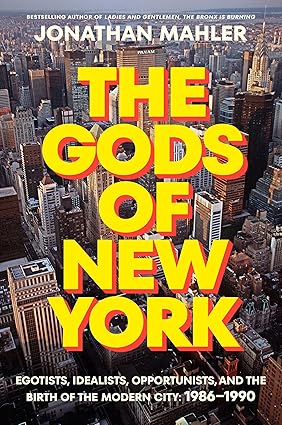
Mahler’s new book, The Gods of New York, takes place a decade later. It centers around the challenges Koch faced in his third term—which included a wide array of problems: the AIDS epidemic, increased racial tensions, and municipal corruption. In response, new rivals arose to challenge Koch, a group that Mahler calls a “new breed of power brokers…crisis opportunists with radically different agendas but a common set of abilities that made them perfectly suited for this moment.”
***
One of these figures was Donald Trump, who made his name by rebuilding Central Park’s Wollman Rink, an ice-skating venue feckless New York City bureaucrats had spent years and millions of dollars failing to reopen. Building on that success, Trump became a national phenomenon, publishing a bestselling book and erecting several new buildings he named after himself. Out of dislike for Trump, Koch stymied his New York development plans, which led Trump to focus on Atlantic City, where he ended up suffering severe business reverses.
A second rival, Rudy Giuliani, was an ambitious prosecutor who saw a path to political success by going after white-collar Wall Street perpetrators, sometimes unfairly, with tactics that included embarrassing them by handcuffing them at their places of work.
Third was Al Sharpton, a street hustler and rabble-rouser who took advantage of racial tensions and incidents (some real, others manufactured) to embarrass or diminish Koch. Sharpton gained national attention as the spokesman for Tawana Brawley, who claimed—falsely, she’d later admit—that a group of white men had abused her and smeared excrement on her. Mahler notes that the “Tawana Brawley hoax” led to Koch calling Sharpton—who at the time was under indictment for fraud—“Al Charlatan.”
Mahler demonstrates that the Sharpton “agenda” was indistinguishable from Sharpton’s ego. When Koch planned a meeting with black leaders to discuss New York’s racial issues, Sharpton begged Jesse Jackson to get him invited. When Koch reluctantly extended that invitation, Sharpton then made a show of refusing it, denouncing the meeting as “a coon show.” It is remarkable to reread the history of Sharpton’s outrageous behavior in light of the respectful treatment he receives in mainstream media today.
***
Finally, there was Spike Lee, the young filmmaker who capitalized on the racial tensions of the late Koch years with his controversial 1989 film, Do the Right Thing. One reason for the political tumult of the late Koch period was that New York was in the midst of some significant demographic changes. As Mahler notes, the overall population was declining while the share of the population that was non-white and foreign born was rising, which meant that by 1986, “for the first time in [New York’s] three-hundred-fifty-year history, the majority of its residents were non-white.”
Demographic upheaval led to racial upheaval, including the horrific Howard Beach killing, in which a white mob chased and beat a group of blacks whose car had broken down in a largely white neighborhood. While running from the mob, one of the blacks was hit by a car and killed, an awful event that inspired Lee to make his film.
Koch was indeed defeated by the many forces arrayed against him, losing the Democratic primary to David Dinkins in 1989. Giuliani, the Republican and Conservative Party nominee, lost that year’s general election to Dinkins by 47,000 votes out of 1.9 million cast, but won an even narrower victory against Dinkins in 1993. Giuliani’s election marked the beginning of a two-decade period during which: a) five different Democratic mayoral nominees were defeated, twice by Giuliani and three times by Michael Bloomberg; and b) crime plummeted, the biggest reason why the quality of life improved markedly. Few realistic, well-informed people have high expectations for the Mamdani Administration, but Mahler’s page-turning book demonstrates that New Yorkers are capable of making sound choices after making unsound ones, having done both within living memory.