Books Reviewed
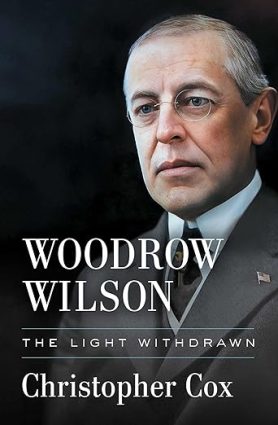
In 1948, when Arthur Schlesinger, Sr., convened a group of fellow historians to rate previous presidents, they rated Woodrow Wilson number four—just behind Abraham Lincoln, George Washington, and Franklin Roosevelt. Another group of historians, assembled in 1962 by Schlesinger, also ranked Wilson number four. Additional reflection has not been kind to the 28th president, however. Two panels less tilted to the left, assembled by The Wall Street Journal in 2000 and 2005, ranked Wilson the eleventh-best president; his rating sunk to 13th and 15th in three further surveys conducted throughout the 2020s.
The Schlesinger panelists clearly saw Wilson as a forerunner of Franklin Roosevelt, who served as his assistant secretary of the Navy: a builder of big government at home and a proponent of international peacekeeping organizations abroad. In Wilson’s Constitutional Government lectures, delivered at Columbia in 1907 and published in book form the following year, he made the argument that a complex industrialized society needs the guiding hand of a large government to tame the forces of unbridled capitalism. It followed that this muscular government needs an inspirational president, unfettered by the checks and balances of an antique constitution.
Wilson’s admirers may have overlooked his 1912 campaign statement that the second paragraph of the Declaration of Independence (“all men are created equal”) should be brushed aside as a mere “rhetorical introduction.” They credited Wilson as the liberal father of the Federal Reserve and federal income tax, the Clayton Antitrust Act, and the Federal Trade Commission. They saw him, too, as the victor of the First World War and the advocate of U.S. participation in the League of Nations, which they thought could have averted the Second. This view was memorialized in the 1944 movie Wilson, winner of five Oscars.
***
But such idealized characterizations have not withstood historical scrutiny. The income tax was instituted during the Taft Administration, and the move to create the Fed was well underway long before Wilson took office. Disciplined Democratic majorities produced the votes for domestic legislation. As commander-in-chief, Franklin Roosevelt wisely refrained from following his former superior’s wartime policies. Wilson nationalized the railroads (as the Confederacy, but not the Union, had done previously) and shipyards; Roosevelt left the railroads alone and chose proven construction engineers Henry Kaiser and Stephen Bechtel to build thousands of ships. Wilson had insisted the U.S. enter World War I independently, not as an ally of Britain and France; Roosevelt collaborated with Britain starting 18 months before Pearl Harbor and kept in coordination with Churchill and Stalin afterward. Wilson proclaimed peace terms and conducted peace negotiations without input from domestic Republicans; Roosevelt brought Republicans into shaping a lasting bipartisan foreign policy. Wilson’s League of Nations was designed to dragoon America into fighting wars other powers thought important; Roosevelt’s United Nations was designed to allow a dominant United States to gain multinational support for military actions it deemed essential.
***
Wilson’s presidency also saw the ratification of two controversial constitutional amendments: Prohibition in 1919 and women’s suffrage in 1920. But Wilson was more a spectator than a supporter of the first, which was repealed in 1933. And he was long a covert opponent and only briefly a reluctant supporter of women’s suffrage. It is this aspect of Wilson’s legacy—his often-whitewashed but decidedly mixed record on civil rights—that comes up for re-evaluation in Christopher Cox’s vigorously critical Woodrow Wilson: The Light Withdrawn.
Cox, who served as chairman of the Securities and Exchange Commission under George W. Bush after 16 years as a California congressman, makes only parenthetical mention of the domestic legislation passed during Wilson’s first term. His book is not a biography or a survey of Wilson’s tenure in office so much as a sustained analysis of his ambivalence toward the suffrage movement and his outright resistance to racial equality. To lay the groundwork, Cox pointedly describes the Wilson Administration’s aggressive internal propaganda and willingness to suppress civil liberties—though he makes no mention of military strategy and gives only glancing treatment of the 1919 peace conference. He does, however, detail the economic and foreign policy collapses of 1919 and 1920. These account for the Democrats’ next two presidential nominees receiving only 34% and 29% of the popular vote (and zero non-Southern electoral votes) in 1920 and 1924—arguably the sternest repudiation ever of any president’s record.
Where hagiographers portray Wilson as a great orator and a hard-working visionary, Cox sees him as a glib and fraudulent hypocrite. Wilson is the only president to hold a Ph.D., from Johns Hopkins University. But Cox points out that Wilson never wrote a dissertation, never learned German (the great scholarly language of the era, in which both presidents Roosevelt were fluent), and persuaded faculty friends to award him the degree after only 18 months of coursework. His book Congressional Government, published in 1885, was based on no personal observation or research; he made the 40-mile trip from the Hopkins campus to Capitol Hill no more than once. The book purports to be a description, in the manner of Walter Bagehot’s The English Constitution published 20 years earlier, of how American government really works. Unfortunately, Wilson’s thesis—that congressional committees, not presidents or individual senators, are the ones who set policy—is supported by only one example. His sole focus is on the Reconstruction committees that sought, to Wilson’s obvious distaste, to ensure black male suffrage.
***
When seeking a professorship in Princeton, Wilson asked for “as leisurely a chair as any,” and as the school’s president he took a five-week vacation to Bermuda where he canoodled with a divorcée named Mary Peck. He returned to the island for three weeks in 1910 and for a month after being elected in 1912. As president, reports Cox, Wilson played 1,200 rounds of golf, including on the April 1917 morning before his speech calling on Congress to declare war. “He would boast at the end of his presidency that he never had a congressman or senator to lunch or dinner,” writes Cox.
Despite his lackluster achievement as a student, minimal success as a scholar, and failure as a university president, Wilson was able to go from a brief term as governor of New Jersey to two full terms as president. In that capacity he was beloved, for a long moment, by millions of Europeans and Americans. His secret seems to have been a seemingly effortless ability to produce a flow of words in lectures and speeches. He was the son and grandson of smooth-talking Presbyterian ministers, and he possessed an almost Emersonian fluency in person and on the page. His prose sounded good and charmed his audiences but, on close inspection, means less than it seems to. He had what Cox calls a “carefully nurtured lifelong skill of choosing just the right words to please his listeners, implying potential agreement without actually revealing himself.”
The reader encounters multiple examples of this tendency to dissimulate in Cox’s account of Wilson’s statements on female suffrage. In his 1912 presidential campaign he declared himself “heartily in favor of its thorough discussion.” In a ten-minute White House meeting with Alice Paul and other suffragettes, he said he had never heard of the issue. Later he said he couldn’t take a stand because the position wasn’t endorsed in the 1912 Democratic platform—another evasion that no one can have taken seriously. Having often said suffrage was only a state issue, he grudgingly endorsed it in an October 1915 referendum in New Jersey, where it lost. In November 1917, New York, the nation’s most populous state and always marginal in close elections, passed a women’s suffrage amendment. Almost overnight, opposition—which had previously been manifested in the form of physical attacks on suffragettes picketing outside the White House—melted away. Only then, after the thing became inevitable, did Wilson call for the Senate to pass the “Susan B. Anthony Amendment.” That December, after the Armistice, Wilson said the war had brought “a new lustre to the annals of womanhood. The least tribute we can pay them is to make them the equals of men in political rights.” But he declined to make more than a couple of phone calls to try to persuade Republican holdouts.
***
Women’s suffrage finally passed in 1919 by an overwhelming margin in the House, and by comfortably more than the two-thirds required in the Senate. Wilson was away and out of contact in Europe. That didn’t prevent him from later telling Cordell Hull, long a staunch House Democrat, that women “are chiefly indebted to me for the suffrage.” Missing from this empty boast was any hint of shame for the gruesome conditions of imprisonment imposed on Alice Paul and other suffragettes, convicted of blocking the Pennsylvania Avenue sidewalk, by Wilson’s D.C. Commissioner Louis Brownlow. This was only one example of Wilson’s willingness, and even eagerness, to imprison critics of his policies.
Why was Wilson so reluctant to support women’s suffrage? At a personal level, he abhorred assertive, successful professional women like Carey Thomas, the president of Bryn Mawr, who served as dean when Wilson taught there and who chided him for the thinness of his academic credentials. In contrast, he reveled in the appreciative company that he sought and obtained from his wife Ellen Axson Wilson, from Mary Peck in Bermuda, and from the widow Edith Galt, to whom he proposed marriage eight months after Ellen’s death. In other words, his attitude toward women was entirely in keeping with his old-world, aristocratic sensibilities. For the essence of Woodrow Wilson is that he was a post-Reconstruction Southern gentleman.
***
Born in the Shenandoah Valley of Virginia, he grew up in one spacious manse in Augusta, Georgia, then moved to another at age 14 in Columbia, South Carolina, five years after the fires set there when General William Tecumseh Sherman’s troops marched in. In his schooling at Princeton (1875-79), the University of Virginia Law School (1879-80), and Johns Hopkins (1883-85), he wrote essays in which he paid what Cox calls “loving tribute to the virtues of the leaders of secession” and to “the righteousness of the cause.” In Congressional Government he described Reconstruction as sweeping in on a “tide of federal aggression” and made veiled complaints about federal efforts to ensure blacks could vote. Wilson’s reliance on slick rhetoric and his “leisurely” professional life reflect the code of the Southern gentleman, presiding over a plantation or a Presbyterian pulpit. That code included a reverence for white women and a sense that they must be protected from violence—and from participation in the often-violent business of politics.
Wilson must have been aware of a fact which 21st-century Americans and even many historians overlook. For three generations after the Civil War, in the 75 years between 1865 and 1940, the United States was culturally, economically, and politically divided into two nations: the North and the South. As I noted in my 2013 book, Shaping Our Nation, only about 1 million blacks and 1 million whites moved from the South to the North during those 75 years—even though wages were twice as high in the North. The terror and violence of the Ku Klux Klan hamstrung Reconstruction in the South. After the mid-1870s, when Northern voters tired of paying for military occupation to enforce Reconstruction, Southern Democrats barred blacks from voting. They imposed racial segregation in schools and public facilities by law, and segregation in all manner of daily life by custom and threats of violence. All but a handful of Northern politicians and voters averted their gaze from this system of racial discrimination, while the legal elite circumvented the obvious intent of the 14th and 15th Amendments via dubious Supreme Court rulings.
In his civilian career, with his eye already on a future political career (in law school, Wilson had business cards printed that read, “Thomas Woodrow Wilson, U.S. Senator from Virginia”), he took care not to appear as a partisan of the South. He trained himself to speak with little or no discernible Southern accent and, from his time at Johns Hopkins onward, sought and accepted positions only in the North. He had no interest in an offer to return to the University of Virginia, which might have resulted in making those business cards useful but would not have led to the presidency. Yet he remained, in the manner of the Southern gentlemen of the day, a staunch Democrat, unwilling as president to negotiate with members of the party that had thrust the hated Reconstruction on the white South. This distaste was evident in his refusal, in 1918, to seek votes for women’s suffrage from the few Republicans in opposition. It was evident, too, in his notorious refusal to include Republicans in his peace treaty delegation or to negotiate the reasonable emendations to the Versailles treaty advanced by Republican Henry Cabot Lodge.
***
In this “two nations” period of American history, it was taken as a political axiom that voters would never elect a Southerner or a Catholic as president. This was a particular problem for the Democratic Party, whose Southern and Catholic bases produced few plausible presidential candidates. Democratic presidential nominations from 1865 to 1908 went seven times to Protestant Tammany Hall opponents from New York, once to a Union Army general from Pennsylvania, and three times to the prairie populist and evangelical Christian William Jennings Bryan from Nebraska. Yet by the time he had shaken off his accent and cut his teeth in politics as the governor of New Jersey, Wilson seemed sufficiently un-Southern to be nominated. At the Democratic convention, House Speaker Champ Clark (a backer of women’s suffrage) failed to win the two-thirds of the vote then required for the presidential nomination. In the general election, Wilson won just 43% of the popular vote but a lopsided majority of electoral votes, Republicans being split between incumbent William Howard Taft and the man who had hand-picked him four years before, Theodore Roosevelt. Similarly, with third-party Progressive candidates in most non-Southern districts splitting the opposition, Democrats won large majorities in both houses of Congress.
On these shaky foundations, Wilson brought Southern attitudes to control of government, even though the 14 Southern states had only 22% of the nation’s population—a low point in history, well below their 33% today. Days before his inauguration, Wilson addressed the Southern Society of New York, saluting the “ideals” of the Confederacy and the Confederate soldiers who had fought for “our own way of life.” He appointed a cabinet heavily stocked with Southerners, including William McAdoo, a Tennessean and New York railroad executive who married Wilson’s daughter in 1914. He made a point of imposing racial segregation in federal employment—something the only other post-Civil War Democratic president, Grover Cleveland, declined to do. And he invited into the White House his old North Carolina friend, Thomas Dixon, whose novels The Clansman (1905) and The Southerner (1913; dedicated to Wilson) were bestselling celebrations of the Ku Klux Klan. Dixon’s work inspired the hit movie Birth of a Nation, which Wilson made a point of screening in the White House in February 1915.
***
The Fugitive Slave Act of 1850 and the Supreme Court decision in Dred Scott v. Sandford (1857) had represented efforts to extend Southern mores and treatment of blacks into the North. Now, it was Wilson who attempted to advance white Southern attitudes and racial segregation into the North, with considerable success. His vision of Reconstruction as oppression of white Southerners became the conventional wisdom of the American historical profession up through the 1960s, and the scornful parody of black accents with which he regaled social guests became a staple of American popular culture into the 1950s.
All of this helps explain what seems utterly paradoxical to today’s progressives, but actually makes perfect historical sense: a Democratic politician dead set against civil rights. Wilson thought of women’s suffrage, like the abolition of slavery and the prohibition of liquor, as one of those reforms championed by New England Yankees and supported in the Yankee diaspora across upstate New York into the upper Midwest. This was the land which supplied the popular vote majority for Abraham Lincoln in 1860 and which produced the stalwart supporters of Reconstruction in the 1870s. By 1900, female suffrage was supported by many Republican politicians and almost no Democrats. It was opposed vehemently by Southern Democrats, who feared it would lead to black women voting. During Wilson’s presidency, most congressional Republicans favored suffrage, while most Democrats (until the House finally passed it in May 1919) were opposed.
Woodrow Wilson treated the Declaration of Independence’s core assertion, that all men are created equal, as surplusage better left ignored. He argued that the separation of powers in the Constitution was an anachronism, hampering the streamlined executive power needed in an industrialized society. Christopher Cox’s account of his stealth opposition to the 19th Amendment—whose ratification is cited by his admirers as one of his achievements—offers yet another reason why this most authoritarian of American presidents continues to slip down the presidential rankings. He deserves to.
Next in the fall 2025 Issue

The Murder of Charlie Kirk
Flawed Prophet