Books Reviewed
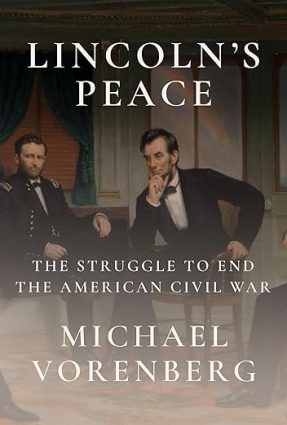
As fighting in the Civil War was winding down in March 1865, Abraham Lincoln sojourned in Virginia for two weeks, ostensibly to relax, but as Michael Vorenberg reveals in his highly readable, deeply researched new book, Lincoln’s Peace, the president’s real goal was to shape the peace settlement that would end the bloodshed. Lincoln met with his top military leaders: General Ulysses S. Grant, Admiral David D. Porter, and General William T. Sherman, with Porter, who served as host aboard the steamboat River Queen during those momentous days, later recalling that the president “had made up his mind that this fraternal strife should cease in one way or another.”
Two months earlier, Lincoln had sailed to nearby Hampton Roads, Virginia to discuss peace terms with Confederate officials, much to the consternation of some Republicans in Congress, who feared he might allow Confederate leaders to retain power and restore white supremacy even if chattel slavery were officially abolished. In response, Lincoln vowed to one lawmaker, “I shall never compromise the principles upon which I was elected.” Around that same time, he put it even more strongly, exclaiming, “So long as I am president, no peace shall be made which does not save the Union and keep our promise to the slave!”
***
But Vorenberg, an associate professor of history at Brown University, is not so sure. He believes Lincoln was too devoted to federalism, too infected with racial prejudice, and too concerned with restoring sectional harmony by appeasing Southern whites to take the stern measures needed to achieve emancipation in the broadest sense. The historian doubts that Lincoln, had he lived, would have fought to give African Americans the vote or to bar the antebellum Southern leadership from holding office again. The president may have had “a good heart,” Vorenberg allows, but “he was a terrible judge of the enemy,” whose racism was stronger than he naïvely imagined.
Vorenberg is right at home, then, with the past two generations of American historians who have generally portrayed Radical Reconstruction favorably, applauding the attempt to replace slavery with true racial democracy while simultaneously bemoaning that effort’s ultimate failure, a failure which resulted in the violent imposition of racial dhimmitude in the era of Jim Crow. Postwar Reconstruction failed, these historians argue, because the North did not enforce persistently enough the enlightened legislative measures passed between 1865 and 1875, including the 13th, 14th, and 15th Amendments, the Civil Rights Acts of 1866 and 1875, and the Enforcement Acts of 1870 and 1871.
***
The chief villain in this revisionist account of Reconstruction is Lincoln’s shamelessly racist successor, Andrew Johnson, whom Vorenberg portrays largely, though not entirely, as a kind of anti-Lincoln. Other contemporary scholars like James Oakes, Jonathan W. White, David S. Reynolds, and William Lee Miller have argued that Lincoln was at bottom a racial egalitarian. Vorenberg is more skeptical.
On April 11, 1865, after acknowledging his unsuccessful attempts to persuade the new government of Louisiana to enfranchise at least some African Americans, Lincoln for the first time publicly endorsed African-American suffrage, stating: “I would myself prefer that [the franchise] were now conferred on the very intelligent [black men], and on those who serve our cause as soldiers.” (By “very intelligent” he presumably meant literate.)
Vorenberg deplores as “unmistakably prejudicial” Lincoln’s willingness to restrict the franchise to “the very intelligent” and those who served in the army, intelligent or not. And yet, months after Lincoln publicly endorsed black voting rights, Frederick Douglass composed a speech in which he acknowledged that although Lincoln’s call for limited black suffrage “seemed to mean but little,” it actually “meant a great deal.”
It was like Abraham Lincoln. He never shocked prejudices unnecessarily. Having learned statesmanship while splitting rails, he always used the thin edge of the wedge first—and the fact that he used this at all meant that he would if need be, use the thick as well as the thin.
Abolitionist Congressman Owen Lovejoy had used this same image to describe Lincoln’s approach to emancipation. In dealing with slavery, the president had inserted the thin edge of the wedge in March 1862 by publicly recommending that the federal government compensate states that adopted emancipation; drove it in deeper in 1863 with the Emancipation Proclamation; deeper still in 1864 by successfully encouraging Maryland and Louisiana to abolish slavery while supporting emancipationists in Tennessee, Missouri, and Arkansas; and fully drove home the thick part in 1865 with the 13th Amendment. Even before March 1862, Lincoln had worked behind the scenes to persuade Delaware to emancipate its slaves.
So too with black suffrage. Lincoln inserted the thin edge of the wedge in 1863 when he authorized Secretary of War Edwin Stanton to empower military forces in Louisiana to organize elections in which citizens were allowed to vote regardless of color (presumably including at least freeborn blacks). He drove the wedge in deeper the following year when he wrote to the newly elected governor of Louisiana, Michael Hahn, recommending that he lobby the delegates to the state’s constitutional convention: “I barely suggest for your private consideration, whether some of the colored people may not be let in [to voting]—as, for instance, the very intelligent, and especially those who have fought gallantly in our ranks.” He drove the wedge deeper by working behind the scenes to get that reform enacted. And he drove the wedge home by endorsing black suffrage in what would be his last public address. In the audience, John Wilkes Booth did not underestimate the importance of the president’s words, turning to a companion and declaring: “That means n-gger citizenship. Now by God I’ll put him through!” Three days later, he did just that.
***
We cannot be sure, of course, what Lincoln would have done to combat the ruthless Southern attempts to maintain white supremacy. It seems likely, though, that Frederick Douglass was right when he wrote months after the assassination that Lincoln
saw the absurdity of asking men to fight for a Government which should degrade them, and the meanness of enfranchising enemies and disenfranchising friends. He was…at heart an antislavery man. He had exhausted the resources of conciliation upon the rebels and the slaveholders and now looked to the principles of Liberty and justice, for the peace, security, happiness, and prosperity of his country. I assume therefore, had Abraham Lincoln been spared to see this day, the negro of the South would have more than a hope of enfranchisement and no rebels would hold the reins of government in any one of the late rebellious states.
More broadly, Lincoln’s Peace asks what the American Civil War was really all about. Preserving national unity? Ending slavery? Vindicating popular government? Modernizing the country’s traditional institutions and culture? And when did it finally end? With the laying down of arms in 1865? The end of Reconstruction in 1877? Plessy v. Ferguson’s “separate but equal” doctrine in 1896? The passage of the Voting Rights Act in 1965? Or has it never really ended?
In dealing with these matters, Vorenberg seeks to expose the “larger fiction of American exceptionalism, the tenacious, indulgent belief that Americans are a favored people who do everything better than everyone else. As an example: they won their wars and wrapped them up neatly.” He criticizes historians like Bruce Catton, Allan Nevins, Jay Winik, and Noah Andre Trudeau who celebrate Appomattox as a noble conclusion to the country’s bloodiest war.
***
There are good arguments to be made that the conflict did not end at Appomattox. After all, Confederate armies were still in the field elsewhere (led by Joseph E. Johnston in North Carolina and Edmund Kirby Smith in the trans-Mississippi theater). A highly effective Confederate commerce raider, the Shenandoah, was still wreaking havoc with the American whaling fleet well into 1865 (a dramatic story Vorenberg tells well). Slavery did not officially end in the Confederate states with the promulgation of the Emancipation Proclamation in 1863 but on Juneteenth 1865. And even then, formal, legalized slavery continued to exist in Kentucky and Delaware (which had not joined the Confederacy) until the ratification of the 13th Amendment in December 1865.
If, Vorenberg argues, “ending slavery was one of the goals of the Union war—indeed its most important goal,” then the war cannot be said to have ended until that goal was achieved de facto as well as de jure. Not only chattel slavery itself but the vestiges of slavery, including the denial of full, equal citizenship to the formerly enslaved, must be extirpated before the war can be said to have truly ended. Thus, Vorenberg believes the Civil War is better understood not as a drama that abruptly ends with the curtain descending at Appomattox but as a series of slowly dimming stage lights, gradually winking out. Emancipation, he argues, was a long, drawn-out process rather than a single, decisive act, and goes so far as to agree with Columbia historian Barbara J. Fields, who insists: “If some citizens live in houses and others live in the street, the Civil War is still going on. It’s still to be fought and regrettably, it can still be lost.”
***
In April 1861, less than a month after the firing on Fort Sumter, a White House secretary reported to Lincoln that the mail bag overflowed with appeals for emancipation. The president told him:
I consider the central idea pervading this struggle is the necessity that is upon us, of proving that popular government is not an absurdity. We must settle this question now, whether in a free government the minority have the right to break up the government whenever they choose. If we fail it will go far to prove the incapability of the people to govern themselves.
The war was something more significant than an attempt to suppress a regional rebellion or even to liberate 4 million enslaved African Americans. Above and beyond those worthy aims was the need to vindicate free government, without which those other goals would not be vindicated. The war was, Lincoln told Congress in a special message delivered on July 4, 1861, a “struggle for maintaining in the world, that form and substance of government, whose leading object is, to elevate the condition of men—to lift artificial weights from all shoulders; to clear the paths of laudable pursuit for all; to afford all, an unfettered start, and a fair chance, in the race of life. Yielding to partial, and temporary departures, from necessity, this is the leading object of the government for whose existence we contend.” A fight to ensure, as he put it two years later at Gettysburg, that “government of the people, by the people, for the people” did “not perish from the earth.”
A century later, Ronald Reagan would express a similar sentiment upon becoming governor of California in 1967: “Freedom is a fragile thing and it’s never more than one generation away from extinction.” Whether totalitarian movements threaten our country from abroad or elements from within seek to suppress free speech, scrap constitutionalism, corrupt the electoral process, pack the courts, replace elected lawmakers with unelected bureaucrats, or excuse political assassination, then in some sense the Civil War will have failed in its ultimate end. As Lincoln so memorably said in his 1862 Annual Message to Congress, “We, even we here,” can “nobly save or meanly lose the last, best hope of earth.”
Next in the fall 2025 Issue

Why Natural Law?
Flawed Prophet