Books Reviewed

One of Leo Strauss’s most profound and least appreciated insights was that the Socrates of Plato’s dialogues anticipated today’s postmodernists by thousands of years. It may shock even seasoned readers of CRB to learn that Michel Foucault, Jacques Derrida, and their intellectual grandfather, Martin Heidegger, were not entirely wrong. But their key insight—that all the things we think we know are influenced by what our community tells us is true and important—was one Plato also understood, according to Strauss.
The ancient analogue of postmodernism was the pre-Socratic notion that “whirl is king”—i.e., that the human parameters of truth are constantly in flux as power changes hands and perspectives shift. Like the postmodernists, Plato saw the force of this argument. Unlike them, he endeavored to go beyond it. Strauss found in the dialogues a sustained effort to answer pre-Socratics like Heraclitus by identifying a stable basis for enduring truth. And so, as Strauss wrote to the Heideggerian Gerhard Krüger in 1932, “Modern philosophy, taken to its conclusion, seems to me to lead to the point at which Socrates begins.”
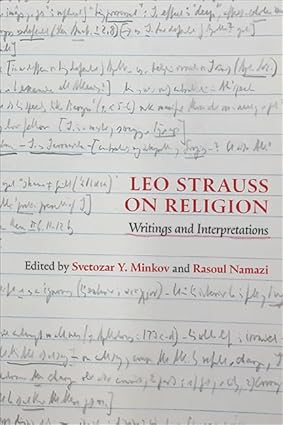
Observations like this help show just how original and radical an intellect Strauss possessed. His work is rich enough to justify the appearance of two new volumes that might otherwise seem to exhibit an almost cultish obsession with Straussian ephemera. “Straussianism” as a cottage industry has not quite reached the point of publishing every scrap of paper on which the German émigré jotted a stray thought. But it is noteworthy that St. Augustine’s Press and SUNY Press considered it worthwhile to produce, respectively, Leo Strauss’ Published but Uncollected English Writings and Leo Strauss on Religion: Writings and Interpretations, two collections featuring incomplete drafts, partial transcripts of public speeches, lecture notes, and alternative versions of published essays. Both books also furnish helpful editorial commentary, clarifying notes, and indices.
Svetozar Minkov, a professor of philosophy at Roosevelt University and a co-editor of both volumes, has recently taken a leading role in preserving Strauss’s legacy. He runs the Leo Strauss Foundation and co-edited (with Boston College’s Hannes Kerber) a 2023 volume of Strauss’s writings on Plato’s Euthyphro. He is also compiling (with Tulane University’s Ronna Burger) a collection of Strauss’s correspondence with Seth Benardete, which is expected to be out this year.
***
Minkov’s co-editor for Leo Strauss’s Published but Uncollected English Writings is Steven Lenzner, a visiting lecturer at Ilia State University in Tbilisi, Georgia and a close reader of Strauss’s works. The edition “gathers in one volume everything Leo Strauss published in English that he did not include in any of his own books,” which comes out to 32 documents covering almost the entire span of Strauss’s academic career, from 1937 to 1972. Though quite a few are familiar, several entries are so obscure as to be almost unknown, such as “John Locke as ‘Authoritarian’” (1967), “Greek Historians” (1968), and “Machiavelli and Classical Literature” (1970). The pieces are framed by Minkov’s introduction and an afterword by David Yanowski of the University of Chicago.
Although I don’t doubt that Minkov and Lenzner had good reasons for their selections, some readers may be left wondering (as I was) about the criteria used. For example, the editors have included Strauss’s essay on Plato from History of Political Philosophy, a collection he co-edited with Joe Cropsey in 1963. It is hard to see in what sense this volume, which has been continuously in print for decades, is not one of Strauss’s “own books.” At the same time, one wishes for further information about some of the more obscure entries. Chapters 12 and 13, for example, are summaries of longer essays published in Iyyun: The Jerusalem Philosophical Quarterly during the mid-1950s. Those longer essays—“The Mutual Influence of Theology and Philosophy” and “What is Political Philosophy”—are at the heart of Strauss’s lifelong interests. One is left wondering why and how readily he agreed to condense his thoughts in these short précis.
Leo Strauss on Religion is co-edited by Rasoul Namazi, assistant professor of political theory at Duke Kunshan University in Jiangsu, China, and the author of Leo Strauss and Islamic Political Thought (2022). The book presents twelve previously unpublished items by Strauss, each with one or two interpretative essays. These essays are somewhat uneven in terms of length and quality. Eminent scholars such as Ralph Lerner, Nathan Tarcov, and Martin Yaffe are among the contributors, but one essay is written by a graduate student, while another author admits, “Although my teachers were all students of Leo Strauss, I have been only a casual reader of Strauss’s oeuvre.”
***
The volume includes speeches, essays, and notes on Judah Halevi, Baruch Spinoza, Gotthold Lessing, and Jean-Jacques Rousseau; a 1963 lecture titled “Religion and the Commonweal” addressing questions of First Amendment jurisprudence; four entries examining Plato’s Symposium; and several pages of notes on Blaise Pascal. Besides the section on the Symposium, these notes on Pascal are the most thought-provoking part of the book. I was especially struck by the compelling but counterintuitive way Strauss handles Pascal’s argument for faith. Contra Pascal, Strauss suggests we are not compelled to believe in order to escape the meaningless abyss of the natural cosmos. In fact, Strauss writes, the finite world of our experience does have “principles of its own” such that “in his thinking man finds his happiness.” Because reason can discern natural right, we need not leap with Pascal into faith in order to escape a meaningless world.
As Benardete explains in Socrates’ Second Sailing (1989), although the good shows itself only in “bits and pieces,” these may come together as a “whole truly articulated by mind.” The fragments of truth are found in “the speeches or opinions of things to which Socrates has recourse” after he turns away from natural science. If we cannot ever attain complete wisdom concerning the whole, Strauss observes, “it does not follow that we do not have the true principles of justice or their knowledge.” Half a century after Strauss’s death, his efforts to uncover those principles have not lost their power, and the fascination with his writings has not abated but only continues to grow.