Anyone who has visited the United States Capitol’s majestic Rotunda—and any viewers of President Trump’s recent indoor inauguration—will likely remember four very large paintings. They are scenes from the American Revolution, twelve feet tall and 18 feet wide, two on either side of the Rotunda’s western portal. Arranged in chronological order, they portray the presentation of the Declaration of Independence to the Continental Congress by the five-man committee responsible for drafting it; the surrender of the British forces under John Burgoyne at Saratoga (which drew France into an open alliance with America); the surrender, four years later, of the British forces under Lord Cornwallis at Yorktown (which effectively ended the war); and General Washington’s resignation of his commission at Annapolis in December 1783.
***
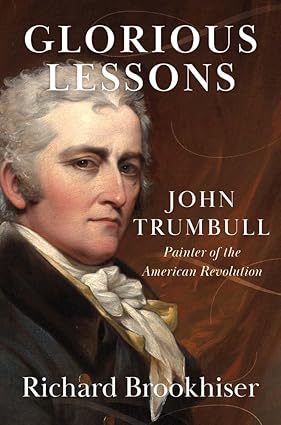
These vast canvases are the work of the Yankee patrician John Trumbull (1756–1843). Though his Declaration of Independence is the definitive image of a pivotal event in world history, and though these paintings are, in thematic and decorative terms, eminently appropriate to their setting, they are not great works of art. What, then, inspired the historian and journalist Richard Brookhiser’s fine new biography, Glorious Lessons: John Trumbull, Painter of the American Revolution?
The answer lies in Brookhiser’s encounter as a Yale undergraduate with Revolutionary War pictures by Trumbull, but not in the Rotunda. Whereas the Capitol paintings are the work of a man well past his prime (he was in his sixties when Congress commissioned them), the Yale Art Gallery displays a series of eight paintings that are largely the work of a much younger Trumbull. What you see in the Capitol are large-scale versions of four of them—but not of the two best, which portray battles at Bunker Hill and Quebec that preceded the Declaration. Trumbull turned 30 the year he completed them.
Along with the gallery’s life-size Trumbull portrait of George Washington, the Yale series made a deep and lasting impression on Brookhiser. “It was a graphic novel,” he writes in his introduction, “its images less numerous than those in a book, but each one larger and more packed. Glimpsed quickly, it was a movie trailer; studied slowly, it was the film itself.” Rarely, moreover, has the teleology of an artistic grand projet been more cogently articulated than it was in a letter Trumbull wrote Thomas Jefferson in 1789, from which Brookhiser takes his book’s title. Trumbull hoped, he wrote,
to preserve and diffuse the memory of the noblest series of actions which have ever presented themselves in the history of man; to give to the present and future sons of misfortune, such glorious lessons of their rights, and of the spirit with which they should assert and support them, and even to transmit to their descendants, the personal resemblance of those who have been the great actors in those illustrious scenes.
***
Glorious Lessons, the first Trumbull biography to appear in half a century, demonstrates that this painter ranks high among American artists, if only because he possessed the skill to convey the historic import of his career’s principal subject matter. Brookhiser, who has written numerous penetrating books on the Founding Fathers, skillfully interweaves Trumbull’s artistic career with its historical setting.
John Trumbull was born and raised in Lebanon, Connecticut, around 20 miles east of Hartford. His father, Jonathan, was a Harvard-educated Puritan merchant who became governor of the colony and then, during the revolution, its rebel governor. As a child, John took to scrawling copies of his sister’s embroidery on the sanded floors of the family manse. Throughout his schoolboy years (he was given a high-quality classical education that had him learning Ancient Greek at the age of six), his interest in painting only grew. He begged his father to let him study with the celebrated Boston portraitist John Singleton Copley instead of attending Harvard. His father refused. Painting was a ladies’ pastime or a mere tradesman’s vocation—and, what was more, “Connecticut is not Athens,” as the patriarch would warn his son years later.
At Harvard, John borrowed art treatises from the library, including one on perspective from which he made copies. He pored over Piranesi’s sublime etchings of Roman ruins. He painted a colored version of a monochrome print from a fine French picture of Abraham’s servant encountering Rebecca at the well. Then he showed his version to Copley, who was favorably impressed. Graduating from Harvard in 1773 at age 17, Trumbull returned to Lebanon. There he engaged in various activities including, at his father’s behest, making maps of Connecticut to support its territorial claims against Pennsylvania. During this time he also painted his first original work with numerous figures, which showed a mortally wounded Roman general refusing to escape the battlefield despite the impending Carthaginian victory. Much later, in an autobiography published two years before his death, he would write that he had designed this painting “by selecting from various engravings such figures as suited my purpose, combining them into groups, and coloring them from my own imagination.”
***
Then, in April 1775, came Lexington and Concord. Trumbull promptly enlisted as adjutant to the commander of a Connecticut patriot regiment who was a family friend. Posted at Roxbury, Massachusetts, he saw the smoke and flames from the brutal struggle for Bunker Hill, located some four miles away on the other side of Boston and its harbor. A short time later, he ventured up from Roxbury to the fortified British line defending Boston and mapped it for George Washington, the newly-arrived Continental Army commander. Trumbull was briefly taken on as an aide-de-camp to the general—a defining event in his life. Afterward, he served as adjutant to General Horatio Gates in upstate New York, where he monitored the horrific suffering—largely the result of a smallpox epidemic—of troops who had retreated from Canada after the disastrous American defeat at Quebec on New Year’s Eve 1775. But early in 1777, months before the British surrendered to Gates at Saratoga, the 20-year-old Trumbull resigned his commission as a colonel in a youthful fit of petulance, because Congress had postdated it by three months. Apart from brief subsequent service in Rhode Island, where he came under fire during a horseback dash to deliver a retreat order, Trumbull’s Revolutionary War service was over, having lasted about two years.
In 1780, while the war was still underway, Trumbull arrived in London to study with the painter Benjamin West. There was no one in America who could provide adequate training. Copley had migrated to the British capital on the eve of the revolution. West—a Pennsylvania native who, like Copley, was born in 1738—had settled there a decade earlier and enjoyed the higher reputation of the two, having been appointed a court painter to George III in 1772. West’s reputation had grown thanks to his Death of General Wolfe (1770), which portrays the mortally wounded British commander surrounded by his lieutenants just as British troops are vanquishing the French in the 1759 Battle of the Plains of Abraham outside Quebec. The lighting of West’s realistic foreground figures, shown in carefully detailed uniforms, imbues them with a vivid yet unearthly actuality that is a hallmark of baroque painting. This, plus the evocative portrayal of the martial tumult in the background, a sky largely screened by an agitated array of clouds and smoke, and a distant curvilinear background that subtly encloses the scene, would influence Trumbull’s best work. Brookhiser, however, does not fail to note the rather invertebrate modeling of the expiring Wolfe.
***
Four months after his arrival in London, Trumbull was arrested as a suspected spy—possibly in retaliation for the Americans’ execution of Benedict Arnold’s young British contact, Major John André, which provoked intense outrage in Britain. The aspiring artist spent seven months in Bridewell, a prison originally built as a Tudor palazzo. It could have been worse. West brought him a picture to copy and a fellow pupil, Gilbert Stuart, painted his portrait. Then West and Edmund Burke, who also visited Trumbull at Bridewell, secured his release on condition he leave the country. West and Copley helped him make bail.
In 1784, after the Revolution, Trumbull returned to London to resume study with West. At night he took drawing classes at the Royal Academy, where a fellow pupil was the considerably younger Thomas Lawrence, destined—like Stuart—to become a prolific and prestigious portrait painter. In his autobiography, the fastidious American would criticize the shortcuts Lawrence took in his figure studies. With West’s encouragement, Trumbull set about painting great events of the Revolutionary War. By the summer of 1786, when he set off for Paris at the invitation of Jefferson, then the American minister to France, Trumbull had completed The Death of General Warren at the Battle of Bunker’s Hill and The Death of General Montgomery in the Attack on Quebec. About one-sixth the size of the future Rotunda pictures, they accompanied Trumbull to Paris and, along with Jefferson’s enthusiasm, ensured a warm reception in elevated cultural and social circles. It was Trumbull who introduced Jefferson, a widower, to his Anglo-Italian inamorata: the beautiful Maria Cosway, wife of a successful English painter of miniature portraits and an artist in her own right.
***
During this first visit to Paris, Trumbull spent over a month visiting distinguished collections and paying calls on leading artists, including the painter Jacques-Louis David and the sculptor Jean-Antoine Houdon. Trumbull arrived in Paris quite confident in his critical judgment, as his autobiography attests. But he was not prepared for the grandeur of the royal palace and gardens at Versailles. They overwhelmed him, as did the work of the Flemish master Peter Paul Rubens, which he encountered in various venues. In Rubens’s cycle of paintings exalting the life of Marie de’ Medici, queen and later regent of France, Trumbull discerned “splendor and harmony…wonderfully united—the truth of nature, and the glow of a nature superior to ours.” These words, which do not appear in Glorious Lessons, reflect timeless classical principles which lend themselves to varied modes of expression and have yielded richer fruit than any other artistic ideal. It might seem strange these days to say that those principles accord with the political principles of the founding. It would not have seemed strange to Washington or Jefferson. Trumbull’s aesthetics and the founders’ philosophy address distinct realms of human endeavor, but it is precisely because they are alike grounded in enduring realities of human nature that they stand to benefit mankind.
Jefferson was keen to have Trumbull depict the creation of the Declaration. As the lead author of the document and an amateur architect, he was able to provide the painter with a sketch of the chamber in the Pennsylvania State House where it was adopted. During a two-month sojourn at Jefferson’s ministerial residence during the winter of 1787-88, Trumbull painted Jefferson’s portrait directly into the original, smaller Declaration displayed at Yale. The tall, sandy-haired Virginian with a ruddy complexion is the central figure among the members of the drafting committee and so in the picture as a whole. For his Yorktown painting Trumbull also made bust-length portraits of French officers—including the Marquis de Lafayette, who would use Trumbull to convey messages to Washington during the turbulent years to come. He displayed an extraordinary facility for making small pictures of this kind.
Trumbull returned to America in 1789, shortly after Washington’s inauguration in New York. By then he had completed the third of his best history paintings. This one, The Sortie Made by the Garrison of Gibraltar, had nothing to do with the Revolution. Rather, it represented the embattled Trumbull’s effort to temper hostility toward himself in certain quarters—especially among British army officers, a number of whom refused to sit for him—by portraying a recent, successful British military breakout during a Spanish siege. Before he left London, the Sortie was put on public display. Trumbull hoped to sell the painting for a large sum after having prints of it made available for sale. He was in fact offered a handsome price, but decided it wasn’t handsome enough for this fine work. His return home was hastened by disappointment with the public response to the picture, which is on view nowadays at New York’s Metropolitan Museum.
***
The next few years found Trumbull traveling up and down the East Coast to paint oil portraits on four-by-three-inch mahogany panels for his Revolutionary War cycle. Dozens of these lively portraits are on display at Yale. Meanwhile, Trumbull had little trouble arranging for Washington to sit for him on numerous occasions, and even induced him to pose mounted on a horse. Yale has the best of the resulting full-length portraits, which was likely influenced by a Van Dyck picture of the ill-fated Charles I of England that Trumbull saw at Versailles. General George Washington at Trenton shows a life-size, supremely self-assured Washington on the eve of his crucial victory at the Battle of Princeton, gazing off to one side with looking glass in hand while behind him a subordinate restrains his rearing white steed.
Trumbull placed advertisements for subscriptions to anticipated prints of over a dozen pictures of major events during the war. The campaign foundered despite the positive response from Washington, John Adams, Jefferson, James Madison, and Alexander Hamilton, and in the event the cycle of paintings was only partially completed. Trumbull attributed the failure to the political factionalism that emerged during the 1790s in tandem with irreconcilable differences over the French Revolution, to which he had become increasingly hostile. The factionalism had turned the public’s eye away from the titanic events surrounding the nation’s founding. A staunch Federalist, Trumbull was eventually—but not permanently—estranged from Jefferson, an ardent supporter of the Jacobins. And in his personal life he suffered the heartbreaking death of a young woman from a distinguished Hartford family, Harriet Wadsworth, whom he had longed to marry.
In 1794, he abandoned painting to serve as Supreme Court Chief Justice John Jay’s secretary for the negotiation of a new treaty addressing thorny issues that lingered between the United States and Britain. “His father had been right,” Brookhiser writes. “America, never mind Connecticut, was not Athens.” Even so, Trumbull would take up the brush again, after an interval of five years or more. When he did, he found his artistic powers seriously diminished. Paintings in Yale’s Revolutionary War series which he started working on in the 1780s but only completed decades later—the Declaration, The Capture of the Hessians at Trenton, The Death of General Mercer at the Battle of Princeton, The Surrender of Lord Cornwallis—are well worth seeing. But his best work was behind him. What, in artistic terms, had he achieved?
***
While Trumbull aspired to paint in the grand manner of the European masters, he only began to receive the requisite training as an adult—unlike European contemporaries who began receiving it in their teens. Taking into account how little formal training he had received, his Bunker Hill and Quebec pictures, both baroque essays akin to West’s Death of General Wolfe, are extraordinary accomplishments.
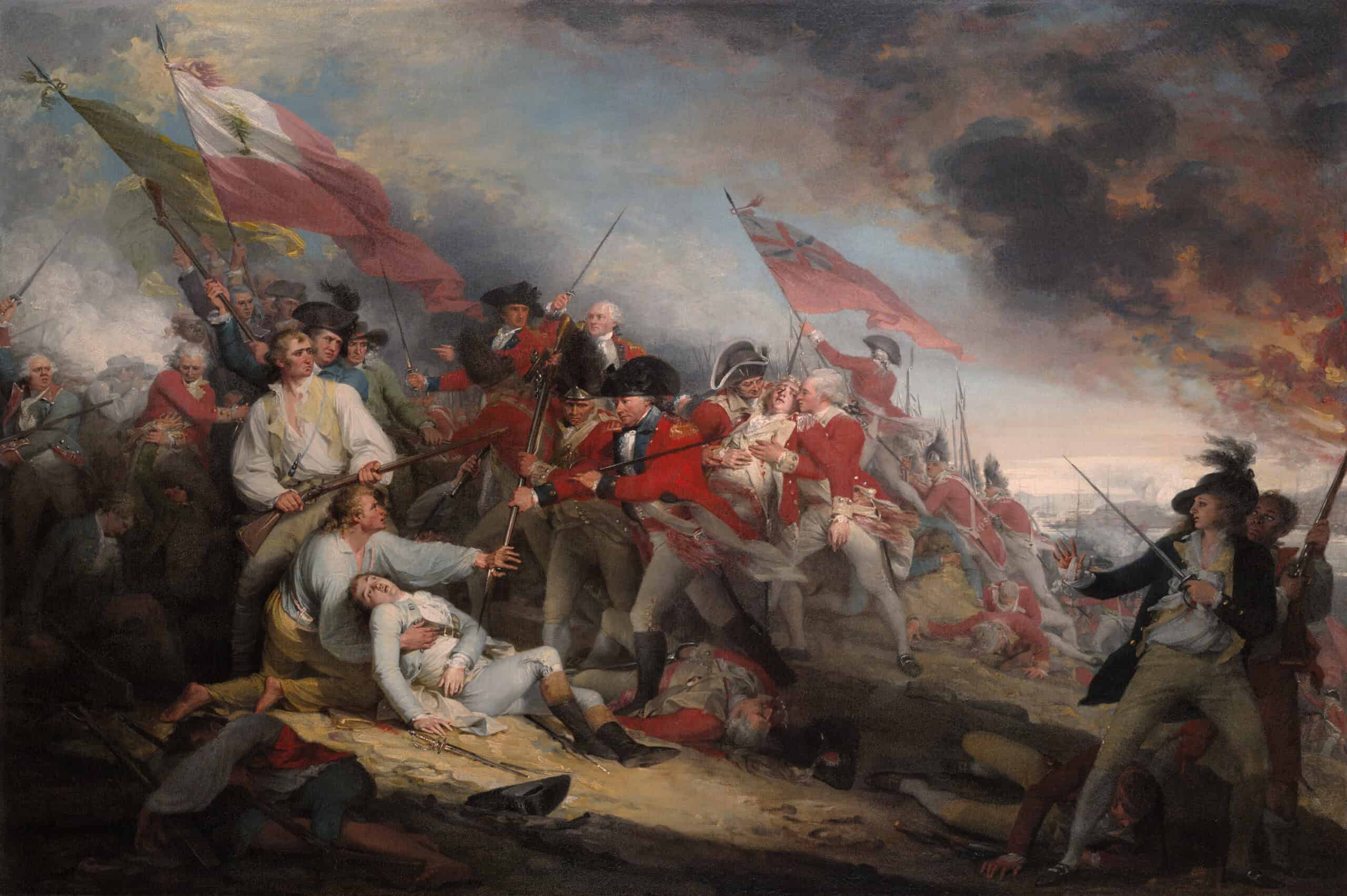
In the Battle of Bunker’s Hill, the scene in the left foreground shows a British major restraining a grenadier from bayoneting the dying American commander, General Joseph Warren. Warren is defended by a kneeling, shoeless warrior, who clasps the threatening bayonet. Patriot banners wave behind them. The major, a real-life Scotsman named John Small, is the most vividly depicted figure in the painting. Brookhiser informs us that Small’s intervention was fictitious, and emphasizes that Trumbull was not interested in providing a merely documentary record of the events he portrayed. Needless to say, Manichaean contrasts between virtuous insurgents and diabolical Brits were not on the agenda.
Situated on a diagonal leading away from the Warren group, which occupies the most brightly lit portion of the painting, a British officer with a bleeding wound under his rib collapses into the arms of two comrades. In the background a mass of Redcoats surges up the hill to its plateau, on a powerful contrary diagonal running right to left. Peering through the melee on the plateau we can make out the British vanguard looping around to confront the faltering patriot ranks to Warren’s rear. As in West’s Death of General Wolfe, the background doesn’t merely recede but rather encloses the scene within the sweep of the landscape across Boston Harbor on the right, the loop of the Redcoat vanguard in the middle, and the beleaguered patriots behind Warren on the left. Clouds mingled with smoke and fire from burning Charlestown, which is out of sight, consume the picture’s upper right-hand corner, giving way to the brighter but still turbulent sky to the left.
***
The Attack on Quebec is a nocturnal scene. Close to the middle of the picture, General Richard Montgomery, struck by a blast of grapeshot from the British side (which is not depicted), slumps to the ground in the arms of the lieutenant behind him. A dead officer sprawls in front of him, his right hand resting on the neck of a fallen comrade. These and other figures in the same brightly lit cluster are situated on a dominant diagonal running from the right background—where we see a blasted tree and in front of it a furled banner—to the left foreground, where three rangers, in strikingly picturesque attire quite unlike Montgomery’s elegant uniform, gesture toward him in alarm. The rangers are set off against luminous clouds of artillery smoke which enclose the scene along with the troops in the right and left background. Between them we catch a glimpse of the St. Lawrence River and hills beyond. The alternation of dark and bright patches in the sky is powerfully atmospheric but hardly naturalistic.
There is a dreamlike quality to this picture. Brookhiser aptly calls it “a surreal composition.” The same might be said of Trumbull’s Sortie in the Met, a twilight scene set in a fantastic landscape amidst fire, smoke, and darkness—with a group of British officers urging a fallen Spanish officer to accept medical attention, which he refuses. For the valiant Spaniard, Trumbull used a head study of his Royal Academy mate Thomas Lawrence, whom he had criticized but now put to good use.
Of these three works, Bunker Hill made the deepest impression on Trumbull’s contemporaries. Abigail Adams, whose husband was serving as minister to London when the picture was completed, wrote: “To speak of its merit I can only say that in looking at it my whole frame contracted, my blood shivered, and I felt a faintness at my heart.” A decade later, Goethe had a more detached but by no means unfavorable reaction to the painting when he encountered it in the shop of the Stuttgart engraver Trumbull had retained. “[Trumbull’s] talent is evident particularly in the character portraits achieved in bold strokes,” he wrote to the poet-philosopher Friedrich Schiller. “The faults are in the disproportion of the figures as related to each other, and the disproportion of the figures themselves. It is well composed in terms of the subject, and for a picture in which so many red uniforms must be introduced, it is very judiciously colored.” Brookhiser understandably doesn’t include Goethe’s remark about the painting’s “faults,” which amount to parts of figures being out of scale with one another as well as faulty perspective overall, resulting in whole figures being out of scale with other figures. Those defects may have stood out to Goethe’s meticulous eye, but they do not register with us ordinary mortals when we look at the painting.
***
Still, problems of scale are more evident in other Trumbull works, including both paintings and figure studies, that he produced in his prime. So is his fallibility in drawing the human hand. He did acquire an impressively fluid graphic technique in pen and ink as well as graphite, which he used in numerous preparatory drawings. And he was an assiduous draftsman. During his first Parisian interlude, he visited the residence that had been occupied by Jefferson’s predecessor, Benjamin Franklin. From an upper floor he made a rapid pen-and-ink sketch of the capital’s skyline, with rooftops in the foreground. Riding in a Parisian diligence, or horse-drawn taxi, he made another such sketch in pencil of two passengers, one snoozing and the other apparently holding a snuff handkerchief to his nose. Brookhiser includes a reproduction of Trumbull’s charming 1790 portrait sketch of a Creek chieftain, made unbeknownst to its subject.
The fact remains that Trumbull’s grasp of form—meaning the classical interpretation of the structure of the human body—was distinctly inferior to that of his French contemporary Pierre-Paul Prud’hon. Prud’hon, like Trumbull an ardent admirer of Rubens, was known for allegorical pictures and portraits including one of Napoleon’s Empress Josephine. He had the enormous advantage of being sent to an academy in Dijon at public expense around the time Jonathan Trumbull nixed his son’s request to study with Copley. At the end of the day, Trumbull suffered the disadvantage of being an artistic provincial two times over, because he received his formal training not in Paris but in London. Recording his grand tour of the masterpieces in Parisian art collections in his autobiography, he does not mention a single work by an English artist.
Glorious Lessons does not adequately address Trumbull’s limitations as a draftsman. And in discussing Trumbull’s Washington portraits, including one owned by the Met that Trumbull produced from memory in West’s studio prior to his arrest as a spy, Brookhiser might have taken stock of the definitive likenesses of the founder that Houdon created. Trumbull’s Yale portrait of 1792 is a pleasure to behold, but his Washington doesn’t bear a close facial resemblance to the man we see in Houdon’s superb plaster bust of Washington at Mount Vernon. Close relatives considered this the best likeness of the Founding Father. Nor is Trumbull’s portrait face close to that of the sculptor’s august marble statue of Washington in the Virginia Capitol in Richmond.
***
By the time we get to the rotunda paintings in Washington, which were produced during the 1820s, Trumbull’s limitations are conspicuous. Age and failing eyesight were no doubt the key factors, as Brookhiser notes (Trumbull had lost the sight in one eye as a result of a bad childhood fall). In his Rotunda Declaration, flesh tones—one of Trumbull’s long suits in his earlier years—are off-key. The left hand of drafting committee member John Adams is noticeably larger than his right, and his facial expression is almost crudely impassive. The modeling of the head of another committee member, Roger Sherman, is botched. At least Ben Franklin’s nicely articulated mouth suggests that Trumbull had studied Houdon’s incomparable portrait bust of the Pennsylvanian sage.
The paintings of the British surrenders are more successful, even if the rows of mounted officers flanking the central figures in Yorktown appear too tightly packed. In Saratoga, the left eye of the distinguished infantry commander Daniel Morgan, who figures prominently in his white garb, is misplaced. The likeness of Washington shown resigning his commission is poor, the architectural perspective mishandled. One signally successful element of the four works, however, is the gilt frames designed by Trumbull’s old friend Charles Bulfinch, then the architect of the Capitol. Trumbull, himself an amateur architect, surely had a say in their design.
Throughout his biography, and especially in two chapters discussing Trumbull’s eight Revolutionary War scenes at Yale, Brookhiser displays common sense, careful observation, diligent background research, and deep historical knowledge. His response to particular Trumbull works is consistently thought-provoking. He emphasizes at the outset that he is not an art historian. On the whole that is not a bad thing, because he is an incisive and often entertaining cultural guide—as in his telegraphic summary, in the final chapter, of developments in painting after Trumbull’s day and down to our own.
One might ask, however, why only one of Trumbull’s paintings—the Declaration—has come close to matching the fame of the German painter Emanuel Leutze’s Washington Crossing the Delaware from 1851, very handsomely displayed at the Met. Brookhiser tells us the Crossing, by all odds the best-known painting of the Revolution, is painted “in a hyperrealistic style.” That suggests something like photo-realism. Leutze’s picture does in fact exhibit a higher degree of naturalism than Trumbull’s war scenes. But Leutze’s figures are not “hyperrealistic.” There is plenty of artifice in his picture, as with his handling of light, as well as the arrangement of the landscape on the left and the patriot flotilla on the right, which recede into the background like two stems of a “V.” The enduring popularity of Leutze’s painting is attributable, first, to its enormous size (twelve feet high and 21 feet long—three feet longer than Trumbull’s Rotunda paintings) and readily legible composition; second, to its not being inartistically true to life; and, third and above all, to the fact that Leutze picked the perfect, supremely inspiring scene to represent. His Crossing is a crowd-pleaser and was conceived as such. Even if it had been painted at the scale of his Rotunda pictures or his Sortie in the Met when he was at the height of his powers, Trumbull’s Bunker Hill almost certainly would not have had such popular impact. With its greater compositional sophistication and more complex thematic content—the fact that it portrays an American defeat and features a benevolent British officer—Bunker Hill was not conceived as a crowd-pleaser. But it was conceived for the public’s edification. Trumbull operated on a higher artistic plane than Leutze, though that hardly disqualifies the latter’s achievement.
***
At this and other points, Brookhiser’s limited knowledge of art history does show. For example, in connection with the expiring Spanish officer in the Sortie, he refers to a masterpiece of Hellenistic sculpture known to us through an excellent marble copy, the Dying Gaul, as “a decadent Roman sculpture of an expiring enemy.” It is anything but decadent (see “Natural Right and Art History,” Summer 2014). Brookhiser also accepts at face value the actually uncertain existence of a sexual relationship between Thomas Jefferson and his slave Sally Hemings. Finally, his simplistic reference to Confederate monuments as tokens of “Lost Cause revanchism” is ill-informed. He adds to this the extremely debatable assertion that the monuments’ removal during the George Floyd riots—at the behest, when not through the direct action, of woke mobs—was “reasonabl[e] enough.”
But Brookhiser admirably recounts Trumbull’s long, eventful life, his astonishing range of acquaintance, and his many disappointments. In the self-portrait from 1802 that appears on the dust jacket of Glorious Lessons, pride and sadness are poignantly mingled on a strikingly handsome countenance. In an increasingly democratic society, Trumbull tried, and failed, to perpetuate a visual sensibility that had typically been the preserve of aristocratic patronage. But the aspiration set out in his 1789 letter to Jefferson—to enshrine the heroic exploits of great patriots and the “glorious lessons” they offer posterity, so as to inspire others to emulate their example—should be borne in mind by every artist who aspires to enrich our nation’s civic realm.
For however quaint or obsolete we moderns might think it, Trumbull’s credo harks back to art’s earliest origins in magic, when the primitive hunter painted animals on cave walls to ensure the success of the next day’s hunt. That mimetic principle—which means that if you want more of something, draw, paint, or sculpt it—yielded three of the finest paintings ever done by an American: Bunker Hill, Quebec, and the Sortie. Trumbull understood that by representing virtue in aesthetically resonant terms, the artist begets more virtue. And in painting, sculpting, or building beautifully, the artist inspires emulation that begets more beauty. A credo well worth pondering in our culturally dysfunctional age, as we prepare to commemorate the 250th anniversary of the events Trumbull so memorably depicted.