Books Reviewed
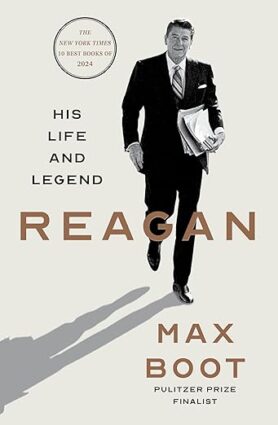
Thirty-six years after the end of his presidency, 20 after his death, Ronald Reagan still looms large in the national imagination. Americans across the political spectrum view him as a transformative leader who revived the nation and defined an era. Most Republicans revere him as the most unambiguously successful, unambiguously conservative recent president. Even his contemporary critics, whether progressives or populists, who disdain some of his policies—such as free markets, free trade, democracy promotion, and a muscular foreign policy—still regard him as a formidable leader.
In the past quarter-century, excellent monographs have explored Reagan’s thought, politics, and policies. Paul Kengor, for example, has produced books on Reagan’s spiritual life, anti-Communism, and Cold War strategy, and has an important one forthcoming on Reagan and race. John Patrick Diggins situated Reagan as a transformative historical figure in Ronald Reagan: Fate, Freedom, and the Making of History (2007). Henry Olsen wrote a perceptive study of Reagan’s economic policies in The Working Class Republican: Ronald Reagan and the Return of Blue-Collar Conservatism (2017). Steven F. Hayward’s two-volume The Age of Reagan (2001-09), in which the political career Reagan began in 1964 becomes the frame for understanding American economic, social, and foreign policy in the latter 20th century, remains the gold standard.
***
Comes now Max Boot, the Senior Fellow for National Security Studies with the Council on Foreign Relations, whose new biography purports to offer a fresh assessment of the 40th president. In the introduction to Reagan: His Life and Legend, Boot writes movingly of his own youthful enthusiasm for the Reagan presidency as a child of a Soviet refugee family in 1980s Los Angeles. His more recent disenchantment with conservatism is the backdrop for his book, which he describes as an effort to “strip away many of the legends…that have accreted like barnacles around the Reagan legacy.” Boot claims that he writes “not as a partisan for or against Reagan but as a historian who wants to set the story straight,” insisting that he offers a “dispassionate look at a once-polarizing figure” which is neither “a hagiography [n]or a hit-job, but rather a fair-minded account.”
As a rule, however, high-minded appeals to balance should make readers more, rather than less, skeptical about authors who declare their scrupulous objectivity. In recent years, Boot has become a Washington Post columnist and fevered critic of Donald Trump and the Republican Party. Normally, a review should focus on the book instead of the author, but Boot makes that impossible by connecting his personal odyssey with his evolving views on Reagan.
This raises a related point about the relationship between history and the present. Often contemporary concerns can provide a helpful lens through which to view the past, such as when notable developments raise questions about how things got this way, or when new policy challenges inspire a search for lessons from past successes and failures. This approach requires a certain humility in approaching history on its own terms, a willingness to learn from it rather than pass judgment on it. If not, history is likely to be rendered as a one-dimensional congeries of oppressors and oppressed, or a simplistic collection of actors to be either condemned or else enlisted as partisans in our current political debates.
***
In the case of Reagan: His Life and Legend, Boot draws a straight line from Reagan to Trump. “Did Reaganism contain the seeds of Trumpism?” he asks in the introduction. “That is a question a modern biographer cannot avoid.” Boot gives his answer in the epilogue. Reagan, he claims, “helped set the GOP—and the country—on the path that ultimately led it to embrace divisive figures such as Donald Trump.” Even readers who share some of Boot’s misgivings about Trump are ill-served by an analysis of the Reagan era that is preoccupied with Trump. Though Boot concedes that Reagan differed from Trump on policies such as immigration, trade, and alliances, the perceptive reader cannot escape the sense that this Reagan biography amounts to a sequel to Boot’s The Corrosion of Conservatism: Why I Left the Right (2018).
In that light, Boot’s claim that “Reagan’s legacy included…a growing white backlash against minority empowerment but also economic policies that helped hollow out the middle class” and paved the way for Trump’s later ascent looks downright silly after the remarkable multiracial working- and middle-class coalition of Hispanics, Native Americans, and blacks that helped fuel Trump’s 2024 election win. Instead, in a line that could have been written by the Walter Mondale campaign in 1984, Boot huffs that Reagan embodied “an idealized and sanitized image of America—an image that airbrushed out pervasive ills such as racism and discrimination, corrosive poverty, and widening inequality.”
Moreover, Boot’s straight line from Reagan to Trump overlooks the Republican presidential nominees in the seven intervening elections: George H.W. Bush (twice), Bob Dole, George W. Bush (twice), John McCain, and Mitt Romney. Whatever else one may think of those figures—and most MAGA proponents think very little of them—they were hardly forerunners of the Trump revolution. If Reagan laid the foundations for Trumpian populism, one would expect to see that influence steadily grow in successive GOP nominees. A more convincing history would locate the seeds of Trump’s ascent in 1990s insurgent candidates such as Pat Buchanan and Ross Perot.
Thus, the Reagan that emerges from Boot’s pen is an affable, capable politician who veers between populist demagoguery and shrewd pragmatism, occasionally delivering a policy achievement or making the nation feel better about itself. Boot’s Reagan, more politician than statesman, is largely bereft of depth, vision, or ideas, and seems more often a lucky bystander to history than a shaper of it.
***
For his research Boot reviewed archival documents and interviewed almost a hundred people who knew or worked with Reagan. Boot also states that he “read the ever-expanding literature on Ronald Reagan: hundreds of monographs and memoirs.” Regardless, he should have read more. The many important Reagan books Boot does not cite, including the ones by Olsen and Hayward, emphasize a theme that he ignores: the role of ideas in Reagan’s political life and statecraft.
This biography does have some strengths. Its well-researched chapters on Reagan’s boyhood and Hollywood years are insightful, locating the roots of Reagan’s character in the rural Midwestern culture of a century ago. Boot writes with poignancy about Reagan’s painful family life: his anguished childhood, failed first marriage, and the emotional scars that his own children suffered from their inattentive father.
Almost wholly absent, however, from the book’s more than 800 pages is any serious inquiry into the intellectual and spiritual origins of Reagan’s convictions about Communism and freedom, social and economic. The book mentions only in passing Reagan’s devoted reading of serious works such as Friedrich Hayek’s The Road to Serfdom (1944) and Whittaker Chambers’s Witness (1952), while it spends several pages on the occasional hyperbole in his speeches and his fondness for some allegedly dubious quotes from John Birch Society pamphlets. So much for a balanced account. Especially since more careful research would have revealed that Kremlin propaganda covertly fueled the slander that Reagan used John Birch Society pamphlets to cite fabricated Soviet quotes—and at least some of those quotes Reagan cited from Soviet leaders were accurate.
One doesn’t have to share Reagan’s convictions to acknowledge that the 1960s saw the most dramatic expansion of government since the New Deal. This transformation enjoyed popular support at the time, evidenced by President Lyndon B. Johnson’s landslide victory in 1964 and the large congressional majorities that passed his Great Society legislation. But tens of millions of Americans dissented from this paradigm shift, as did an array of political leaders and intellectuals. Boot, however, disregards the possibility that there could have been any principled or prudential objection to ’60s leftism.
***
Instead, he treats the conservative movement that Reagan joined and then came to lead as nothing more than a menagerie of cranks and conspiracists, fueled by economic resentments and racial grievances. He repeatedly accuses Reagan of making crude racist appeals and “sending out an unmistakable dog whistle to white bigots” in his 1966 gubernatorial campaign, merely for criticizing welfare excesses and supporting law and order. Nowhere does Boot acknowledge what millions of Californians (and other Americans) at the time saw every day: a nationwide crime surge that included 20% annual increases in serious crime rates, with black Americans two and a half times more likely than white Americans to be the victims of violent crime. By 1968 most Americans rated crime their top domestic policy concern, and 81% held that “law and order has broken down in this country.” In dismissing Reagan’s focus on crime as crass pandering to white racism, Boot dismisses the possibility that Reagan campaigned on law and order because most voters had a deep, valid concern about it.
Boot’s obsession with convicting Reagan of racism—the book’s index contains entire sections titled “Reagan’s racism” and “Reagan’s invocations of racism,” treating the subjects as fact—leads to irresponsible speculation. Aside from the single (and oft-reported) careless comment Reagan made in a 1971 phone call with Richard Nixon that disparaged African leaders as “monkeys” for favoring Communist China over Taiwan at the United Nations, Boot fails to find any other documented instance of Reagan using racist terms. Nevertheless, Boot twice claims it is “doubtful” that Reagan never used racist language. He makes this baffling accusation despite Reagan’s six decades in the public eye, with millions of his words recorded and witnessed, and despite the nearly 100 people Boot interviewed who knew Reagan. None of these sources has produced any evidence of Reagan ever using racial slurs. It becomes clear that Boot wishes there were such evidence.
Typical of the book’s failure to take Reagan seriously is its dismissal of his 1966 California gubernatorial campaign theme of the “creative society.” Boot calls it a “vapid slogan.” Yet as Henry Olsen describes in The Working Class Republican, Reagan developed the concept into a viable alternative to LBJ’s heavy-handed Great Society. The creative society embraced market principles, property rights, a government safety net, targeted investments in education and infrastructure, and personal initiative. When combined with Reagan’s extensive outreach to the state’s Mexican-American population, this led to a strong wave of both white and Hispanic working-class support for Reagan’s winning campaign and his 1970 re-election. It worked as governance as well as politics. Historian Francis Gavin points out in “Thinking Historically: A Guide for Strategy and Statecraft” for the online platform War on the Rocks (November 19, 2019) that a creative society is exactly what California became under Reagan’s two-term governorship, as he presided over the state’s economic and entrepreneurial boom that grew the middle class while producing world-leading industries as varied as Napa wine, Hollywood cinema, and Silicon Valley microcomputing.
***
When the book arrives at the presidency, it feels rather like reading a serialized slew of 1980s New York Times and Washington Post stories about the Reagan White House. All of the headlines are there—about personnel disputes and policy fights, summit meetings and scandals, Oval Office speeches and Democratic criticisms—but Boot provides little that is new. Though he credits Reagan with restoring the nation’s morale, the reasons why Reagan could do so elude him. His portrait of Reagan as a proto-racist lightweight with a congenial personality and pragmatic streak will appeal to 21st-century progressive sensibilities, but indulging this caricature means disregarding two decades of scholarship illumining Reagan’s statecraft and ideas.
The “Reagan Revolution” at its core, however, began with his long-time fascination with the American Founding and its enduring meaning. In the White House, the revolution was about the ideas that Reagan either originated or embraced. In domestic and economic policy these included supply-side economics, regulatory reform, free trade, welfare reform, originalism in jurisprudence, and federalism. In foreign and defense policy the principal ideas included a new theory of force and diplomacy to exploit Soviet vulnerabilities, competitive strategies for military modernization, the Reagan Doctrine of arming anti-Communist insurgencies, a strategic shift in Asia from China to Japan, and democracy promotion. Each of these concepts had supporters and critics. As policies, some worked better than others. Regardless, understanding the Reagan presidency means understanding these ideas. Boot instead gives cursory treatment to some while ignoring the rest altogether.
He also blames Reagan for bad outcomes and denies him credit for good ones. Boot claims that Reagan’s policies “inflicted real hardship on millions of ordinary people while…exacerbating income inequality,” yet says the 1980s economic recovery was “not, for the most part, of his doing” because “Reagan’s primary contributions were to lift people’s spirits and not impede the Fed’s anti-inflationary campaign.” While conceding Reagan’s political courage in backing Federal Reserve Chairman Paul Volcker’s high interest rates, Boot downplays or disregards Reagan’s leadership in increasing employment, curbing inflation, and restoring growth through the combination of tax cuts, deregulation, and increased energy production at home and abroad.
***
Boot has previously written several very good books on American military history and security policy, spanning the days of the early republic to the modern era. This expertise makes his tendentious treatment of Reagan’s foreign and defense policies all the more disappointing.
Reagan: His Life and Legend views Reagan’s Cold War policies skeptically while showing an odd credulity about a Soviet Union with a weak and unmenacing military, inefficient yet resilient economy, benign intentions, and immunity to Reagan’s pressure. Almost every page in the book that treats Communism—whether in 1940s’ Hollywood, in the Global South, or in the Soviet Union itself—minimizes its malevolence, and never mentions its 100 million victims. This would have provided important context for Reagan’s antipathy to the Marxist-Leninist project, and the hard policy choices he faced. Instead, Boot disparages Reagan’s anti-Communism as being “in thrall to a mindset little changed from the early days of the Cold War” and dismisses Reagan’s forceful denunciations of the Soviet system as “histrionic rhetoric.”
And what of the Soviet Union’s immolation and the Cold War’s peaceful end? It is a “myth…that Reagan had a plan to bring down the ‘evil empire’ and that it was his pressure that led to U.S. victory in the Cold War,” Boot contends. “In reality, the end of the Cold War and the fall of the Soviet Union were primarily the work of Soviet leader Mikhail Gorbachev…. Reagan did not bring about Gorbachev’s reforms, much less force the collapse of the Soviet Union.” Boot makes similar claims throughout the book.
Yet Gorbachev himself indicated otherwise. He regularly bewailed the pressure that the Soviet system felt from Reagan’s policies and confessed his desperation to relieve that pressure. Shortly before the 1986 Reykjavik summit with Reagan, Gorbachev warned his Politburo colleagues that trying to keep pace with Reagan’s military build-up meant “we will be pulled into an arms race beyond our power, and we will lose this race…the pressure on our economy will be inconceivable.” During the summit Gorbachev complained to Reagan that American policies to increase global energy production and drive down petroleum prices were inflicting great pain on the oil-export-reliant Soviet economy. After Reagan deployed nuclear-tipped Pershing II and ground-launched cruise missiles in Europe to counter the SS-20 nuclear missiles the Kremlin had targeted against most major NATO cities, Gorbachev complained to the Politburo that the American missiles “are like a pistol held to our head.” The leverage Reagan created with these missile deployments led directly to Gorbachev’s signing the Intermediate Nuclear Forces Treaty, which withdrew and destroyed the SS-20s. Reagan’s insistent pressure on human rights also bedeviled Gorbachev, yet helped induce the Soviet leader to release many dissidents from prison and further eroded the legitimacy of the Soviet system.
***
Consider Reagan’s Strategic Defense Initiative (SDI), his ambitious vision of building a layered defense against ballistic missiles. Boot derides SDI and contends that Gorbachev knew it was a “costly fantasy” that would never work, and thus the Kremlin felt little pressure from it. That makes little sense. If the Soviet leader genuinely believed SDI was Reagan’s expensive folly, he would have gleefully let the Americans indulge it and bear the costs of such waste. In contrast, historians such as Duke University’s Simon Miles and Johns Hopkins’s Sergey Radchenko have shown that Gorbachev genuinely feared SDI could neutralize the USSR’s strategic advantage in ICBMs and impose unsustainable costs on the Kremlin budget. In To Run the World: The Kremlin’s Cold War Bid for Global Power (2024), Radchenko concludes that Gorbachev “was deeply concerned about Reagan’s [SDI] and feared that competing with the United States in space would be prohibitively expensive.” Gorbachev’s military and intelligence officials may have been divided over SDI’s feasibility, but one only needs to read the transcripts of Reagan and Gorbachev’s summit meetings to see how obsessively the Soviet leader himself feared the program—and how those fears motivated him to make significant concessions.
Even Reagan’s iconic 1987 Berlin Wall speech does not escape an attempted debunking. Boot simultaneously claims that Reagan’s demand “Mr. Gorbachev, tear down this wall!” likely prolonged the wall’s lifespan by emboldening Soviet hardliners and that Reagan did not really believe the Wall needed to come down (the latter assertion based only on a stray elliptical comment he made to a Soviet official over a year later). Yet the book ignores Reagan’s long-standing antipathy to the wall dating to his denunciation of it in a 1967 debate with Robert Kennedy, his several personal interventions to keep the famous line in his 1987 speech, the 14 additional instances in public and private over the next year and a half after the speech where Reagan repeated his demands that the wall come down—and of course the inspiration his call gave to the people of divided Berlin, who just 29 months later disregarded their hardliners and took down the wall themselves.
Boot concedes Reagan’s fervency to avoid a nuclear apocalypse and his commitment to diplomacy with Gorbachev, but portrays the American president as being swept along by Gorbachev’s reforms rather than showing much leadership or vision of his own. This leaves Boot making a contorted argument to the effect that Reagan may have intended the Soviet Union’s collapse but nothing he did contributed to it, whereas Gorbachev intended to preserve the Soviet Union but instead single-handedly caused its collapse. This could hardly be more wrong-headed.
***
Authorship is a matter of choices, and in other foreign policy areas Boot’s choices are revealing. His book omits Asia almost entirely, even though Asia remains the area of Reagan’s second-most significant foreign policy legacy behind ending the Cold War. (In 1983 the White House even considered calling his Asia strategy “the Reagan Doctrine.”) Yet the book’s index does not contain the word “Japan,” and only mentions Taiwan on one page. Reagan, however, often described the U.S.-Japan relationship as “the most important bilateral relationship in the world” and devoted substantial attention to Asia throughout his presidency. With his secretary of state George Shultz, Reagan successfully transformed the U.S.-Japan relationship from primarily an economic rivalry into primarily a strategic partnership that became the anchor of American security interests and alliances in Asia, then as now.
Similarly, the book neglects altogether Reagan’s personal leadership in shaping the 1982 Third Communiqué with China and his corresponding arms sales commitment to Taiwan, which remains a cornerstone of U.S. support for Taiwan today. If part of the craft of history is illuminating the past for its relevance to the present, in our current era where China has become America’s foremost foe and Asia the region of paramount priority, surely Reagan’s legacy there should matter enough to merit inclusion in a biography that purports to be comprehensive.
***
While ignoring some of the most consequential foreign policy developments that did happen under Reagan, Boot devotes four pages to something that very likely did not happen. The “October Surprise” is a hoary conspiracy theory that the 1980 Reagan campaign secretly connived with the Iranian regime to delay releasing the 52 American hostages held by Tehran until after the election to ensure Jimmy Carter’s defeat. A cabal of disreputable characters including Palestinian terrorist Yasser Arafat, disgraced Texas Democrat Ben Barnes, and dodgy Iranian arms merchants have all variously claimed to have been conduits for the alleged gambit. But after 45 years, countless congressional, legal, and media investigations, and many detailed refutations, no proof has emerged to sustain any of the outlandish allegations. Boot is careful to concede that none of the rumors has been substantiated, but he credulously repeats them and insists there is “substantial and credible” evidence to back them up. (For a rebuttal of the various October Surprise conspiracy claims, see William Inboden and Joseph Ledford’s “Be Skeptical of Reagan’s ‘October Surprise,’” War on the Rocks, April 10, 2023.)
The book’s dust jacket boasts that it is a “profoundly revisionist biography,” but the decades-old progressive criticisms it parrots are stale and discredited rather than profound or revisionist. In the end, Max Boot’s failure to take Reagan more seriously as a statesman undoes this biography’s lofty intentions.
Next in the winter 2025 Issue
The Age of Le Pen

Now What?