Books Reviewed
Listen to this article
Everyone knows at least a little Horace. Quintus Horatius Flaccus (65-8 B.C.) was one of those poets who labored meticulously over phrases, and then those phrases worked their way into everyday speech as if they had always been there. When Robin Williams told the boys of the Dead Poets Society (1989) to “seize the day,” he was quoting Horace: carpe diem. Philosophers had argued for centuries that the best life was a balancing act between extremes, but it was Horace who gave that counsel of moderation its immortal name: the “golden mean,” or aurea mediocritas. Immanuel Kant’s rallying cry of the Enlightenment, sapere aude or “dare to know,” is from Horace. So is the noble slogan that Wilfred Owen dragged through the mud of the Great War’s trenches, “The old Lie”: dulce et decorum est pro patria mori (“How sweet and right it is to die for your country”). Horace said of his own poetry that it would last longer than a bronze monument. And like the shattered remains of an ancient bronze statue, fragments of Horace’s lines sank into the landscape of our language and stayed there—in pieces, perhaps, but enduring.
Everyone knows a little Horace, but fewer and fewer people have read one of his poems from start to finish. They are difficult, and he meant them to be. Lord Byron’s alter ego Childe Harold, upon leaving school, bid farewell to “Horace; whom I hated so, / Not for thy faults, but mine.” Like many an English schoolboy, Harold was cursed “to comprehend, but never love” Horace’s intricate meter and sly allusions, the densely tangled Latin, studded with foreign loan words, that gives even advanced readers migraines. While Virgil was laboring over his Aeneid, a swashbuckling war epic with a steady rhythmic pulse like that of Shakespeare or Milton, Horace was reviving the supple and ever-changing verse forms of Greek lyric poets like Sappho and Alcman. Friedrich Nietzsche compared his poems to a carefully crafted mosaic of words, in which “every piece, as sound, as place, as concept, radiates its power right and left and through the whole.” He meant that as a compliment. But today, when even Virgil in English is a tall order for students, many teachers don’t bother with Horace. He is, increasingly, one of the most important poets that nobody reads.
***
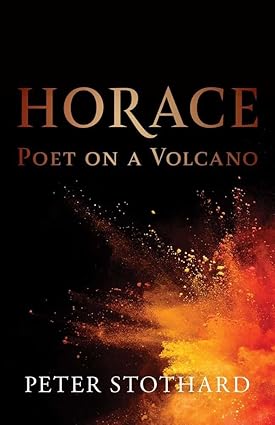
One way of easing into his work is through his dramatic life story. That’s the approach taken by Peter Stothard, former editor of The Times Literary Supplement, in Horace: Poet on a Volcano, an enviably graceful and erudite new entry into Yale University Press’s “Ancient Lives” series that opens up Horace’s poetry for new and experienced readers alike. Stothard’s subtitle is taken from a learned rant that Horace tacks onto the end of a long poetic letter about artistic technique, the Ars Poetica. (All translations in this review are mine, though Stothard, who studied classics at Oxford and whose previous books include literary accounts of the Spartacus slave uprising and the life of Cleopatra, does a fine job with the Latin on his own.)
The volcano of Stothard’s subtitle is not the one best known among us moderns—Vesuvius would not bury Pompeii in ash until more than 80 years after Horace’s death. During his lifetime, another monster volcano inspired fear and fascination all across the Mediterranean. Mount Etna, in Sicily, erupted dramatically in 44 B.C. when Horace was in his twenties. Virgil described it as “throwing up gobs of flame that lap at the stars.” Most evocative of all for Horace, though, was an episode that was rumored to have taken place several hundred years earlier, in which the philosopher Empedocles cast himself into Etna’s crater to encourage a general misapprehension that he was a god.
***
That is why Horace muses that if a poet stumbled accidentally into a pit in a fit of distraction, no one would save him. “How can you know,” they’d say, “whether in his wisdom he threw himself down there” like Empedocles? It’s a typically Horatian passage in that it’s rivetingly confessional and also totally cryptic. Maybe Horace wants to cultivate the image of the transcendent sage, so imperiously aloof from workaday concerns that even the end of his life on this plane is a grand poetic gesture of self-immolation. Or maybe he’s just an absent-minded nebbish in a world of political treachery, so oblivious to the court intrigues going on around him that he doesn’t see the precipice he’s walking toward until he’s face-down in a pit of molten lava. He remains a total cipher even in the act of baring his soul. He might be a genius, or a madman, or just a pretentious lout—qui scis, as the onlookers in his poem say: “How can you know?”
Horace lived at a time when self-concealment was a useful skill. He was the son of an ex-slave, doubly tainted by his low birth and by his youthful service in the rebel armies of Julius Caesar’s assassin Brutus. In 42 B.C., when the rebels fell to the combined forces of Marc Antony and Caesar’s heir Octavian at the Battle of Philippi, Horace was on the losing side. Barely more than a decade later, though, Octavian had turned on Antony and crushed him at the Battle of Actium—while Horace, in the meantime, had conveniently discovered new allegiances. He was well on his way into Octavian’s good graces, and Octavian was well on his way to becoming Augustus, Rome’s first emperor. It was the last chapter in a century of civil war and bloodshed. As Rome’s 500-year-old republican constitution crumbled, populist generals fought viciously to be the last strong man standing. In the process, lots of people found themselves switching sides more than once to avoid ending up on a hit list. Horace was the sort of person who would die rather than misplace a word in a verse, but he held his political commitments loosely at best. This order of priorities was an advantage when it came to navigating the maze of booby traps that was Roman civic life during the transition from republic to empire. He became an expert at it.
***
Stothard launches his story, as Horace would have advised, in medias res—another indelible phrase he invented, also from the Ars Poetica. Poet on a Volcano opens on Horace as a young man, carousing among Brutus’ troops in the lead-up to Philippi. He escapes the battle, writes Stothard, “a damaged man, at first almost a maddened man, an indulger of himself as soon as he could be, soon deft in the meters of his art and the tactics of survival.” His earliest work, a collection of Satires from the hungry years when he slummed it in Rome’s squalid tenement district, froths and boils with the frustrations of the penniless artist. He mellowed out over time. It got easier as he moved up in the world. With each successive collection of his poems—two books of Satires, one of Epodes, four of Odes, and two of Epistles—sputtering invective gradually gives way to the sedate philosophizing of a country gentleman. He probably crossed paths with Cicero’s son as a student in Athens. He made friends with Virgil. But his big break was becoming a favorite of Gaius Maecenas. Maecenas was a professional dandy and one of Augustus’ closest intimates, his designated minister of culture. Like Horace, he was a man of letters before politics. The circle he gathered around him represented the vanguard of a new movement in the arts, a revival of Latin poetry to go with the restoration of Roman peace. Augustus certainly took pride in this literary coterie, but it was not exclusively or even primarily a top-down state enterprise. Maecenas was in charge of it, and he had, as Stothard writes, “a real love of words that would last longer than a propaganda campaign.”
Romans in those days tended to cope with the charged atmosphere in one of two ways. Some plunged headfirst into politics and secured whatever forms of influence were available under the new arrangement, governing far-flung provinces or angling for Augustus to deputize them in his management of the capital city. Others, inspired by the Epicurean school of thought which counseled a refined detachment from current affairs, did their best to keep apart from court intrigues and concentrate on the finer things in life. This was Horace’s way. He was schooled by the testy lawyer Gaius Trebatius in the crucial practice of networking. But he bristled at the suggestion that an artist should use his talents exclusively to curry favor, and he drew the line resolutely at prostration. So, he had to surround himself with well-connected protectors without ever obligating himself too deeply or consenting to write what he was told. As Stothard puts it, “he needed help to be as independent as he thought a poet should be.” This was the kind of help Maecenas, and probably Maecenas alone, could give him. He knew he had it made when his patron bestowed on him a fabulous villa, a farm in the Sabine hills northeast of Rome. Its ruins are still nested in their magnificent setting, lush with woods and waterfalls.
***
By the time he composed his Epistles, that farm had become Horace’s emblem of everything he prized in life. It was, he wrote, “a sweetly shaded refuge from civilization” where he could escape the gaudy urbanities of the metropolis at last. The country was preferable to the most splendid town on earth, he wrote to the city-slicker Aristius Fuscus, and the proof was that even the magnates of Rome planted trees among the columns of their mansions to adorn their courtyards. “Drive nature out with a pitchfork,” he concluded in another of his endlessly quotable lines, “and it comes rushing right on back.” Augustus might boast that he had found Rome a city of brick and left it one of marble. But all the artifice of man could not improve upon nature’s simple pleasures. It was a point Horace had already driven home in his second book of Satires, when he was still smarting from the indignities of low-rent city life with its loose women and cheap wine. Repurposing a fable from Aesop, Horace staged an archetypal confrontation between the Town Mouse and the Country Mouse, in which the Country Mouse ends up fleeing decisively back home after a tour of the city: “There’s nothing for me in this life,” he announces. “I’ll content myself with my woodland hidey-hole and my bowl of beans, safe from my enemies.” Horace the Country Mouse felt much the same way.
***
“Safe from my enemies.” Who was Horace hiding from? Most of what we know about him, we know through his poems and a relatively terse biography that the historian Suetonius pieced together from the imperial archives a few generations after Horace’s death. It’s more information than most ancient authors left behind, but still meager by modern standards and always cloaked in Horace’s signature ambiguity. Stothard could be accused of sometimes taking his source material too much at face value, and he certainly embellishes on it with gusto, but he does it plausibly and well. This is imaginative literary nonfiction of a kind that Horace has always invited, along the lines of Columbia University professor Gilbert Highet’s classic survey of Latin authors, Poets in a Landscape (1957). For instance: Suetonius cites a rather breathless allegation that the famous Sabine villa had a room walled with mirrors in which Horace, who never married, “had whores arranged, so that he would see sex in every direction he looked.” It’s characteristic of Stothard’s technique that he parlays this salacious gossip into an elaborate metaphor for the poet’s ever-shifting persona, picturing him all alone in the hall of mirrors where he took his call girls. “Horace had many faces now in the lamplit room in his home,” Stothard writes. “Everywhere he stared back at himself.” Whether or not he ever actually did that, there’s something true to Horace in this image, the many-sided man who craved notoriety but never transparency. A little like Bob Dylan, he managed to become an icon and an enigma at once, and he stayed that way. He might have liked to know that these days people quote him all the time without realizing they’re doing it, or even knowing his name.
It helped that he cut an unimposing figure in person. He was short and fat, a man who obviously liked food almost as much as sex, and Stothard makes much of this (the word “tubby” appears in his account more times than perhaps is strictly necessary). But then, Augustus apparently made much of it, too. Suetonius reports that the emperor teased Horace for writing such slim books when he himself was so round, inviting him to write on the curved surface of a jar “so your verse can be as swollen as your gut.” There was a touch of menace behind the jab: perhaps, Augustus was not-so-subtly hinting, he might round out his next book with a little more praise of the royal personage? Horace did manage to satisfy this implicit demand with commissioned pieces like the Carmen Saeculare, an elaborate hymn in celebration of Augustus’ family policy to be performed at a civic festival called the Ludi Saeculares or Epochal Games. It was an ancient tradition, revived for a new age. Horace marked it with due pomp and circumstance, but one gets the distinct impression that his deepest concerns lay elsewhere, with his farm and his more slender verses.
***
Even when he was awash with accolades and supported by friends in high places, Horace was never quite at ease in high society. He remained wary of political rivals and warier still of political friends. He joked nervously about sending his books to market polished and shaved like expensive hooker boys—he feared a fall from grace, as everyone did in those days, but above all he feared pimping out his artistic gifts even for a good cause. He always wanted to hold something in reserve, to keep the core of himself and his craft pure. So, it suited him to hide. Most of the time he could pass himself off as a comic figure: the harmless little ink-stained lech among warriors and statesmen, the poet wandering distractedly along the edge of the volcano. Every now and then, though, he would slip a knowing glance at his most discerning readers and reveal the divine madness behind the comic mask, the sublime visionary who might just jump in on purpose for the sake of his art.
***
If any poem fully captures this touchy, flawed, and achingly lovable man, it might be poem 4 in his first book of Epistles. This is the mature Horace at his finest, distilled into 16 deceptively chatty yet perfectly polished hexameter lines. Albius Tibullus, the epistle’s addressee, was a fellow lyric poet—a tried-and-true kindred spirit who had followed Horace’s work since the lean, mean days of the Satires:
Albius, you were an honest judge of my Satires—
What should I say you’re up to out there in Pedum?
Writing a piece that will vanquish Cassius of Parma?
Or creeping in silence among the wholesome groves,
Attending to all that befits the wise and the good?
You’re more than a body: you’ve got a heart. The gods
Gave you grace with your riches, the art of enjoyment and taste.
What more could a tender wet-nurse wish for a nursling
Who’s already wise and can say what he feels, and to whom
Esteem, and vigor, and tact accrue in abundance,
Whose lifestyle is chic and who never wants for coin?
Amid your hopes and worries, amid rage and fear,
Treat every dawning day like it’s your last,
And every hour, unhoped for, will be welcome.
If you visit you’ll laugh to find me fat and sleek,
A pampered hog in Epicurus’ herd.
Cassius of Parma was a poet, too. He was also one of Caesar’s assassins, a soldier who like Horace fought with Brutus, and unlike Horace, stuck it out with Antony at Actium. He escaped detection longer than any of the other conspirators, but one of Augustus’ agents finally spotted him in Athens and executed him. In asking whether Tibullus means to vincere Cassius—to “overthrow” or “outdo” him—Horace is inquiring, as delicately as possible, whether Tibullus intends to insert himself into the dangerous game of poetry as politics. He is comparing notes with his fellow traveler on the right approach to mixing art with public affairs. Better, he gently suggests, and safer—more saluber or “wholesome”—for Tibullus to spend his time in the countryside of Pedum, wandering among the woods in philosophic contemplation. After all, Tibullus isn’t just a matinee idol with a nice body, though he certainly is that. He is also in possession of every adornment and accomplishment one could wish upon a Roman gentleman. Horace next launches into an apparently gratuitous torrent of flattery that is also, ingeniously, a catalogue of the virtues he admires most. Grace and eloquence, taste and tact, a comfortable living—these are the things that make for the good life.
Then, in three abrupt lines of exquisite Latin, Horace drops all casual pretense and turns alarmingly serious. The good life is a fragile thing in these wretched days, he tells Tibullus, as if suddenly grabbing him by the shoulders and looking him dead in the eye. “Amid your hopes and worries, amid rage and fear, / Treat every dawning day like it’s your last, / And every hour, unhoped for, will be welcome.” Seize the day. Stay out of danger if you can. It’s philosophy as a survival tactic, and Horace is not mincing words. Then the veil of cultivated irony drops right back into place, as if this raw and urgent moment never happened. Look at us now, Tibullus, says Horace: you’d laugh to see me, the grubby striver all gussied up and sitting pretty in my fancy house. After all, what is a poet, really, but Epicuri de grege porcus, “a hog in Epicurus’ herd”?
***
Another quotable line. John Adams, complaining that all modern philosophy had turned into low Epicurean pleasure-mongering, asked despairingly: “Are we all to become Epicuri de grege porci?” He seems to have understood that Horace, however he protested, considered himself more than that. If he absconded from the city and held Augustus at arm’s length, it wasn’t simply to amuse himself or to indulge his appetites, though they were prodigious and he indulged them plenty. There was a higher purpose to his escapism, too. He was not immune to stirrings of patriotism or insensate to the grandeur that was Rome. But he also understood something that Socrates knew and that plenty of writers today, hounded out of Hollywood on ideological grounds or blacklisted for tweeting the wrong thing at the wrong moment, have discovered. Political movements need artists and philosophers but also, often enough, destroy them. The man in search of “all that befits the wise and good” should beat a healthy retreat to the woods whenever he can. This, Peter Stothard’s biography reveals, was Horace’s greatest achievement: to dance on the edge of the volcano, to speak meaningfully into the moment without being consumed by it. He died at 56, shortly after Maecenas, and like Maecenas he left his material property to Augustus. But everything he had of real value—his perfect turns of phrase, his elaborately crafted verse, his marvelously inscrutable soul—those things he left to all posterity, and so to us.