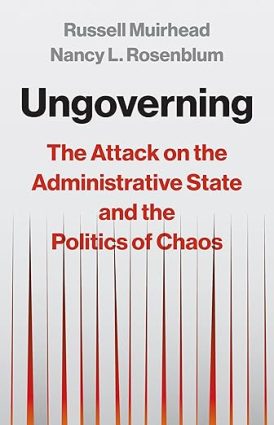
The authors of Ungoverning: The Attack on the Administrative State and the Politics of Chaos do not believe that an expansive, unelected bureaucracy poses a threat to republican government, even if they wouldn’t defend everything it does. Indeed, for Russell Muirhead and Nancy L. Rosenblum, professors of government at Dartmouth and Harvard, respectively, any attempt to reduce the power or reach of these agencies is itself an assault on democracy. Even with a $37 trillion deficit, the federal government is not spending enough, they claim, and they are not shy about suggesting new programs and goals that would not only dig us deeper into debt but would move us further away from our constitutional design.
Although the various parts of the federal bureaucracy are intended to serve the elected branches, the reality is somewhat different. Agencies meant to carry out the will of the president and the Congress have grown more autonomous over time into something like a fourth branch of government—or perhaps better still, a unified shadow government beyond the reach of voters that combines legislative, executive, and judicial powers, and prevents the original three branches from operating as intended.
***
Muirhead and Rosenblum admit there is a “wave of frustration with government bureaucracy and government performance,” and that, although “most administrative failings are mundane and corrigible, others are life-altering, even life-threatening.” But the “reactionary movement” behind what they call “ungoverning” is not really interested in institutional reform, only in “deconstruction.” Proposals to reduce the national debt are, in effect, a “deliberate effort to dismantle the capacity of the government to do its work.” Ungoverning is “animus toward government itself.” It “is the reversal of already highly developed state capacity. It is a kind of backward evolution,” inviting “the politics of chaos.” Because the administrative state is a global phenomenon, the authors insist that “ungoverning is not just about Donald Trump,” nor was Trump’s previous administration only about ungoverning—though they are still sure to denounce the president as a “fascist.”
Throughout the book Muirhead and Rosenblum present the alternative to administrative rule as “personal rule,” as if a slightly smaller bureaucracy, one that has less discretion and smaller budgets, risks a descent into despotism or anarchy. They frequently complain about politicians second-guessing the “experts,” or substituting their own policies for those recommended by specialists, as if the only legitimate governing is done by bureaucrats. Not even the COVID-19 experience has diminished the authors’ faith that administrative experts know best and shouldn’t be questioned. They strongly criticize Florida governor Ron DeSantis for ignoring directives about masking and closing schools, despite the overwhelming evidence now that the governor was right and the experts wrong.
And yet, though the book doesn’t acknowledge it, there is a price to be paid for turning over to unelected bureaucrats more and more of what government does. And this is not just a problem at the federal level but for many states as well. For example, the Clean Air Act, first passed in 1963 and amended several times since, includes nothing about providing subsidies for electric vehicles, and yet the Biden Administration went ahead anyway and launched a program providing $7,500 for eligible electric vehicle buyers. Likewise, the Civil Rights Act of 1964 says nothing about how to determine gender; it simply asserts that there shall be no discrimination based on race or gender, and assumes that gender is determined biologically. The harsh reality is that the federal government does too many things; those who should be thinking about how to meet challenges or solve problems too often avoid doing so; and the real politics of chaos will begin when no one wants to buy the nation’s junk bonds anymore.
***
Ungoverning claims that the authority of the administrative state derives from the agencies’ fidelity to statutes, accountability to the executive, institutional memory, and above all, impartiality to what the authors call “process” or correct procedures. But Muirhead and Rosenblum present an idealized version of the administrative state, in which bureaucrats only administer things, based on their specialized knowledge; they never wander into political decision-making. To return to the recent experience of COVID, the Centers for Disease Control and Prevention (CDC) not only advocated masking and school closings in the name of public health but banned in-person religious services and made it impossible for some businesses to operate, putting millions of people out of work. These decisions were not based on science but on the public health profession’s commitment to minimizing the risk a health threat poses. To make sensible policy, however, minimizing risk is not the only serious consideration. Choosing the right level of risk depends on comparing various risk levels to the burdens they impose, which is a political, not a scientific, determination. Only politically accountable representatives can think through how to measure the infection risk of such activities as attending school, going to work, or attending religious services, versus the benefits those activities provide to society.
What’s more, it’s simply untrue that administrators, in the most important matters, are merely faithful to statutory intent. Administrators are not blank slates. They often will have their own view of what should be done and impose that view in the face of vague and ambiguous statutory language. The overwhelming majority are progressives who feel obligated to take liberties with the law in order to advance progressive goals, often in collusion with courts. Boston College political scientist R. Shep Melnick has coined the term “leapfrogging” to describe the process by which agency officials loosely interpret statutes and courts not only back them up but often add even more aggressive language.
***
Agencies can easily invent clever evasions of proper administrative procedure, and have done so with increasing frequency. In 2016, under President Obama, the Department of Education and the Department of Justice did not issue a regulation requiring schools to allow transgender students to use the bathroom of their choice. That would have required the laborious regulatory procedures outlined in the Administrative Procedures Act. Instead, the departments issued a “Dear colleague” letter, which did not have the force of law but instead stated that it “provides information and examples to inform recipients about how the Departments evaluate whether covered entities are complying with their legal obligations” under “Title IX of the Education Amendments of 1972…and its implementing regulations that prohibit sex discrimination in educational programs and activities operated by recipients of Federal financial assistance.”
The letter reiterated a previous administrative edict that deviates from the traditional understanding that sex is determined biologically. Rather, sex was now to be determined by one’s “gender identity,” defined as the “internal sense of gender” that each individual chooses, “even if their education records or identification documents indicate a different sex.” The letter applied to “a school’s Title IX obligation to ensure nondiscrimination on the basis of sex” and “requires schools to provide transgender students equal access to educational programs and activities even in circumstances in which other students, parents, or community members raise objections or concerns,” including, for example, restrooms.
Although no explicit penalties were provided, the letter offered “significant guidance,” which “does not add requirements to applicable law, but provides information and examples to inform recipients about how the Departments evaluate whether covered entities are complying with their legal obligations.” The blackmail is clear: abide by the interpretations the letter contains or you are breaking the “applicable” law and, thereby, putting at risk the extensive federal funding the government provides. The first Trump Administration rescinded the letter. Then in 2021 the Biden Administration issued a new “Dear educator” letter restoring the principle of gender identity. In February 2025, Trump rescinded that letter and restored the principle that sex is determined biologically. Thus, we’ve had bureaucratic ping pong rather than any deliberative process for determining the meaning of the word “sex.” If Congress fails to engage in such deliberation, one imagines that a returning Democratic administration will make its own backhand return.
***
Until last year, the Supreme Court had abetted this type of administrative aggrandizement. In Chevron U.S.A., Inc. v. Natural Resources Defense Council, Inc. (1984), it gave deference to the agency in determining the meaning of a statute. Agencies only had to show that their interpretation of ambiguous statutory language was “reasonable.” Forty years later, in Loper-Bright Enterprises v. Raimondo (2024), the Court overturned this interpretation. It ruled that courts must exercise their own independent judgment in determining what a statute means rather than deferring to agency interpretations, even if those interpretations are “reasonable.” This power shift is salutary but not without risks. Judges are also prone to bias and myopia, as the practice of “leapfrogging” demonstrates. But statutory interpretation is what judges are trained to do and their independence from the executive branch better places them to do it impartially. Individual lower court judges may continue to leapfrog, but there is reason to hope that appellate courts will discourage this kind of agency deference.
The term “administrative state” is itself a misnomer. There should be no “fourth branch of government.” Executive agencies are part of the executive branch and should be brought to heel. The end of Chevron deference points in the right direction, but more aggressive curbing of phony claims to expertise is necessary. Another Supreme Court decision, West Virginia v. Environmental Protection Agency (2022), is a further step in the right direction. In that case, the Supreme Court ruled against the EPA’s Clean Power Plan, finding that the plan lacked clear congressional authorization to implement a “generation-shifting” approach to energy production. The EPA cannot force coal-fired power plants to switch to cleaner sources like wind or solar, although the agency can still set technology-based standards to improve pollution control within existing facilities. To support its decision, the Court invoked what has come to be called the “major questions doctrine.” The majority opinion, written by Chief Justice John Roberts, argued that the EPA’s actions raised a “major question” about the agency’s authority, and that such significant decisions should be made by Congress, not by an executive agency. Ironically, the major questions doctrine is now being invoked by critics of the Trump Administration’s frequent resort to executive authority, on matters ranging from freezing funding for childhood vaccinations to ending birthright citizenship. Sound judicial doctrine ought to restrain the Right as well as the Left. It remains for Congress and the courts, however, to define more clearly what constitutes a “major question.”
***
Just as Loper-Bright shifts authority from agencies to courts, the major questions doctrine shifts it from agencies to the Congress. Now it is up to Congress to restore and enhance its capacity to perform the requisite oversight. Such a task used to be central to its mission before individual representatives replaced conscientious attention to such mundane but crucial duties with the sort of ideological grandstanding aptly called “virtue signaling.” Congress and the courts will need to require much stricter adherence to the regulatory procedures enshrined in the Administrative Procedures Act.
Ever since Woodrow Wilson, American progressives have become increasingly disenchanted with the very idea of a limited government. Chafing under what they see as the antiquated strictures of the Constitution, they’ve despaired of Congress’s slow political give and take. They’ve come to put their faith instead in a potent combination of a presidential leader who would continually test the limits of executive power and a core of administrators who would advance a progressive agenda while claiming they were merely enforcing existing law and deploying their technical expertise. More and more, Republican administrations have joined in. Now, to their chagrin, as Russell Muirhead and Nancy Rosenblum’s Ungoverning shows, progressives are coming to see that excessive presidential and administrative authority can be wielded for anti-progressive purposes. If only they might now rediscover the virtues of a constitutionally constrained government.
Next in the fall 2025 Issue
The Real Watergate Scandal

Streaming Shakespeare