Books Reviewed
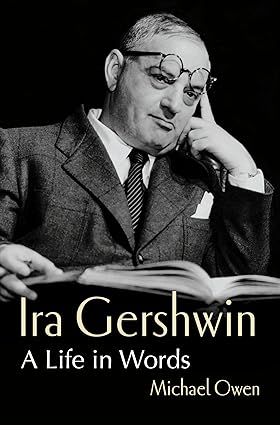
There is a rhyme in Ira Gershwin’s lyric for “Someone to Watch Over Me” that is easily missed when the song is sung in a rhythmically flexible ballad style, as it usually is today:
Although he may not be the man some
Girls think of as handsome
To my heart he’ll carry the key.
That level of quiet yet fierce craft is classic Ira Gershwin, and yet it is no surprise that Michael Owen’s Ira Gershwin: A Life in Words is the first full-length biography of him. For all his gifts, Ira lived in the shadow of his meteorically gifted and more artistically driven brother, George, two years his junior, including for the almost 50 years Ira outlived him.
Ira wrote lyrics with George for 13 years, starting with songs for a string of fizzy musical comedy hits in the 1920s and beyond with titles like Funny Face and Girl Crazy. The latter harbored a perfect example of how Ira embedded art within these generally ephemeral projects. The second stanza of “But Not for Me” ends with the exquisite pun “The climax of a plot / Ends in a marriage knot / But there’s no knot for me.” With inventions like this, complemented by musical ones from George, it was as if the brothers were itching to move the form forward, and like many musical comedy writers of the ’20s, they were. This led to their trio of satirical political musicals, the most popular of which, Of Thee I Sing, won Ira and its book authors (George S. Kaufman and Morrie Ryskind) the Pulitzer Prize in 1933. The challenge in a biography of Ira is that his artistic arc stopped largely at about this point.
***
To be sure, he always worked at a lofty level, becoming one of a small guild of lyricists in the first half of the 20th century—Lorenz Hart, Oscar Hammerstein, Dorothy Fields, and Johnny Mercer were others—who elevated a craft into an art. Even for a song that served largely to bring on a dance routine, “Island in the West Indies” (written with Vernon Duke for The Ziegfeld Follies of 1936), Ira’s languid coda was:
Learn the lingos
Of pink flamingos
Where nothing’s immoral
’Way out on the coral
All day we’ll ramble
Where starfish gambol
Just you and me an’
The Caribbean
And love.
After George’s early death of a brain tumor at age 38 in 1937, Ira penned the lyrics to Kurt Weill’s music for Lady in the Dark in 1941, a hit about (of all things) psychoanalysis, inspired by librettist Moss Hart’s sessions on the couch. Musical lyrics founded in Freudian concepts were new to Broadway, and this show’s coherence puts paid to the idea of Oklahoma, two years later, as the first Broadway musical in which the music and the plot worked together. One imagines an alternate universe where Ira could have helped to anticipate the layered and ironic “concept musical” pioneered by Hal Prince and Stephen Sondheim in the 1960s.
But as fate had it, the next three artistically ambitious projects Ira took part in were failures. One was a stage musical celebrating Renaissance artist Benvenuto Cellini with a resounding 18-minute opening sequence (The Firebrand of Florence); another set to music a wry farce about divorce among the wealthy (Park Avenue); then there was a musically fecund fantasy/comedy film (Where Do We Go from Here?). Robert Kimball’s The Complete Lyrics of Ira Gershwin (1993) includes reams of elaborate, clever, and often touching material for these three pieces, but today they are all but forgotten. These episodes left Ira, brilliant but self-admittedly lethargic, disinclined to toil further for Broadway, or, it seems, to seek a larger artistic canvas in general.
From the late 1940s on, he wrote lyrics for the occasional movie musical to help pay the bills; A Star Is Born with Judy Garland being the signature example. But beyond this, the high points of his career were (reluctantly) traveling to Russia in 1955-56 with a Porgy and Bess company and gathering a generous sampling of his work in the book Lyrics on Several Occasions in 1959. That book is decorated with such ample anecdotes about the songs’ creation that it all but qualifies as an autobiography, and in fact has likely helped discourage actual biographies of Ira, especially given how well covered his life is in the now countless biographies of his brother.
***
Ira presents other challenges to the biographer as well. His personal life was not the stuff of drama. He seems not to have dated before his marriage, and Leonore (née Strunsky) Gershwin set her cap for him rather than the other way around. It seems to have been a rather cordial marriage—as in Leonore had to remind Ira to celebrate her birthday. Ira’s life offered almost none of the easy scores a biographer typically makes use of: he and his wife did not have children, they did not divorce, Ira had no paramours of record, and there was always plenty of money.
Especially tricky in telling his life story is that creation was not Ira’s prime motivation—his attitude toward writing was often driven more by concerns financial than artistic: “How I dread it! Work! Work!” as Owen quotes from one letter. Ira was happier at the gambling table, the racetrack, or his swimming pool. (Traveling from New York to work with him on The Firebrand of Florence, Kurt Weill, in an anecdote that doesn’t make it into this book, became irritated at Ira’s disinclination to get to work, grousing, “I didn’t come to California to swim in the pool.”) In the late 1950s, while Ira was in commemorational mode gathering his work for Lyrics on Several Occasions, his contemporaries Hammerstein, Fields, and Mercer were all still taking on new projects. Ira’s life consisted mainly of first watching big things happen to his brother, and later on wishing he still could. Late in his life Ira was still talking to his brother in his sleep.
As such, his work is what will interest us. Perceiving its true genius requires a certain attention, however. A typical encomium, such as in the citation for his honorary degree from the University of Maryland in College Park, goes that he had a “unique mixture of wisdom and whimsicality, of satire and sentiment,” and that he “has laughed at man’s foibles, been amused by his peccadilloes, but has never failed in fun and good humor.” But this could be said of almost any lyricist of Ira’s time; his genius was more specific.
***
Cole Porter’s lyrics were sexy. Ira’s friend and sometime collaborator Yip Harburg’s were playful. Even into the 1970s, Dorothy Fields’s always sounded uncannily like someone overheard on the sidewalk. Ira’s style was less immediately dramatic in comparison. Rooted in his young lad’s love of tea-cozy light verse of the kind driving Gilbert and Sullivan’s work, the essence of Ira’s lyrics was, first, a low-key but particular puckishness, crossing the Gilbert essence with an embrace of the colloquialisms of America between the wars, and second, as Owen puts it, “honed to perfection with the skill of a diamond cutter.” Harold Arlen never knew “any lyric writer who studies his work line for line, progressively for the ideas and for the rhymes, as Ira does.”
In “They Can’t Take That Away from Me,” at the end of the lyric “the way you changed my life,” Ira told George to make the note on “life” higher. Here, a perfect climax in the lyric meets a gorgeous climax in the melody, depicting a person of modest temperament erupting briefly in exclamation out of the love that anchors a life. The lyric of “Fascinating Rhythm” today seems eternal, as if it had always existed:
I know that
Once it didn’t matter—
But now you’re doing wrong:
When you start to patter
I’m so unhappy.
Won’t you take a day off?
Decide to run along
Somewhere far away off—
And make it snappy!
But Ira’s first stab at putting words to the quirky melody was “Syncopated City”—cute, but not magic. Ira’s lyric for that song, feeling so human—“start a-hopping, never stopping”—is a kind of uncanny perfection.
Owen documents that even genius lyricist Johnny Mercer had taken an early crack at the melody of “The Man That Got Away” from A Star Is Born with the lyric “I Can’t Believe My Eyes.” Let’s face it: no one would still be singing that version of the song today. Ira listened to Harold Arlen making a piano wail with that song’s melody, and came up with a lyric that sounds as if it welled up from, well, where? Judy Garland? The character Esther Blodgett she plays in the movie? Or a place none of us could ever reach or know?
The night is bitter,
The stars have lost their glitter;
The winds grow colder
And suddenly you’re older—
And all because of the man that got away.
Ever since this world began
There is nothing sadder than
A one-man woman looking for
The man that got away
***
But these words came from someone whose retiring and undriven nature defeats Owen somewhat. His book ends up more chronicle than portrait and, for all its diligence, has a perfunctory quality. As a historian, researcher, and archivist who previously wrote a biography of American jazz singer Julie London, Owen is more interested, for example, in the details of Ira’s contracts and royalties than most readers will be, while central aspects of his personal life go unmentioned until the end of the book. For example, only in the last 20 pages or so during Ira’s twilight years do we learn that Leonore was extremely difficult, that “of all the women in the world, Ira had more love for Emily [Paley, his sister-in-law] than any other,” that The Lost Weekend author Charles Jackson was a close friend, or that Ira was especially close to the writer Harry Kurnitz.
Ira Gershwin: A Life in Words will serve as a welcome brick in the ever-fascinating wall of sources on the Gershwin story writ large. For most readers, however, the more useful and gratifying source on Ira will be to engage his work in either Lyrics on Several Occasions or Kimball’s comprehensive anthology. These sources bring Ira alive in a way that his resolutely quiet and humble life perhaps cannot.