Books Reviewed

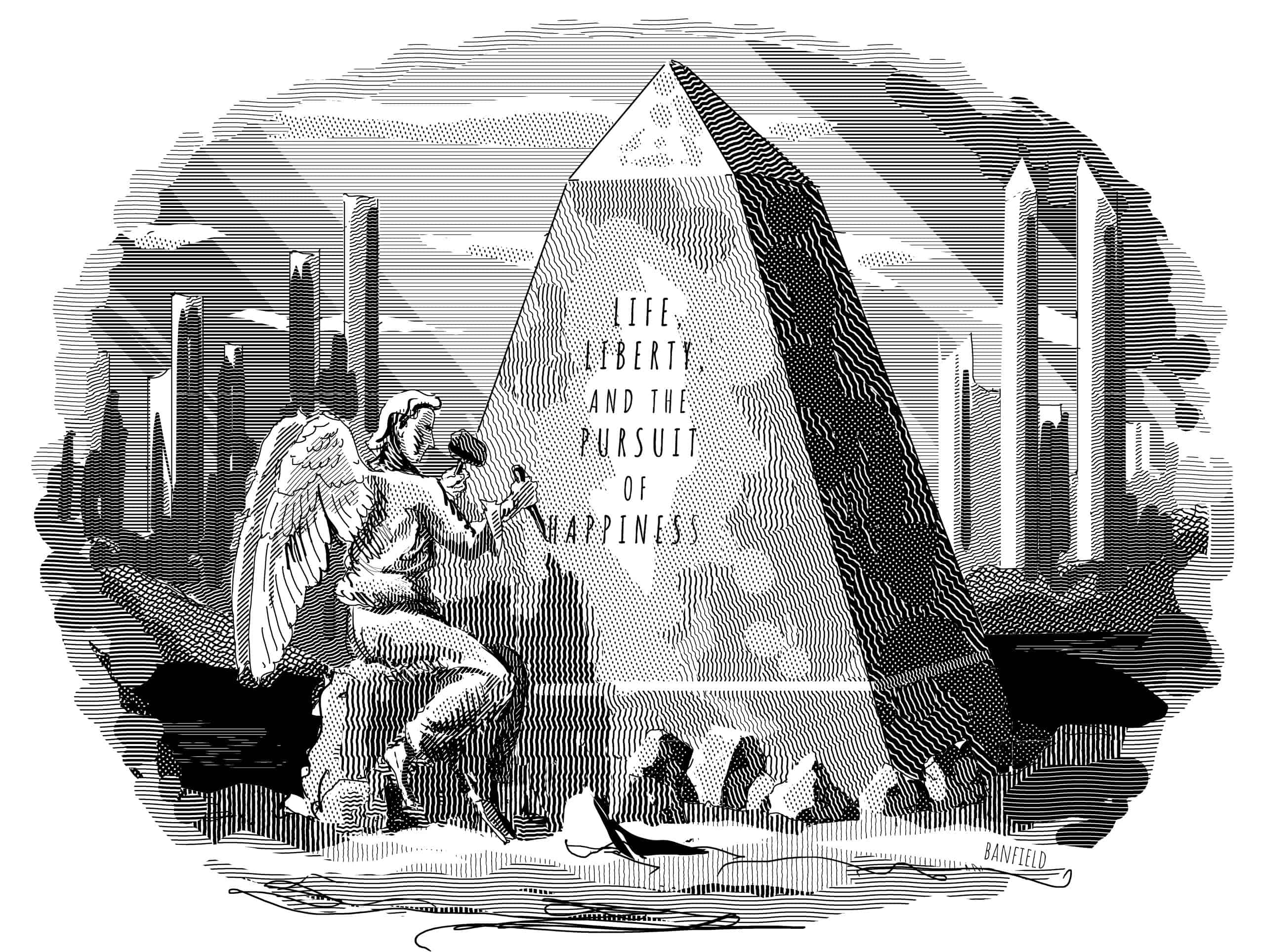
As we approach the 250th anniversary of the United States’s emergence as an independent nation—a celebration that will culminate with a wide range of national and local observances on July 4, 2026—the question naturally arises as to how best to incorporate the American Revolution into the education of Americans, and in particular the civic education of young Americans. The question is a natural one because it reflects an assumption held by many, if not most, Americans that the Revolution, and the Declaration of Independence that justified it, have always been fundamental to what America is, and to what it aspires to be. If we want the rising generations to know their country, we need to be sure they know about the Revolution and its principles.
Although a long bibliographical essay would be needed to chart all the different perspectives about the Revolution historians have offered for the past century or so, much of it boils down to Carl Becker’s famous 1909 dichotomy between the Revolution understood as a dispute over home rule and the Revolution as a dispute over who would rule at home. Or to put it another way, between the Revolution, on the one hand, as a primarily elite political affair, having to do with the organization of the British Empire, in which certain general ideas and ideals played a central role, and on the other, as a burgeoning social revolution, with stark internal class conflict, at times bordering on civil war, led by forces seeking to move the new country in the direction of a more democratic and egalitarian society.
This debate is well worth having because it brings out the American Revolution’s rich complexity. We will continue to seek out and debate its meanings precisely because the Revolution remains so powerfully central to us—a signal event in which our identity as a people was planted, but whose abundant significance overflows any single attempt to capture and confine it.
***
That is not the only way to see things, of course. In The Memory of ’76, a finalist for the 2025 George Washington Prize, historian Michael Hattem argues that our reliance on the Revolution as a source of national identity and self-definition has been an unfortunate thing, a mistake even, that has caused us more trouble than it’s been worth. Although “the popular memory of the Revolution has been an important vehicle through which Americans have defined and voiced their understanding of the present and their hopes for the future,” the associate director of the Yale-New Haven Teachers Institute acknowledges, our “origin myth,” as he calls it, has been “consistently contested,” and has led to conflicts “over partisanship, regionalism, race, gender, class, ethnicity, and religion.”
The book is a long, somewhat selective slog through the American cultural past, attempting to discern how, during different times and circumstances, the Revolution has been understood by the general public and by those who would deploy it to shape and direct public opinion. The “memory” referred to in the book’s title is less about historians’ competing interpretations of the past than it is about “public memory,” the residuum of popular ideas about the past—a much more slippery thing, difficult to identify with certainty, often defined in a random and arbitrary way, highly subject to the confirmation biases of the person collecting the evidence.
***
Hattem largely provides short accounts of how different individuals at different times, ranging from abolitionists and feminists to movie producers and January 6th rabble-rousers, made use of the Revolution and its legacy for their own purposes. Sometimes these purposes were at odds with the selfless, patriotic sentiment of “the Spirit of ’76”—or even helped to buttress the argument for Southern secession in the 1860s.
Mostly displeased with what he sees along the way, the author begins and ends his account by flatly asserting that “remembering the nation’s founding has often done far more to divide Americans than it has to unite them,” and that “revising the past is an important and long-standing American political tradition.” These two statements, taken together, wouldn’t seem to augur well for a successful celebration next year. Are we to ignore our past, or reinvent it? Is that really the choice before us?
Whenever present-day American academics say that the meaning of an event is “contested,” it’s their way of signaling that whatever consensus about that meaning appears to exist in the public mind is one of which they disapprove, one that they regard as a lingering vestige of popular sentiment that scholarly authority hasn’t yet successfully banished. “Contested” is almost never used in a neutral way. You will not find professional historians saying that the tenets of modern feminism, for example, have been “consistently contested,” even if, in fact, they have been.
Hattem describes the underlying structure of our “contested origin myth” as a version of “the hero’s journey” made famous by Joseph Campbell. The nation began life with a “call to adventure,” underwent “trials and temptations,” and eventually emerged triumphant, “reborn” in the creation of a new nation. Yet, this rather abstract and jejune account does not map well onto the specific events of American history, let alone the “multiple and often contradictory memories of the Revolution” that the book goes on to adduce. It’s not clear whether this deep narrative structure really supplies anything resembling an origin myth for America. It sounds more like a generic fairy tale.
If one is going to apply anthropological terminology and reasoning to historical subjects—indeed, to the history of one’s own country—one ought to be consistent about it, and not use the tools of anthropology exclusively as tools of debunking. The term “origin myth,” as used in The Memory of ’76, implies that the story we think of as our foundational narrative is something false, something we invented, something that amounts to little more than a primitive delusion or childish notion, akin to the story of Romulus and Remus as the founders of Rome. It is mythical in the same way that Orpheus is mythical. But leave aside for the moment the question of historical accuracy and take the anthropological argument seriously. Could it be the case that all ordered societies need shared accounts of their origins in order to be coherent and lasting? If that’s so, then wouldn’t the discrediting of one “origin myth” leave a vacuum to be filled, if we are to avoid dire and disintegrative consequences? What will we become without our foundational narrative upholding us?
***
The word “myth” here is tricky, too, because while we often use the term as a synonym for “falsehood,” or even “lie,” it has another, far more capacious meaning, one more in line with what Campbell, Plato, C.S. Lewis, and the best anthropologists have meant by the word. A myth in this latter sense is a large organizing story that embraces meanings whose range extends beyond the visible horizons of our lives, telling truths that cannot be comprehended by empirical evidence, that dwell in an unmapped futurity that isn’t yet reachable, that don’t admit of confirmation or disproof, that are aspirational in character, that cannot be apprehended by us in any way other than by being embedded in a grand story.
And what is to say that an origin story cannot contain two or more contending forces? It is possible that a pattern of “contestation” is not a bug but a feature in a free society. That is, it is possible to revere Thomas Jefferson, as I do, and yet be thankful for a society in which the founder can also be openly criticized and even despised as a hypocrite, spendthrift, dilettante, domestic tyrant, racist, partisan, crypto-revolutionary, or what have you, as many do. Perhaps having a “contested origin myth” is not such a bad thing, if what you are interested in having is a free society. After all, a “contest” is something that brings people together, and presumes to hold them together, precisely because we must first agree on the grounds of the contest before we can disagree about its proper outcome.
Michael Hattem argues that the legacy of the Revolution is incoherent, because it’s used for two diametrically opposed political purposes: first, to defend the status quo, and second, to promote change. But this isn’t necessarily a collision of contradictory terms, not once you get outside the airless seminar room. As is often observed, the West itself is a unique confluence of competing ideals, embodied by the cities Athens and Jerusalem, ideals that enhance and correct one another, even as they battle against one another’s hegemony. We wouldn’t be ourselves without that contestation, without both elements of it.
***
And there’s the fact that a pattern of contestation is arguably present in all great modern revolutions that have had a lasting impact. We found out in 1989, the 200th anniversary of the French Revolution that commenced in 1789, just how ambivalent the French are about the meaning of their own great revolution, the iconic modern revolution. Sure, the French nearly all embrace republicanism—so much so that just one republic hasn’t proven to be enough for them. Chinese premier Zhou Enlai’s famously misunderstood response in 1972 to a question about the success of the French Revolution—“It’s too early to say”—is still remembered because the statement carries a certain resonance, a certain plausibility, even though Zhou was talking about the “revolution” of 1968 rather than 1789.
But I don’t think it would be justifiable to say the same thing about the American Revolution, that it’s too soon to tell. As Abraham Lincoln declared in his 1838 Lyceum Address, America was an experiment, a successful experiment—even if one facing new threats. There is something unique about the large role played by the American Revolution in our culture, as an agent of stability and an energizing reference point—what came to be known, beginning with Jefferson, as the Spirit of ’76. This paradoxical uniqueness is made evident by the fact that one of the most conservative organizations in the United States is called the Daughters of the American Revolution. The essential character of the American Revolution has been looked upon by Americans as something to be conserved, protected, revered, sustained.
This propensity is not entirely unique to us. In Mexico for most of the 20th century the dominant political party was known as the Institutional Revolutionary Party. Yet for most of its history that party was as ossified and un-revolutionary as the meticulously preserved corpse of Vladimir Lenin still on display in Moscow’s Red Square, just as it has been for over a century now. Is this the only form that an institutionalized revolution is destined to take?
***
The problem is this: how to keep the energy of revolution bottled up and yet vital? How to avoid that descent from aspirational charisma into corpse-cold routinization? How to preserve the living faith of the dead, rather than the dead faith of the living? William Words-worth famously wrote about the French Revolution as it appeared to its enthusiastic contemporaries:
Bliss was it in that dawn to be alive,
But to be young was very heaven!—Oh! times,
In which the meagre, stale, forbidding ways
Of custom, law, and statute, took at once
The attraction of a country in romance!
But of course, that ecstatic, romantic dawn did not last, not for France and not for Wordsworth.
Lincoln worried over a similar problem in the Lyceum Address, when he lamented how the success of the American Revolution and the creative heroism of the founders was being overtaken and negated by growing lawlessness and violence precipitated by conflicts over slavery. The Revolution didn’t need to be fought all over again, he argued; it needed instead to be revered and preserved. Lincoln traced out the need for a form of civic education, the inculcation of what he called a “political religion,” which centered around a powerful “reverence for the laws” and devotion to reason as keys to the steady perpetuation of our institutions.
I think we can take Lincoln’s thoughts as a starting point in answering this problem for ourselves. If the Spirit of ’76, the spirit of the Declaration, is to be preserved and perpetuated—and perhaps we should also say revived—education will have to play a central role: a civic education, an education for republican citizenship. And that education should not be only in the memory of ’76, which, like much of history, can often be a random and turgid thing—one damned thing after another. Instead, it should seek to capture and instill the enduring spirit of ’76, the spirit that made the Declaration of Independence a document of worldwide influence, and that makes it on its Semiquincentennial still a living thing today.
Next in the fall 2025 Issue

Never Trump After 2024
Ancient and Modern