Books Reviewed
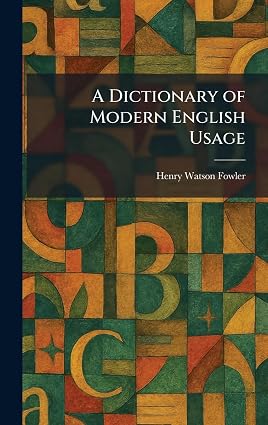
In Enemies of Promise (1938), the critic and essayist Cyril Connolly notes that he is setting out to write a book that will last ten years. Not an easy thing to do, and Enemies of Promise didn’t do it. Whenever I receive a small royalty check—or peasantry check, as I think of them—for a book I published more than a decade ago, I’m especially pleased. Imagine, then, what I might feel in 2026 if I were H.W. Fowler, whose A Dictionary of Modern English Usage, a compendium of inexact words and troubling rules, is now a century old and still not merely readable but immensely useful to those among us who wish to be discerning in their use of the English language.
Little in the early career of Henry Watson Fowler (1858–1933) suggested that he would one day write a book for the ages, or that he would come to be known, as a biography of him by Jenny McMorris has it, as The Warden of English (2001). At Balliol College, Oxford, Fowler finished with second-class honors and failed to pass his divinity exam. His public school teaching days were short-circuited by his atheism. A stab at journalism didn’t work well either. Only after all this did he find his true métier, that of lexicographer. He discovered this when working with his brother, Francis George Fowler, on The Concise Oxford Dictionary of Current English (1911), which, like Modern English Usage, with subsequent revisions, has remained in print.
Work on A Dictionary of Modern English Usage was interrupted by Fowler’s service in World War I. When the book was finally published in 1926, it was a bestseller, undergoing three reprints that same year. This was owing, doubtless, to its continuing pertinence, but even more to the character of its author, his vast knowledge of the English language, and his impressive common sense in setting it out for readers keen to use English in a precise manner.
When the Rules Truly Apply
A touch unsure about my use of the word métier, I checked it in Modern English Usage. From there I was sent to the article “French words,” where I read:
Display of superior knowledge is as great a vulgarity as display of superior wealth—greater, indeed, inasmuch as knowledge should tend more definitely than wealth toward discretion & good manners. That is the guiding principle alike in the using & in the pronouncing of French words in English writing & talk. To use French words that your reader or hearer does not know or does not fully understand, to pronounce them as if you were one of the select few to whom French is second nature when he is not one of these few (& it is ten thousand to one that neither you nor he will be so), is inconsiderate & rude.
Only on second, slightly shaky thought have I decided to let métier stand.
“Vulgarity,” “discretion,” “good manners,” “inconsiderate,” “rude”: one is not used to seeing such words applied to language, but to H.W. Fowler they are of language’s essence. English is perhaps as rule-ridden as any language, but Fowler cuts through all that might have been considered schoolmarmish in this realm to inform his readers when the rules truly apply. He begins his article on “Split infinitive,” for example, by writing: “The English-speaking world may be divided into (1) those who neither know nor care what a split infinitive is; (2) those who do not know, but care very much; (3) those who know & condemn; (4) those who know & approve; & (5) those who know & distinguish.” He then provides examples of all five cases.
A Dictionary of Modern English Usage also takes up that other notable schoolroom taboo, “Preposition at End” of a sentence, concluding: “Follow no arbitrary rule, but remember that there are often two or more possible arrangements between which a choice should be consciously made; if the abnormal, or at least unorthodox, final preposition that has naturally presented itself sounds comfortable, keep it; if it does not sound comfortable, still keep it if it has compensating vigor, or when among awkward possibilities it is the least awkward.” As for rules generally, Fowler’s view is that it is better to break the rule than to write something barbarous in attempting to avoid doing so.
Language, like a spoiled child, is given to endless change. Some of this change is necessary, some for the better, much not. Perhaps the worst are those changes that set out to display the elegance of their users. One of the most famous among these is found in Fowler’s article “Elegant Variation.” This misstep entails relentlessly referring to the same thing, person, or action by different words. Fowler writes: “It is the second-rate writers, those intent rather on expressing themselves prettily than on conveying their meaning clearly, & still more those whose notions of style are based on a few misleading rules of thumb, that are chiefly open to the allurements of elegant variation.” He then provides more than five columns of examples of the error in action.
Useful information on the most fundamental of linguistic matters is also to be found in the pages of Modern English Usage. More than eight full pages are given over to the subject of “That.” Five are devoted to “Position of Adverbs.” Fowler can even be interesting on “The” (five pages) and “And” (two pages). He is especially helpful on distinctions, among libel, defamation, and slander, between possible and probable, owing to and due to, and much more.
Unlikely to Go Out of Style
Turn to nearly any page in A Dictionary of Modern English Usage and you will discover something you had not thought of before. Such is the richness of the book that I, who have been consulting it for more than 40 years, continue to find relevant, sometimes amusing, bits in the book, some of them hiding behind beguiling titles. “Out of the Frying-Pan” is about the fact that a “very large proportion of mistakes that are made in writing result neither from simple ignorance nor from carelessness, but from the attempt to avoid what are rightly or wrongly taken to be faults of grammar or style.” Examples, inevitably, follow. Twenty-three pages earlier one encounters “Object-shuffling,” which “describes what unwary writers are apt to do with some of the many verbs that require, besides a direct object, another noun bearing to them a somewhat similar relation, but attached to them by a preposition.”
As far back as 1926, Fowler notes that “vision, in the sense of statesmanlike foresight or political sagacity, is enjoying a noticeable vogue.” Even back then he notes “[t]he notorious misuse” of “transpire,” “making it mean happen or turn out or go on; & the legitimate meaning that has been misinterpreted into this is to emerge from secrecy into knowledge, to leak out, to become known by degrees.”
Fowler’s entry on “Vogue-words” is one unlikely ever to go out of style, for such words never lose their appeal, at least not for some people. Among the vogue words of recent days, appearing too late for Fowler to have written about them, are “outlier,” “impactful,” “incentivize,” “awesome,” and others. “Every now & then,” Fowler writes of vogue words, “a word emerges from obscurity, or even from nothingness or a merely potential & not actual existence, into sudden popularity…. Ready acceptance of vogue-words seems to some people the sign of an alert mind; to others it stands for the herd instinct & lack of individuality; the title of this article is perhaps enough to show that the second view is here taken; on the whole, the better the writer, or at any rate the sounder his style, the less will he be found to indulge in the vogue-word.”
Blurred distinctions, inflated terms, vogue words, every age has its gush of hopeless language—contemporary English perhaps more than most. Over the past hundred years, for those who have availed themselves of it, H.W. Fowler’s A Dictionary of Modern English Usage has been splendidly useful in helping to stave off the seemingly endless gush of such writing and speaking. Who should be surprised if those who use English need to call this extraordinary book into service for yet another century?
Next in the summer 2026 Issue
The Political Contradictions of Trumpism

Red and Dead