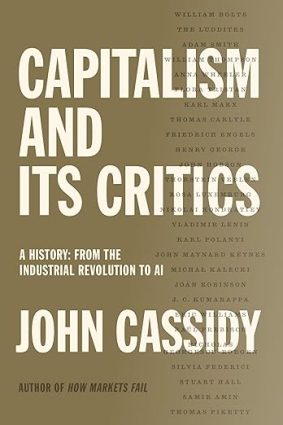
It’s no great news flash that both capitalism and its defenders have had a tough time of it lately. To be sure, capitalism has always generated criticism. This is among the principal claims of Capitalism and Its Critics: A History: From the Industrial Revolution to AI, by New Yorker staff writer John Cassidy. Some form of capitalism, roughly construed as an economic system in which wealth (capital) is privately owned and exchanged for profit, has predominated in the West for 500-odd years. It has always been a defining feature of life in America, where, in Carl Degler’s famous formulation, it “came in the first ships.” Throughout its centuries of history, cavils and complaints against capitalism have risen and fallen intermittently. In recent decades, they have risen.
Beginning in the late 1990s, remonstrances against capitalism—or, to be more precise, the neoliberal form of capitalism, often erroneously conflated with globalism—began to mount after reaching a low ebb in the 1980s and early to mid-’90s. The complaints picked up steam at the turn of the millennium, as evidenced by the anti-globalization protests at the 1999 World Trade Organization meeting and the public expressions of concern over China’s entrance into that organization in 2001. Anti-capitalist sentiment was further intensified by the Great Recession of 2007-09 and by the challenges posed to all of us during the COVID years. A variety of recent surveys demonstrate that many people, ranging from everyday Joes and Janes to influential members of the press, the professoriat, and the political class (most on the left, but some on the right), are down on capitalism. Among younger demographic groups, it often polls worse than socialism.
***
There are many lessons about all this to be drawn from Cassidy’s invigorating, often insightful, but ultimately tendentious book. Two are especially important. The first is that critics of capitalism, like the poor, will always be with us. Since the time of the so-called Industrial Revolution, where Cassidy begins his story, “the central indictment of capitalism has remained remarkably consistent: that it is soulless, exploitative, inequitable, unstable, and destructive, yet also all-conquering and overwhelming.” The second lesson, though, is that capitalism will probably not be going anywhere any time soon. Cassidy describes it at one point as a “shape shifter”: it has proven sufficiently supple, flexible, and malleable both to quell dissent and to overwhelm every alternative proposed.
This is not surprising to clear-eyed observers. Over the past 200 years or so, capitalism has ushered in levels of economic growth, development, and overall human flourishing unknown and well-nigh inconceivable to our species anywhere in the world at any earlier point in time. It has been responsible for an explosion of wealth creation over the centuries covered by Cassidy. In the developed world, people today are roughly 25 times richer in real terms than they were in A.D. 1800. In the developing world they are roughly eleven times richer. Even during the frequently derided capitalist era we have just lived through—that of neoliberalism, or hyperglobalization, or what have you—we find very significant economic gains worldwide, huge declines in the proportion of the world’s population living in extreme poverty, and impressive increases in living standards, educational levels, and human health, particularly in the developing world. Cassidy knows this and grudgingly acknowledges it from time to time. He even includes an astonishing graph showing the spike in global average GDP that capitalism precipitated. But that doesn’t stop him from lamenting the persistence of the world’s most successful economic system for the better part of 600 pages.
***
British-born and Oxford-educated, Cassidy is the author of two previous books: Dot.Con: The Greatest Story Ever Sold (2002), and How Markets Fail: The Logic of Economic Calamities (2009). The first dealt with the internet stock bubble of the late 1990s, and the second with the relationship between free-market ideology and the onset of the Great Recession. Both books were well researched and generally well received, especially among the bien pensant establishment. Cassidy seems to be targeting this audience with Capitalism and Its Critics.
His particular bête noire is clearly neoliberal capitalism, which reigned supreme from the 1980s to the time of the Great Recession. In a broad sense, neoliberal capitalism can be seen as arising in reaction to the faltering performance of most Western economies resulting from “managed capitalism,” under which free markets were heavily leavened by government oversight between World War II and the 1970s. Most writers have come to associate neoliberalism impressionistically with Margaret Thatcher, Ronald Reagan, the International Monetary Fund, and the “Washington Consensus.” It is typically characterized as extremely pro-business, tending to support open trade, to encourage the transnational movement of capital and labor, and to reduce significantly the role of the state in economic life, including social welfare. Cassidy originally intended Capitalism and Its Critics as a history only of this era. But he came to see the problems of neoliberal capitalism as symptomatic of dysfunctions that have persisted throughout capitalism’s history, so he broadened his scope.
Being a journalist—and not an economic historian, much less an economic theorist—Cassidy spends little time defining capitalism. He does see fit in his introduction, however, to offer readers a paragraph on the subject. He states that he will be following the German economic historian Jürgen Kocka in defining capitalism as an economic system “characterized by widespread mobilization of capital and production for profit in an environment of secure property rights.” Very well, up to a point. But such features can be found in some economic systems going back to pre-classical times (the Phoenicians spring to mind). Admittedly, economists love parsimony. But this definition will likely seem meager and imprecise to most, bereft as it is even of nods in the direction of economic freedom, market mechanisms, competition, prices as signals for the allocation of resources, the entrepreneurial spirit, or contracts enforceable by neutral third parties. Some or all of these features are usually mentioned by writers on capitalism. And for the record, it should be noted that Kocka’s definition is actually far more rigorous and better calibrated than Cassidy suggests. He does remind us, however, that he will be focusing only on capitalism’s “industrial” phase, beginning around the 1770s.
Then he moves briskly on to the task at hand, namely, acquainting readers with critics of capitalism great and small. He ranges from major figures such as Karl Marx and Friedrich Engels to virtual unknowns. The 28 relatively short chapters are organized chronologically and methodically, if somewhat mechanically. Each one features a critic or in some cases a critical movement. Cassidy begins by introducing the featured critic or movement, offers a potted biographical sketch, then lays out the nature of the critic’s or movement’s objections to capitalism. The lone exception to this formula is the final chapter, wherein Cassidy speculates about the many challenges that capitalism, which he views as increasingly embattled, will face going forward.
***
The “critics” featured in the early chapters are somewhat questionable. The first, William Bolts, was not so much a critic of capitalism qua economic system as a disgruntled former employee of the English East India Company pursuing a vendetta against his former employer. The second “critic” is none other than Adam Smith, often considered the patron saint of capitalist economics. Cassidy believes Smith belongs in the book because of his opposition to mercantilism, monopolistic trading companies, and slavery, which were associated with early phases of capitalism. Subsequent chapters cover the Luddites and a few more or less inconsequential communitarian socialists.
In the main, these early chapters serve as amuse-bouches for the book’s more substantive fare. Cassidy really finds his stride with chapter 8, on Friedrich Engels and The Communist Manifesto. Most of the later chapters deal with well-known critics of capitalism who are often Marxist, Marxisant, or “progressive,” to use the debased coinage of the realm. Thus we find chapters on Marx and many of the usual suspects—people such as Henry “Single-Tax” George, the anti-imperialists John Hobson and Rosa Luxemburg, the brilliant American Marxist economist Paul Sweezy, the Polish Marxist economist Michał Kalecki, and the sharp-tongued, eccentric British economist Joan Robinson. We get a worshipful chapter on John Maynard Keynes, progenitor and avatar of the “managed” social welfare capitalism that is close to Cassidy’s heart. Later chapters feature devotees of managed capitalism such as the economists Dani Rodrik, Joseph Stiglitz, and, inevitably, Thomas Piketty.
Other varieties of critic are included as well. There are individual chapters on the quirky American economist Thorstein Veblen; the nondoctrinaire Russian economist Nikolai Kondratiev, whose views ultimately got him imprisoned and executed in 1938 during Stalin’s Great Purge; J.C. Kumarappa, a close associate of Mohandas Gandhi and theorist of so-called Gandhian economics; and the noted Trinidadian statesman Eric Williams, an astute critic of imperialism and author of the classic work Capitalism and Slavery (1944). There is a chapter devoted to the “dependency theorists,” who viewed the underdevelopment in Latin America and other parts of the Global South largely as functions of their subordinate and unequal relationships with developed countries in Europe and North America. A few of these more minor critics might have been better left out. If one were being arch, one might say that in according figures like Kumarappa sustained attention, Cassidy is filling much-needed gaps in the historical record.
***
There is also the surprising appearance of conservatives Milton Friedman and Friedrich von Hayek. Like Adam Smith, these two Nobel Prize winners are not usually considered critics of capitalism but rather placed among its foremost champions. Cassidy believes it legitimate to include them, however, because of their opposition to Keynesian or neo-Keynesian managed capitalism. It’s true that Friedman and Hayek were critical of that form of capitalism, but only insofar as it was disfigured by state intervention. It was because they believed so deeply in markets and freedom that they resisted government attempts to “manage” capitalism through inappropriate intervention and overreach.
As for the true critics discussed, though they differ on specifics, the general contours of their critiques are, as Cassidy suggests early on, “remarkably consistent.” I might add predictable and hackneyed. The same charges occur again and again in Capitalism and Its Critics. Capitalism is destabilizing—indeed, inherently unstable—ruthless, and exploitative of both humans and the Earth. It generates inequalities while alienating, estranging, and dispiriting many, if not most, of those ensnared in its operations.
Cassidy writes well; his biographical sketches are for the most part lively and informative, though he relies heavily on standard sources for his information—Tristram Hunt’s 2009 biography on Engels, and Roy Harrod and Robert Skidelsky’s studies on Keynes, for example. But the portraits feel fresh, if a bit adulatory. It is in fact ironic that Cassidy generally treats his chosen critics so uncritically. He affords a rather avuncular indulgence to Marx’s more violent and spiteful views. He tends to handle his subjects’ complicated, controversial, and sometimes disturbing behaviors or positions with kid gloves. But he is clearly capable of close and insightful textual analysis, a talent he demonstrates in a number of chapters—nowhere more so than in his discussions of Engels’s writings and the third volume of Marx’s Capital. He offers a very nuanced take on Keynes, and his discussions of Sweezey’s and Kalecki’s critiques of Keynesian economics—both coming from the left—are often astute.
***
The problem with Capitalism and Its Critics, then, is not the author’s intellectual acumen. The problem is that it offers only, to borrow the title of a poem by Charles Simic, “A Partial Explanation.” The book is partial in more ways than one: It is incomplete and it is slanted. It distorts the nature of capitalism and makes it difficult, if not impossible, for readers to appreciate its longevity and successes. Cassidy fails to lay out satisfyingly the arguments in defense of capitalism before enumerating its flaws. Ironically, this makes it difficult to understand the positions of capitalism’s critics, because the context of their critiques is often elided. Cassidy’s contemptuous view of laissez-faire and neoliberal capitalism, especially, is apparent in his inadequate discussion of “orthodox” neoclassical economics. He seems to view it as little more than a cynical attempt by 19th-century elites to remove politics and social struggle from economic explanation via abstraction, mathematization, mystification, and rationalization.
Neoclassical economics is the taproot of modern economics. Although it had precursors in the first half of the 19th century, its real emergence dates from the early and mid-1870s. Neoclassicism was based on what is known as the marginal principle. This is the idea that prices are best explained by focusing on marginal utility (satisfaction) and marginal cost in economic decision-making—i.e., the additional benefit to a consumer or additional cost to a supplier created by one more unit of a particular commodity, good, or service. Neoclassical economics and its primary tool, marginal analysis, should properly be seen in the context of the rise of more systematic scientific practices and formal methods in many disciplines. In the case of economics, this entailed the application of differential and integral calculus, as well as principles drawn from physics and mechanics. Neoclassicism’s rise can be traced to independent discoveries in three distinct places across Europe by William Stanley Jevons (England), Léon Walras (France), and Carl Menger (Austria). By 1900, neoclassical economics had become “orthodox” economics—sometimes referred to disparagingly by critics as “bourgeois” economics. Marginalism remains foundational, though not unchallenged, in the discipline even today, particularly in microeconomics.
***
Cassidy has little time for neoclassical economics or marginalism. He gives Jevons and Walras a single mention and Menger none at all. He sees neoclassicists as apologists for capitalism, and he seems to rue the fact that “[a]fter 1890, when Alfred Marshall, a professor at Cambridge, published his Principles of Economics, most economists used supply and demand curves, rather than the labor theory of value, to explain how market prices get determined.” It is not surprising, then, that Cassidy treats later adherents of “orthodox” economics—dissimilar figures ranging from Hayek and Friedman to Paul Samuelson and Robert Solow—with distaste or aversion. For Cassidy, the only acceptable camp to be in is that of managed capitalism. He deplores the laissez-faire eras in capitalism’s history, to wit: everything from circa 1770, when he begins, to the 1930s, plus the neoliberal era stretching from the late 1970s or early 1980s until the financial crisis of 2007-09 and beyond, some would say almost to the present day. It is during these long periods, Cassidy believes, that capitalism’s shortcomings have been most egregiously on display. That leaves only the period of managed capitalism—give or take 40 years, between the mid-1930s and the mid-1970s—to praise or emulate.
One can challenge the idea that another era of “managed capitalism” is even possible: not for nothing does leftist historian Jefferson Cowie refer to the 1930s-70s in the U.S. as “the great exception.” But Cassidy’s interpretation of capitalism’s long-term trajectory is seriously flawed as well. As numerous scholars over the years have pointed out, capitalism has been responsible for an explosion of wealth creation over the centuries covered by Cassidy. In his view, none of this can make up for what he considers capitalism’s worst flaw: inequality, particularly the inequality represented by the so-called 1%. In a discussion on “plutocracy” late in the book, he makes a passing swipe at Amazon CEO Jeff Bezos, informing readers that “[i]n 2023 Amazon’s Jeff Bezos took possession of a custom-built 417-foot-long superyacht that came with a helipad-equipped support vessel and was rumored to cost $500 million.” We should be glad that Cassidy went to press before Bezos’s over-the-top Venice wedding to Lauren Sánchez in June 2025.
***
Even so, Cassidy’s account of the super-rich is only another partial explanation. There is more to the story. Bezos—today the world’s third-richest person—was born to a 16-year-old high-school student from Albuquerque, New Mexico and an 18-year old who worked as a unicyclist in a circus. After learning of the pregnancy, the couple drove to Juárez, Mexico to get married. When Bezos was born in January 1964, his mother had just turned 17. His biological father had trouble financially and drank heavily, leading his mother to file for divorce a little over a year after the marriage. While working as a secretary to make rent, she also attended night school, bringing the baby along with her to classes. There she met a Cuban immigrant named Miguel Bezos who married her and adopted her baby. Miguel Bezos later graduated from the now-defunct University of Albuquerque with a degree in computer science and got a job with Exxon, which meant moving his family to Houston.
In Houston, young Jeff Bezos attended a public elementary school and was soon recognized as a superstar student. He continued to excel in secondary school and, later, at Princeton, where he was elected to Phi Beta Kappa and graduated summa cum laude with a B.S. in Engineering. None of this is to say that Bezos was completely self-made—his stepfather worked for Exxon and his maternal grandfather was regional director of the U.S. Atomic Energy Commission in Albuquerque—but he wasn’t born on third base, either.
Including such details would have required a more well-rounded view of capitalism and a broader appreciation of the complexities, contingencies, and possibilities of this economic system than Cassidy could muster. The sardonic, even gratuitous reference to Bezos is indicative of Cassidy’s attitude about wealth creation and wealth creators. He hurts his case in Capitalism and Its Critics by not even attempting to give capitalism—the system that enabled a transformative company like Amazon, with over 1.5 million employees and a market cap of $2.33 trillion—its proper due. That Amazon was founded in July 1994, during the height of the neoliberal era, is worth remembering too.
Next in the fall 2025 Issue

Streaming Shakespeare

The Murder of Charlie Kirk