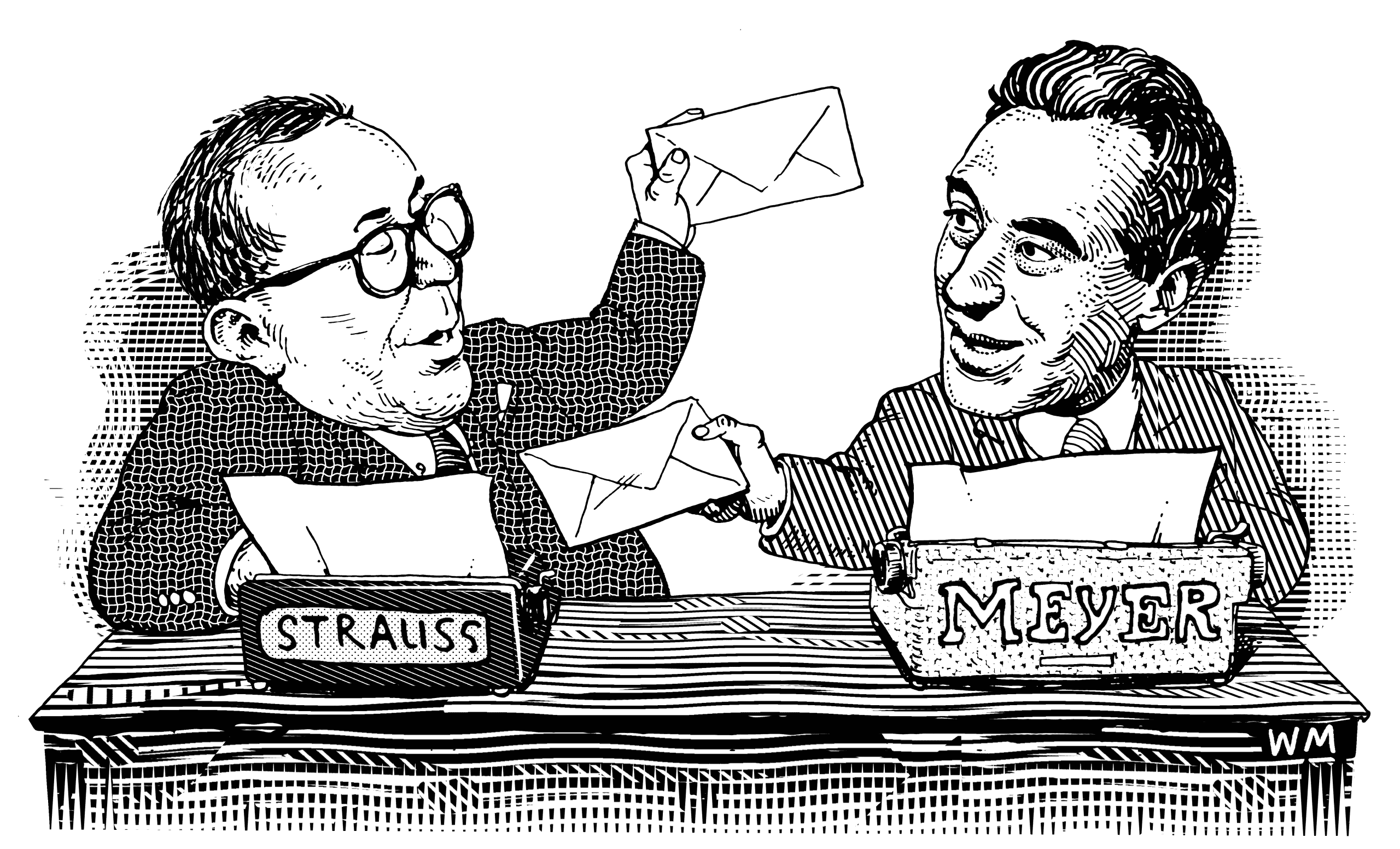
Although Leo Strauss (1899–1973) studied political philosophy almost exclusively, he was also interested in practical politics throughout his life. He was a young Zionist, recalling in his 1970 talk “A Giving of Accounts,” “When I was 17, I was converted to Zionism—to simple, straightforward political Zionism.” Later, as a professor at the University of Chicago, he joined students in political discussions. Notable among them was Robert Goldwin, who from 1960 to 1966 directed the university’s Public Affairs Conference Center and later became an advisor to President Gerald Ford. At the Center, he brought scholars together with politicians and businessmen, among them Charles H. Percy, a prominent businessman, Republican Party thought leader, and future U.S. senator. Strauss’s published writings, however, contain very few direct discussions of contemporary politics. The major exceptions are in the preface to Liberalism Ancient and Modern (1968), in the introduction to The City and Man (1964), at the beginning of the autobiographical preface to Spinoza’s Critique of Religion (1965), and in a review of John Dewey’s German Philosophy and Politics (revised edition, 1942) in What Is Political Philosophy? (1959), which also includes an essay on German diplomat and philosopher Kurt Riezler that contains several revealing political