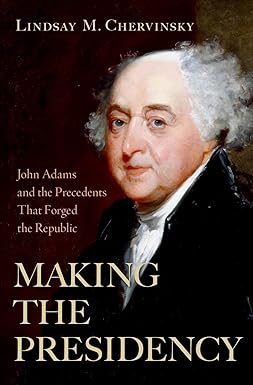
Lindsay Chervinsky, the executive director of the George Washington Presidential Library at Mount Vernon, has written a book on the one-term John Adams presidency as a follow-up to her book The Cabinet: George Washington and the Creation of an American Institution (2020). The title Making the Presidency suggests that Adams helped “make” the presidency by setting, as the subtitle says, two key Precedents That Forged the Republic: first, demonstrating the chief executive’s right to fire cabinet members—a right inseparable from the duly elected executive’s right to set policy—and second, stepping down from office in order to allow the peaceful transfer of power. George Washington had asserted the former right, though he never exercised it, and he set the precedent of presidents transferring power when he chose not to seek a third term. When Adams stepped down in 1801, however, for the first time one political party was peacefully yielding power to the other in an era of extreme partisan bitterness and distrust. As Adams put it years later in a letter to Thomas Jefferson, who succeeded him in office: “I should like to see an election for a President in the British empire or in France or in Spain or in Prussia or Russia by way of experiment. We go on pretty well, for we use no other artillery than goose quills.”
Chervinsky refers to the events of January 6, 2021 directly and indirectly several times in the book, and one motivation for writing it seems to be contrasting Adams’s actions following his loss in the 1800 election with those of Donald Trump after the 2020 election. In late 1800 and early 1801 radical Federalists concocted various schemes to try to keep Jefferson out of power. (The idea that the House and Senate may assert the right to decide which slate of electors is official is not new.) Those efforts failed in part because Adams and other more moderate Federalists like John Jay and John Marshall refused to go along. They agreed with Republican Senator Charles Pinckney, who held that the state legislatures and not “any branch or party of our Federal Government” had that power to certify an election.
Given the role courts at the state and federal level have assumed in contested elections since at least 2000, that line of reasoning has interesting implications for our day. It is interesting, too, to think about the leniency Adams showed, against the wishes of many in his cabinet, toward the leaders of Fries’s Rebellion of 1799–1800 (a tax revolt by Pennsylvania Dutch farmers), imitating the leniency Washington showed, against Alexander Hamilton’s wishes, after the Whiskey Rebellion in 1794. When the danger has passed, scorched earth prosecutions seldom turn out well politically. An insurrection is a political as much as a criminal event; to prosecute everyone with any connection to the event is a political category error.
***
Although Chervinsky shows little interest in Adams’s political writings, she does provide a solid account of his presidency, showing how one of the great theorists of executive power learned, for the most part, how actually to be an executive. Among the founders Adams was “Mr. Checks and Balances.” Indeed, he coined the phrase “checks and balances” (which doesn’t appear in The Federalist’s defense of the Constitution), and repeated it several times in his writings, including in March 1797, as he began his term as president, writing his wife, Abigail: “Jealousies and rivalries have been my theme, and checks and balances as their antidote, till I am ashamed to repeat the words.” In Adams’s view, a good free republican constitution ought to have two tripartite checks: among the legislative, executive, and judicial powers; and within the legislative among two houses and an executive armed with a veto. As he wrote in early 1787, “power must be opposed to power, and interest to interest.”
How did the president fit into a Constitution with checks and balances? Americans had rebelled against George III, and wanted to have a republic without kings or aristocrats. So, what kind of thing was this new executive? Adams disagreed with many Americans who thought they could dispense with a unitary executive after breaking with the king. Nothing else would do: “the unity, the secrecy, the dispatch of one man has no equal; and the executive power should be watched by all men; the attention of the whole nation should be fixed upon one point,” he wrote in early 1787. In order to act and in order to be accountable, the president needs to be one man. And he needs to come armed with a veto, because “without this weapon of defence,” such an executive “will be run down like a hare before the hunters.”
***
Chervinsky is not always a careful writer. She often uses language to convey an impression rather than a precise meaning. Near the start of the book, for example, she calls Adams “one of the most qualified Presidents in American history.” A couple of chapters later she adds that “he had never served in an executive capacity”—which would seem to make him less than well qualified. Over four years he learned to use the qualifications he did have as an experienced politician and as a student of executive power to make up for many of his deficiencies as a practitioner of executive power. When he first took office in 1797, Adams made rookie mistakes. For starters, he chose to keep Washington’s final cabinet. There was no precedent to follow, and, as Adams knew, by 1796 even Washington was having trouble getting men to serve in the cabinet. Many secretaries felt neither personal nor political loyalty to Adams, and they weren’t sure that they, as a matter of constitutional practice, had to defer to the president’s policy preferences. Which caused Adams many headaches.
Meanwhile, politically speaking, the most strident members of the Federalist Party—the “Arch-Federalists,” as Chervinsky calls them—were riding high. And they were well represented in the cabinet. Viewing Jefferson’s party not as “Republicans,” as Jefferson called his team, but rather as American Jacobins, and regarding themselves as true heirs of the men who wrote and defended the Constitution, they sought to crush their political enemies. These High Federalists almost got their way after Republican sympathies for France, combined with partisan blindness, exposed Jefferson, James Madison, and their supporters as narrow partisans.
France thought that the 1795 Jay Treaty with Britain was de facto a treaty of alliance, and they started attacking American shipping. Adams, like Washington, wished to be neutral in Europe’s wars. He sent diplomats to France to try to calm the waters. They came back empty-handed. Federalists struck a belligerent tone, while Republicans were certain that the mission’s failure was the fault of French-hating Federalists. Chervinsky, as far as I know, is the first historian to document how Adams, in a rare show of partisan prudence, coordinated with Federalists in Congress to maneuver for the release of the dispatches in the “XYZ affair,” in which three French agents, labelled “Messrs X, Y, and Z,” demanded bribes before entering discussion. After Adams held the dispatches back from Congress in an assertion of executive privilege, Republicans, as anticipated, demanded their release, only to be stunned by their contents. The public was incensed. Republican affection for France hurt the party badly in the 1798 midterm elections. And Adams, perhaps for the only time in his life, was a legitimately popular figure.
***
The Arch-Federalists then abused their near-monopoly on power. They pushed the unpopular Sedition Act through Congress, criminalizing criticism of the government, in addition to the Alien Friends Act which empowered the president to deport any foreigner he personally found dangerous. (The logic was that residency is not a vested legal right, but rather a privilege which the president might revoke at his discretion.) The other two Alien Acts were the “Alien Enemies Act,” which is still on the books and has been in the news lately, and a Naturalization Act, which increased from five to 14 the number of years it took to become a citizen. Chervinsky finds that Adams probably had mixed feelings about the Sedition Act, but he signed it and the others anyway. She might have noted that Adams, like other early presidents, would only use the veto to block a bill he regarded as unconstitutional, and the “freedom of the press” was a term with a history. Before 1776 it meant no prior restraint on publication. Under British and colonial law, one could be prosecuted for seditious libel for abusing his liberty. It was, in fact, the Republican reaction to the Sedition Act that we have to thank for our more expansive view of the First Amendment, and the Republican reaction to the Alien Friends Act which has made residency a legal right. That’s an important story of the Adams years.
Throughout the Quasi-War, Adams’s cabinet often thought they understood developments in Europe, particularly in post-1789 France, better than he did. A seasoned diplomat and keen student of human nature and human affairs, Adams was repeatedly vindicated. He was also able to discern, with remarkable accuracy, Federalist machinations to manage his options. His problem was that at the start of his presidency he had very few ideas of how to counter them and keep himself in charge of his administration. In foreign policy, Adams thought his cabinet had, in effect, become partisans of Britain just as Jefferson’s legions had become partisans of Revolutionary France. He wrote shortly after leaving the presidency that “we have no Americans in America. The Federalists have been no more Americans than the Anti’s.” Over time Adams grew more assertive in foreign policy, and his strategy brought the Quasi-War to a successful conclusion. He realized that the French wanted to make peace when many Federalist hotheads thought it was time officially to declare war, and perhaps, back home, to use the American army to break the Jacobin Republican Party. Adams understood better than his detractors that doing so could break the Union rather than the opposition.
***
Chervinsky doesn’t put it quite this way, but it seems that Adams was finally in a position to take full control of his administration after Hamilton’s failure to achieve a Federalist victory in the New York legislature in May 1800, putting him and the Arch-Federalists in a weaker position. Hamilton had pushed through legislation to ensure that all of New York’s electoral votes went to the party that won the state legislature, as opposed to allowing them to be split, as New York had done in the 1796 election. It was a gamble, and Hamilton lost, outmaneuvered by his arch-rival Aaron Burr. Having lost, Hamilton suggested the old legislature, not yet out of office, change the rule back, to split the state’s electoral votes. Wisely, John Jay put the kibosh on that. Jay understood that such political maneuvering to fortify an election against the “wrong” result undermines confidence in the democratic process.
For much of Adams’s presidency many cabinet secretaries had been coordinating their efforts with Hamilton. What’s more, they, like today’s elite permanent bureaucracy, were not sure they were bound to follow the duly elected president. Secretary of State Timothy Pickering said it was the duty of men in positions like his “to prevent, as far as practicable, the mischievous measures of a wrong-headed president.” Whether that meant defying direct orders, or stopping just short of it, he didn’t say. Chervinsky isn’t clear about it, either. For his part, Adams took charge in May 1800 by firing every defiant member of his administration. He had written that for the president to be accountable to the people he must, in fact, be in charge. In May 1800, he finally started to understand what that meant in practice.
Adams fired Secretary of War James McHenry and cashiered Pickering, replacing him with John Marshall. For the remainder of his presidency, Adams finally had a functioning administration. But he lacked Marshall’s ability—well-documented in this book—to manage and moderate the different factions in the Federalist Party. Adams had made the executive branch functional at the expense of splitting his party. News of peace with France arrived too late to influence the election of 1800, and the split among the Federalists likely cost them the victory. He lamented High Federalist folly. In the same letter in which he said that the Federalists were too pro-British, Adams noted: “No party, that ever existed, knew itself so little, or so vainly overrated its own influence and popularity, as ours. None ever understood so ill the causes of its own power, or so wantonly destroyed them.”
***
There is another element of executive power, one that makes Americans uncomfortable, and one that, though Adams understood it as a writer and theorist, he never mastered as a practitioner. In his writings, Adams observed that “[a]mong every people, and in every species of republics, we have constantly found a first magistrate, a head, a chief, under various denominations, indeed, and with different degrees of authority, with the title of stadtholder, burgomaster, avoyer, doge, gonfaloniero, president, syndic, mayor, alcalde, capitaneo, governor, or king; in every nation we have met with a distinguished officer.” I quote the full passage to give a flavor of Adams’s style. He never used two examples when ten would do. But that empirical overreach had a purpose: to show, by repeated example, that the phenomena he described were not mere cultural artifacts. Adams was consciously resisting the growing philosophical tendency to view human nature as radically fluid, moving beyond John Locke’s contention that we have no innate ideas to a belief that human nature, even in large groups, has no common tendencies or dispositions. That’s what the French radicals and many of their American acolytes failed to grasp. The implication of Adams’s analysis applied to the executive was that heads of state are natural, and the president is naturally America’s head of state.
Is it really a coincidence that all presidents to some degree, and the great presidents to a great degree, become national father figures? Or, to cite a very different example, was it merely due to peculiarities of Russian culture that so many wept at the death of Stalin? If not, that reality has important implications for the nature of the presidency and the constitutional order as a whole. If men will love even a tyrant, it behooves us to minimize the chances that one arises. Americans have always been uncomfortable admitting that reality. Adams certainly was. It is probably the very same Puritan iconoclasm that allowed him to see that element of leadership, even in republics, so clearly that also made him too self-conscious ever to play the role effectively.
***
But how should a republican constitution manage this kingly tendency in politics? Adams held that the way to do so was by creating a constitutional order with a well-designed system of checks and balances that directed men’s ambitions toward serving the republic. A would-be aristocracy, Adams noted ad nauseum, will always gather around power, and, he noted, they always prefer a weak executive so that they can rule with minimal accountability. Why? Because they are human. Adams wrote Jefferson in 1816, “Power always thinks it has a great Soul, and vast Views, beyond the Comprehension of the Weak; and that it is doing God Service, when it is violating all his Laws. Our Passions, Ambition, Avarice, Love, Resentment…insinuate themselves into the Understanding and the Conscience and Convert both to their Party.” The human capacity for self-interested self-deception, like our desire to be loved, praised, esteemed, and admired (the last being what Adams called the central political passion) is sewn into the human heart. Any politics that tries to do away with those tendencies, or assumes they are merely artifacts of culture or don’t apply to properly trained and credentialed men, will inevitably come to grief. Adams thought checks and balances were the answer.
A century ago, Progressives dismissed Adams’s ideas as irrelevant. They regarded checks and balances as passé, a “Newtonian” anachronism in Professor Woodrow Wilson’s account. The first sentence of The Political Science of John Adams (1915) by the Progressive intellectual C.M. Walsh, reads: “The theory reviewed in this work is obsolete.” But is it? Madison thought that any significant expansion of federal power would inevitably make the legislature secondary, turning the executive into a king. If there’s a way to bring checks and balances into today’s mega-state, Adams’s writings—and his example—remain essential in this era of passionate debate over the reaches and limits of executive power.
Next in the fall 2025 Issue
The Real Watergate Scandal
Hijacking America’s Story