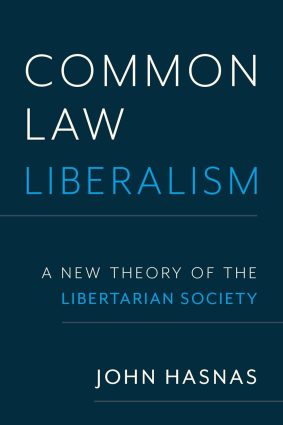
Change the initial conditions of an experiment, and the same laws of nature will yield a different outcome. So, too, in a theory of politics, alter the suppositions even a little and a different picture of the world will result. This is what Georgetown business professor John Hasnas does to John Locke’s political philosophy in his lucid, lively, and logical new book, Common Law Liberalism: A New Theory of the Libertarian Society. Hasnas tweaks Locke’s assumptions about the state of nature just enough to produce a world of law and peace without the need for government, much less a sovereign leviathan. No need for men to behave like angels, either. To reap the benefits of civil society, Hasnas argues, people need only be a little less short-sighted, and a little more willing to compromise, than Locke imagined them to be.
Locke himself began by borrowing the approach of Thomas Hobbes’s Leviathan, imagining the condition of men without government. Finding them willing to follow the law of nature and to mind their own business until things get out of hand, Locke supposed they could form government by law and structure it to be lawful, returning it to constitutional order if it in turn crossed its limits. Though their accounts of human psychology differed more in rhetoric than in fact, Hobbes and Locke disagreed sharply on one question: whether anarchy (Hobbes) or tyranny (Locke) is the greater evil. In this, Hasnas clearly agrees with Locke but thinks he concedes too much to his forebear by accepting that law can only be made successfully by a singular legislative authority. Instead, Hasnas argues, laws can form spontaneously as men seek peace with one another through negotiation, out of which emerge customary settlements and eventually customary rules. This is not just a theory, according to Hasnas: there was empirical confirmation of it right under Locke’s nose in the form of the common law.
***
Citing the historical work of Harold Berman, Arthur Hogue, J.H. Baker, and others, Hasnas sketches the origin of common law in medieval England after the withdrawal of the Romans left the island without a sovereign government. First, criminal law emerged from the practice of paying reparations for bodily injuries, even murder, to prevent clan warfare. Then property law arose to settle the inheritance of landed estates. Within historical memory, commercial law developed from the law merchant, that is, from the practice of those conducting international trade. Most recently, the law of torts took shape to compensate those harmed as a result of others’ actions or negligence. In all these matters, law was fashioned from the bottom up, not the top down, not at the command of an overarching state but at the instigation of a society looking for ways to settle disputes. Yes, there were courts—the common law courts in England were staffed by royal judges, Hasnas concedes. But as there were many different courts, themselves initially improvised, they competed with one another for the fees of their litigants and had to satisfy their customers to thrive. In short, the common law evolved from the activities of those who needed justice and those who could supply it. As the Scottish Enlightenment philosopher Adam Ferguson put it, in a phrase Hasnas repeatedly quotes, common law is “the result of human action, but not the execution of any human design.”
***
Hasnas knows he is challenging a mainstream view that all law is made by the state or, in Hobbes’s language, that law is a command of the sovereign. Hasnas is right that both political scientists and lawyers overlook the continuing importance of common law, from the regulation of contracts and commercial transactions to the enormous influence of tort law on businesses and on social behavior in general. His claim is not that common law is perfect—everyone can think of an outrageous jury verdict, and calls for tort reform can be heard from politically powerful voices—but that it has proven effective in establishing sufficient justice to ensure social peace. Moreover, it achieves real, widespread consent from the people generally, not the abstract consent posited by social contract theory. Legislation, which includes executive orders and administrative rules, is less effective in achieving its aim, grounded as it is in predictions of likely effects rather than in lived experience. It is also dependent on coercion, since it is imposed by the politically powerful upon those who dissent. Common law succeeds better than political law, which is inevitably partisan, in achieving the practical common good. By “common good,” Hasnas means at least, and perhaps only, social peace. The specific rules of common law evolve over time in his account, but the whole system works to resolve conflict—like Hobbes’s, though through opposite means.
Hasnas writes at the outset of his book that he has two aims:
The first is to establish the fairly moderate proposition that good public policy requires a comparative assessment of the effectiveness of common law and legislation as regulatory mechanisms. The second is to establish the more radical proposal that a peaceful and prosperous society can exist without legislation, and ultimately without any essential services being supplied on a monopolistic basis by a government.
He adds: “[M]y aspiration is to persuade my readers of both propositions, but I will be happy if I persuade them only of the first.” In fact, though, it is the second that drives the first in the argument, for his passion to make a coherent case for a libertarian society animates his account and draws attention to the value of common law’s actual achievements. With his fellow libertarians, he denies the legitimacy and necessity of the state; against them, he argues that there is a moral duty to obey customary law, since it ensures the peace that is instrumental to the achievement of one’s natural moral duties.
***
The precise nature of these duties is not the subject of his essay, though they seem to include the duty to act rationally, to act upon others only with their consent, to respect their liberties, and to keep promises. Like Friedrich Hayek, one of libertarianism’s foundational thinkers, Hasnas ties the case for individual liberty to the “epistemic limitations” of human beings: we cannot know for certain what is good for us individually or socially, but given liberty we can discover it experimentally, through trial and error. Customary law operates on the level of society in the same way: through trial and error, society hits upon rules that facilitate human interaction by keeping the peace without infringing on individual liberty.
As examples of customary law, Hasnas cites not only the common law in all its complexity, but also a biologist’s successful scheme to find a way for Philippine fishermen to prevent overfishing of seahorses, and the code of ethics for attorneys. The first case shows how ordinary people (the fishermen, not the biologist) can discover rules without their being imposed by the state. The second shows that duties can be real and rational precisely because of epistemic uncertainty. The uncertainty of guilt or innocence, for instance, produces the elaborate rules of due process, which include the duty of the attorney to give even a client whose guilt he suspects the best legal defense he can. The traditional law of nations is a further example to which Hasnas nods, even though of course it supposes states rather than replacing them with customary law (he does express his hope that sooner or later mankind might do the latter).
Whatever can be said of his libertarian ideal type, Hasnas means the common law to be a serious model for social order or at least a realistic alternative to the regulatory state. Here, I think, his argument has real cogency. As he points out, what people call unregulated markets or unregulated behavior actually tends to be regulated, not by expensive and ineffective administrative agencies but by common law enforced through lawsuits. Although the process can be slow—as if the legislative process is not!—the outcomes can be dramatic. Powerful corporations notice them immediately and adjust their practices accordingly, knowing that forming public sentiment in order to influence juries’ sense of right and wrong is much more difficult than hiring lobbyists to influence legislators. To the objection that tort law ordinarily operates only after a wrong has been done, Hasnas replies that legislation itself is usually passed only after a crisis. He is confident and persuasive that much environmental law could develop without legislation, and also that the law of free speech itself was better served by common law procedures, which recognized the genuine harm caused by defamation.
***
His account is sophisticated enough to factor in the difference between modern common law—self-consciously “judge-made”—and traditional common law, which insisted that the judge find the law in custom and existing precedent. One wishes, however, for more granular attention to examples of successful regulation by common law, even or especially in more controversial areas such as civil rights or sexual harassment. Or consider what’s known as “the liability of deep pockets,” a tendency on the part of courts to assess liability for damages according to the ability to pay rather than the degree of fault. Is this practice judicially enabled, or does it reflect the natural predispositions of democratic institutions such as juries? What about “qualified immunity,” which simultaneously releases individual officers of the state from duties they had under the old common law, and encourages state overreach by extending the state’s sovereign immunity to its agents?
To work this out would demand more than a mere sketch of common law’s history, for only when speaking abstractly can one say that customary law “evolved” without human design. True, its development was not the design of a single legislator, but it required the work of many minds thinking together in a tradition. As the Elizabethan-era jurist Sir Edward Coke wrote, it was “fined and refined by an infinite number of grave and learned men,” not to mention the common sense of a national culture. The state cannot ensure wisdom or refinement, nor can it impose a culture. But originally the English king, then the American states and even our federal government, established or protected institutions such as the Church or churches, schools, universities, and the like. These in turn did the work of building up a lawful people who could make the common law their own and sustain its action and development. John Hasnas is right to contest Hobbes’s claim that justice can be imposed by the state. But he is wrong, I think, if he believes with Hobbes that an aspiration for social peace is sufficient as the only common good.